
VFD vs Soft Starter: What's the Difference for Motor Control?
A practical comparison of starting current, speed control, torque, energy use, harmonics, bypass arrangements, cost, and industrial motor applications.
Why Motor Starting Method Matters
Starting an induction motor directly across the line can draw several times its rated current. The actual value depends on the motor design and supply conditions, but the resulting voltage drop, heat, mechanical shock, and process disturbance can affect both the motor and the wider electrical system.
A variable frequency drive (VFD) and a soft starter can both reduce the severity of starting. They do it differently and provide very different capabilities after the motor reaches operating speed. The correct choice begins with the load’s speed and torque requirements—not the motor kilowatt rating alone.
A soft starter is primarily a starting and stopping device. A VFD controls frequency and voltage throughout operation, allowing continuous speed and torque control. That single distinction explains much of the difference in cost, complexity, energy-saving potential, and application fit.
How a Soft Starter Works
A soft starter normally uses pairs of silicon-controlled rectifiers, or SCRs, to control the portion of each AC waveform applied to the motor during acceleration. By increasing the applied voltage progressively, it limits current and reduces mechanical shock while the supply frequency remains fixed.
Motor torque falls quickly when voltage is reduced; as a useful approximation, induction-motor torque is related to the square of applied voltage. A setting that strongly limits current may therefore provide too little accelerating torque for a high-inertia or high-breakaway-torque load. Ramp time and current limit must be coordinated with the motor, driven equipment, supply, and allowable starts per hour.
After acceleration, many soft starters close an internal or external bypass contactor. The motor then operates directly from the line, reducing SCR heat and losses. Unless a special low-speed or energy-optimization function is provided, the soft starter does not regulate normal running speed.
How a Variable Frequency Drive Works
A VFD rectifies incoming AC to a DC link and then uses an inverter stage to create AC output with controlled frequency and voltage. Because induction-motor speed is closely related to supply frequency, the drive can control speed during starting, normal operation, stopping, and process transitions.
Modern drives may use scalar V/Hz control, sensorless vector control, closed-loop vector control, or other strategies. The appropriate method depends on speed range, torque accuracy, encoder requirements, and the load. A VFD can provide controlled acceleration, current limiting, reversing, process regulation, and—in suitable configurations—dynamic or regenerative braking.
The conversion principle resembles other inverter equipment, but a motor drive is designed around motor control rather than solar conversion or grid export. Buyers should not treat a solar inverter and a VFD as interchangeable products.
The Main Difference: Control After Startup
If a motor must run at line frequency and full speed whenever it is on, a soft starter may provide all the required functionality. It reduces starting stress, may provide a controlled stop, and is usually bypassed during normal operation.
If speed must change with process demand, the VFD remains active and controls the motor continuously. This makes it suitable for airflow, pressure, flow, conveyor speed, dosing, tension, coordinated lines, and other processes where output cannot be controlled efficiently or accurately with a fixed-speed motor alone.
Do not specify a VFD merely because it has more functions. If the motor always runs at full speed and only needs a gentler start, those functions may add cost, heat, harmonics, commissioning work, and maintenance without creating value.
Starting Current and Starting Torque
A soft starter reduces voltage to limit current, and the available torque reduces at the same time. This works well when the load can accelerate with reduced torque, but it may be unsuitable for loaded conveyors, crushers, positive-displacement pumps, or other loads with demanding breakaway or acceleration torque unless carefully engineered.
A correctly selected VFD can generally start a motor with controlled current while maintaining more useful torque, particularly when vector control is applied. Nevertheless, overload rating, acceleration time, motor data, ambient derating, and the load’s torque-speed curve still determine whether the drive will start the machine successfully.
For either device, ask for a start study when the supply is weak, the motor is large relative to the transformer or generator, the load has high inertia, or several motors may start together.
When a VFD Can Save Energy
VFD energy savings are strongest when a variable-torque load—especially a centrifugal fan or pump—would otherwise run at full speed while dampers, valves, or bypass lines reduce output. Under idealized affinity-law behavior, flow is proportional to speed, pressure or head to speed squared, and power to speed cubed. Real systems include static head, efficiency changes, and operating limits, so project savings should be calculated from the actual duty profile.
A soft starter usually does not reduce normal running speed after bypass and therefore does not create the same process energy savings. It may reduce starting demand and mechanical stress, but starting energy is often a small part of total operating energy.
For constant-torque loads such as many conveyors and positive-displacement machines, reducing speed can still reduce total energy delivered over time, but the cubic relationship should not be assumed. A VFD also has its own conversion losses, so a motor that always operates at full speed may not use less energy through a drive.
Harmonics, EMC, and Motor-Cable Effects
A soft starter produces waveform distortion mainly during starting. Once bypassed, its normal running harmonic contribution is limited. A VFD uses a rectifier and high-frequency switching continuously, so input harmonics, electromagnetic compatibility, common-mode voltage, and output voltage rise time must be considered.
The installation may require line reactors, DC chokes, harmonic filters, EMC filters, shielded motor cable, correct bonding, output reactors, sine-wave filters, or motor-bearing protection. Requirements depend on drive design, system impedance, cable length, motor insulation, switching frequency, local limits, and nearby sensitive equipment.
Long motor cables can increase reflected-wave voltage at the motor terminals. Older or non-inverter-duty motors may require additional review. The drive manufacturer’s cable-length tables and filter recommendations should be followed rather than relying on a generic maximum distance.
Stopping, Braking, and Emergency Functions
A soft starter can provide a controlled voltage ramp-down, which may reduce water hammer in some pump systems. It generally cannot provide precise deceleration or absorb regenerative energy in the same way as a VFD. Some loads coast regardless of reduced voltage, so a soft-stop setting must be tested against the process.
A VFD can control deceleration, but rapid stopping may raise the DC-link voltage when the load regenerates. The system may require a braking resistor, braking unit, regenerative drive, or a longer stop time. Hoists, centrifuges, high-inertia fans, and downhill conveyors need special attention.
Neither device should be assumed to provide an emergency stop or safe isolation by itself. Safety functions such as safe torque off, contactors, disconnectors, and machine-safety circuits must be selected and validated for the required safety architecture.
Cost, Size, Heat, and Maintenance
A soft starter is generally less expensive and more compact than a VFD of comparable current, and bypass operation reduces heat during normal running. It can be attractive for fixed-speed motors where starting performance is the main requirement.
A VFD has more power-electronic components, generates continuous heat, and usually needs more panel space, ventilation, parameter management, and EMC attention. On the other hand, it may eliminate throttling devices, improve process control, reduce mechanical wear, provide diagnostic data, and deliver energy savings that justify the additional investment.
Compare total installed cost rather than device price alone. Include enclosure size, cooling, reactors and filters, bypass equipment, sensors, communications, engineering, commissioning, spare parts, downtime risk, and expected energy performance.
| Selection factor | Soft starter | VFD | Buyer implication |
|---|---|---|---|
| Normal running speed | Normally fixed at line frequency after startup | Continuously adjustable through output frequency | Choose a VFD when the process needs speed regulation |
| Starting method | Reduces applied voltage while frequency stays fixed | Controls both output frequency and voltage | Check the load torque curve and allowed starting current |
| Running energy savings | Usually limited after bypass | Potentially substantial on variable-speed centrifugal loads | Calculate savings from the actual duty profile |
| Harmonic and EMC impact | Mainly during starting; limited after bypass | Continuous consideration during operation | Review reactors, filters, cable, bonding and system limits |
| Cost and complexity | Generally lower, smaller and simpler | Higher cost, heat loss and commissioning requirements | Compare total installed and operating cost |
| Best-fit duty | Fixed-speed load needing controlled start or stop | Variable-speed, process-control or demanding torque duty | Select from the process requirement, not feature count |
Application Examples
Soft starters are commonly considered for fixed-speed pumps where controlled starting or stopping is needed, fans that always operate at one speed, compressors approved for reduced-voltage starting, unloaded conveyors, and machines where mechanical shock is the main concern.
VFDs are commonly selected for variable-air-volume HVAC fans, pressure-controlled pumps, conveyors requiring adjustable speed, mixers, extruders, dosing equipment, cranes, coordinated production lines, and processes that require controlled acceleration, deceleration, reversing, or feedback control.
These are starting points, not automatic rules. Pump minimum-flow requirements, compressor lubrication, motor cooling, resonance bands, hazardous-area restrictions, and equipment-manufacturer limitations can change the decision.
Integration into an MCC or Control Cabinet
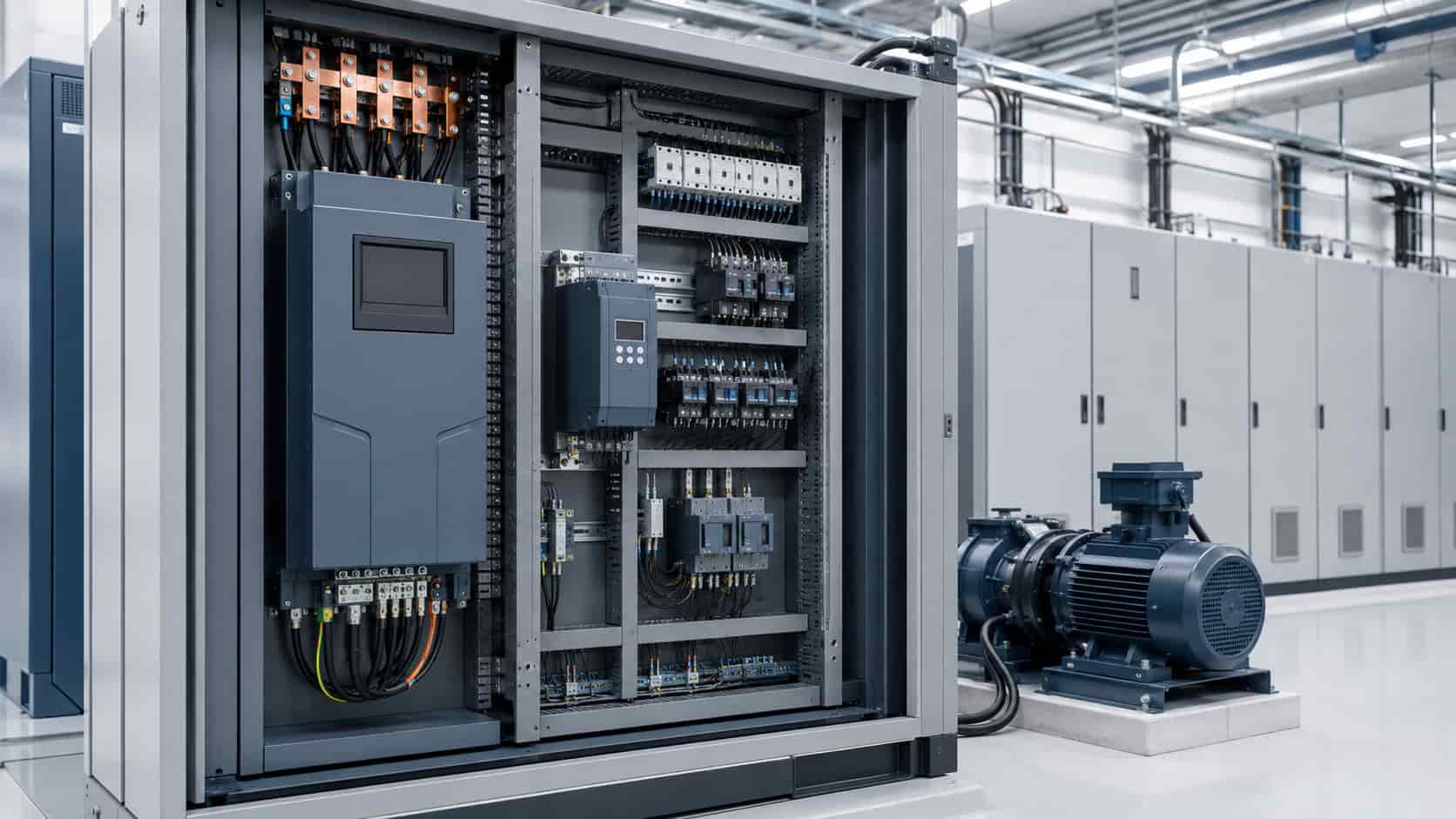
Both devices can be installed as feeders in a motor control center. A coordinated MCC design must consider incoming capacity, short-circuit rating, protective-device coordination, isolation, bypass, control power, ventilation, cable routing, EMC separation, communications, and maintenance access.
Each motor feeder can use the control method appropriate to its duty. Our guide to MCC panels explains the wider assembly, while the custom control cabinets guide covers applications that need process logic, special communications, instrumentation, or nonstandard layouts.
For VFD feeders, confirm whether a maintenance bypass is required and how interlocking prevents incorrect switching. For soft starters, confirm whether the bypass contactor is internal or external and whether protection remains active after bypass.
Selection Checklist for Buyers
Provide the supplier with motor nameplate data, efficiency class, duty, speed range, load torque curve, inertia, starts per hour, acceleration and stopping requirements, supply voltage and fault level, generator operation, ambient temperature, altitude, enclosure conditions, cable length, communications, and applicable standards.
Then compare continuous current—not only motor kilowatts—along with overload capability, derating, current limit, control method, bypass arrangement, harmonic performance, EMC requirements, protective functions, braking options, enclosure rating, cooling, and service support.
The final choice is straightforward only after the process requirement is clear: use a soft starter when the objective is controlled starting and stopping at fixed running speed; use a VFD when the process needs continuous speed or torque control, or when validated energy savings justify it.
Where KEXINGYU E-POWER GROUP Fits
KEXINGYU E-POWER GROUP can supply VFDs and soft starters and integrate them into coordinated MCC and control-cabinet projects. Final equipment selection should be based on the exact motor, driven load, electrical system, operating profile, environmental conditions, and project standards.
Before ordering, request a documented feeder schedule, device data, protection arrangement, heat-loss information, panel layout, and test plan. Project-specific performance values and accessory requirements should be confirmed in the approved technical submission.
VFD and Soft Starter Questions
Recent Posts
Energy Storage for Data Centers: A Growing Backup Power Option
Energy Storage for Data Centers: A Growing Backup Power Option Batteries have always backed up data centers in the form of UPS strings. Grid-scale BESS
Thermal Runaway in Lithium Batteries: What BESS Buyers Should Understand
Thermal Runaway in Lithium Batteries: What BESS Buyers Should Understand How thermal runaway starts, how it propagates, and which evidence buyers should require before approving
Switchgear Lead Times in 2026: A Buyer’s Planning Guide
Switchgear Lead Times in 2026: A Buyer’s Planning Guide Realistic timelines vary significantly by voltage class and type — here’s how to plan procurement without