
Medium Voltage Cable Standards Explained: IEC vs GB vs BS
How the three major cable standard families differ, and how to determine which one your project actually needs.
Introduction
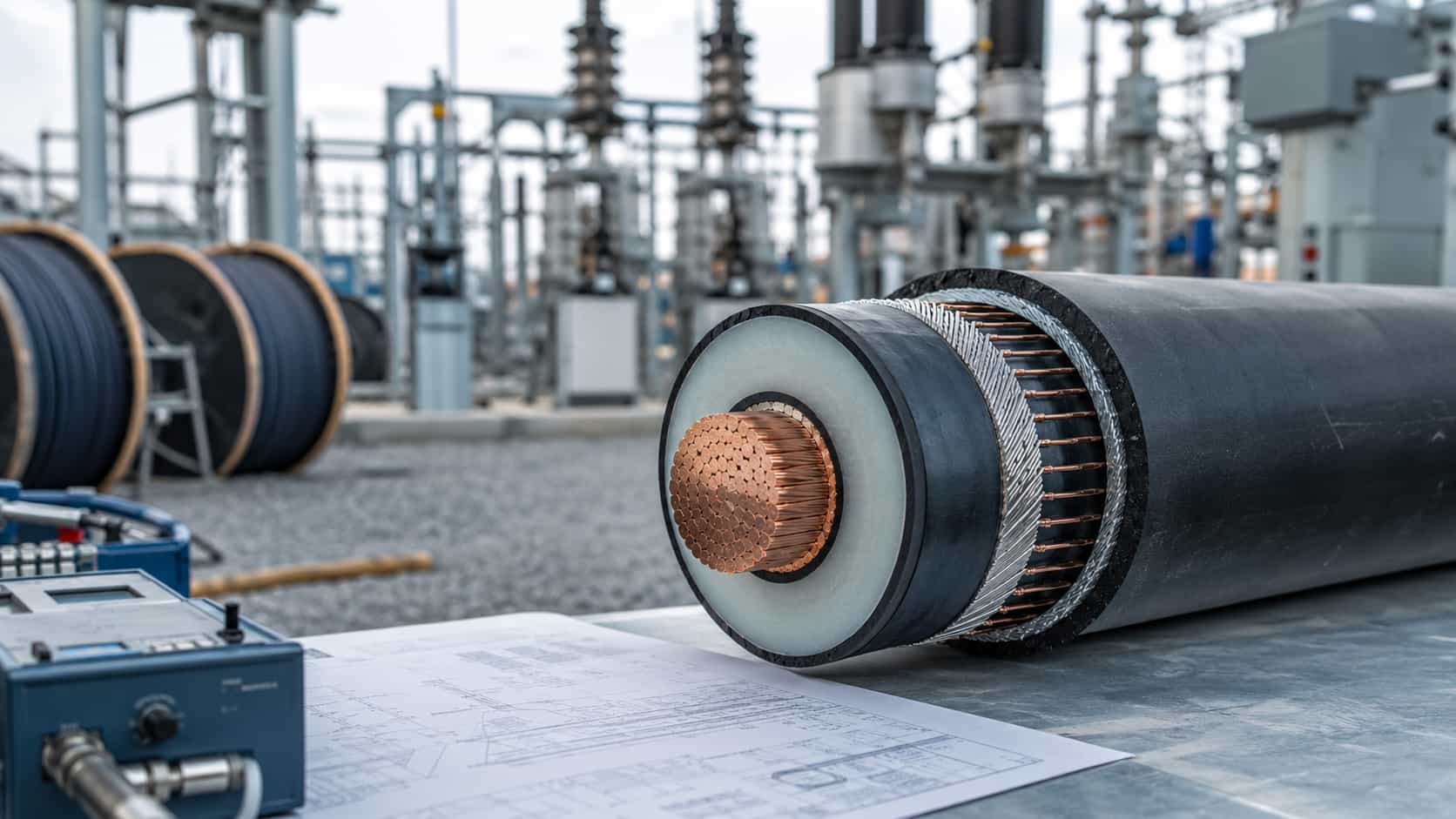
Medium voltage cable specifications almost always reference a standard — IEC, GB, or BS being the three most common on international projects. These aren’t interchangeable labels; each represents a distinct set of test requirements, voltage classifications, and construction rules, and specifying the wrong one for your project’s destination can mean cable that technically works but fails to meet local code or import requirements.
Why standard selection matters specifically for MV cable
At medium voltage, XLPE insulation (discussed in our XLPE cable explainer) becomes the standard construction, and the differences between standard families show up most clearly in how insulation thickness, screening, and voltage classification are defined and tested — differences that matter far less at low voltage but become significant as voltage class increases.
IEC 60502 — the international baseline
IEC 60502 covers power cable for rated voltages from 1kV to 30kV and is the most widely referenced international standard, forming the basis that many national standards are built from or harmonized against. For projects without a specific national standard mandated, or for multi-country projects where a common reference point is needed, IEC 60502 is generally the default choice.
GB standards — China's national standard
GB standards (Guobiao) are China’s national standards, and GB/T 12706 is the primary reference for XLPE insulated power cable. While closely related to IEC in structure, GB standards have some distinct requirements around testing methods and classification. Projects with significant Chinese design, engineering, or equipment input often specify GB standards, and cable manufactured in China is frequently produced to GB as the primary reference standard even when export markets require IEC or another standard as well.
BS standards — British and Commonwealth influence
BS standards (British Standards), particularly BS 6622 and BS 7870 for MV cable, remain the reference point for the UK and a substantial number of former British Commonwealth countries, including parts of Africa, the Middle East, and South and Southeast Asia. Projects in these regions frequently specify BS standards explicitly, sometimes alongside IEC as a secondary reference.
Key differences between the three
The practical differences center on voltage classification systems, specific insulation and screen thickness requirements, test methods and acceptance criteria, and terminology used on datasheets and certificates. A cable built to one standard’s requirements isn’t automatically compliant with another’s, even when the underlying construction is similar — this is why dual or triple certification, where a manufacturer specifically designs and tests a cable to meet more than one standard, exists as a distinct manufacturing approach rather than something assumed by default.
Which standard your project should use
The starting point is almost always the destination country’s regulatory and utility requirements — check what the local grid operator, building code, or project specification explicitly calls for. In the absence of a mandated standard, IEC 60502 is the safest default for international projects. For projects spanning multiple countries or supply chains, it’s worth confirming with your EPC or engineering consultant which standard the overall design package is built around before finalizing cable orders.
Can a cable be certified to multiple standards at once?
Yes — manufacturers can design and test cable to satisfy the requirements of more than one standard simultaneously, though this needs to be explicitly verified rather than assumed. Ask for the specific test reports referencing each standard your project requires, following the same verification approach covered in our cable certifications checklist.
Where Kexingyu Power fits in
We manufacture medium voltage cable to IEC, GB, and BS standards, with dual-certification available where projects require it. Browse the full range on our Cables & Wiring Systems page.
MV Cable Standards
Common questions from project buyers determining which medium-voltage cable standard, test documentation and certification their project requires.
01 Is IEC 60502 accepted for medium-voltage cable projects everywhere?
IEC 60502 is widely used as an international reference for power cables with extruded insulation, but it is not automatically accepted for every project. Some countries, utilities and consultants require a national or project-specific standard such as BS, GB or another local specification. Buyers should confirm the required standard with the approving authority before ordering.
02 Can a GB-standard cable specification be converted directly to an IEC equivalent?
Not through a simple one-to-one conversion. GB and IEC standards may share many technical principles, but their detailed requirements for dimensions, materials, testing and acceptance criteria may differ. The proposed cable construction should be reviewed against the full target standard rather than approved only because it appears broadly equivalent.
03 Do countries with British-standard systems always require BS cable?
No. Some countries continue to use BS-based specifications, while others have adopted IEC standards fully, partially or alongside national requirements. Historical practice alone is not enough to determine the correct standard. Buyers should check the current utility specification, tender documents and local authority requirements for the specific project.
04 Does dual-standard cable certification increase project cost?
It can increase cost because additional design review, testing, documentation or third-party certification may be required. However, dual-standard compliance can be practical for projects supplying multiple countries or facilities, provided one cable construction can genuinely satisfy both standards. Confirm the exact certification scope rather than relying only on a general dual-compliance claim.
Recent Posts
Energy Storage for Data Centers: A Growing Backup Power Option
Energy Storage for Data Centers: A Growing Backup Power Option Batteries have always backed up data centers in the form of UPS strings. Grid-scale BESS
Thermal Runaway in Lithium Batteries: What BESS Buyers Should Understand
Thermal Runaway in Lithium Batteries: What BESS Buyers Should Understand How thermal runaway starts, how it propagates, and which evidence buyers should require before approving
Switchgear Lead Times in 2026: A Buyer’s Planning Guide
Switchgear Lead Times in 2026: A Buyer’s Planning Guide Realistic timelines vary significantly by voltage class and type — here’s how to plan procurement without