
Prefabricated Substations: Faster Deployment for Mining and Remote Sites
When the nearest town is hours away and skilled crews are scarcer than equipment, the substation that arrives tested and ready beats the one that gets built on site
Introduction
Mining and remote industrial sites do not get to choose the easy version of electrification. The grid often ends at the gate, the weather window is short, qualified electrical crews are hours or flights away, and every month between “equipment ordered” and “first megawatt delivered” is production the project financed but cannot earn. A conventional site-built substation concentrates all of those difficulties into one package: civil works, crane lifts, cable terminations and commissioning, all performed in the least hospitable conditions the map has to offer.
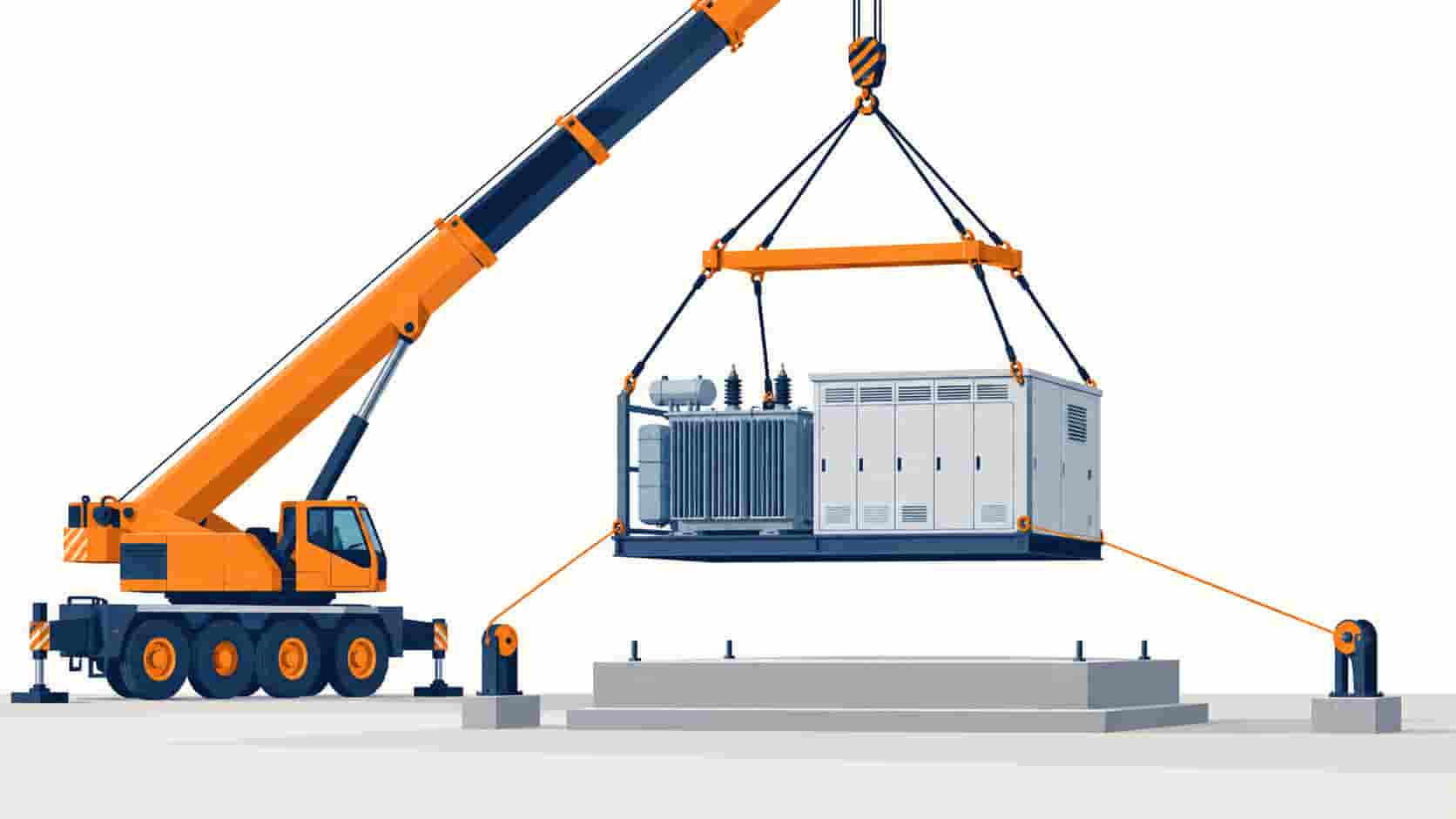
Prefabrication moves that work to where conditions are controllable. The substation is built, wired and tested at the manufacturer’s works—as a compact enclosure, a skid-mounted package or a walk-in e-house—and arrives on site as a finished block that only needs a plinth, external connections and a short commissioning visit. For remote mining duty, this is not a luxury; it is usually the difference between a schedule and a hostage situation.
This guide walks through the formats that make up the prefabricated family, how they are designed for transport and extreme environments, what the deployment sequence actually looks like compared with site construction, and what belongs in an RFQ so the unit that arrives matches the site that was promised. For the wider product family, start from our transformer and substation range.
Why Mining and Remote Sites Favor Prefabrication
The economics of a remote power project are dominated by two costs that never appear on an equipment quotation: the cost of keeping skilled people on site, and the cost of schedule slip. A site-built substation demands both in quantity—months of specialist labor living at the site, and a critical path exposed to rain seasons, access roads and logistics chains where a single delayed shipment stalls everything behind it.
Prefabrication attacks both at once. The work that would occupy a site crew for months—equipment setting, busbar assembly, wiring, functional testing—happens at the factory in parallel with the site’s civil works. What remains on site is set-and-connect: place the block on its plinth, land the cables, and commission with a small team for days rather than months. The production start date moves closer by an entire construction phase, and the residual risk concentrates in one item—the delivered unit—rather than in a hundred small site activities.
There is also a quality argument that matters doubly at remote sites: a fault found at the factory is a punch-list item, while the same fault found after energization at a mine three hundred kilometers from the nearest service town is an outage with a helicopter quote attached. Factory testing is not paperwork here; it is the cheapest maintenance visit the unit will ever receive.
What a "Prefabricated Substation" Actually Covers
The label covers a spectrum rather than a single product, and quotations under the same words can describe very different scopes. At one end sits the compact secondary substation—a sealed enclosure holding MV switchgear, a transformer and an LV board, ideal for small plants and camps. Skid-mounted packages place MV boards, one or two transformers, and LV or motor control gear on a single fabricated steel base, factory-piped and factory-wired, ready to serve a processing plant or a conveyor drive.
At the other end are the larger formats: the e-house—a transportable walk-in building divided into MV, transformer and LV/SCADA rooms—that serves as a complete mine main substation; and containerized units built to ISO footprint so they can ride standard multimodal transport to the end of the road. Somewhere between sits the mobile option on a trailer, aimed at exploration phases and temporary pits that move faster than construction could follow. What unites them all is the factory integration: equipment fitted, wired, tested and documented as one deliverable.
The formats, and where each earns its keep:
| Format | What It Is | Best Suited For |
|---|---|---|
| Compact secondary substation | Sealed enclosure with ring main unit, transformer and LV board, type-tested as an assembly | Small plants, camps, water pumping and dewatering duties |
| Skid-mounted package | MV switchgear + transformer(s) + LV/MCC on one steel skid, factory-wired and piped | Processing plants, conveyors, crushersâsingle-point industrial loads |
| E-house (walk-in) | Transportable building with MV hall, transformer bay and LV/SCADA room, HVAC included | Mine main substations and harsh climates where indoor access matters |
| Containerized unit | ISO-container format, splittable to respect road weight limits | Very remote sites reached by multimodal transport |
| Mobile (trailer) unit | Complete substation on wheels, road-legal and rapidly redeployable | Exploration phases, temporary pits, emergency replacement |
Designing for Remote Reality: Transport, Climate, Environment
The factory gate is not the hard part; the last three hundred kilometers are. Transport envelope is a design input, not a logistics afterthought: road weight limits and bridge classes determine whether the e-house travels whole or splits into MV, transformer and LV modules; lifting points, jacking arrangements and tie-down frames belong on the drawings from day one. An altitude above 1,000 meters derates insulation and cooling, and the manufacturer needs the site’s elevation, not a promise to “check later”.
Climate writes the rest of the specification. Temperature range drives HVAC capacity and material selection; dust and sand push enclosure protection to IP5X-level filtration; coastal or aggressive industrial atmospheres justify C4/C5 corrosion classes; vermin screens protect against the local fauna, which at remote sites is a genuine design load. Solar gain, wind speeds and seismic requirements all belong in the RFQ as site data, because a standard-climate design shipped to a desert or a plateau will fail in exactly the ways the site survey could have predicted.
Finally, the electrical neighborhood matters: many remote mining systems run as hybrids with diesel generation and increasingly battery storage. A prefabricated substation can be factory-integrated with the protection and metering interfaces those sources need—our overview of battery energy storage covers the storage side—but only if the hybrid architecture is declared before design freeze, not after the unit is built.
From Factory to First Power: The Deployment Sequence
The deployment story is where prefabrication pays its bill, so it is worth being precise. Before shipment, the complete unit passes a witnessed factory acceptance test—protection functions, interlocks, dielectric tests, thermal checks—against the contract specification. The site’s civil scope shrinks to the plinth, cable trenches and earthing, all of which can proceed while the unit is being built. Arrival, setting, external cabling and commissioning compress into weeks, with a specialist crew present for days rather than months.
How the two approaches compare, stage by stage:
| Stage | Site-Built | Prefabricated |
|---|---|---|
| Civil works | Full building and equipment plinths sit on the critical path | Plinth and trenches only, running parallel to factory build |
| Equipment installation | Cranes, rigging and alignment on site, weather-dependent | Factory-fitted; set the block and connect |
| Wiring and cabling | Site crews terminate everything in the field | Internal wiring done at the works; external ends only |
| Testing | Full commissioning built from scratch at site | FAT witnessed at factory; site re-verification of connections |
| Weather exposure | Wet or freezing seasons can stall the sequence for months | Most work happens indoors before shipment |
| Specialist labor | Extended presence of several trades for months | Short commissioning team visit |
Two schedule notes for planning. First, the factory lead time for a prefab unit is real—months, not weeks—and current market queues for switchgear and transformers touch everything; our review of the transformer lead-time situation is a sober baseline. Second, the logistics leg needs early booking: heavy-haul permits and escorts for an e-house move are arranged in advance, and the deployment calendar should treat transport as a milestone, not an errand.
When Prefabricated Is Not the Answer
Prefabrication has a ceiling, and pretending otherwise produces bad projects. Very large substations—at transmission voltages, or with multiple large power transformers—belong to conventional construction, where the sheer scale of equipment and layouts exceeds what transportable modules can carry. Utility interface points are a second boundary: where the grid operator mandates its own switchgear types, protection schemes or building standards, a sealed third-party block will not pass the gate, and the interface substation must play by the utility’s rules.
Local content requirements can tip the decision too—some jurisdictions mandate on-site labor share that a fully factory-built unit cannot satisfy without hybrid arrangements. And even the right format still needs honest site diligence: flood levels, access road capacity for the heaviest shipment, and ground conditions under the plinth are remote-site classics that no amount of factory quality can retrofit. Prefabrication removes construction risk from the equipment, not engineering risk from the site.
What to Put in the RFQ for a Mining Project
A remote project cannot afford a vague specification, because every ambiguity ships three hundred kilometers before anyone discovers it. The essential line items:
- Electrical scope: rated voltages, transformer ratings with impedance and losses, switchgear configuration, protection philosophy, and IEC references named per assembly.
- Site data pack: altitude, temperature and humidity range, seismic and wind figures, pollution/dust level, corrosion class—so the enclosure and cooling are designed for the real site.
- Transport envelope: road and bridge limits on the actual route, maximum module weight and dimensions, lifting and jacking requirements.
- Factory test scope: witnessed FAT with the test list, standards and report format agreed before order—this is the quality milestone for a remote delivery.
- Hybrid interfaces: generator and storage integration points, metering, SCADA protocol and points list for the mine’s control room.
- Logistics and installation support: shipping supervision, installation supervision, and commissioning team scope and duration.
- Spares, tooling and training: recommended spares stocked on site, special tools, and operator training—service response at remote sites is measured in days.
- Documentation language and format: as-builts, test records and manuals in the language the site team actually reads.
Supplier selection follows the same logic as any heavy electrical purchase—factory capability, references in comparable climates, and integration discipline under one contract. The vetting questions in our transformer manufacturer checklist extend naturally to prefab scopes, and where the project horizon is short enough that even a prefab build is too slow, the mobile substation option covers the gap.
Conclusion
For mining and remote sites, prefabricated substations convert the worst part of electrification—months of construction at the end of a bad road—into a factory order and a short site visit. The formats scale from a sealed compact unit for a camp to an e-house running an entire mine, and the value is consistent: schedule compressed, interfaces reduced, and quality tested before it ever meets the weather.
The discipline sits in the site data and the RFQ. Declare the altitude, the climate and the transport route; fix the factory test scope; and plan the logistics as a milestone. Do that, and the unit that arrives is the one the site was promised—ready to set, connect and energize. When you are ready to price one, the team at KXY E-Power Group quotes prefabricated substations as complete, tested packages for exactly these conditions.
Frequently Asked Questions
Recent Posts
Voltage Stabilizers vs UPS: Do You Need Both?
Voltage Stabilizers vs UPS: Do You Need Both? One device fixes how high or low the voltage is; the other fixes whether there is voltage
Energy Storage for Data Centers: A Growing Backup Power Option
Energy Storage for Data Centers: A Growing Backup Power Option Batteries have always backed up data centers in the form of UPS strings. Grid-scale BESS
Thermal Runaway in Lithium Batteries: What BESS Buyers Should Understand
Thermal Runaway in Lithium Batteries: What BESS Buyers Should Understand How thermal runaway starts, how it propagates, and which evidence buyers should require before approving