
Solar + Storage Power Packages: What to Specify Before You Buy
A solar and storage package is one product in the buyer's mind—but it is six engineering decisions in reality, and the quotes you receive will differ in every one of them.
Introduction
Falling photovoltaic prices and maturing battery technology have turned solar-plus-storage from a demonstration project into the default starting point for industrial power in much of the world. Factory owners facing unreliable grids, mine operators burning delivered diesel at eye-watering cost, and developers of new industrial parks all arrive at the same question: what exactly should I buy, and how do I compare the offers?
The market has answered with the solar storage power package—a pre-engineered bundle of PV capacity, battery energy storage, power conversion, and the transformers and switchgear that tie it to your loads. The promise is real: one supplier, one integration responsibility, one commissioning signature. But the promise is only kept when the buyer specifies the package correctly, because two offers with identical headline kilowatts can behave completely differently on site. This guide walks through what a complete package contains, how to size it around a real load curve instead of a spreadsheet average, and the mistakes we see most often when buyers—often buying energy equipment for the first time—evaluate proposals.
If you are new to battery storage itself, it is worth reading our plain-language introduction to BESS first; this article assumes that foundation and focuses on the package as a purchase.
What a Solar + Storage Package Actually Contains
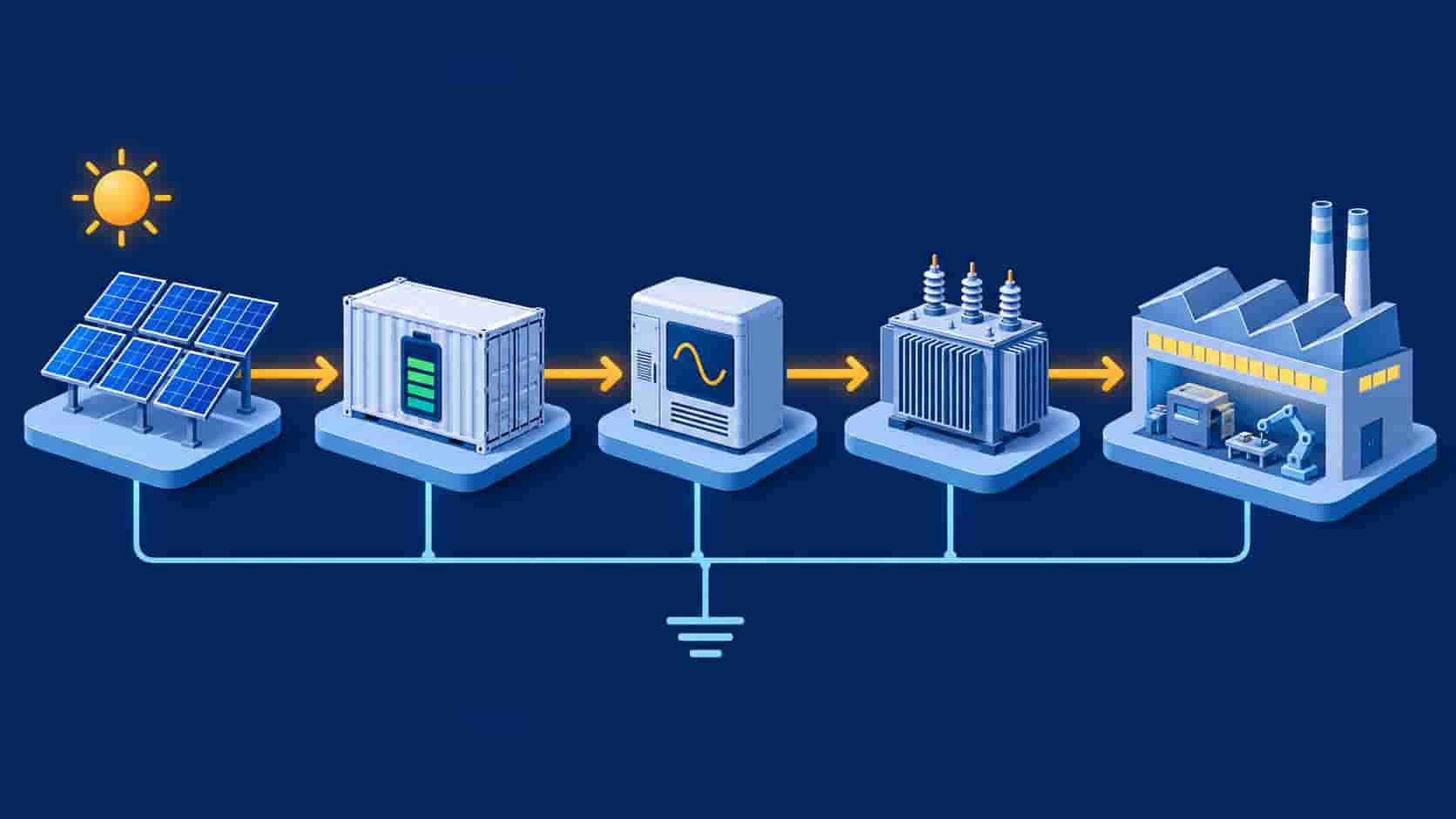
A credible package quotation should itemise six building blocks. If any of them is missing, it is not a package—it is a panel or a container with homework attached.
1. The PV array and mounting. Modules, mounting structure engineered for your wind and snow loads, DC cabling, combiner boxes, and string inverters or a central inverter arrangement. Ground mount, rooftop, or carport changes both cost and engineering effort.
2. The battery energy storage system. Battery racks or a containerised BESS with integrated fire suppression, thermal management and access control. The container-versus-cabinet decision matters more than buyers expect—our comparison of containerised and cabinet-type energy storage covers the trade-offs in siting, capacity scaling and maintenance.
3. Power conversion (PCS). The bidirectional inverters that charge the battery from PV or grid and discharge it to your loads. PCS rating determines how fast you can charge and discharge—the power half of the sizing equation—while battery capacity is the energy half.
4. The energy management system (EMS). The control brain that decides, second by second, whether the battery charges, discharges or stands by, and how it coordinates with PV output and any diesel generation. The distinction between the battery management layer and the site-level control layer is easy to blur in negotiations; our article on BMS versus EMS in battery storage explains who is responsible for what.
5. Transformers and MV switchgear. The step-up or step-down transformers, medium-voltage switchgear, and protection relays that connect the package to your site network. This is the block most often quoted vaguely, and the one that causes the ugliest surprises—budgets discover late that the PV and BESS arrive at 400 V but the plant busbar runs at 11 kV. A supplier who engineers the whole chain is worth talking to; our transformers and substations capability exists precisely because this boundary between “solar scope” and “electrical infrastructure scope” is where projects stumble.
6. Site works and integration. Foundations or plinths, cable trenches, earthing and lightning protection, SCADA integration, and the commissioning and training package. Packages that look cheapest usually achieve it by quietly moving these items from the quote to your side of the contract.
Sizing Starts With the Load Curve, Not the Panel Price
The single most common sizing failure is treating the package as an energy-arithmetic exercise: “the plant uses 10 MWh a day, so we need X megawatts of PV and Y megawatt-hours of batteries.” That arithmetic ignores when the energy is needed, and timing is the entire business case.
Start from a 24-hour load curve measured at fifteen-minute resolution if at all possible. Three numbers drive everything: the daytime base that PV must cover, the evening shoulder that the battery must carry as the sun falls, and the nighttime floor that either battery discharge or a generator must serve. A plant running two shifts has a fat daytime hump and a thin night—a friendly profile for solar. A camp or a continuous-process plant runs flat around the clock, which pushes the design toward more storage or hybrid generation.
Then apply the physical constraints in order:
- Peak demand sets PCS power. The inverter must deliver the highest simultaneous load the battery will serve, including motor starts, with margin.
- Shift length sets battery energy. Multiply the load the battery must carry by the hours it must carry it, then add reserve. Depth-of-discharge limits and temperature derating eat into nameplate capacity faster than most buyers expect.
- Recharge window sets PV oversizing. The array must refill the battery and feed the daytime load simultaneously, with realistic irradiance—not brochure irradiance—for your exact site.
- Fuel savings set the economics. For diesel-displacement projects, model fuel consumption hour by hour against the load curve; annual savings are what the CFO will actually inspect.
For grid-connected plants the same logic applies with tariff data instead of fuel data: size the battery against the demand charge and the price windows it is meant to arbitrage. Our guide to sizing BESS for peak shaving walks that calculation in detail, and it applies unchanged to the battery block of a solar hybrid package.
Four Load Profiles, Four Different Packages
Suppliers shape the package around the load profile. Before you issue an RFQ, identify which of the four profiles below matches your site—then check that the offers you receive actually reflect it.
| Load Profile | Recommended Package Shape | Battery Role | Design Points to Insist On |
|---|---|---|---|
| Daytime-only industrial load (single-shift factory, irrigation pumping) | PV sized near the daytime load, small battery for smoothing and cloud transients | Seconds-to-minutes smoothing; rides through cloud edges and motor starts | PCS power above battery energy; motor-start headroom; anti-islanding protection if a grid or genset connection exists |
| Round-the-clock camp, telecom or auxiliaries load | PV plus a battery sized for the evening-to-morning shift, genset retained as backstop | Carries the full load overnight on typical days; genset runs only after consecutive poor-solar days | Cycling strategy agreed in writing; generator auto-start coordination tested; battery thermal design for night temperatures |
| Grid-connected plant cutting demand charges | PV for daytime energy, BESS sized by the tariff windows and demand peaks | Peak shaving and time-of-use arbitrage; PV self-consumption | Size from measured demand data, not nameplate; check export limits and interconnection rules before committing |
| Full off-grid process plant (mining, island industry) | Large PV, large BESS, synchronised diesel sets and a hybrid EMS running the whole site | Primary spinning reserve and frequency response; displaces fuel around the clock as PV allows | Spinning reserve policy defined; EMS authority over gensets contracted as one scope; load-bank commissioning of the full hybrid system |
Hybrid Control: Making Solar, Storage and Diesel Play Together
On sites with existing generators—and that is most industrial sites in weak-grid regions—the control layer is where packages succeed or fail. The battery must discharge when the sun drops without tripping the gensets, the gensets must not idle wastefully at low load while the battery still has energy, and the whole scheme must survive a factory full of large motors starting and stopping.
Three control questions must have contractual answers:
- Who commands the gensets? Either the EMS sends start/stop and setpoint signals to the generator controller, or a site PLC does. Both work; a half-specified mixture of both does not.
- What is the spinning reserve policy? The battery typically holds back a slice of its state of charge so it can respond instantly if a genset trips or the load jumps. The reserve fraction is an engineering decision that should be documented, not an accident.
- How are faults contained? Define what happens on battery failure, PV failure, communications loss between subsystems, and emergency stop. A package quote that is silent on failure modes is quoting an ideal day only.
Ask bidders to describe, in one page, how their EMS handles a large motor start at night, a cloud front at midday, and a genset trip at 70% load. The quality of those three answers tells you more about a supplier than any datasheet.
When a Solar + Storage Package Is Not the Answer
Honest suppliers talk buyers out of bad fits. Solar plus storage underperforms, and sometimes should be rejected outright, in these situations:
- Heavy 24/7 process load with no space. Continuous electrochemical or smelting loads with a small or shaded site cannot host enough PV to matter, and the battery required to shift meaningful energy becomes enormous. A generator-based or grid-plus-BESS design serves better.
- Pure backup requirement. If the goal is riding through outages rather than cutting energy cost, a battery-plus-charger or generator solution is simpler and cheaper than a PV-hybrid package.
- Short-project horizons. Temporary sites under two to three years rarely amortise the PV and battery capital; mobilised diesel with fuel logistics often wins the cash-flow comparison.
- Stable, cheap grid with no demand charges. Where power is reliable and tariffs are flat, the arbitrage and resilience value shrinks to near zero. Wait for the tariff structure to change.
- No one to operate it. A hybrid package is a small power plant. If the site has no electrical staff and no budget for remote monitoring service, the system will drift away from its design operating point within months.
The second table lists the buying-stage mistakes that turn a sound concept into a difficult project. Every line has a fix; insist on it before signing.
| Mistake | What Goes Wrong on Site | The Correction |
|---|---|---|
| Sizing PV to annual energy instead of the load curve | Midday surplus is curtailed while the battery empties every evening; diesel still runs every night and the payback model collapses | Model hour by hour against a measured 24-hour load curve; check surplus and deficit both, and trim PV until the model stops wasting energy |
| Accepting battery nameplate without cycling, cooling and warranty detail | Usable capacity is a fraction of the brochure number; cells age fast in heat and the warranty excludes the real duty cycle | Specify depth of discharge, C-rate, ambient temperature class and warranted cycles or throughput in the contract; make the warranty match the duty |
| Treating the diesel interface as a footnote | EMS and governor mismatches cause trips under load, or gensets idle wastefully while the battery holds energy; the hybrid system fails exactly when it is needed most | Share genset controller models, ratings and communication protocols at RFQ; require a written control scheme and a factory integration test of the genset-battery loop before shipment |
| Forgetting the transformer and MV switchgear | The package lands at low voltage while the plant busbar is medium voltage; procurement of a missing transformer delays energisation by months | Assign the interface transformer, MV switchgear and protection relay settings to one scope in writing, with ratings agreed at RFQ stage |
| Comparing offers on price per kilowatt-hour alone | Differences in round-trip efficiency, auxiliary consumption, cycle life and service response dwarf headline price differences over the first five years | Evaluate on levelised cost of storage and warranty terms; require the same duty cycle in every quote so the numbers are comparable |
| No commissioning spares, no training, no remote support | A minor fault strands the system for weeks waiting for parts; staff reset settings by trial and error | Contract a commissioning spares package, on-site operator training and a defined remote-monitoring service level before delivery |
What to Ask Suppliers Before You Sign
Use this list as the RFQ floor. A serious supplier answers each item without prompting; hesitation on any of them tells you where the project risk will land.
- A line-item scope split: PV, battery, PCS, EMS, transformers, MV switchgear, site works, commissioning—so nothing hides between packages.
- The sizing model itself: the load curve used, the irradiance data source, the resulting hourly energy balance, and the assumptions on reserve and curtailment.
- Battery datasheet specifics: chemistry, usable energy at your duty cycle, cycle or throughput warranty, thermal management design and fire suppression standard.
- The genset interface: protocols, which controller commands which, and the tested behaviour on genset trip and motor start.
- Interface ratings: connection voltage, fault levels, protection coordination study, and who supplies and sets the relays.
- Delivery and commissioning plan: factory acceptance test scope, shipping configuration, site installation boundaries, and the load-bank or integrated test at handover.
- Warranty and service: response times, remote diagnostics, spare parts availability in your region, and performance guarantees with real numbers attached.
Conclusion
A solar and storage package earns its keep only when it is engineered around one specific load curve, one specific site and one specific tariff or fuel reality. The buyers who are satisfied a year after commissioning are the ones who pinned down the load profile first, forced every supplier to model against it, and refused to let the transformer and switchgear boundary stay vague.
The good news is that this discipline is not hard—it is a checklist applied early. Send the same load data to every bidder, demand the same assumptions in every model, and compare offers on lifetime cost rather than first price. Do that, and the package that arrives on site will be the one you thought you bought.
Frequently Asked Questions
Quick answers to the questions buyers raise most often about solar and storage packages. Open any item for the short version.
Recent Posts
Voltage Stabilizers vs UPS: Do You Need Both?
Voltage Stabilizers vs UPS: Do You Need Both? One device fixes how high or low the voltage is; the other fixes whether there is voltage
Energy Storage for Data Centers: A Growing Backup Power Option
Energy Storage for Data Centers: A Growing Backup Power Option Batteries have always backed up data centers in the form of UPS strings. Grid-scale BESS
Thermal Runaway in Lithium Batteries: What BESS Buyers Should Understand
Thermal Runaway in Lithium Batteries: What BESS Buyers Should Understand How thermal runaway starts, how it propagates, and which evidence buyers should require before approving