Sustainable Data Center Cabling: LSZH Adoption and Recyclability

Quick Answer: Sustainable cabling rests on three honest levers: LSZH construction, long service life that postpones replacement, and end-of-life recovery — backed by documentation that proves every claim.
Sustainability claims about cable deserve skepticism by default. A cable is a composite product: highly recyclable metal wrapped in engineered polymers that range from readily reprocessable to effectively permanent. The honest sustainability conversation is therefore about choosing the right construction for fire safety, making it last as long as the building, and planning recovery of the parts that genuinely recover.
Introduction
Data centers consume cable by the kilometer, and the industry’s environmental attention has rightly moved to the materials in the tray. But cable sustainability is not a sticker on a drum. It is a set of engineering choices — insulation chemistry, sheath material, operating margin and documentation — that determine what the cable emits in a fire, how many decades it serves, and what can be recovered when the hall is eventually refitted.
This article works the topic in that order: why LSZH has become the default fire-performance choice for data centers and what it does and does not deliver for the environment, where recyclability genuinely stands for XLPE and PVC, why service life is the most underrated sustainability lever, and which procurement documents separate verified claims from green paint. The electrical fundamentals behind the constructions are covered in our data center power collection.
Why LSZH Became the Data Center Default
Low smoke zero halogen construction earns its place on fire performance first and environmental credentials second. Under IEC 60754 testing, halogen-free compounds release little or no hydrogen chloride when burning — the corrosive gas that destroys electronics far beyond the flame zone and endangers the people evacuating. Under IEC 61034, the smoke released in a confined route stays thin enough to see through. Combined with flame-spread limits under IEC 60332, LSZH cable in a cable-filled data hall means a fire that people can evacuate from and a building whose switchgear survives the smoke event. The family-level trade-offs are compared in our LSZH versus fire-retardant cable guide.
The environmental side of the same choice is real but narrower than marketing suggests: halogen-free combustion does not release persistent corrosive residues into the building, and modern LSZH compounds avoid some of the additives that complicate polymer recycling. What LSZH does not change is the fundamental recyclability of the insulation system underneath — which is where the thermoset problem begins.
| Construction | Fire Performance | Recyclability Reality | Best Fit |
|---|---|---|---|
| XLPE insulation + LSZH sheath | Strong; halogen-free smoke behavior | Copper fully recoverable; XLPE not re-meltable | Data halls, occupied buildings â the default |
| XLPE insulation + PVC sheath | Adequate flame spread; HCl in fire | Copper recoverable; PVC recyclable in dedicated streams | Industrial outbuildings, buried routes |
| Thermoplastic (PVC) insulation | Weaker smoke and gas profile | More reprocessable; still halogen-bearing | Legacy retrofits, non-critical circuits |
| Mineral insulated (MI) | Highest fire survival | Copper and magnesium oxide essentially all recoverable | Fire-resistant circuits, life-safety feeders |
The Recyclability Question: Thermosets, Thermoplastics and Copper
XLPE is cross-linked polyethylene: the cure that makes it tolerate 90°C continuous operation and short-circuit temperatures also makes it a thermoset that will not re-melt. Recovered XLPE cannot be re-extruded into new insulation; its practical afterlife is grinding into fillers and low-grade applications, or energy recovery. This is a materials-physics fact, not a supplier failing — and any spec claiming “fully recyclable XLPE” deserves the same scrutiny as any other unverifiable green claim. The chemistry behind the insulation choice is explained in what XLPE cable actually is, and the head-to-head with PVC — which is recyclable in dedicated streams, at the cost of halogen content — is set out in our XLPE versus PVC comparison.
The metal is a different story entirely. Copper and aluminum recover at essentially full value and full quality, forever, which is why demolition-grade cable is a commodity rather than a waste. For a data center, two implications follow: design every route for eventual extraction (trays and penetrations that allow pulling cable back out, not pouring it into slabs), and treat the metal as an asset with a residual value that the decommissioning budget can credit back.
Service Life: The Most Underrated Sustainability Lever
The greenest cable is the one you do not manufacture twice. A correctly derated XLPE feeder on a well-managed tray serves twenty-five to thirty years; the same cable pushed against its thermal limits in a grouped, under-ventilated tray ages in a fraction of that and drags a full replacement project behind it. Correct sizing, honest grouping calculations and condition monitoring are therefore sustainability measures as much as reliability measures — the failure mechanisms that premature aging sets in motion are catalogued in our guide to common causes of cable failure.
Life extension also argues for conservative conductor sizing at design time. Oversizing copper costs money once and buys decades of margin, lower losses — wasted watts are also emissions — and a feeder that survives two generations of load growth. Value engineering that shrinks conductor size to win a bid is, on any honest lifecycle ledger, an anti-sustainability decision.
Procurement Levers: Documentation, Drums and Standards
What a buyer can actually enforce is paperwork. Test reports to IEC 60754 and IEC 61034 prove the LSZH claims rather than asserting them; batch certificates trace the copper; and the standards landscape that structures these requirements is mapped in our IEC, GB and BS cable standards guide, with the certification checklist angle covered in the power cable certifications checklist. Ask suppliers for environmental product declarations where they exist, and treat their absence as information too.
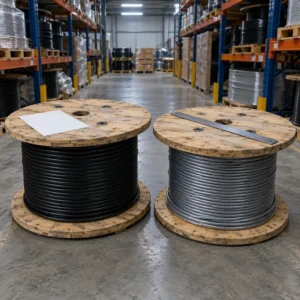
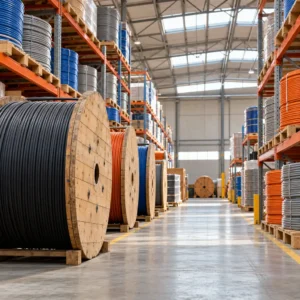
Logistics carries sustainability weight as well: returnable or recyclable drums, delivery plans that avoid re-shipping mis-cut lengths, and copper price linkage that stabilizes procurement across phases — reducing the waste that speculation-driven over-ordering produces. None of this appears on a product label, which is precisely why it belongs in the RFQ.
| Check Item | Requirement | Why It Matters |
|---|---|---|
| LSZH where it counts | IEC 60754 / 61034 reports, not adjectives | Fire safety is the foundation claim |
| Honest recyclability terms | Copper recovery planned; XLPE limits stated | "Fully recyclable XLPE" is not a thing |
| Extraction-friendly routing | Trays and penetrations allow cable withdrawal | Metal is an asset only if you can reach it |
| Thermal margin at design | Conservative sizing and honest grouping | Service life is the biggest sustainability lever |
| Condition monitoring | Trends catch aging before replacement | Not manufacturing the cable twice |
| Verified documentation | Batch certs, test reports, EPD where available | Claims without paper are decoration |
When Green Labels Are Not the Answer
Eco-labels on cable drums are, so far, mostly marketing wearing a lanyard. There is no widely enforced, cable-specific sustainability certification comparable to energy labels on appliances, which means the buyer’s protection is the same as ever: verifiable test reports, traceable materials and a supplier who volunteers the thermoset limitation rather than burying it. A specification that demands evidence outperforms a specification that demands badges.
And there is a boundary to what cabling can carry: cable is a small fraction of a data center’s embodied footprint next to the building, the power train and the IT hardware. Specifying LSZH, planning copper recovery and buying for thirty-year life are the right moves — presented as what they are, a meaningful component of a much larger sustainability program, not its centerpiece.
RFQ Checklist: Ordering Sustainable Cabling
Make the sustainability requirements enforceable, so include:
- LSZH construction with IEC 60754 and IEC 61034 test reports per batch
- Flame-spread class stated to IEC 60332 for the installation context
- Batch copper certificates and traceability to the mill
- Environmental product declaration or equivalent documentation, if held
- Honest statement of insulation recyclability limits (thermoset vs thermoplastic)
- Conductor sizing philosophy favoring thermal margin and low losses
- Returnable or recyclable drum logistics stated in the delivery plan
- Phased delivery matched to construction, avoiding re-shipments
- Copper price linkage across the delivery calendar
- Decommissioning note: routes designed for cable extraction and metal recovery
Conclusion
Sustainable cabling is not a product you buy; it is a set of decisions you make. Choose LSZH where people and electronics share the building, size for a thirty-year life instead of a fifteen-year one, route for extraction, and demand documentation that proves each claim.
Kexingyu Cable Group (KXYE) supplies LSZH-constructed cable with batch-level test reports, transparent material statements and copper price linkage across phased deliveries — so the sustainability case for the tray rests on evidence, not adjectives.