Telecom and Network Cables for Buildings: HYV, Cat5e and Beyond
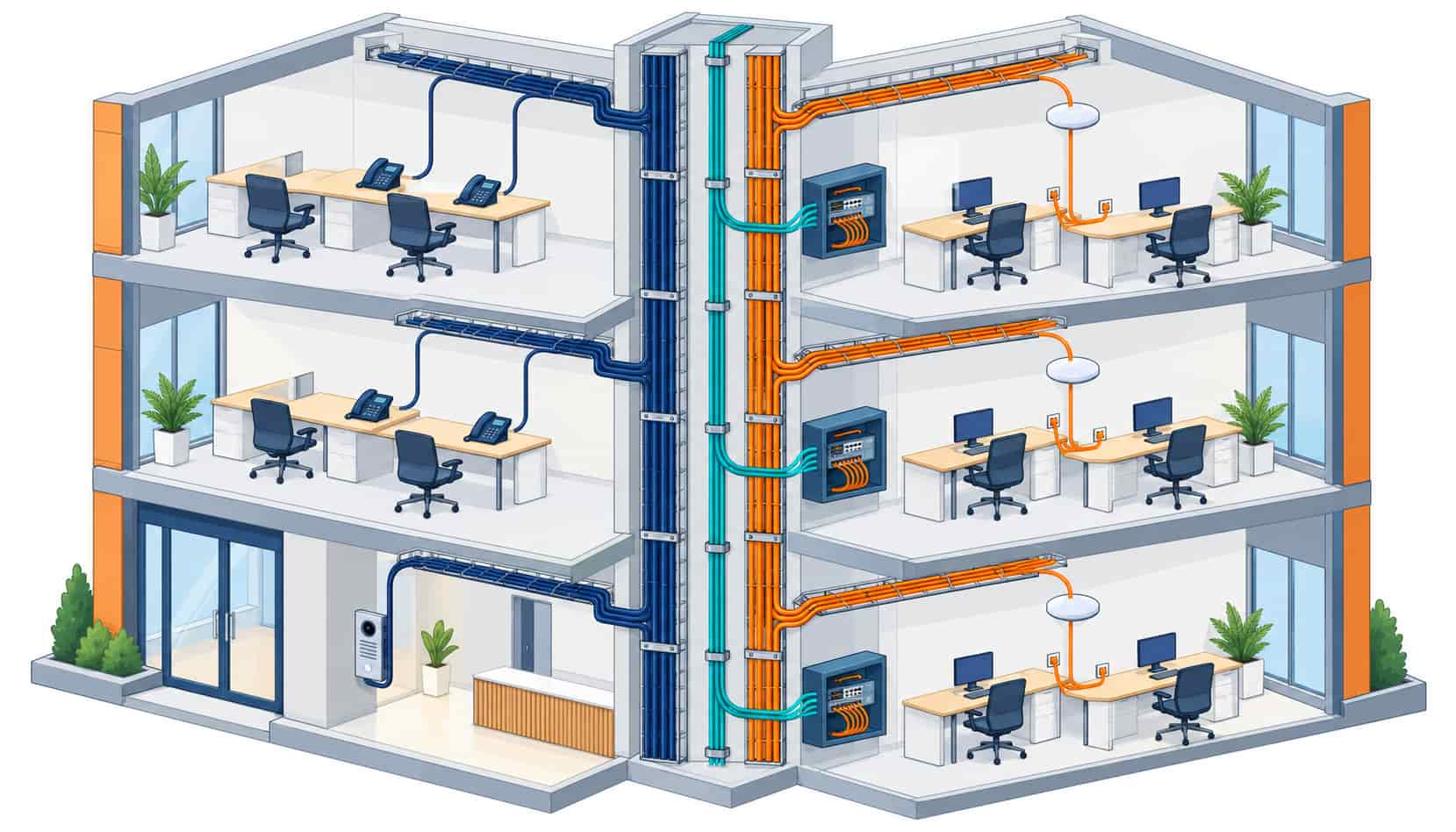
Quick Answer: HYV is China’s classic multi-pair telephone cable for voice and low-speed signal — today it shares the riser with Cat5e and Cat6 structured cabling.
Every building has two nervous systems: the power that runs the lights and the cabling that runs the conversations. The second system is older than it looks — telephone-grade copper still hums in risers everywhere, now sharing space with network categories that refresh every few years. In Chinese buildings the voice layer is specified as HYV, and understanding it beside the Cat families is the difference between a riser that serves both worlds and one that serves neither well.
Introduction
Buyers meet the telecom-cabling decision in retrofits, new commercial buildings, hotels and campus projects: how much legacy voice copper, how much structured data cabling, and how the two coexist in the same riser without interfering. Chinese material lists answer the voice half with HYV — a construction international buyers half-recognize from old telephone-catalog pages. This guide decodes it, maps the Cat families around it, and gives the planning logic for specifying both in one coherent scope. The signal-cabling boundary against control and instrumentation work is mapped in our control versus instrumentation cable guide.
The Letters, Decoded
H is hua — telephone, the telecom cable family. Y here names the core insulation — polyethylene, the classic voice-cable dielectric, chosen for its stable electrical properties rather than its flame behavior. V is the PVC outer sheath. So HYV reads “telephone cable, PE-insulated pairs, PVC sheathed,” built in multi-pair layouts: 10, 20, 30, 50, 100, 200 pairs and up for riser and distribution duty, with the pairs color-coded in standard combinations for the splicer’s sake. The conductor is small — 0.4 to 0.5 mm copper typical — because voice duty needs loop resistance discipline, not ampacity. Flame-retardant and armored variants exist as HYV22 and the ZR-prefixed grades for risers where codes demand them.
| Family | Construction | Built For | Where It Fits Today |
|---|---|---|---|
| HYV | Multi-pair, PE insulation, PVC sheath | Voice, low-speed signal | Telephone risers, intercom, legacy PABX, entry systems |
| HYV22 / ZR-HYV | HYV plus steel tape armor / flame-retardant grade | Voice in harsh or fire-graded routes | Buried entrances, risers with code requirements |
| Cat5e UTP/FTP | 4 twisted pairs, 100 MHz, 24 AWG | Gigabit Ethernet | Cost-driven data horizontal cabling |
| Cat6 / Cat6A | 4 pairs, tighter twist geometry, 250/500 MHz | Gigabit to 10-gigabit short runs | Standard commercial data cabling |
| Fiber (OM/OS) | Glass core, backbone geometry | High bandwidth, long runs, electrical isolation | Riser backbone, data halls, campus links |
Where HYV Still Earns Its Keep
Voice refused to die, it just changed jobs. HYV today carries PABX and hotel room telephony, building entry phone and intercom systems, elevator emergency phones, gate access speech circuits, fire telephone jack systems and the low-speed signaling that legacy building systems assume. Its virtues are exactly right for this duty: dozens of pairs in one sheath, termination on punch-down blocks that any telecom technician reads fluently, and loop characteristics tuned for speech rather than data. What it is not is a network cable — pair twisting in HYV is casual by Ethernet standards, and pushing data-grade protocols down unshielded, loosely-twisted pairs ends exactly as badly as physics predicts.
The Cat Families: Structured Cabling Basics
Structured cabling is a different discipline wearing the same copper. Cat5e and Cat6 specify pair twist precision, geometry control and tested bandwidth — 100 MHz for Cat5e, 250 MHz for Cat6, 500 MHz for Cat6A — that turns four twisted pairs into a gigabit-and-up transmission line. The craft lives in the geometry: consistent twist rates that fight crosstalk, and in shielded variants (FTP), an overall foil or braid that must be grounded like any shield. Structured cabling is planned as a permanent infrastructure — patch panel to outlet in permanent-link topology, certified after installation — which is why it prices higher than voice copper and why its certification paperwork matters as much as its copper. Data halls take this discipline to its extreme; the power side of those halls is covered in our data center power guide.
| Building Area | Voice Layer | Data Layer | Planning Note |
|---|---|---|---|
| Hotel guest rooms | HYV to room phone, entry and emergency speech | Cat6 to TV, AP and desk outlets | Two separate risers; keep them separated |
| Commercial offices | Minimal â PABX fading to VoIP over the data layer | Cat6A horizontal, fiber backbone | Voice rides data; HYV only for entry and life-safety speech |
| Residential towers | HYV for entry phone and legacy extensions | Cat5e/Cat6 per unit to router position | Intercom upgrade paths decide the HYV pair count |
| Campus and industrial | HYV22 for gate phones, intercom between buildings | Fiber between buildings, Cat6 inside | Outdoor routes need armor and surge discipline |
| Retrofit projects | Reuse HYV where it tests clean | New Cat6 horizontal | Certify reused copper or it becomes tomorrow's fault list |
Installation and Interference Discipline
Voice and data copper coexist badly when installed casually. Power circuits induce hum into telephone pairs and crosstalk into data cables, so separation discipline applies to both: distance from power runs, crossings at right angles where separation is impossible, and riser segregation between the voice layer and the data layer. Shielded variants and armored telecom cable ground like any other shield — deliberately, on a recorded scheme. And the physical layer is where most “network problems” are born: crushed conduit corners, over-tight cable ties, and bends tighter than the category allows are the quiet killers of certified performance. The failure mechanisms careless installation seeds are the usual suspects in our cable failure causes guide.
Export Mapping and Procurement Notes
HYV translates to “multi-pair telephone cable, PE-insulated, PVC-sheathed” — a construction recognized worldwide wherever voice copper persists. State the pair count, conductor diameter (0.5 mm typical), and any armor or flame-retardant prefix, and attach the certification paperwork per the discipline in our power cable certifications checklist. For the Cat families, buy on category certification rather than on price alone: a genuine Cat6 channel carries tested geometry and marked jackets, and the counterfeit margin in this category is notorious — verify the certificate matches the drum print. For mixed voice-plus-data scopes, a supplier who can quote both families coherently saves an integration argument; the single-supplier logic is the one in our one-stop power equipment sourcing guide.
When Legacy Voice Copper Is Not the Answer
HYV is not data cabling, however tempting the “four pairs are four pairs” argument sounds — Ethernet needs tested geometry, not mere copper. Nor is it future-proofing: every year more voice moves onto the data network as VoIP, shrinking the HYV layer to life-safety speech, entry systems and legacy niches. Specifying today’s building for yesterday’s telephony at tomorrow’s volume is the classic retrofit mistake; the wiser plan sizes the data layer generously and lets the voice layer shrink to exactly the circuits that still need dedicated copper.
RFQ Checklist: Ordering Building Telecom Cabling
Make the scope quotable, so include:
- Voice layer: HYV with pair count, conductor diameter, sheath and armor grades
- Data layer: category (5e/6/6A), shielded or unshielded, jacket rating
- Riser design: which routes carry voice, which carry data, separation plan
- Color code and pair identification conventions stated
- Backbone media: fiber types and counts where risers demand it
- Certification requirements: category test reports, marks per destination market
- Shield grounding scheme recorded for shielded and armored variants
- Separation distances from power circuits per the installation design
- Batch test reports and drum print verification
- Integration with the building’s power scope: single-supplier options stated
Conclusion
A building’s cabling plan is a peace treaty between two copper generations: HYV, the voice veteran that still carries the conversations safety depends on, and the Cat families, the tested geometry that everything digital rides on. Specify each in its lane, separate them physically, certify both, and the riser serves the building for decades of both worlds.
Kexingyu Cable Group (KXYE) supplies the full building-communication scope — HYV multi-pair voice cable, armored and flame-retardant grades, and Cat-family structured cabling — with batch test reports and export-ready documentation for mixed voice-and-data projects.