GB 31247 Burning Behavior Classes: What B1 Cable Really Means
Quick Answer: GB 31247 grades cable burning behavior into B1, B2 and B3 classes — and a B1 claim without the test report naming that class is a word, not a property. Fire codes have stopped asking whether a cable burns and started asking how much heat it releases, how far flame travels, how thick the smoke is, and what the gases contain. GB 31247 is China's answer to that question — a graded classification that turns burning behavior into a certificate-able number. This guide unpacks the classes, the suffixes and the evidence chain behind them.
Introduction
A fire-safety specification lives or dies on testability, and the older cable vocabulary — flame retardant, low smoke — describes intentions rather than measured performance. GB 31247, the classification standard for the burning behavior of power and control cable, replaced intention with measurement: laboratories burn the cable in a controlled rig, instrument the results, and issue a class. The class now appears in Chinese fire-design documents as a requirement — B1 in occupied public buildings, graded requirements elsewhere — which makes it a purchasing variable international buyers must read correctly, especially wherever the WDZB designation family intersects the schedule.
What GB 31247 Actually Measures
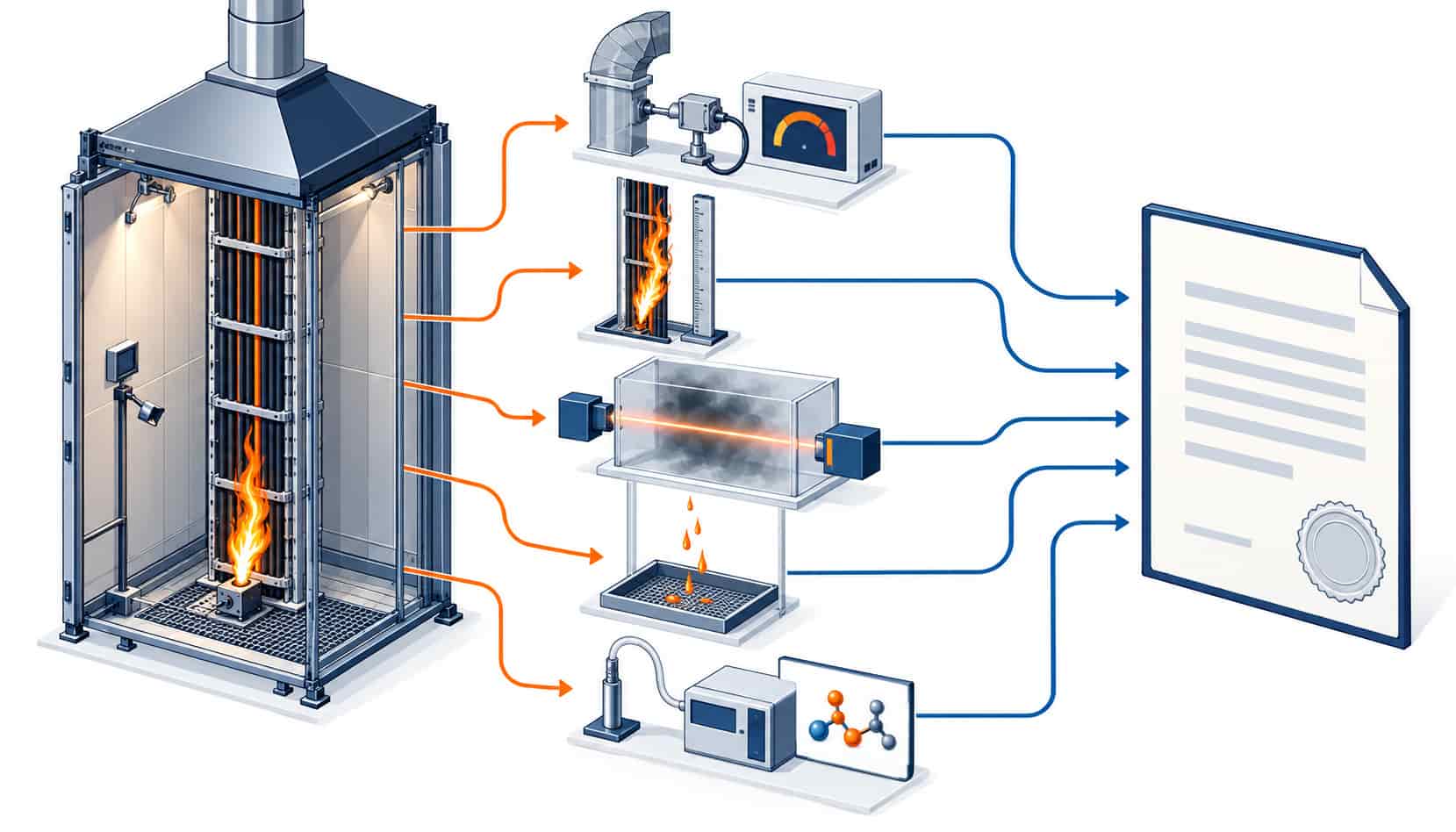
The standard evaluates a bundle of cable burned under controlled conditions, and grades four families of behavior. Heat release — how much energy the burning cable pumps into the room, measured by calorimetry, because heat drives flashover. Flame spread — how far flame climbs the vertical bundle, because spread turns one tray into a fire highway. Smoke production — total smoke emitted as the burn progresses, because smoke kills more occupants than flame. And the supplementary behaviors: burning droplets (d), which carry fire downward, and toxicity of the combustion gases (t), which decides whether the escape path stays survivable. The class compresses all of this into one letter grade plus three suffixes — a sentence of measured fire behavior, not a marketing adjective.
| Class | What It Certifies | Supplementary Suffixes | Typical Requirement |
|---|---|---|---|
| B1 | Highest graded class: strictest limits on heat release, flame spread and smoke | s1âs3 smoke, d0âd2 droplets, t0ât2 toxicity | Occupied public buildings, high-value facilities, code-designated routes |
| B2 | Intermediate graded class: moderate limits on the same battery | Same suffix system | General occupied buildings per fire design |
| B3 | Baseline graded class: the minimum classification the standard issues | Same suffix system | Low-occupancy or utility spaces |
The Suffix System: Reading B1(s1, d0, t1)
The letter grade is only the first half of the sentence. The smoke suffix s1/s2/s3 grades smoke production from the strictest s1 down; the droplet suffix d0/d1/d2 grades whether burning droplets fall — d0 meaning none, the strictest; the toxicity suffix t0/t1/t2 grades combustion-gas toxicity from the strictest t0. A full designation reads like B1(s1, d0, t1), and fire designers write exactly that into schedules. The buyer’s discipline follows: when a quotation offers “B1 cable” without the suffixes, the offer is underspecified — the three behaviors the suffixes grade are precisely the ones occupants experience, and a B1 with poor smoke and toxicity grades is a different fire safety story than a B1(s1, d0, t0). Demand the complete designation and the test report behind it.
How B1 Differs from a Flame-Retardant Claim
Flame retardancy — the ZR family and its IEC 60332 analog — asks one question: does flame spread? GB 31247 asks that question plus three more, measured simultaneously, and issues a graded answer. A ZA cable can pass the harshest spread test and still produce heavy smoke and toxic gas; a B1(s1, t0) cable has been measured and limited on all of it. This is why the graded system is displacing the adjective system in Chinese fire design: the graded class is comparable across manufacturers because the test rig removes the sales language. The relationship between the older vocabulary and the graded one is exactly the bridge the WDZB designation builds — the WDZ prefix family carries the halogen-free, low-smoke story, and the B grade pins the measured performance on top; the contrast with the adjective-only approach is mapped in our LSZH and flame-retardant comparison.
| Behavior | Strictest | Middle | Baseline |
|---|---|---|---|
| Smoke production | s1 â lowest total smoke | s2 â moderate | s3 â graded compliance |
| Burning droplets | d0 â no flaming droplets | d1 â droplets, short persistence | d2 â droplets permitted |
| Gas toxicity | t0 â lowest toxicity index | t1 â moderate | t2 â graded compliance |
The Evidence Chain: Reports, Marks and Batch Discipline
A burning-behavior class is only as real as its paper, and the paper has levels. Type testing: a national-accredited laboratory burns representative samples and issues the class certificate — this is the foundation, and the certificate should name the tested construction. Batch reality: the class belongs to the construction as tested, so the factory must keep compound formulations, dimensions and processes under control for every drum to share the tested behavior; responsible manufacturers tie batch records to the type certificate. Destination enforcement: Chinese fire acceptance checks the class against the design document, and export buyers should expect the same rigor where EN 50575-style regimes apply — GB 31247’s B1/B2/B3 ladder maps conceptually onto the European Euroclass system, though the tests differ and classes are not interchangeable across systems. The general discipline of demanding paperwork with the claim is the one in our power cable certifications checklist, and the certification landscape it sits in is the one in our China electrical equipment certification guide.
Where B1 Is Required — and What It Costs
Chinese fire design assigns the graded classes where occupancy and value concentrate: public assembly buildings, hospitals, schools, transit systems, high-rise cores and — increasingly relevant to this series — data halls, where the cable mass per room is enormous and the smoke question is existential; the power-dense halls behind this shift are covered in our data center power guide. The cost logic follows the test difficulty: graded compounds and the type-testing investment price B1 constructions above adjective-only equivalents, which is precisely why the schedule should not demand B1 where the code does not — but also why substituting “equivalent” ungraded cable into a B1 route is a fire-code violation, not a value-engineering win. The standards landscape across IEC, GB and BS that this class sits in is mapped in our MV and LV standards guide.
When the Graded Class Is Not the Answer
A burning-behavior grade does not size a conductor, protect a route, or keep a circuit alive — it describes how the cable burns, nothing more. Fire pumps and alarm circuits need circuit integrity, a different property family; the graded class does not replace it. Buried and outdoor routes have no fire-behavior audience at all, and paying B1 prices there buys nothing. And the class is a claim about tested constructions: field-altered terminations, wrong accessories and unapproved repairs void the relevance of the certificate without ever contradicting it. The grade earns its price exactly where the code and the occupancy demand measured fire behavior — and nowhere else.
RFQ Checklist: Ordering Graded Cable
Make the class quotable, so include:
- Complete designation with suffixes: e.g. B1(s1, d0, t1), not “B1 cable”
- Type-test certificate from an accredited laboratory, naming the tested construction
- Batch traceability tying delivered drums to the type-tested formulation
- Base designation complete: insulation, sheath, voltage class, armor
- Fire-design document clause requiring the class, cited in the schedule
- Equivalent-class confirmation rules if substitution is ever proposed
- Installation constraints: accessories and termination methods that preserve the rating
- Batch test reports and copper certificates keyed to drum IDs
- Destination-market treatment of the class stated up front
Conclusion
GB 31247 turns fire behavior from adjective into arithmetic: heat, spread, smoke, droplets and toxicity, measured on one rig and compressed into a class and three suffixes. Read the full sentence — B1(s1, d0, t1) — demand the report that names the tested construction, and the graded class becomes what fire design intends it to be: a number you can hold to evidence.
Kexingyu Cable Group (KXYE) supplies the graded burning-behavior family with accredited type-test certificates, batch traceability to the tested construction, and export-ready documentation — so the class on the schedule arrives with the measurement behind it.