
Flame Retardant Categories ZA, ZB, ZC: Matching Cable to Risk Level
Quick Answer: ZA, ZB and ZC grade flame retardancy by the bundled cable load in the test — the correct grade is set by how much cable shares the tray. Flame retardancy sounds like a yes-or-no property, and buying it that way is the most common fire-safety mistake in cable schedules. The letters ZA, ZB and ZC actually describe a ladder of test severities, and standing on the wrong rung is invisible at the quotation and decisive in the fire. Which grade you owe is set by the tray — how much cable hangs together, side by side, feeding the flame. This guide reads the ladder and matches it to real installations.
Introduction
A single cable in free air is a modest fire load; a hundred cables banded on one tray are a fuel bundle that can carry flame like a wick. That’s why flame-retardant testing bundles the samples. The international IEC 60332-3 family, and the Chinese grading it inspired, test cables mounted together, with the amount of combustible material per meter of tray defining the test category. The ZA/ZB/ZC letters in Chinese designations — the ladder behind the ZR prefix — are the language of that test. Matching the letter to the installation density is a specification skill that costs nothing at order time and decides everything at fire time.
What the Grades Actually Test
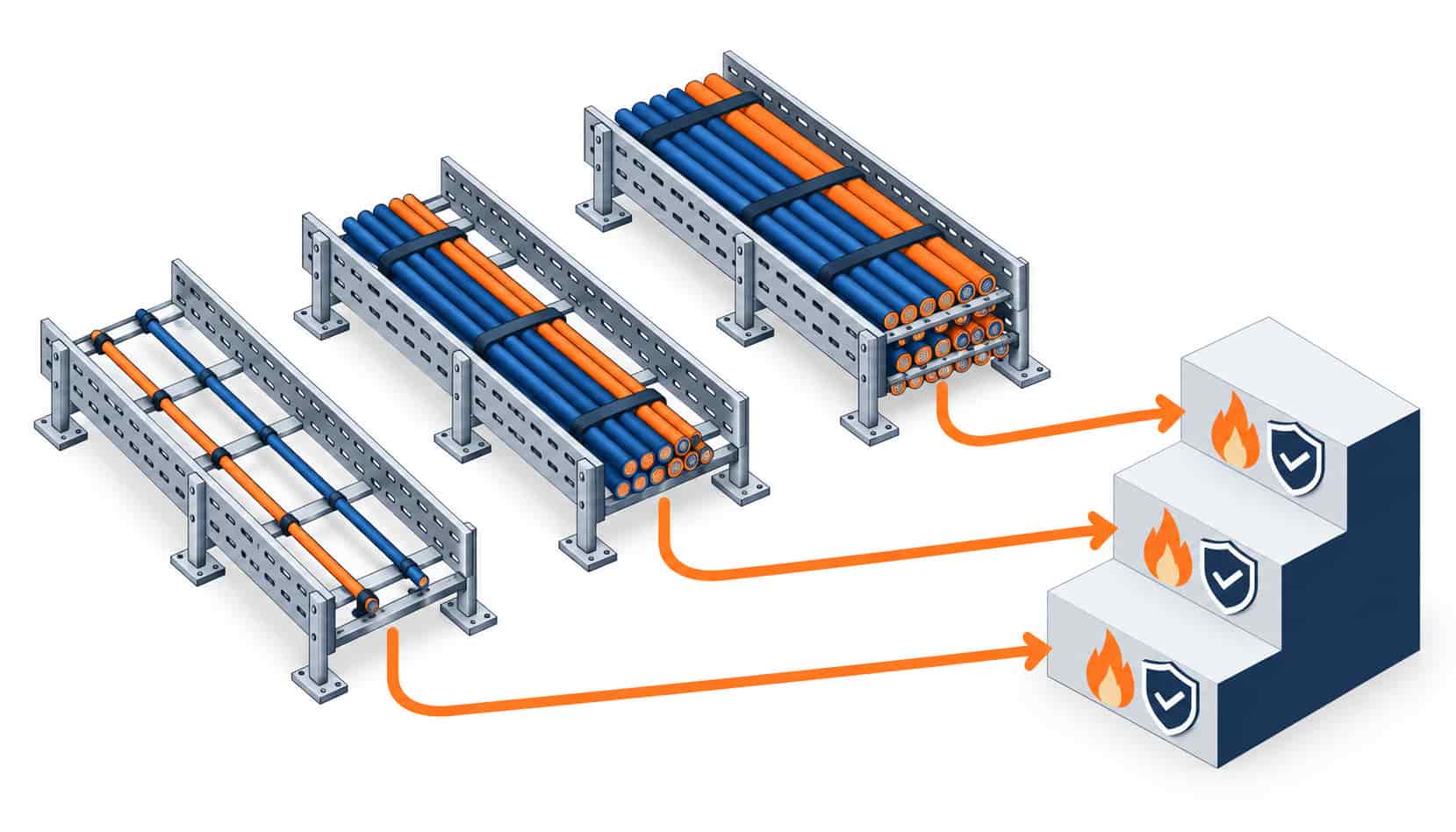
The bundled flame-spread test mounts the cable on a vertical ladder, applies a standardized flame at the bottom for a fixed time, and measures how far flame spreads upward after the burner stops. The pass condition is self-extinguishing below a stated height. The categories differ in one dominant variable: the volume of combustible cable material per meter of ladder. ZA (category A) demands the test with the heaviest installed bundle — the largest volume of cable per meter, the harshest fire the tray could realistically present. ZB (category B) halves that bundle density; ZC (category C) halves it again. So a cable that passes ZA has survived a fire fed by far more neighboring cable than one that passed only ZC. Since real trays present real densities, the grade has to describe the installation, not just the cable.
| Grade | Test Bundle | Severity | Typical Installation |
|---|---|---|---|
| ZA | Highest combustible volume per meter (largest bundle) | Harshest | Dense cable fields: data halls, main risers, trunk trays |
| ZB | Moderate bundle volume | Intermediate | General distribution trays, multi-circuit risers |
| ZC | Smallest bundle volume | Mildest | Small trays, low-density runs, isolated circuits |
The Density Logic: Grade Follows the Tray
The matching rule is mechanical: estimate the combustible volume of cable per meter of the worst tray or riser section, and buy the grade whose test bundle covers it. A data hall’s main cable field — hundreds of cables banded together on deep trays — presents category-A densities, so anything less than ZA is a grade the installation will outgrow the day it fills; the power-dense halls behind this profile are covered in our data center power guide. A commercial floor’s distribution tray with a dozen circuits sits comfortably at ZB. A short inter-panel run or a control cable on an isolated tray is legitimate ZC territory. The error directions aren’t equal. Overspecifying costs a modest premium. Underspecifying installs a tray whose fire test never matched its real fuel load — and the fire doesn’t read the schedule. The fire-behavior story beyond spread — smoke and halogen — is a separate axis, compared in our LSZH and flame-retardant guide.
Where the Letters Sit in the Part Number
In Chinese designations the grade rides the flame-retardant prefix: ZA-YJV, ZB-YJV, ZC-YJV, and in the halogen-free family the equivalent grading appears in the WDZ system’s own ladder. A bare “ZR” without a grade letter is schedule shorthand that needs resolving — quotations that read only “ZR” should be pinned to ZA, ZB or ZC before ordering, because the three are different cables at different prices. The same discipline applies to the armored and sheath letters around the prefix. The fire grade combines with, not replaces, the rest of the designation; the full reading system is covered in the designation decoders of this series, and the graded burning-behavior classes that sit above this spread-only ladder are the subject of the GB 31247 guide.
| Installation | Sensible Grade | Reasoning |
|---|---|---|
| Data hall main cable fields | ZA | Hundreds of cables share deep trays â category-A fuel density |
| Main building risers | ZA or ZB | Vertical bundles feed flame; density decides the rung |
| Floor distribution trays | ZB | Multi-circuit but moderate density |
| Panel-to-panel runs | ZC | Few cables, short routes, low fuel load |
| Isolated control circuits | ZC | Legitimate minimum where trays are sparse |
| Code-specified routes | Per fire design document | The designer's grade clause overrides these defaults |
Cost Logic and Substitution Discipline
The grade ladder prices by test difficulty: ZA constructions carry the most flame-retardant compound engineering and the harshest type test, ZC the least. That pricing makes the ladder a temptation to value engineers, and the substitution deserves its own discipline. Substituting one grade down converts an audited fire property into an unaudited one, and it survives quotation review precisely because the cables look identical. The defensible substitutions are upward — ZB for a specified ZA costs a little more and loses nothing — and density-verified: if the installed tray genuinely ended up lighter than the design assumed, a grade reduction with the fire designer’s signature is engineering, not value engineering. The paperwork discipline behind every fire claim is the one in our power cable certifications checklist, and the mechanical failure modes that no flame grade addresses are the routine entries in our cable failure causes guide.
Export Mapping: The IEC Bridge
The Chinese ZA/ZB/ZC ladder corresponds conceptually to the IEC 60332-3 categories A, B and C — same bundle-density logic, same ladder. So the translation into international specifications is direct: “flame spread, category A (7 L/m), per IEC 60332-3” for a ZA construction, with the analogous B and C statements. State the category in the RFQ, attach the type-test report, and the grade crosses borders as evidence. The full standards landscape this sits in is mapped in our IEC, GB and BS standards guide. Where the destination regime is smoke-driven rather than spread-driven, the LSZH conversation takes over from the spread ladder entirely.
When the Grade Ladder Is Not the Answer
Flame spread is one fire question of several, and a ZA letter doesn’t answer the others: it says nothing about smoke density, gas toxicity, heat release or circuit integrity. The graded burning-behavior system exists for the combined question, and fire-pump circuits need integrity constructions rather than spread grades. Nor does the grade apply where no bundle exists — a cable in free air, a short appliance connection, an outdoor run on an isolated support. The spread test models a tray, and paying grade premiums where the model doesn’t apply is spending without a property. Match the ladder to the tray; use the other fire vocabularies for the other questions.
RFQ Checklist: Ordering by Flame-Retardant Grade
Make the grade quotable, so include:
- Grade letter explicit: ZA, ZB or ZC — never a bare “ZR”
- Equivalent IEC 60332-3 category stated for cross-border clarity
- Tray density described: cables per tray section, worst-case section identified
- Fire design document clause cited where the grade is code-driven
- Base designation complete: insulation, sheath, voltage, armor around the prefix
- Type-test report required naming the tested grade
- Substitution rules: upward allowed, downward only with fire designer sign-off
- Batch test reports keyed to drum IDs
- Smoke and halogen requirements stated separately where relevant
- Destination-market certification needs stated up front
Conclusion
ZA, ZB and ZC aren’t quality levels but fuel-load matches: the grade certifies that the cable self-extinguishes in a bundle as heavy as the tray it will live on. Read the tray, pin the letter, demand the report — and the cheapest fire-safety variable in the schedule does exactly the job the fire designer assumed it would.
Kexingyu Cable Group (KXYE) manufactures the full ZA/ZB/ZC ladder with accredited type tests per grade and batch documentation, so the letter on the schedule describes a fire test that matches the installation — verified and export-ready.
Recent Posts

Power Cable Warranty Terms: What to Demand and What to Watch For
Power Cable Warranty Terms: What to Demand and What to Watch For Quick Answer: A usable warranty names its scope, duration, evidence standard, exclusions and
The Cable Sample Approval Process: What to Test Before Mass Production
The Cable Sample Approval Process: What to Test Before Mass Production Quick Answer: Sample approval tests the supplier’s claims while changes are still cheap —
Cable Drum Packaging for Export: Specs, Marking and Transit Protection
Cable Drum Packaging for Export: Specs, Marking and Transit Protection Quick Answer: Export packaging is a technical specification: drum size for weight and bend radius,