
IEC 60502 Explained: The Standard Behind LV and MV Power Cables
Quick Answer: IEC 60502 is the two-part standard for extruded-insulation power cables — Part 1 for LV, Part 2 for MV — fixing the construction and tests most schedules quietly assume. Ask a cable factory which standard governs a medium-voltage feeder and the answer, across most of the world, is a single number: 60502. The standard sits underneath millions of meters of installed cable — in industrial plants, urban distribution, renewable projects and building mains — yet many buyers cite it without knowing what it actually fixes and what it leaves to other documents. Reading it properly changes how you write specifications and how you read test reports, because it tells you which properties are guaranteed by geometry, which are proven by routine tests, and which need your own extra demand. This guide reads it the way a specifier should.
Introduction
IEC 60502 exists because power cables from one to thirty kilovolts share a common architecture — conductor, insulation, screen where needed, sheath — and a common set of failure questions. Does the insulation withstand the voltage? Does the construction survive installation? Does the sheath keep the environment out? The standard answers those questions with dimension tables, test sequences and rated-voltage definitions, published in two parts that split the range. Chinese GB standards for the same cable families are built on the same skeleton, which is why a cable factory can usually serve IEC-shaped schedules and GB-shaped ones from the same lines. For the international buyer, 60502 is the common language that makes a quote from one factory comparable with a quote from another — a role it shares with the wider IEC, GB and BS landscape mapped in our MV and LV standards guide.
Parts 1 and 2: The Voltage Split
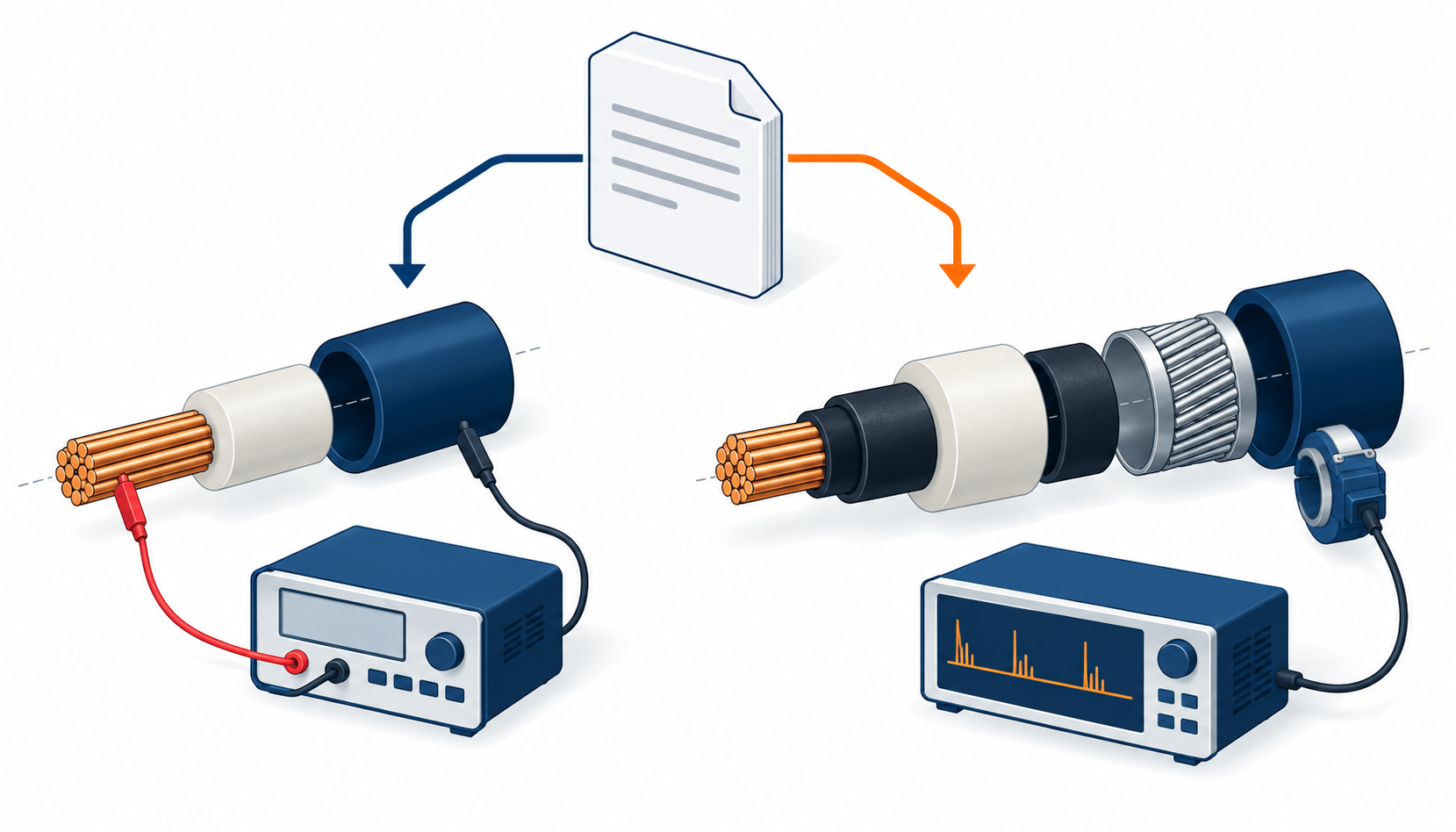
IEC 60502-1 covers cables rated 0.6/1 kV — the workhorse LV range that feeds panels, motors and distribution boards. IEC 60502-2 covers 3.6/6 kV up to 18/30 kV — the MV range for incoming feeders, transformer links and primary distribution. The split isn’t arbitrary. Above LV, cables acquire metallic screens to control the electric field, insulation thickness grows substantially, and the test regime adds partial-discharge measurement and impulse tests that LV cables never see. The two parts share philosophy but not text, so a schedule should cite the part explicitly: “IEC 60502-1” for the LV distribution scope and “IEC 60502-2” for the MV feeders, with the rated voltage named beside it. A citation that reads only “IEC 60502” leaves the factory guessing which test regime you expect the evidence for.
| Aspect | Part 1 (LV) | Part 2 (MV) |
|---|---|---|
| Voltage range | 0.6/1 kV | 3.6/6 kV to 18/30 kV |
| Typical insulation | PVC or XLPE | XLPE (EPR permitted) |
| Metallic screen | Not required | Required â field control |
| Routine tests | Conductor resistance, voltage test | Plus partial discharge, tan delta |
| Type tests | Electrical, non-electrical set | Plus impulse, heating cycle, PD stability |
| Typical duty | Panels, motors, distribution | Incoming feeders, transformer links |
Reading U0/U: What the Two Numbers Mean
The voltage rating on a 60502 cable is written U0/U — for example 0.6/1 kV or 8.7/15 kV — and the two numbers answer different questions. U0 is the rated voltage between each conductor and earth; U is the rated voltage between conductors. The system’s earthing regime determines which number binds. In an earthed system the U0 value must cover phase-to-earth voltage, while in an isolated or resonant-earthed system a single earth fault leaves the healthy phases sitting at line voltage, so U0 must cover phase-to-phase voltage instead. That’s why the same 15 kV class can appear as 8.7/15 kV for earthed systems and 12/20 or even 26/35 kV constructions elsewhere. Choosing the wrong U0 for the earthing regime is a classic specification error — the cable passes every test and still runs over-stressed. The full arithmetic of the two-number system, with the common classes and where each applies, is worked through in the voltage-rating explainer linked from our cable size selection guide.
What the Standard Actually Fixes
IEC 60502 is a construction-and-test standard, and its fixed points are concrete. Conductor requirements reference IEC 60228 — the class system that decides whether the cores are solid, stranded or flexible. Insulation compounds and their minimum thicknesses are tabulated per voltage class, with XLPE the dominant modern choice and its material behavior profiled in our XLPE insulation primer. Non-draining requirements, sheath compounds and thicknesses, armor dimensions where specified — all dimensioned. The test regime then layers three cycles: routine tests on every length (conductor resistance, voltage withstand), sample tests on batches (dimensional checks, more), and type tests that qualify the design itself — the electrical set plus, for MV, impulse withstand and heating-cycle stability. For the buyer this fixes what the factory’s quality system must be able to prove per batch, and what the type-test certificate in the file must actually show. Where PVC versus XLPE insulation choices sit inside those tables, the material-level comparison is in our XLPE versus PVC guide.
What the Standard Does Not Fix
Just as important is what 60502 leaves out, because schedules that assume otherwise over-specify or under-protect. Fire behavior — flame spread, smoke, halogen content — belongs to other standards; a 60502 cable is fire-tested only where the schedule adds a fire-performance designation on top. Ampacity isn’t in the standard either: current ratings come from the separate IEC 60287 calculation framework, adjusted for installation conditions. Accessories — joints and terminations — are outside its scope entirely, and the accessory selection discipline is its own checklist in our cable accessories guide. And the installation rules that determine whether the cable’s ratings survive contact with reality — bending radii, pulling tensions, separation — live in installation standards, not in the cable’s own document. A complete specification cites 60502 for construction and tests, then names the companions for fire, rating and installation.
Using 60502 in International Procurement
In an RFQ, IEC 60502 works best when cited with three anchors: the part number, the rated voltage U0/U, and the governing clauses for anything the project treats as critical — sheath compound, armor type, conductor class. A line like “LV distribution cables per IEC 60502-1, 0.6/1 kV, XLPE insulated, PVC sheathed, Cu/PVC/PVC, conductor class 2” quotes unambiguously anywhere in the world. The type-test reports offered against that line should name 60502 explicitly and show the test laboratory’s accreditation — the certificate evaluation discipline is the one in our power cable certifications checklist. And where the destination market layers its own national mark on top of IEC compliance, the two document chains must both close; the customs-and-certification logic for that layering is the one in our China electrical equipment certification checklist.
| Citation Item | Correct Form | Common Error |
|---|---|---|
| Part number | IEC 60502-1 or 60502-2 explicit | Bare "IEC 60502" leaving the test regime ambiguous |
| Rated voltage | U0/U matched to earthing regime (e.g. 8.7/15 kV) | Class chosen without checking the earthing system |
| Insulation | XLPE or PVC named per the part's table | Thickness assumed beyond the standard's minimums |
| Conductor | IEC 60228 class stated | Flexibility expected from class 2 stranded cores |
| Fire behavior | Cited from its own standard, on top of 60502 | Fire performance assumed inside the citation |
| Ampacity | Calculated per installation conditions | Rating assumed from the standard itself |
When IEC 60502 Is Not the Answer
The standard has edges, and projects that cross them need companion documents rather than stretched citations. Below 1 kV in special flexing duty, flexible-cord and flexible-cable standards govern, not 60502. Above 30 kV, the high-voltage cable standards take over with their own screen, test and accessory worlds. Where the fire design drives the specification — smoke, halogen, circuit integrity — the fire standards lead and 60502 provides the base construction underneath. And where a national standard with its own certification scheme governs the destination market, the IEC citation may satisfy the engineering review while the national mark satisfies the inspector; both chains need planning. None of these cases makes 60502 wrong. It’s simply the foundation layer, and foundations don’t carry the roof alone.
RFQ Checklist: Citing IEC 60502 Correctly
Make the standard citation complete, so include:
- Part number explicit: IEC 60502-1 for LV, 60502-2 for MV
- Rated voltage U0/U matched to the system earthing regime
- Insulation compound named (XLPE or PVC) with the part’s thickness table
- Conductor class per IEC 60228 stated
- Sheath compound and color, armor type and wire size where applicable
- Fire performance designation cited separately where the design requires it
- Routine and sample test evidence required per batch, keyed to drum IDs
- Type-test report required, naming IEC 60502 and an accredited laboratory
- Accessories specified from their own standard with matching voltage class
- Ampacity stated from the rating calculation, not assumed from the standard
Conclusion
IEC 60502 is the quiet foundation of the world’s LV and MV cable fleets: two parts, a voltage-rating grammar that respects earthing regimes, and a test architecture that tells you exactly what evidence to demand per batch and per design. Specifiers who cite it with part, voltage and construction anchors get comparable quotes and verifiable deliveries. Those who cite it as a bare number get whatever the factory’s interpretation produces.
Kexingyu Cable Group (KXYE) manufactures its LV and MV ranges to IEC 60502 with routine, sample and type-test documentation per batch, so the citation in your schedule arrives backed by the evidence the standard promises — tested and export-ready.
Recent Posts

Power Cable Warranty Terms: What to Demand and What to Watch For
Power Cable Warranty Terms: What to Demand and What to Watch For Quick Answer: A usable warranty names its scope, duration, evidence standard, exclusions and
The Cable Sample Approval Process: What to Test Before Mass Production
The Cable Sample Approval Process: What to Test Before Mass Production Quick Answer: Sample approval tests the supplier’s claims while changes are still cheap —
Cable Drum Packaging for Export: Specs, Marking and Transit Protection
Cable Drum Packaging for Export: Specs, Marking and Transit Protection Quick Answer: Export packaging is a technical specification: drum size for weight and bend radius,