What Is a Drag Chain Cable? The Complete Guide for Machine Builders
Quick Answer: A drag chain cable is a motion-rated cable built to bend and glide inside a cable carrier for millions of cycles — its stranding, shields and jacket all differ from ordinary flexible cable.
Every machine that moves has a cable problem. The axis travels, the cable follows, and a hundred times a minute the cable is bent, straightened, pressed against its neighbors and pulled back again. Standard cable treats this as abuse. Drag chain cable is built for it as a design condition — and the difference between the two is worth several thousand euros of downtime a year on any production machine. This guide explains what a drag chain cable actually is, what changes inside it compared with ordinary flexible cable, how to match the cable to the chain and the duty cycle, and the selection checks that separate a cable which lasts five years from one that fails in month nine.
Introduction
The term covers more ground than most buyers expect. A drag chain cable — also called an energy chain cable, e-chain cable or chain cable — is any cable engineered to run inside a cable carrier: the guided plastic or steel chain that feeds power and signals to moving machine parts such as linear axes, gantries, tool changers and telescoping arms. The carrier controls the bend radius and keeps cables from tangling, snagging or rubbing against the frame; the cable’s job is to survive that controlled bending for the life of the machine, not the life of the warranty.
It helps to be precise about what “survive” means. A stationary power cable might be bent once, during installation, and never stressed again. A cable in a dragging application on a woodworking router, running eight hours a day, may complete several million bend cycles a year. Those are different products regardless of what the catalog cover says, and the consequences of confusing them show up in the common causes of cable failure — conductor breakage a few centimeters from the strain relief, shield rupture, jacket cracking at the same point on every cycle. Machine builders who buy on price per meter without naming the duty usually rediscover these failure modes on their customer’s floor, under warranty.
What Makes a Cable a "Drag Chain" Cable
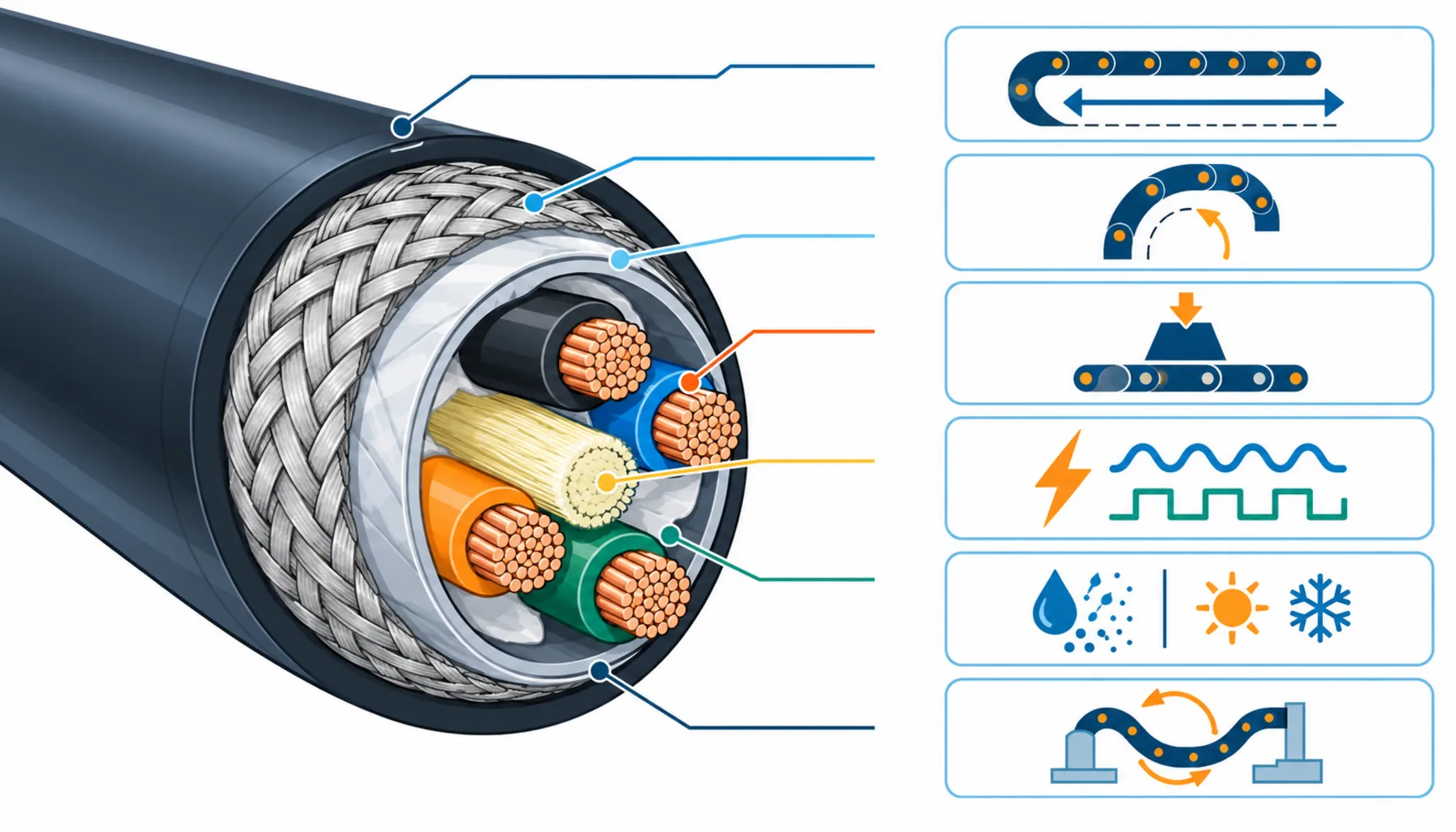
Open up both cables and the difference is immediate, even before you reach for a datasheet. Four construction choices separate a genuine motion cable from a flexible cable with a marketing name:
Finer stranding with a short lay. Ordinary flexible cable uses Class 5 copper; motion cable goes finer — Class 6 or specialized ultra-fine stranding — and closes the lay in short, tightly pitched bundles. Short lay stranding is what lets individual wires slide against each other as the cable bends instead of fatiguing in place. This single choice drives most of the cost difference, and most of the lifespan difference, as covered in the conductor detail of the cable size selection guide.
A pressure-bearing center element. Many drag chain cables carry an aramid braid or a central tension member that carries pulling forces so the copper carries none. In a chain, the cable is constantly pulled by its own weight and accelerated at each end of travel; without a strain-relief core, that load lands on the conductors.
Shield and core layout designed for movement. Cores are cabled with short, approved lay lengths, sometimes around a central element, and shields are optically monitored braids rather than fragile foils. Foil shields crack after a few thousand cycles; a braid built for motion rides the bend and keeps its coverage. The single-point grounding discipline that makes these shields effective on a running machine is the same one described for control circuits in control versus instrumentation cable.
A jacket compound chosen for the motion, not the shelf. PVC works in gentle, low-speed chains. PUR dominates real production equipment because it resists oil, coolant and abrasion while staying flexible — the compound comparison in XLPE versus PVC explains why sheath chemistry matters more as duty increases. TPE and low-friction compounds cover the rest of the map.
None of these features is visible from the outside, which is exactly why the datasheet matters and why a catalog page that only says “highly flexible” without stating stranding class, bend radius and cycle count is telling you what it omits.
The Cable Families You Will Put in a Chain
A working chain usually carries several cable families side by side, each with its own motion requirements, and it pays to specify them separately even when one supplier wins them all.
| Family | Job in the Chain | What Breaks First in Cheap Versions |
|---|---|---|
| Power and drive cable | Feeds motors and drives — the axis muscle, often paired with the drives compared in the VFD vs soft starter guide | Conductor fatigue near the strain relief; insulation from continuous flexing at speed |
| Servo and feedback cable | Carries encoder and resolver signals that close the motion loop | Shield rupture — the first thing to bleed noise into a position signal |
| Control cable | Discrete I/O, sensors, safety loops along the axis | Jacket cracking at the chain's fixed-end transitions; core breakage at glands |
| Industrial Ethernet and data cable | PROFINET, EtherCAT and similar real-time buses riding the same chain | Impedance changes from crushed or kinked pairs; foil shields that crack early |
| Hybrid power-data cable | One construction carrying motor power and feedback together | Uneven wear — the data pair fails while the power cores still look fine |
Sizing: Chain First, Cable Second
Two numbers decide most drag chain cable outcomes before brand or price enter the conversation. The first is the minimum bend radius. Every motion cable states one, calculated from cable diameter, and the chain’s inner radius must respect it with margin — a cable rated for 7.5× diameter does not belong in a chain whose inner radius works out to 6×. High-speed, high-cycle axes push the requirement further: as travel speed rises, the safe radius grows because the cable has less time to distribute stress around each bend.
The second number is the fill ratio. Chains have a recommended maximum fill — typically kept well under half the chain’s cross-section — and the spacing rules inside the chain matter as much as the total: cables need clearance so they do not rub each other, heavier power cables are positioned with lighter data cables separated or screened, and internal dividers exist for a reason. A chain packed to the gills works on installation day and cooks its cables for the next two years. Weight matters here too: a cable too heavy for the chain’s upper run sags, and sag translates into uncontrolled bend radius at the ends of travel.
Travel length, speed and acceleration round out the sizing set. Long travels at high acceleration stress the cable differently than short strokes — and they change which end fittings and strain reliefs will hold. Get these numbers into the RFQ; a supplier who knows travel and duty can propose a construction that fits, while a supplier who only knows “2 meters of travel” will quote the cable they want to sell.
Environment Beats Catalog
The chain handles the bending; everything else lands on the cable jacket. Inside a machine tool, the enemies are chips and coolant — cutting oil that swells the wrong compound, abrasive swarf that sands a soft jacket thin. In food and packaging equipment, washdown chemistry and steam attack both jacket and gland. On wood or stone routers, dust works into every clearance. Cold logistics buildings change the picture again, because a compound rated for bending at +20°C can stiffen badly at −25°C and crack at the first morning start-up. None of this is exotic; it is just the actual environment, stated honestly in the specification instead of left for the jacket to discover.
Electromagnetic environment belongs in the same paragraph. A chain that carries a servo drive power cable next to an encoder cable is a noise system, and the fix is construction discipline — braided shields, separation, correct grounding — rather than hope. Buyers who skip this section usually meet it later as intermittent faults that no one can reproduce on the bench, the most expensive class of warranty call a machine builder can sign up for.
Why Drag Chain Cables Fail Early
When a motion cable dies young, the autopsy almost always finds one of a short list of causes: installation-time damage nobody recorded, a bend radius violated at the chain entry, strain relief clamped too hard or too loose, a jacket compound mismatched to the coolant, or the cheapest failure of all — a standard flexible cable installed where a motion cable was specified. Each of these is preventable at specification time, which is why the failure taxonomy in common causes of cable failure reads like a checklist for this article. The pattern worth remembering: cables rarely fail in the middle of the chain. They fail where motion meets constraint — at the moving end, at the gland, at the first bend.
When a Drag Chain Cable Is Not the Answer
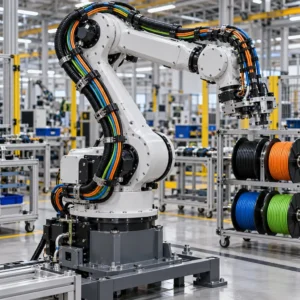
Honesty about scope keeps this guide useful. Three motion situations want a different product, and specifying a chain cable into them is a slow-motion failure. First, continuous rotation: a rotary table or robot joint that twists the cable around its own axis puts torsion loads on the conductor lay that no chain-rated cable is built to absorb — that is a torsion cable’s job. Second, cables that loop freely without a carrier on short, fast axes sometimes do better with continuous-flex constructions designed to hold their own natural bend. Third, cable-on-spool applications such as cranes and hoists add winding and multi-axis bending that call for reel-duty designs. And when the whole question is protecting cables on a moving robot arm rather than feeding a linear axis, the dress pack approach is the one to study. The chain is a tool for guided, back-and-forth travel. Outside that envelope, change the cable concept, not the brand.
| Check | What to Pin Down | Why It Decides the Outcome |
|---|---|---|
| Travel and speed | Stroke length, velocity, acceleration, cycles per hour | Sets the duty class and whether the construction is even suitable |
| Chain geometry | Inner bend radius, available width, fill limits, dividers | A cable that violates radius or fill fails on schedule, not by luck |
| Electrical load | Current, voltage, voltage drop at full travel, drive type | Undersized conductors heat up; heating accelerates every other failure |
| Signals in the chain | Encoder, Ethernet, sensor cables and their separation needs | Noise problems are specified in this line, or debugged later |
| Environment | Coolant, oil, chips, washdown, temperature range, UV | Chooses the jacket compound more decisively than price does |
| Proof and spares | Flex test report, batch traceability, spare drum policy | Turns a promise of 5 million cycles into evidence you can hold |
RFQ Checklist: What to Send the Cable Supplier
Put the machine’s questions in writing before the quotes come back:
- Travel length, speed, acceleration and duty cycles per hour, honestly stated
- Chain inner radius, cross-section and fill plan with divider layout
- Family list: power, servo, control, data — with separation requirements
- Environment: coolant type, chips, washdown, temperature range at the chain
- Required flex life with the test method that will verify it
- Strain relief and gland hardware included in the scope, not assumed
- Flex test reports and batch traceability demanded as a delivery item
Conclusion
A drag chain cable is not a flexible cable with a better mood; it is a different engineering object — fine short-lay stranding, a strain-carrying core, motion-grade shields and a jacket chosen for the machine’s actual chemistry. Match it to the chain geometry and the duty cycle, keep the environment honest in the specification, and it will outlast the machine’s first overhaul. Skip those steps and no brand name will save the jacket.
Kexingyu Cable Group (KXYE) supplies cable solutions for moving machinery and supports buyers with the specification discipline this guide describes — construction transparency, batch traceability and honest duty ratings. For motion applications beyond guided chains, our engineers will tell you which product class fits and which one does not; start at the RFQ page with your travel, speed and environment data.