Hybrid Power-Data Cables: One Cable for Power, Signal and Ethernet
Quick Answer: A hybrid cable carries motor power, control signals and Ethernet inside one jacket — saving chain space and installation time when engineered well, and becoming a single point of failure when specified casually.
Every motion system faces the same wiring arithmetic: the servo needs power, the encoder needs a shielded feedback line, and increasingly the axis needs an Ethernet connection — and all three have to travel the same chain, the same robot dress pack, or the same telescoping column. The traditional answer is three cables and the routing headaches that come with them. The hybrid answer is one cable with everything inside: power cores, shielded pairs, sometimes an Ethernet element, all sharing a jacket and a single set of glands, connectors and chain real estate. Hybrid constructions have moved from niche to mainstream because that arithmetic is compelling — less chain fill, one connector at the motor, one pull during installation. But a hybrid cable is also a compromise, and the compromise has rules. This guide covers how hybrid power-data cables are built, where they win, where they quietly cost more than separate cables, and the specification discipline that keeps one cable doing three jobs for the life of the machine.
Introduction
The driver behind hybrid cable is motion system economics, and it is easy to see why the approach spread. In a cable chain, three separate cables occupy three times the cross-section, rub three sets of jackets against dividers, and terminate in three sets of connectors at each end. In a robot dress pack, three cables mean three sets of flex fatigue points at the wrist. A well-engineered hybrid construction shares the center space, wraps each signal family in its own shield, and terminates once — and the machine builder counts the savings in chain fill, assembly hours and spare-part variety. Servo motor manufacturers pushed the format hardest: hybrid motor-feedback cables that carry drive power and encoder signals in one construction are now standard offerings across the major drive platforms, and industrial Ethernet variants extend the idea to the network side.
The engineering truth behind the convenience is that combining functions in one jacket multiplies the ways the cable can be specified wrong. A power core that heats up now sits against a signal pair that did not sign up for the temperature. A shield that fails takes down functions that separate cables would have isolated. The failure patterns of common cable failure still apply — hybrid cables just fail with better company.
Inside a Hybrid Cable: How the Jobs Are Separated
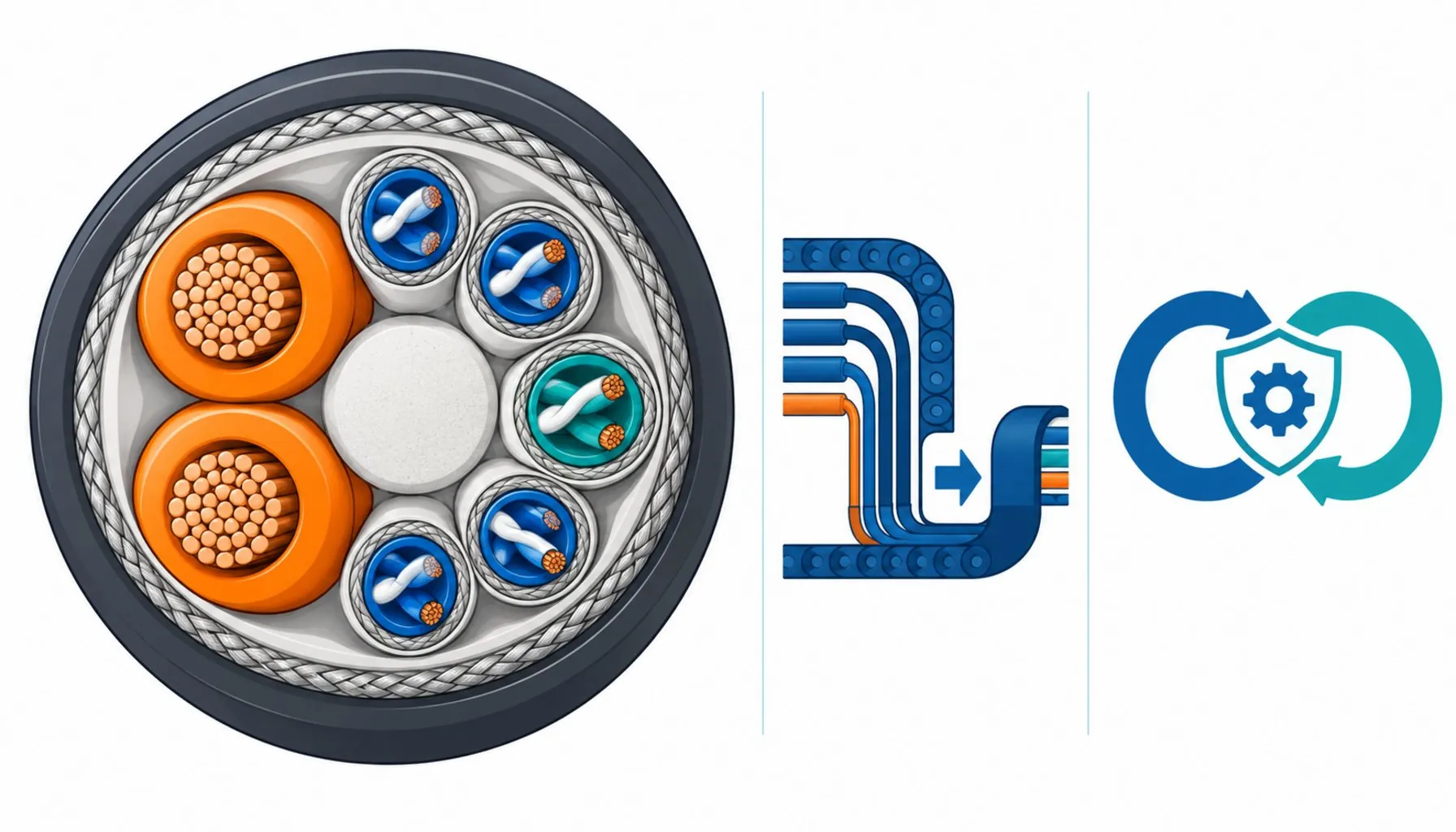
A hybrid construction is several cables wearing one jacket, and the quality of the design shows in how well each element is protected from its neighbors.
| Element | What It Carries | Its Non-Negotiable | Design Feature That Provides It |
|---|---|---|---|
| Power cores | Motor drive current with PWM content | Current rating and heat that stays inside its own zone | Sized conductors, insulation rated for the drive's voltage edges |
| Feedback pairs | Encoder and resolver signals that close the motion loop | Individual shielding, isolation from power-core heat and noise | Individually shielded pairs in their own layer, often over a separator |
| Ethernet element | PROFINET, EtherCAT or similar real-time traffic | Controlled impedance geometry that survives flexing | Bonded, flex-rated Ethernet element with its own shield |
| Overall structure | All elements sharing one jacket through millions of cycles | Shared flex life — the weakest element sets the cable's life | Short-lay stranding throughout, strain-carrying core, motion-grade jacket |
Where Hybrid Cable Wins
The table’s last row is the honest catch: a hybrid cable is a chain whose weakest link is inside one jacket. Separate cables let a motor power feed outlive a data cable; a hybrid cable makes them die together. That is acceptable when all elements share the same duty and lifetime — which well-designed servo hybrids do — and a liability when one element is being asked to outperform the others.
Where Separate Cables Still Win
Four situations favor the combined construction, and they cover most of the market’s enthusiasm. First, servo axes with matching hybrid motor cables: when the drive manufacturer offers a hybrid power-feedback cable for the motor, the connector at the motor is designed for it, the element counts match the drive’s requirements, and the construction is engineered for shared duty. This is the format’s home ground. Second, space-constrained chains and dress packs: where chain fill or wrist real estate is the binding constraint, one cable beats three by arithmetic, and the fill savings often lets the whole system drop to a smaller chain. Third, telescoping and column applications — lifters, vertical take-out units — where every cable adds to the fold bundle and the fold housing is the cost driver. Fourth, installation economics on repeated builds: machine builders producing dozens of identical axes gain real money from one pull, one set of glands and one spare-part number.
Specifying a Hybrid Cable Without Regrets
The honest cases against hybrid are as concrete as the cases for it. When the power requirement and the signal requirement have different lives — a high-power axis whose conductors run hot next to a data element rated for lower temperature — combining them couples their fates, and the data element becomes the fuse for a perfectly healthy power feed. When EMC is marginal — long parallel runs, aggressive drives, a noisy environment — the physical separation of separate cables buys isolation that even well-designed hybrids approximate rather than equal; the noise logic follows the same separation discipline as any power-versus-signal decision. When maintenance strategy favors isolation — a plant that wants to replace a failed data cable without powering down the axis — hybrids turn one failure into a full replacement. And when standards or customer specifications require physical segregation of certain circuits, the hybrid is disqualified regardless of its engineering quality. The decision is per-axis engineering, not a catalog allegiance.
When a Hybrid Cable Is Not the Answer
Three disciplines keep a hybrid purchase honest. First, verify each element separately: the power cores’ current rating at the actual duty, the feedback pairs’ shielding against the drive’s noise, the Ethernet element’s flex rating at the actual radius and cycle count — the same per-element scrutiny that separate cables would each receive, applied inside one jacket. Second, verify the whole at motion: flex test data for the combined construction at stated conditions, because element-level ratings do not add up to a system rating. Third, plan the connector reality: hybrid cables live or die at their hybrid connectors, whose availability, locking hardware and termination quality deserve the same attention as the cable — a point that applies to every accessory decision in the cable accessories checklist. Buyers who verify those three lines convert hybrid convenience into hybrid reliability; buyers who accept a single combined datasheet number inherit whatever compromise hides inside it.
| Check | What to Pin Down | Why It Decides the Outcome |
|---|---|---|
| Element inventory | Exact power, feedback and data content required per axis | Hybrid only fits when the elements genuinely match the system |
| Per-element ratings | Current, shielding and impedance specs verified separately | A combined datasheet number hides per-element compromises |
| Motion duty | Flex cycles, radius and speed for the combined construction | The weakest element sets the cable's life — know which one it is |
| EMC plan | Drive noise, run lengths, grounding; hybrid vs separate comparison done | Marginal EMC environments favor physical separation |
| Connector supply | Hybrid connector availability, termination quality, lead times | The connector is the hybrid's single point of assembly truth |
| Maintenance policy | Acceptance of coupled lifetimes; spare strategy per axis type | One failure replaces everything — plan spares accordingly |
RFQ Checklist: What to Send the Cable Supplier
Honesty about scope keeps this guide useful. Hybrid constructions solve the routing arithmetic of motion systems — chains, dress packs, telescoping columns, servo axis connections. They are not the answer when regulation or customer standards require physical segregation of power and data. They are not the answer when element lifetimes diverge badly — a hot power feed and a temperature-sensitive data element in one jacket is a scheduled compromise. They are not the answer in marginal EMC environments where separation is the only defense. And they are not a substitute for correct power sizing: the power cores inside a hybrid follow the same load and drop discipline as any power cable, starting from honest data the way conductor sizing always does. Choose per axis, verify per element, and the hybrid earns its place.
Conclusion
Put the axis’s reality in writing before quotes come back:
- Element inventory: power current and voltage, feedback signals, data protocol and rate
- Motion duty: chain or dress pack geometry, flex cycles per day, radius, speed
- Drive and motor platform: hybrid connector requirements, matching cable standards
- EMC environment: drive switching, run lengths, grounding scheme
- Per-element documentation: current, shielding and impedance data requested separately
- Combined-construction proof: flex test at stated conditions, batch traceability
- Connector and spares plan: hybrid connector sourcing, replacement strategy per axis