Conductor Stranding for Flex Applications: Class 5, Class 6 and Ultra-Fine Copper
Quick Answer: Stranding class decides flex life before any other layer does: Class 5 serves occasional flexing, Class 6 serves chains and robots, and compact ultra-fine builds serve the tightest joints.
Under every flexible jacket and every expensive shield sits the layer that actually decides whether a moving cable survives: the copper. A conductor that flexes a million times is not a solid rod and not a coarse bundle; it is a precisely engineered rope of many fine wires, and the difference between stranding classes is the difference between a cable that retires its machine and a machine that retires its cable. Yet conductor class is the most skimmed line in motion cable specifications, partly because the class system looks dry and partly because the industry talks about jackets far more fluently. This guide makes the copper legible. It explains what the IEC stranding classes actually describe, where Class 5 is enough and where it quietly fails, why Class 6 is the entry ticket for chain and robot duty, what ultra-fine and compacted flex constructions add, and how lay length, the detail nobody quotes, separates real flex cable from relabeled stationary cable.
Introduction
The classification system behind the class names comes from IEC 60228, the international standard for conductor construction, and the full framework of classes and their stationary-world meanings is covered in the earlier guide to the IEC 60228 conductor system. This guide stays on the moving side of that framework: what happens to copper when it bends a million times, and how the number and fineness of the wires decide the outcome. The mechanism is fatigue. Every bend stretches the copper at the outside of the curve and compresses it at the inside, and copper, bent repeatedly, work-hardens, cracks and opens. Coarse strands concentrate that strain in a few thick wires; fine strands in short lay spread it across hundreds of thin ones that slide past each other as the cable flexes. Nothing else in the cable construction, not the jacket, not the shield, not the insulation, can substitute for that geometry, which is why stranding class is the first specification to read and the last to compromise on. The failure it prevents, conductor fatigue at transitions, is the single most common mode in the catalog of cable failure causes.
Class 5: The Flexible Class With Limits
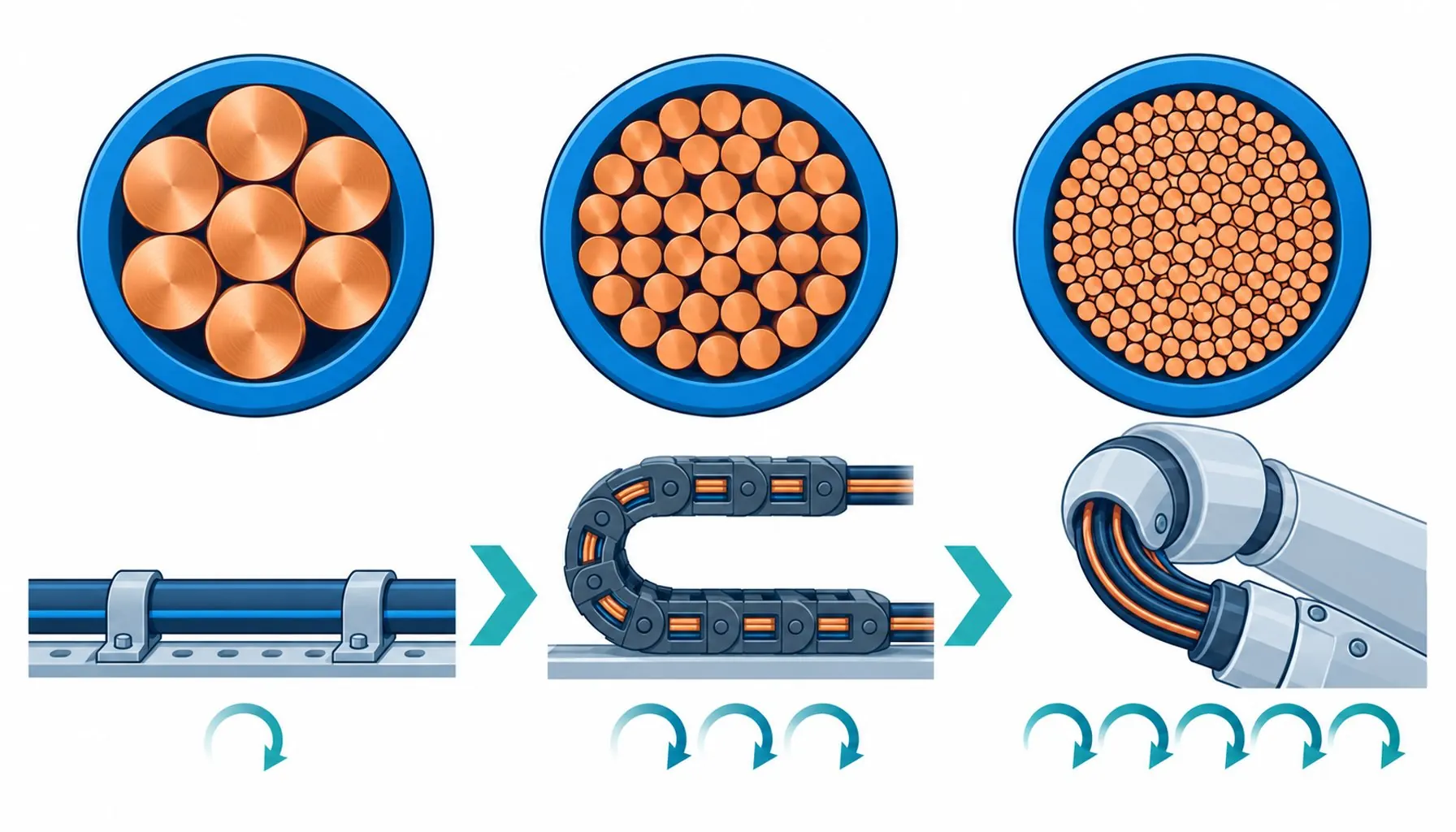
Class 5 is the flexible conductor of the stationary world, and it does honest work there. Its strands are fine enough for good flexibility, easy termination and reasonable flex endurance, which is why it serves portable tools, occasional-motion equipment and cable that moves rarely at generous radii. It is also the economical choice where flexibility matters for handling but fatigue does not: a cable that flexes a few hundred times a day at 150 millimeters can live a long life on Class 5 copper. The trouble starts when Class 5 is sold as motion cable. Its strand count and lay geometry were never designed for continuous cycling at small radii, and in a chain or on a robot axis its conductors work-harden at the tightest point exactly the way coarse copper does, only a little later. Machines running Class 5 cable in genuine chain duty report the classic signature: conductor opens at glands and chain exits at cycle counts that a real flex cable would shrug off. Class 5 in motion is not always wrong, but it is always a decision that needs a duty justification, not a default.
| Construction | Typical Build | Right For | Wrong For |
|---|---|---|---|
| Class 5 | Fine strands, ordinary lay, standard bunching | Occasional flexing, generous radii, portable equipment | Chain cycles, robot axes, small radii |
| Class 6 | Finer strands than Class 5, short lay, flex-bunched | Drag chains, gantries, general motion duty | Sub-40 mm radii, combined torsion |
| Ultra-fine / compacted flex | Very fine wires, short or reversed lay, often rope-layed | Robot wrists, compact joints, high-cycle continuous flex | Benign static runs, where its cost buys nothing |
Class 6: The Entry Ticket for Motion
Class 6 takes the Class 5 idea one step finer and re-engineers the geometry for fatigue rather than for handling. More, thinner wires; shorter lay so the bundle deforms as a unit without stressing individual wires; bunching and stranding operations chosen for sliding rather than stiffness. The result is a conductor whose flex endurance at motion radii exceeds Class 5 by margins that show up directly in machine uptime, which is why every serious chain cable and robot cable specification starts here. Class 6 is also where the lay length question becomes visible to buyers: two Class 6 conductors with different lay lengths are different products, and the short-lay geometry behind flex life is a whole subject of its own, treated separately because it is the detail that separates genuine flex cable from its imitators. Suppliers are sorted the same way any partner is vetted, per the manufacturer verification checklist, before lay geometry ever gets compared. For most machine builders, the practical rule is simple: continuous flex duty means Class 6 as the floor, and anything less needs a written justification tied to duty that is genuinely light.
| Your Duty | Conductor Call | Why |
|---|---|---|
| Moves a few times a day at generous radius | Class 5 | Fatigue budget is huge relative to use |
| Chain, gantry or axis duty with real cycle counts | Class 6, short lay | The fatigue-versus-cycle math demands it |
| Robot wrist, compact joint, radius under ~7.5d | Ultra-fine, tested in geometry | Class 6 alone does not cover the tightest loops |
| Combined torsion duty | Ultra-fine with torsion-balanced lay | Twist redistributes strain; construction must expect it |
| Stationary runs everywhere | Standard classes per IEC 60228 | Paying flex money for no duty is waste |
Ultra-Fine and Compacted: Serving the Tightest Joints
Below Class 6 sits the territory of specialist flex conductors, and the machines that need them are multiplying. Ultra-fine constructions push strand counts far past the Class 6 minimums, often in rope-layed or compacted geometries where sub-bundles are stranded into a conductor the way a rope is laid from yarns. The gains are real: usable flex life at radii that would kill standard Class 6 within weeks, and the small diameters that compact joints demand. The costs are equally real: copper fill and DC resistance shift as fineness increases, which tightens power sizing; termination gets harder, since hundreds of hair-fine wires need the right ferrules and crimp discipline; and cost rises with the strand count. Termination deserves its own warning, because the finest conductor in the world dies at a poor crimp, and the fitting and accessory choices around it, covered in the review of cable accessories, belong in the same specification conversation. And the verification habit stays the same as everywhere else in motion cable: accept flex data at your radius, from cable tested as a system, and read the supporting documents with the discipline of the datasheet guide rather than by the class number on the cover.
When Stranding Class Is Not the Answer
Honest limits: class is necessary but not sufficient, and treating it as the whole specification produces its own failures. A Class 6 conductor in a cable whose lay, insulation and jacket are stationary-grade will not deliver Class 6 flex life, because fatigue is a system outcome. Conversely, an ultra-fine conductor in a benign duty is money spent for nothing, and the overspecification habit hides real differences between suppliers. Class also says nothing about torsion; a rotating duty needs lay geometry designed for twist, whatever the strand count. Read the class as the first filter, then make the cable earn the application with system-level data, which is the same closing discipline every guide in this series lands on.
RFQ Checklist: Specifying Conductor Construction
Make the copper a line item with evidence attached:
- Stranding class stated per circuit, with the duty justification for anything below Class 6
- Lay length and bunching geometry required in the datasheet, not just the class name
- Flex test data at the installed radius, cycle count and failure criterion defined
- DC resistance and copper fill data where power sizing is tight
- Termination plan: ferrule and crimp specification matched to the strand count
- Torsion duty named where rotation exists, with lay geometry designed for it
Conclusion
Stranding class is the quietest big decision in motion cable: invisible inside the jacket, decisive at cycle 400,000. Class 5 handles honest light duty, Class 6 is the floor for real motion, and ultra-fine constructions open the tightest joints that standard classes cannot serve. Specify the copper with the same care as the jacket and the shield, demand lay geometry and flex data rather than class names, and the most common failure in moving cable stops being common.
Kexingyu Cable Group (KXYE) builds motion cable on Class 6 and ultra-fine conductor platforms with lay geometry and flex data published, not implied. Send your duty profile through the RFQ page, and we will match conductor construction to the radii and cycles your machine actually delivers.