Motion Cable Standards Explained: A Map of What Applies Where
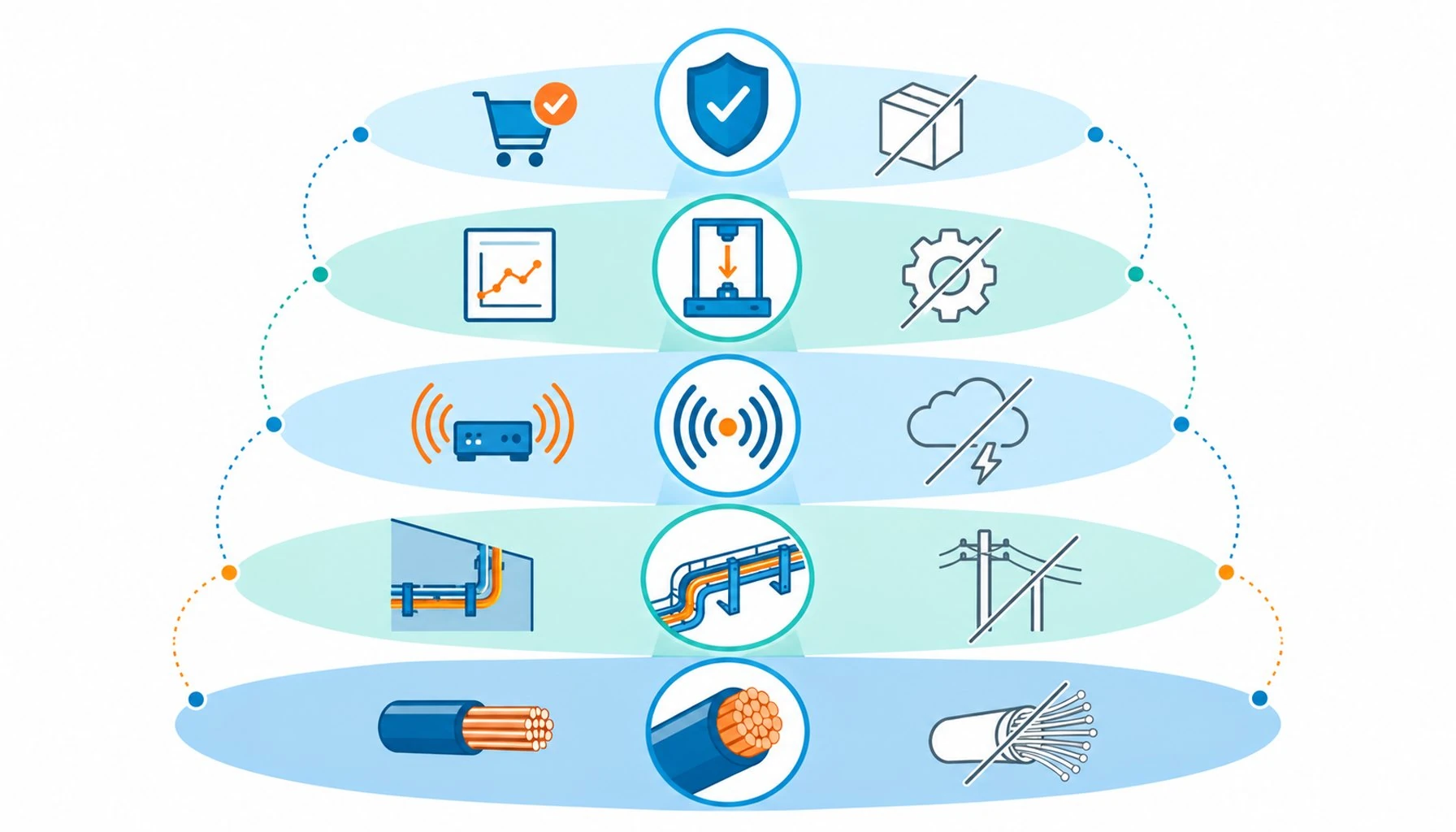
Quick Answer: No single standard covers motion cable; the requirements arrive in layers, conductor classes, machinery wiring rules, EMC behavior and market-access marks, and the buyer’s skill is knowing which layer answers which question.
Ask which standard applies to a robot cable and the honest answer is several, layered. The conductor inside follows one document family, the machine’s wiring follows another, the EMC behavior follows a third, the chain rating on the datasheet follows no public standard at all, and the marks that let the machine cross borders follow several more. Buyers who expect one document to certify a motion cable end up either reassured by marks that answer the wrong question or lost in documents that do not apply. This guide is the map: the layer structure of motion-cable standards, what each layer actually governs, where the gaps are, and how to walk a machine’s duty through the layers to a specification.
Introduction
Standards exist to make claims comparable and compliance checkable, and they do that superbly where their scope reaches. Motion cable lives partly inside their reach and partly outside: the electrical and safety layers are well standardized, while the performance layers that make motion cable special, flex life, chain rating, torsion endurance, are mostly self-declared against in-house test methods. The map below is drawn for the buyer, not the standards engineer, and its organizing question is the buyer’s question: which document answers this concern about this cable on this machine.
The static-cable world’s standards map, from transformers to switchgear, follows the same layered logic and is treated in the guides to the transformer standard and the switchgear standard family; motion cable inherits the electrical layers of that world and adds its own.
Layer One: Conductor and Construction Standards
The conductor is the best-standardized layer. International wiring rules grade stranding into classes, and the classes, from solid through fine to the finest flexible builds, are defined, measurable and comparable across suppliers. A Class 6 conductor from one maker is verifiably the same family as a Class 6 from another, even though the lay geometry within the class remains a maker’s choice, the distinction that separates genuine flex builds and that a ten-minute strip-and-count audit verifies. Voltage ratings, conductor resistance and dimensional standards complete this layer. What it answers: is the copper real, graded and comparable. What it does not: whether the construction survives your chain, which is the layer above.
Layer Two: Machinery Wiring Rules
The machine, not the cable, is the subject of the wiring layer. The machinery wiring standard that governs electrical equipment of industrial machines specifies what cable in a machine must achieve: protection against mechanical damage, conductor sizing, color identification, shield requirements for signal circuits and the bonding architecture. It is the document machine builders live in, and it constrains cable selection from the machine side. Its scope, structure and the practical consequences for wiring practice, from cabinet layout to bonding execution, are treated in the guide to control cabinet construction, which is the companion to this map for anyone building or modifying machines. What this layer answers: what the machine’s cable must do to be compliant wiring. What it does not: which commercial product meets the duty best.
Layer Three: EMC and Interference Behavior
The electromagnetic compatibility layer governs how the machine behaves in its electrical environment, and cable is a central component of that behavior: shields, bonding and separation discipline are the machine’s EMC architecture. The standards here define emission and immunity expectations for equipment, and the cable’s role, as the designed return path and the shielding boundary, operates against the interference environment created by the drives compared in the guide to drives and soft starters. What this layer answers: what the machine must achieve and what the harness must contribute. What it does not: a plug-and-play EMC rating for a cable; EMC is a system property, tested at the system level.
Layer Four: Performance Testing, the Honest Gap
Here the map shows open country. Flex-cycle ratings, chain ratings and torsion endurance are not governed by a single public international standard with universal test geometry; they are declared by makers against in-house or supplier-chain test methods, with the conditions stated or omitted as the maker chooses. The buyer’s protection is not a mark but method: demanding the conditions behind the numbers, radius, speed, temperature, failure criterion, and the test reports behind them, the discipline detailed in the datasheet-reading guide. Some regional and industry-specific test frameworks exist and are useful for comparability, but the honest statement is that performance claims in this market are only as good as their stated conditions. What this layer answers, when a supplier states it fully: how long the cable lives in your duty. Nothing else answers that question.
Layer Five: Market Access and Safety Marks
The marks layer governs what may legally be sold and installed where: the regional safety marks, the harmonized European framework that machinery compliance rides on, the North American listing systems and the national certifications of destination markets. These marks are necessary, checkable and genuinely protective on the safety dimensions they cover, and they are also silent on flex life and chain performance, which is why the layer sits last in this map rather than first. The certification landscape and its checklists for power cable are mapped in the guide to power cable certifications, and the destination-market certification planning for complete machines follows the logic of the equipment certification checklist.
The Map on One Page
The layers, their governing documents and their honest scopes compress into the table below, which is the reference version of this map.
| Layer | Governs | Answers the question | Does not answer |
|---|---|---|---|
| Conductor and construction | Stranding classes, resistance, dimensions | Is the copper graded and comparable | Whether the construction survives your chain |
| Machinery wiring rules | Cable as machine wiring: protection, sizing, identification | What compliant machine wiring requires | Which commercial product fits the duty best |
| EMC framework | Emission and immunity of equipment; harness contribution | What the machine and harness must achieve | A standalone EMC rating for a cable |
| Performance testing | Flex, chain and torsion endurance (self-declared) | How long the cable lives, if conditions are stated | Anything, when the conditions are omitted |
| Market access marks | Legal sale and installation per market | May this cable be sold and installed here | Flex life, chain rating, duty performance |
Walking a Duty Through the Map
The map becomes a tool when a duty walks through it. A robot harness for a European machine: conductor class from layer one, wiring compliance from layer two, shield and bonding architecture from layer three, cycle evidence with stated conditions from layer four, CE-adjacent compliance and destination marks from layer five. A North American machine adds the listing layer with its own wire types. An export machine multiplies the marks layer by destination. The worked examples below show the walk for the cases buyers most often meet.
| Machine case | Layer emphasis | Key documents and evidence | The trap to avoid |
|---|---|---|---|
| Robot harness, European machine | Layers two, four and five | Machinery wiring compliance, cycle evidence with conditions, CE-adjacent marks | Trusting marks while skipping the flex evidence |
| North American machine build | Layers one, two, five | Conductor classes plus listing system wire types | Assuming European constructions transfer directly |
| Export machine, multiple destinations | Layer five multiplied | Destination-by-destination certification plan | Quoting marks for one market into an RFQ for three |
| Chain-heavy motion axis, any market | Layer four first | Stated-condition cycle and endurance reports | Letting compliance layers substitute for performance evidence |
| EMC-sensitive harness near drives | Layer three plus four | Shield architecture, bonding plan, continuity through cycling | Treating EMC as a cable property instead of a system one |
When Standards Knowledge Is Not Enough
Honest limits: standards describe floors, not fitness. A fully compliant cable can still be the wrong cable for the duty, because compliance answers legality and safety, not wear life. Conversely, the most performance-proven construction still needs the marks the destination market requires, and no duty evidence compensates for missing market access. Standards also lag practice: constructions for humanoid-scale robots and extreme compact joints are entering territory the documents do not yet describe, which makes the stated-conditions discipline more important, not less. The map organizes the documents; the machine’s duty and the buyer’s method still make the decision.
RFQ Checklist: Specifying Through the Layers
Attach the map to the RFQ itself:
- Layer one requirement: conductor class with strand data, from the construction sheet
- Layer two statement: the machinery wiring rules the installation follows, and what they demand of the harness
- Layer three plan: EMC expectations and the harness architecture that meets them
- Layer four evidence: cycle and endurance claims with full conditions and reports
- Layer five list: destination markets, so the marks quoted are the marks needed
- Documentation package: which of the above the supplier delivers as standard with each order
Conclusion
Motion cable standards arrive in layers, and the buyer’s skill is knowing which layer answers which question: conductor documents for the copper, machinery wiring rules for the machine’s frame, EMC frameworks for the system behavior, stated-condition test evidence for the life of the cable, and market-access marks for the legal map. No single document certifies a motion cable, and no layer alone should carry the purchase. Walked in order, the layers turn standards from a wall of acronyms into a checklist that ends in the right cable.
Kexingyu Cable Group (KXYE) supplies motion cable with the full documentation stack: conductor construction sheets, machinery-wiring support, EMC architecture guidance, stated-condition test evidence and destination-market certification planning. Send your machine and its markets through the RFQ page, and we will map the requirements before we quote the cable.