Japan's Robot Industry: Cable Demand from the Country That Built It
Quick Answer: Japan invented the industrial robot industry, still runs its largest fleet outside China, and its builders ship machines worldwide, so its cable demand leads by specification.
Every conversation about industrial robots eventually passes through Japan. The country’s manufacturers built the modern robot business, its factories ran the earliest fleets, and its integrators wrote many of the practices the rest of the industry now treats as standard. That history matters for cable, because Japan’s demand is not only large, it is formative: what Japanese machine builders specify at home gets exported inside their machines to every other continent. Understanding how Japan buys motion cable means understanding how a large part of the world will buy it two product cycles later.
Introduction
IFR’s World Robotics 2026, published in September 2026, put global installations at roughly 600,000 units for 2025 and reported that the United States, with 38,500 installations, moved ahead of Japan into second place for the year. Read that carefully rather than rushing past it: the United States had to post a 12 per cent record year to edge past Japan, a country a fraction of its size. Japan’s annual installations sit just below that American figure, and its operational stock remains the largest outside China. Behind those numbers sit the world’s most established robot builders and a supplier base that has grown up around them for half a century.
This article reads that market from the demand side: who buys cable in Japan, what the domestic fleet consumes, and how the machine export business multiplies the effect. The import rules and compliance expectations for machines entering Japan are covered in a separate guide and are not repeated here. Buyers comparing cable sources for Japanese-spec projects can start with the checklist for evaluating a Chinese cable manufacturer.
The Industry Structure That Shapes Demand
Japan’s robot industry is vertically deep. A handful of large builders design the arms, drives and controllers; below them sits a dense layer of system integrators who build cells for domestic factories; below them sit component suppliers, cable among them, who have shipped to the same customers for decades. This structure produces a distinctive purchasing pattern. Cable is rarely bought as a generic commodity. It is bought against a build standard inherited from the robot maker, with the integrator as the middleman who enforces it.
For a cable supplier, that means the Japanese market tests documentation before it tests price. A datasheet is read as an engineering commitment, not marketing copy. Where a European or American buyer might accept a catalogue figure with a caveat, a Japanese integrator will ask what test produced it, at what radius, on what sample size, and how the result maps to the batch being shipped. The discipline of reading specifications this way is exactly what the guide to reading an equipment datasheet honestly teaches, and in Japan it is simply the default.
Two Fleets, Two Cable Markets
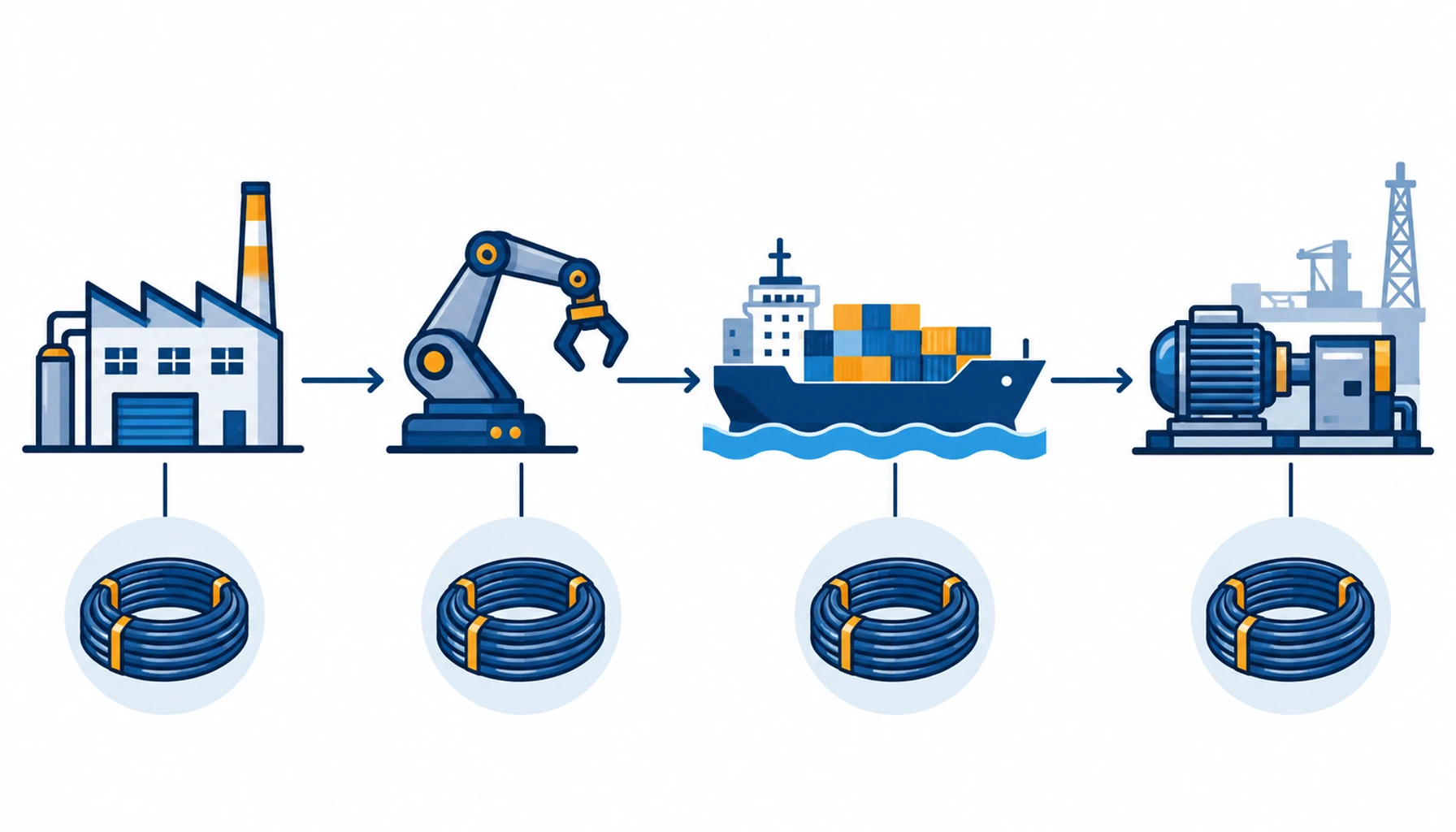
Japan’s cable demand splits into two flows that age differently. The first is the domestic fleet: the robots running in Japanese automotive, electronics and machine tool plants, one of the oldest large fleets in the world. These machines consume cable through replacement. Servo power, encoder and brake cores fail on their own schedule, driven by bending cycles and jacket wear, and a fleet of that age generates a continuous stream of refit work for integrators who need cable that matches original dimensions and connector layouts.
The second flow is export. Japanese machine builders ship robots, machine tools and automation cells worldwide, and every one of those machines carries cable specified in Japan but installed in factories from Monterrey to Manchester. This flow is why Japan functions as a specification bellwether. A jacket compound or stranding design that wins acceptance with Japanese OEMs tends to appear in machine build standards elsewhere within a few years, because the OEMs carry their specs with them. Suppliers who win credibility in this flow effectively rent that credibility across every market the machines land in.
Market data reflects the scale beneath both flows. QYResearch’s 2026 analysis of the robot drag chain cable market puts global demand at roughly USD 850 million in 2026, heading toward USD 1.24 billion by 2032, with Asia’s mature markets, Japan prominent among them, holding the largest replacement share. The high-flex robot cable segment that serves new machine builds grows faster still, with PW Consulting’s 2026 review putting it on a compound path above eleven per cent through 2032.
What Japanese Buyers Specify, and Why
Three habits distinguish Japanese motion cable purchasing. The first is long-horizon thinking. Machines are expected to run for decades, and cable is specified so that replacement, when it comes, is a planned maintenance event rather than a redesign; that pushes buyers toward constructions with predictable, documented flex life rather than headline numbers. The second is layout discipline. Control cabinets, cable carriers and dress packs are engineered to keep bend radii generous and torsion controlled, because the fleet’s engineers learned decades ago that most premature failures trace back to routing, a theme the analysis of common cable failure causes keeps confirming.
The third habit is supply chain formality. Japanese machine builders qualify suppliers slowly, audit them, and then stay with them, which makes breaking in hard but staying in easy. For an outside supplier, the practical entry is through the integrator layer or through export projects where the Japanese builder needs capacity and cost discipline its domestic base cannot always offer. Where that happens, the builder will still impose its documentation standards, so the supplier’s quality system matters more than its location. The choices between build models are compared in the guide to OEM versus ODM supply.
| Demand segment | What drives it | Cable profile | What the buyer verifies first |
|---|---|---|---|
| Domestic fleet replacement | One of the world's oldest large robot fleets, refit on planned maintenance cycles | Matched constructions for servo, encoder and brake cores; dimensions and connectors as original | Flex-life evidence and dimensional match to the outgoing cable |
| Domestic new cells | Integrator-led automation of electronics, food and machine tool plants | Short-lay stranding, PUR jackets where coolant is present, shielded data cores | Test reports at the actual bend radius and speed |
| Machine export builds | Japanese robots and machine tools shipped inside export equipment | Build standard carried from Japan, with destination-market certificates added | Traceability and batch documentation that survives an overseas audit |
| Component supply chain | OEM-qualified cable feeding robot assembly lines at home | Consistency above all: repeat shipments with identical construction and test data | Quality system and change-control discipline |
When the Legacy Is Not the Answer
The table explains a pattern outsiders often miss: Japanese demand is steady rather than spiky. Volume does not swing with the news cycle; it compounds with the installed base and the export pipeline. For cable makers, that favours suppliers who can hold a construction stable across years of shipments, which is harder than it sounds and is the real gate the qualification process guards. Panel-side wiring on these machines follows the same conservatism, as the guide to control cabinet build standards describes.
| Decision | Why it decides the outcome | How to prepare |
|---|---|---|
| Whose build standard governs | The robot maker's spec, not the end user's, usually defines the cable | Get the OEM build standard or the integrator's detailed spec in writing |
| Flex-life evidence format | Japanese buyers want test conditions, not marketing numbers | Have radius, speed and cycle-count data per construction ready to share |
| Construction stability | Repeat shipments must match; silent changes break qualification | State change-control terms and lock constructions in the order documents |
| Export documentation | Machines built in Japan may land anywhere; cable must carry its papers | Confirm which destination certificates the build requires and who supplies them |
| Replacement dimension match | Refit work requires cable that drops into existing carriers and connectors | Sample against the outgoing cable before quoting volume |
RFQ Checklist: Cable for a Japanese-Spec Robot Project
Three cautions. First, Japan’s engineering reputation does not transfer automatically to a project; a cable specified for a Japanese-built machine still has to suit the actual duty, radius and environment where it runs, which is why the certification overview in the cable certification checklist matters alongside the brand story. Second, the maturity of the market means the easy volume is in replacement, and replacement work rewards precision over enthusiasm: a supplier who cannot match dimensions and documentation will not see a second order. Third, do not read the domestic market as closed; export-driven capacity needs and the integrator layer leave real openings, but they open for suppliers who arrive with evidence and hold constructions stable, not for those who arrive with a price list.
Conclusion
Send these with the inquiry so the quote lands on the first pass:
- The governing build standard: robot OEM spec, integrator spec, or the destination machine standard
- Axis duty per cable: travel, cycles per shift, bends and torsion where wrists rotate
- Actual bend radius and carrier type, with the flex-life test condition requested to match
- Core schedule: servo power, encoder, brake and any data cores in one composite or separate
- Jacket requirement by environment: coolant, oil, chips, cleanroom or outdoor exposure
- Dimensional constraints from any replacement run: outer diameter, bend stiffness, connector fit
- Destination markets for exported machines, so certificates ship with the cable
- Change-control expectations: what triggers re-qualification and how notice is given