Germany: Machinery Exports and the Premium PUR Cable Market
Quick Answer: Germany runs Europe’s largest robot fleet and exports machines worldwide, and its buyers’ preference for PUR-jacketed motion cable sets a premium standard that travels with every machine.
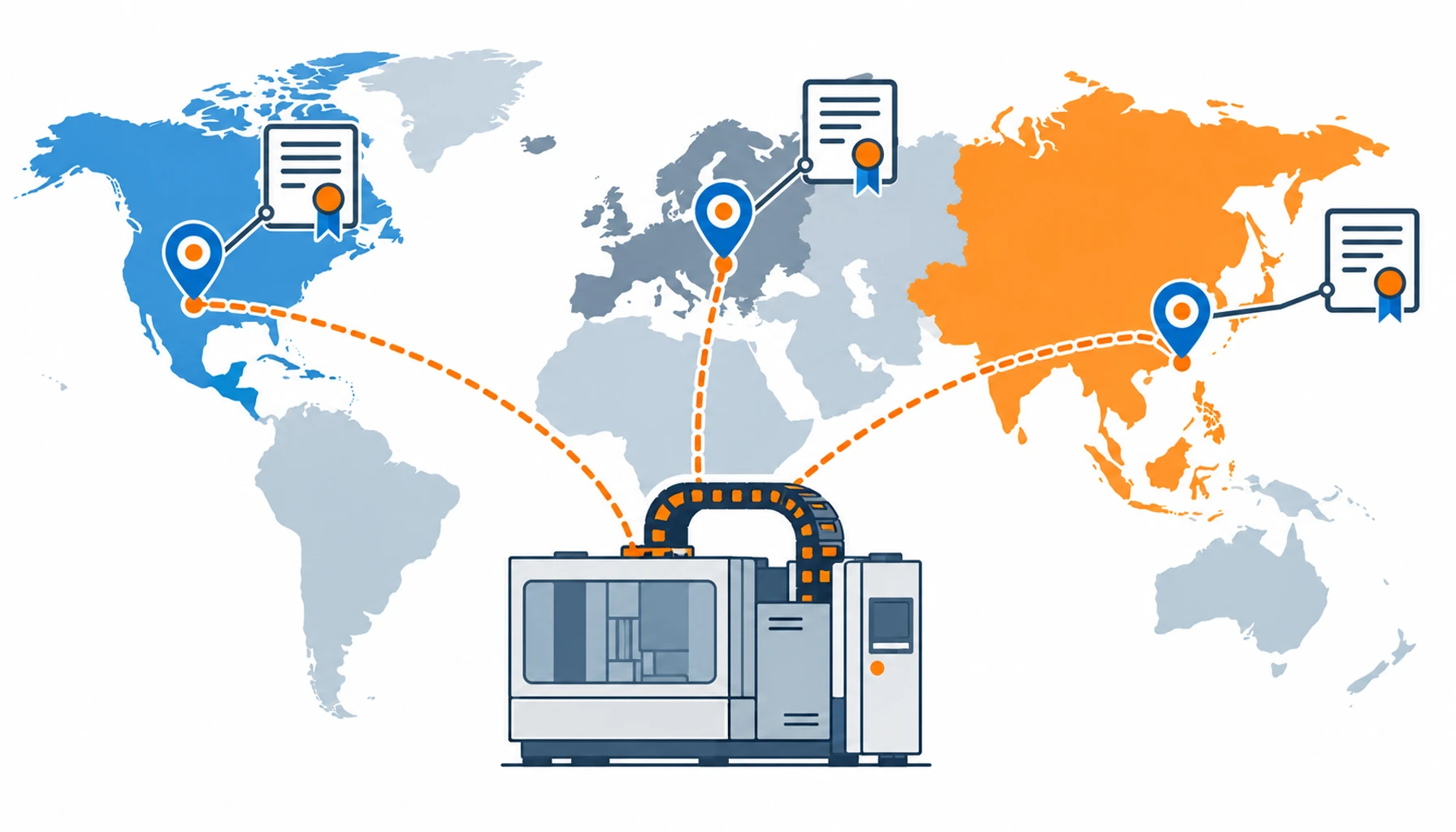
Germany occupies a peculiar position in the cable world. It is simultaneously one of Europe’s largest robot markets and the world’s most successful machinery exporter, which means German cable demand is double-barrelled: the cable installed in German factories, and the cable specified in Germany and installed everywhere else. The second barrel matters more than the first. When a German machine builder chooses a cable construction, that choice ships inside the machine to markets on five continents, and it becomes the reference standard the machine’s next owner must match when they replace it.
Introduction
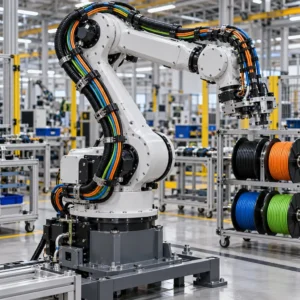
The scale is easy to state. IFR’s World Robotics 2026 counts Germany as the largest robot market in Europe, accounting for around 41 per cent of the European Union’s installations, and ranks it among the world’s top five by operating stock. But the statistics understate the influence. German machinery exports span machine tools, packaging lines, printing presses, woodworking equipment and automation cells, and nearly all of it moves: carriages, gantries, rotary tables, robot arms. Every moving axis carries drag chain or high-flex cable, and every one of those machines was engineered in a country that has strong opinions about jackets.
This article covers the demand side: where the cable goes, why PUR dominates the premium segment, and what German purchasing culture expects from a supplier. The regulatory framework for machines sold into Europe, including the Machinery Directive, is treated in its own article and is not repeated here. Suppliers weighing entry into this market should begin with the groundwork in the checklist for vetting an equipment manufacturer, because German buyers will do it for you, thoroughly, if you do not do it first.
Where German Cable Demand Actually Comes From
Four sources feed the German motion cable market, and they behave differently. Domestic robot installations, concentrated in automotive and its suppliers, electronics and metalworking, consume cable at commissioning and then again through replacement as the fleet ages. Domestic machine building for German factories, from press feeds to intralogistics, adds the same demand at a smaller scale. Then come the two export flows that give Germany its outsized influence: complete machines exported to end customers worldwide, and automation components, including cable-bearing assemblies, sold into machine builders abroad.
The export share changes the psychology of specification. A German builder designing a machine for a food plant in Brazil and a packaging line in Kansas does not design two machines; it designs one and expects the cable to cope with both. That pushes construction margins upward and favours jacket compounds that tolerate oil, coolant, abrasion and temperature swings without complaint. It also means a cable decision made in Stuttgart propagates through service inventories on three continents, because spare drums are stocked wherever the machines run.
Why PUR Owns the Premium Segment
The German preference for polyurethane jackets is not fashion; it is the compound that best answers the duty profile of exported machinery. PUR resists abrasion far better than PVC, sheds oil and coolant rather than absorbing or embrittling, stays flexible at low temperatures that would stiffen standard compounds, and holds up under the constant pressure and rubbing inside a cable carrier. PW Consulting’s 2026 analysis of the drag chain cable market puts PUR at roughly 45 per cent of global drag chain cable demand, and the premium European segment, Germany at its centre, sits above that share.
The catch is that PUR demands more from the manufacturer. Polyurethane extrusion is less forgiving than PVC processing, and a poorly compounded PUR jacket can underperform a good PVC one, which is why German buyers qualify jacket suppliers rather than trusting the polymer name. When a supplier presents a PUR motion cable to a German engineer, the questions come quickly: which hardness, which compound family, what abrasion test result, what behaviour at minus temperatures. Vague answers end conversations. The material fundamentals behind those questions are set out in the comparison of insulation and sheath materials, and the failure patterns the compounds are chosen to avoid are catalogued in the guide to why cables fail on machines.
| Source | Scale driver | Cable profile | Purchasing character |
|---|---|---|---|
| Domestic robot fleet | Largest in Europe; around 41 per cent of EU installations per World Robotics 2026 | Servo, encoder and dress pack cable; PUR jackets standard in most cells | Established supplier lists; replacement bought through integrators |
| Domestic machine building | Machine tools, presses, packaging and intralogistics for German plants | Long-travel carrier cable, gantry festoon, torsion on rotary axes | Spec-driven; duty calculations expected with the quote |
| Complete machine exports | One of the world's largest machinery exporters by value | Export-grade constructions with wide environmental margins, mostly PUR | One design, many destinations; certificates per destination |
| Components and assemblies | Cable-bearing subassemblies sold to machine builders abroad | Semi-finished and kitted motion cable assemblies to customer drawings | Drawing-tolerant, volume-stable, quality-audited |
What German Purchasing Expects From a Supplier
What unites the four is an expectation of margin: cable built so it does not need to be thought about again. German engineers famously over-design the parts that stop machines, and motion cable sits squarely in that category. A supplier who quotes the minimum construction that passes will lose to one who quotes the construction that cannot fail, even at a higher price. That is what “premium market” means in practice: not luxury, but intolerance of downtime.
When the Premium Standard Is Not the Answer
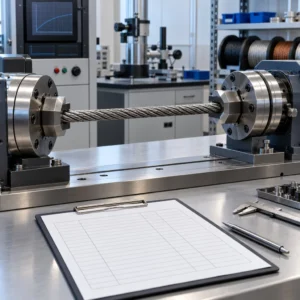
German machine builders run formal supplier qualification, and the sequence is predictable. First the technical file: constructions, materials, test evidence, and the standards the cable is made to, with European harmonised standards carrying natural weight, as the mapping in the IEC, GB and BS standards guide helps suppliers navigate. Then samples, often tested in the builder’s own lab against its own duty profile, not just against the datasheet. Then a first article and a small series before volume. Each step filters; most suppliers who fail do so at the evidence stage, by presenting claims without the test data behind them.
Two habits earn disproportionate credit. The first is precision in communication: answers that distinguish what was tested from what is inferred, which the discipline in the guide to reading datasheets honestly makes habitual. The second is stability: a construction that ships identically for years, with change notices given early. German production planning is built on assumptions about components that do not move, and a cable supplier who honours those assumptions becomes, in effect, part of the machine’s design.
| Decision | Why it gates the order | What good looks like |
|---|---|---|
| Jacket compound selection | PUR is the default expectation; substituting silently fails the file review | PUR offered as standard, with hardness and compound family stated |
| Abrasion and oil evidence | The two duties German machines most punish | Test reports against recognised methods, matched to the shipped batch |
| Low-temperature behaviour | Export machines meet cold stores and outdoor installations | Flexibility data at the relevant temperatures, not just a rating |
| Dimensional tolerance | Carriers and connectors are designed around stated dimensions | Outer diameter and bend stiffness tolerances committed in writing |
| Change control | Production planning assumes stable components | Written notice period for any construction or material change |
RFQ Checklist: Cable for a German Machine-Build Project
Three cautions keep this article honest. First, premium does not mean gold-plating every run: an axis that moves once an hour does not need a top-tier flex cable, and a good German engineer will reject an over-specced quote as readily as an under-specced one, because both show the supplier did not understand the duty. Second, the German market’s standards reflect German machinery, and cable sold to builders elsewhere can be specified more economically where the duty allows; the point is to choose by duty, not by flag. Third, the market is open but not cheap to enter: qualification takes months, and the honest path runs through the certification overview in the cable certification checklist and a realistic assessment of what your quality system can evidence.
Conclusion
Send these so the quote reaches engineering on the first pass:
- Machine type and destination markets, so environmental margins and certificates can be set
- Duty per axis: travel, cycles per shift, speed and acceleration profile
- Actual bend radius in the carrier, and whether torsion occurs on any axis
- Jacket requirement: PUR assumed unless the environment says otherwise, with compound data requested
- Abrasion, oil and low-temperature test requirements, named by method where possible
- Dimensional tolerances and connector or carrier fit constraints
- Volume forecast and construction stability expectations, including change-notice terms
- Whether the cable travels in exported machines and which destination certificates follow it