Vietnam and Thailand: Electronics Factories Automating Fast
Quick Answer: Vietnam and Thailand anchor Southeast Asia’s electronics manufacturing, and their factories are automating fast enough that motion cable demand is riding a structural build-out.
The electronics supply chain spent the last decade building a second home in Southeast Asia, and Vietnam and Thailand are its two anchors. Vietnam absorbed enormous smartphone and consumer electronics assembly capacity; Thailand deepened an existing base that spans hard disk drives, automotive electronics and appliances. Now the second phase is running: the region is moving up from assembly toward components, testing and precision work, and moving up that ladder means automating. Every new robot cell, every automated test line and every conveyor upgrade inside those plants consumes motion cable, and the consumption is starting to show in the region’s import statistics.
Introduction
The regional backdrop is easy to describe and hard to overstate. IFR’s World Robotics 2026 records global installations at roughly 600,000 units for 2025, and while neither Vietnam nor Thailand ranks near China’s 354,000-unit year in raw numbers, their growth comes from a different engine: relocation and expansion of electronics production, driven by supply chain diversification and by each government’s industrial incentives. Vietnam’s industrial parks along the northern coast and around Ho Chi Minh City filled with assembly capacity; Thailand’s established electronics and automotive clusters in the Bangkok region and the Eastern Economic Corridor added precision work on top.
This article reads the two markets from the factory floor: what the plants make, what duty their machinery runs, and how the cable buying actually happens. The standards and import formalities for machines entering these markets are covered separately. The electrical build-out that feeds the factories, from park substations to hall distribution, is treated in the batch-two analyses of Vietnamese industrial park power demand and Southeast Asian data centre power.
Two Countries, Two Automation Personalities
Vietnam’s automation personality is young and volume-driven. Its manufacturing base grew explosively around large-scale consumer electronics assembly, and that industry automates in a specific way: long lines of repetitive handling, served by compact cells, conveyors and increasingly by vision-guided robots, running at volumes that make cycle counts brutal. The cable duty profile follows: tight radii, millions of cycles, and encoder and sensor signals that must stay clean inside dense production halls.
Thailand’s personality is older and more layered. Its electronics sector grew alongside one of the world’s major automotive industries and a dominant position in hard disk drive production, and its plants automate with a mix of Japanese-spec machine tools, assembly robots and precision test equipment. Duty is similar to Vietnam’s at the assembly stage but adds the heavier payloads and longer travels of automotive-tier work, plus the audit-heavy documentation culture that Japanese and Western parent companies bring. The two countries converge on the same cable requirements from different directions, which is why suppliers treat them as one regional demand pool with two specification dialects.
What the Region's Plants Buy
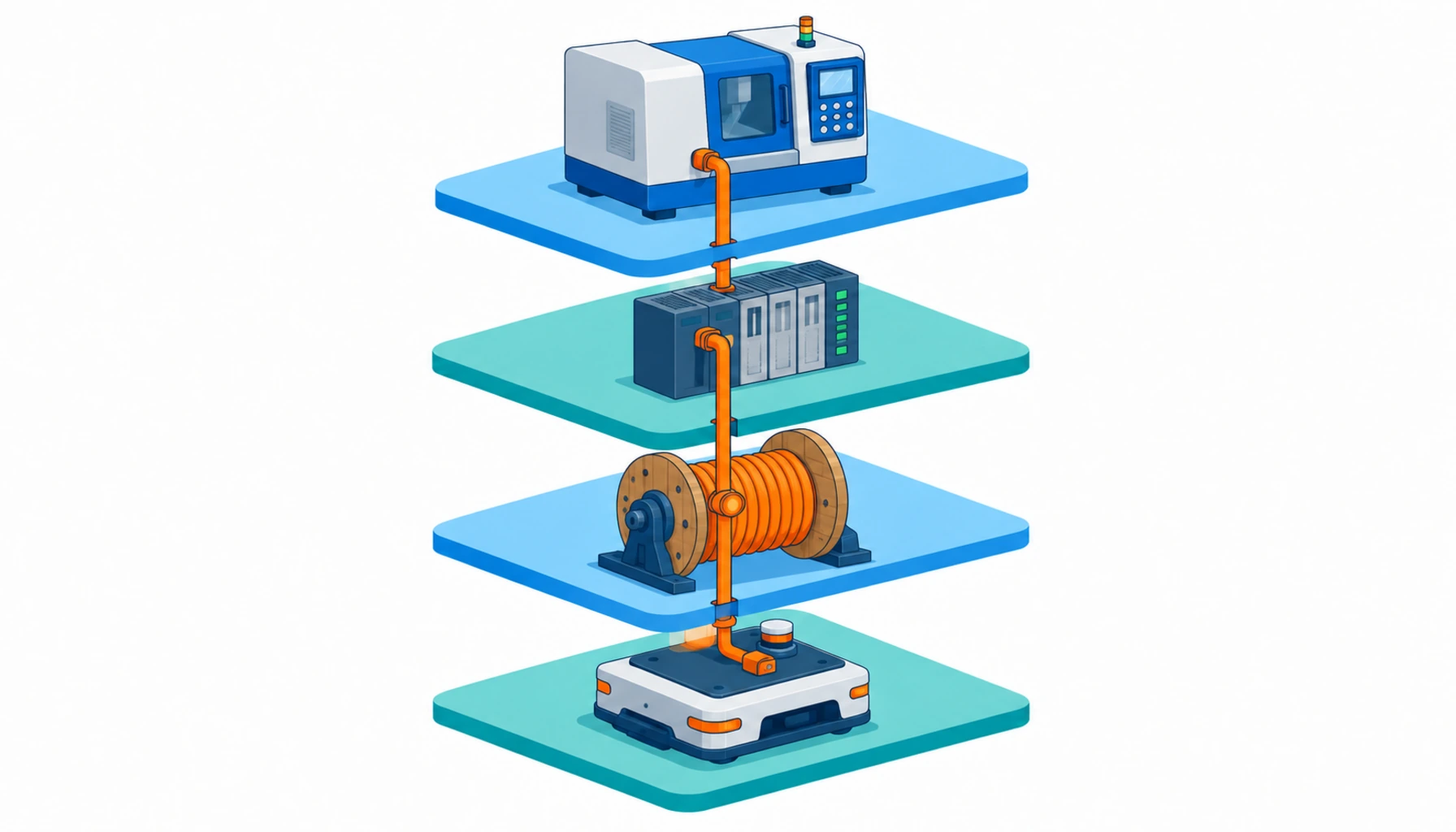
Three demand layers make up the regional cable market. The first is new line equipment: the robots, mounters, conveyors and test handlers arriving inside machines from Japan, Korea, China and the West, each carrying cable specified by its builder. The second is local integration: the Thai and Vietnamese machine builders and integrators who equip the next tier of factories, who buy cable directly and whose specifications decide what the country’s mid-market runs on. The third is replacement and upgrade: the first generation of regional installations has aged into refit cycles, and upgrade projects that add automation to manual lines consume cable without ever appearing in a robot statistic.
The market research behind the layers is consistent. QYResearch’s 2026 analysis projects the global robot drag chain cable market growing from roughly USD 850 million in 2026 to about USD 1.24 billion by 2032, with Asian manufacturing expansion holding the largest share of new demand. The warehouse and logistics layer, increasingly visible in both countries’ e-commerce build-outs, rides PW Consulting’s 2026 projection of AMR demand growing from about USD 7.6 billion to USD 23.4 billion over the same window. Neither figure belongs to these two countries alone; both describe currents flowing through them.
| Demand layer | Where it appears | Cable duty profile | What decides the order |
|---|---|---|---|
| Imported line equipment | Large electronics plants owned by global brands | Specified by the machine builder; high cycles, tight carriers | Match to the builder's standard and delivery to schedule |
| Local integrators and builders | Mid-market factories across both countries | Mixed duty, budget-sensitive, wide ambient range | Price with honest ratings and available stock |
| Replacement and upgrade | Aged first-generation installations, manual lines adding automation | Match to original construction; urgency when lines stop | Availability, traceability and dimensional fit |
| Emerging logistics automation | E-commerce fulfilment and port-adjacent hubs | Continuous motion, charging interfaces, round-the-clock duty | Cycle evidence and responsive supply |
Regional Conditions That Shape the Specification
The layer structure explains a pattern foreign suppliers often misread: the same cable can be a premium product in one layer and a commodity in another. An imported Japanese machine’s dress pack is specified to the parent’s standard and audited accordingly; the integrator two streets away buys on price and needs the rating to be honest, not exotic. Suppliers who segment their offer across the layers, and keep evidence available for both audiences, capture volume that a single-position strategy misses. The mechanical reasoning behind segment-appropriate sizing is set out in the guide to cable size selection, and the failure patterns that honest ratings prevent are catalogued in the analysis of common cable failure causes.
When Regional Headlines Are Not the Answer
Two physical realities repeat across both countries. The first is climate: halls run hot and humid, coastal plants add salt air, and monsoon-season moisture finds every weakness in a termination or a jacket compound. Cables and compounds rated for temperate defaults age faster here, so temperature and humidity margins belong in every specification. The second is power quality in growing industrial parks: fluctuating loads and drive-dense halls create electrical noise that lands on shield integrity, and the grounding discipline described in the industrial power distribution checklist earns its keep on every line.
Layered over both is the audit culture of the parent companies. Electronics plants in the region supply customers who inspect, and inspections walk from the product to the paperwork. Cable that arrives without batch records or test evidence creates findings, and findings cost the plant more than the cable ever did. The certification landscape those papers map to is summarised in the overview of cable certification schemes.
| Decision | Why it matters in Vietnam and Thailand | Practical handling |
|---|---|---|
| Climate-rated compounds | Heat, humidity and salt air age temperate defaults early | Specify heat and humidity margins; consider PUR in harsh halls |
| Layer-appropriate offer | Imported machines, integrators and replacements buy differently | Segment the offer: spec-matched, value-rated and replacement lines |
| Shield and grounding | Drive-dense halls and weak power quality stress signals | Provide braid data and agree grounding with the integrator |
| Audit-ready documentation | Parent-company inspections walk from product to paperwork | Ship batch records and test evidence with every drum |
| Stock for breakdowns | Replacement demand arrives when lines have stopped | Hold or reserve stock for common constructions with key accounts |
RFQ Checklist: Motion Cable for a Vietnam or Thailand Plant
Three cautions. First, “Southeast Asia” is not one market: Vietnam and Thailand differ in industrial structure and specification culture, and neither resembles the smaller ASEAN economies the headlines bundle them with. Second, relocation headlines do not guarantee orders; individual plants expand on individual economics, and cable demand follows qualified customers, not news flow. Third, growth does not lower the evidence bar: whether the buyer is a global brand’s plant or a second-tier integrator, the certification overview in the cable certification checklist and honest test data remain the entry ticket.
Conclusion
Include these so quotes match the regional reality:
- Plant type and location: coastal or inland, and the hall’s real temperature and humidity range
- Duty per axis: travel, cycles per shift, and whether motion runs continuously
- Actual bend radius and carrier type, measured where the cable replaces an existing run
- Whether the cable serves imported machinery, local integration or replacement duty
- Shield requirements for drive-dense halls, with grounding practice noted
- Audit documentation requirements from the parent company or end customer
- Stock or call-off expectations for replacement supply
- Required certificates, named at inquiry stage