Site Terminations and Quick Connectors: Speed Against Reliability
Quick Answer: On a working site, most electrical faults start at a connection, and most connections are chosen for speed. The workable rule: quick connectors for circuits that move, proper terminations for circuits that stay, and a crimp standard for everything in between. Buy rated hardware, ban the tape-and-twist, fit strain relief at every entry, and inspect connections on the same schedule as the cable.
Introduction
A site makes and breaks connections constantly: a board repositioned, a feeder extended, a machine relocated, a circuit split for the new work area. Every one of those connections is a decision, and the site’s fault record is mostly the sum of those decisions.
The tension is real. Speed matters on a site that moves weekly, and a termination culture that ignores speed gets ignored. The answer is not to slow everything down; it is to decide, in advance, where quick connections are good enough and where they are not, and to buy the hardware for both categories. This guide walks that line.
Where Quick Connectors Belong
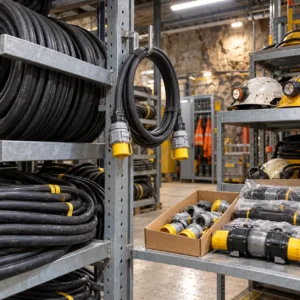
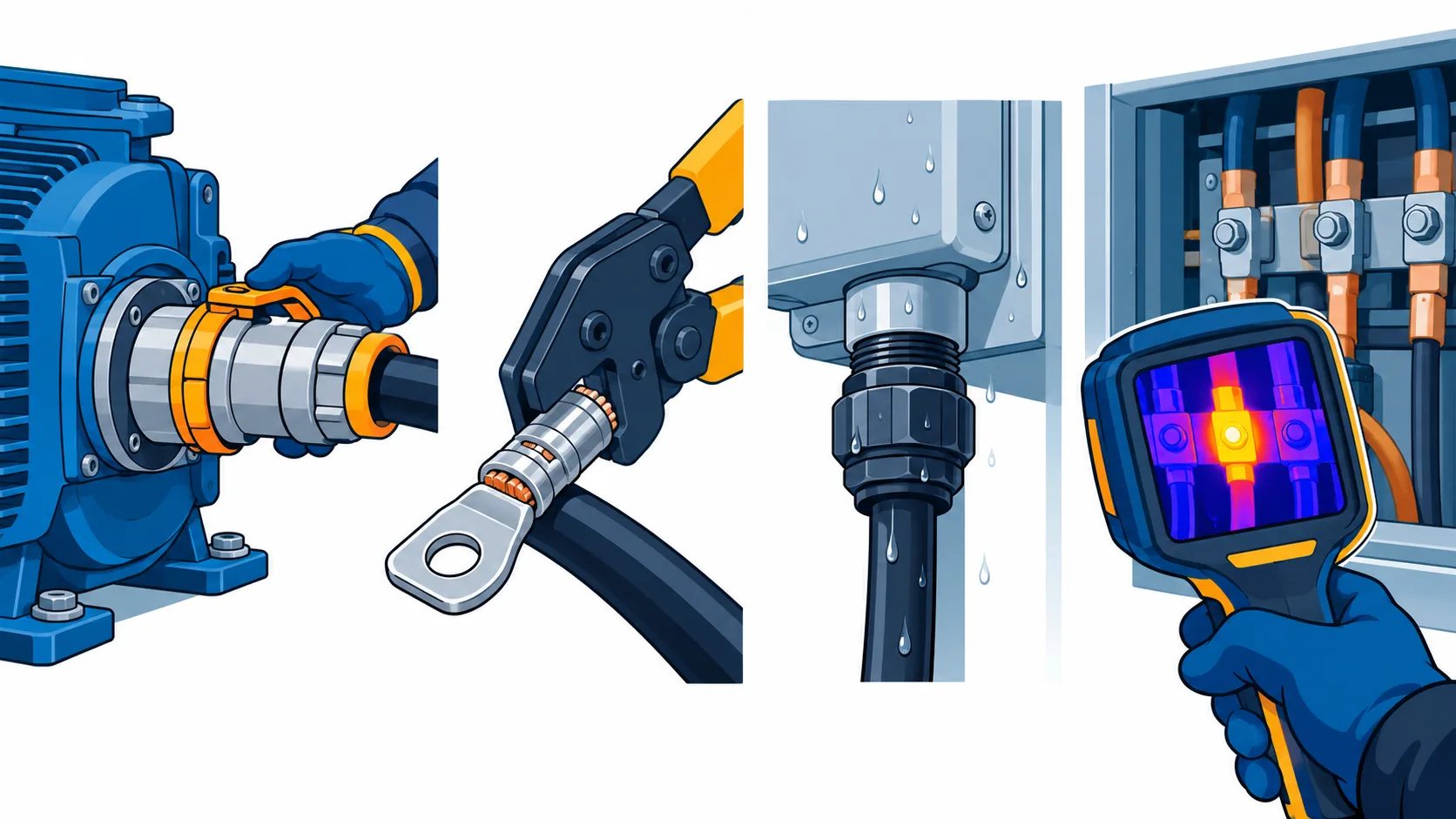
Quick connectors, rated couplers and plugs designed for repeated make-and-break, are the right answer anywhere a circuit moves: machine feeds, area distribution, lighting circuits, and anything the crew reconnects on the programme. A rated connector made correctly is a sound connection, and it is far better than a badly made permanent one, which is exactly what time pressure produces.
What to specify. Ingress ratings matched to the position, contact ratings matched to the load with headroom for motor starting, a latch that survives handling, and strain relief at the cable entry, because the entry is where handled connectors fail. Buy one connector standard per load class across the site; mixed generations are the origin of most connector faults, because incompatible halves get forced together and the contact never seats properly.
The discipline that makes them work. Connectors are inspected with the cable: faces clean and unburnt, latches intact, entries strain-relieved. A connector that has been driven over is a suspected fault even if it works, and the inspection culture that swaps it costs less than the midnight hunt for the intermittent one.
Where Proper Terminations Are Non-Negotiable
Circuits that stay put, and anything carrying serious load, deserve a real termination: lugs crimped with the correct tool, insulation and sealing to the standard, and the torque discipline that keeps the joint at its designed contact pressure. The supply side of the site, the incoming feed, the main boards, generator connections and long feeder runs, is permanent in every way that matters.
The crimp standard. Most bad permanent terminations are crimp failures: wrong lug, wrong die, or pliers where a tool should be. Conductor classes determine the crimp geometry, and our note on IEC 60228 conductor classes explains why a flexible Class 5 conductor and a solid core do not share a termination. Buy the crimping tooling with the lugs, and make the tooling the only accepted method; a calibrated tool and a die schedule cost a fraction of one joint failure on a main feeder.
Sealing and insulation. Outdoor terminations need sealing against moisture, and the site’s permanent joints deserve the same heat shrink and resin discipline a substation would use. Where the termination is medium voltage or anything the site cannot verify, testing is part of the acceptance; our note on MV cable termination and testing covers the evidence, and the same logic scales down: a termination is tested, not assumed.
| Circuit Type | Moves? | Connection to Use | Evidence to Demand | Cost and Lead-Time Driver | How It Fails |
|---|---|---|---|---|---|
| Machine and equipment feeds | Weekly or daily | Rated quick connectors with strain relief, one standard per load class | Ingress and contact ratings, cycle life data | Connector quality is cheap against the downtime it removes | Forced mixed halves, broken latches, wet faces |
| Area distribution and lighting | Continuously | Rated couplers, weather-rated positions, inspect-with-cable routine | Ingress ratings per position | Modest hardware premium; inspection is labour | Burnt faces from loose seating, driven-over bodies |
| Feeder and board connections | Sets and stays | Crimped lugs with calibrated tooling, sealed glands, torqued | Tool calibration records, lug schedule, torque marks | Tooling and labour; hardware is minor | Wrong-die crimps, loose joints heating under load |
| Supply and generator connections | Once, then permanent | Full termination standard with sealing and acceptance testing | Test records per termination | The site's most expensive connections, correctly so | Moisture ingress, contact heating, faults on the biggest feed |
The Gray Zone: Temporary Circuits That Stay Too Long
Most sites have a layer of circuits that started temporary and became permanent by inertia: the feeder to the site offices, the supply to the gate and hoist, the workshop feed. These circuits carry real load for years on connections built for months, and they are the site’s quietest risk.
The answer is a review trigger, not a new philosophy: any temporary circuit that has survived six months, or picked up load beyond its original design, gets its connections upgraded to the permanent standard. The upgrade is usually a day’s work with hardware already in the stores, and it removes the class of fault that arrives as a hot joint in a board nobody has opened since it was installed. Write the trigger into the site electrical standard; leaving it to judgment means it never happens, because the circuit works today.
Buying the Hardware: Kits, Tools and the Standard
Termination quality is mostly a logistics achievement. The site that has the right lug, the right die and the right seal within reach at every board builds good joints; the site that improvises with pliers and tape builds the fault record.
Buy kits, not bins. Termination kits assembled per cable type and load class, stocked at the distribution points, keep the correct hardware within reach. A bin of mixed lugs is how wrong crimps happen. Where the site also buys cable, boards and generators as a package, the kits can be specified to match the delivered constructions exactly, which our note on coordinated power equipment supply covers; the fit between the cable’s conductor and the lug’s barrel is exactly the kind of detail a single source can guarantee.
Buy the tools with the consumables. A calibrated crimp tool per work area, with the die set for the lug range in use, is part of the order, not a capital request made after the first joint failure. For the smaller flexible cords serving tools and temporary boards, the same rule scales down; our flexible cord range and its matching connectors belong to the same kit standard, just lighter duty.
Write the one page. A connection standard that fits on one page, categories, hardware, tooling, inspection, is the deliverable that makes the rest work, and it belongs in the project file the auditors read.
What Separates a Good Connector From a Cheap One
Quick connectors look identical in a catalogue photograph and behave completely differently in the field, and the differences are all in details a buyer can check before the first failure.
Contact mass and spring. A good connector’s contacts carry real cross-section and a contact spring that holds pressure through thermal cycles. A cheap one thin-plates its contacts and relies on friction, which works cold and walks loose hot. Weigh two connectors of the same rating; the heavier one is usually the honest one.
Latch and body. The latch survives hundreds of make-break cycles with gloves on, and the body is a real insulating material that does not crack at winter morning temperature. Cheap bodies crack, and the crack is the water path. Ask for cycle life and the low-temperature rating; the declarations that matter are the ones a supplier hesitates to make.
Strain relief. The entry either grips the cable’s sheath or lets the conductors take the pull. This single detail decides whether a dragged connector lasts a season or a week, and it can be verified by eye: pull the cable and watch whether the body or the wires take the load.
Declarations. Ingress ratings, contact ratings and cycle life, stated in writing, are what separate a catalogue from a datasheet. The same scrutiny applies to lugs and crimps: barrel length, wall thickness, and whether the maker’s dies are named. None of this checking costs more than an hour per supplier, and it buys years of quiet connections, because on connections the site really does get what it specified, provided something was specified at all.
What to Freeze Before the Order
| Decision | What to State | Evidence to Attach | Cost of Leaving It Open |
|---|---|---|---|
| Connector standard | One connector series per load class, site-wide | Rating and ingress declarations | Forced mixed halves and intermittent faults |
| Crimp standard | Lug schedule per cable type, calibrated tooling required | Tool calibration records and die list | Wrong-die crimps heating on the main feeders |
| Sealing standard | Outdoor terminations sealed; resin or heat shrink named | Sealing method per position | Moisture joints failing in the first wet season |
| Acceptance testing | Supply and generator terminations tested, records kept | Test records per termination | The biggest feed on the site running on trust |
| Temporary-to-permanent trigger | Six-month review rule for ageing temporary circuits | Trigger written into the site standard | Years of real load on connections built for months |
| Kit logistics | Termination kits stocked per cable type at the boards | A kit list per distribution point | Pliers, tape and the fault record they produce |
Inspection and Failure Signs
Connections announce their failures early if anyone looks: discolouration, heat smell at a board, a connector that sits loose in its housing, a crimp whose lug spins on the conductor. The inspection that catches these is the same walk that inspects the cable, extended to open every board on the route on a rotating schedule.
Thermal checks. A thermal camera on the main boards quarterly finds the heating joints before they find you, and the survey costs less than one joint failure on a feeder. Mark and re-check anything reading warm; a joint that heats once will heat again.
The records. Connection inspections go in the same record system as the cable tests, because the connection is part of the circuit’s evidence chain; our note on insulation resistance testing covers the electrical side of that chain. And when a termination failure does occur on supplied equipment, the warranty conversation turns on the installation records, which our note on power cable warranty terms explains; sites with records get warranty honoured, sites without them get opinions.
Training the crews. The best hardware fails in untrained hands, and the cheapest training works: a toolbox session per crew on the two categories, the crimp tool and the torque wrench, run at site induction and repeated when the standard changes. Twenty minutes per crew, twice a project, buys more connection reliability than any hardware upgrade, because most bad joints are made by people who were never shown the difference.
When a Quick Connector Is Not the Answer
When the load is the main feed. Anything the whole site depends on deserves the permanent standard, however temporary the site claims to be.
When the position is wet or buried. Quick connectors in standing water or below ground are a fault with a delay on it; joint to the permanent standard or relocate the connection.
When the connector has been abused. A driven-over, burnt or latch-broken connector is replaced, not re-used. The saving is a few units against the cost of the intermittent fault it leaves behind.
When the failure is upstream. A connector that keeps burning may be reporting an overloaded circuit or a failing machine. Fix the load before re-terminating the same joint a third time.
RFQ Checklist
- Connector series named per load class, one standard site-wide
- Ingress and contact ratings declared for every connector type
- Strain relief specification for all cable entries
- Lug schedule per cable type with calibrated tooling required
- Sealing method named for outdoor terminations
- Acceptance test records for supply and generator connections
- Temporary-to-permanent review trigger in the site standard
- Termination kits listed per distribution point
- One-page connection standard as a contract deliverable
- Quarterly thermal survey of the main boards
Conclusion
Site connections are bought in two categories, quick for the moving circuits and permanent for the staying ones, and the failure record comes from the circuits that were assigned to the wrong category. Fix the categories, buy the rated hardware and the tooling, kit the stores, and inspect connections with the same routine as the cable. The site’s fault list shrinks to genuine mysteries, which is where a fault list should live.
Kexingyu Cable Group (KXYE) has manufactured cable in Quanzhou since 1996, supplying site cable with matching connector and termination schedules, tooling guidance and coordinated boards and generators through one channel. Send us your connection census, and we will come back with the hardware list that fits your cable. The fastest route is a request for quotation.