Cable Fire Investigation: Reading the Evidence and Buying for the Next One
Quick Answer: A cable fire investigation lives or dies in the first two hours, because the evidence that identifies the cause is destroyed by the cleanup that follows. Char depth, copper condition, soot pattern and which cables survived the same event all point to different causes, and none of them can be recovered once the tray is stripped and the area washed down. If the site is cleared before anyone records it, the investigation becomes an opinion.
Introduction
Most cable fires are reported as a cable fault, which is rarely what happened. A cable burns because something else heated it, because a joint failed, or because a fire that started elsewhere found the cable as fuel. Separating those three cases is the whole point of the investigation, and it decides whether the answer is a different cable, a different joint or a different route.
This guide is for buyers, facility engineers and insurance-side reviewers who have to answer two questions after an event: what started it, and what changes on the next purchase order. It sets out the failure signatures that point to each cause, the evidence to secure before anything is touched, the decisions to freeze before ordering replacement cable, and the fire performance evidence that is worth paying for. Fire performance and flame retardant constructions sit in our fire resistant cable range, and the test methods behind the claims are covered in our note on halogen and smoke testing.
What the Evidence in a Cable Fire Actually Shows
Char depth is a direction indicator, not a severity score. Cable insulation chars progressively from the heat source outward, so the side of the cable that is most damaged faces where the heat came from. On a bundle that has burned in place, the pattern of char across the cable circumference usually locates the origin more reliably than any single measurement.
Copper tells you the temperature and the order of events. Copper anneals, melts and oxidises at characteristic temperatures, and a conductor that has melted into droplets experienced something very different from one that was merely annealed. The distinction between melted and annealed copper is one of the most useful findings in a cable fire, and it survives in a bagged sample but not in a skip.
Which cables survived matters as much as which ones burned. Where several circuits ran on the same tray and only one failed, the survivor’s construction is a control sample. Comparing the failed cable against a cable of a different construction that saw the same heat is evidence that no laboratory test can replace.
Aluminium and steel structures record the heat too. Melted aluminium, distorted tray, spalled concrete and the colour of galvanised steel all indicate a temperature range and a direction, and they stay in place while everyone argues. Photograph them with a scale before anything is moved.
Failure Signatures Compared
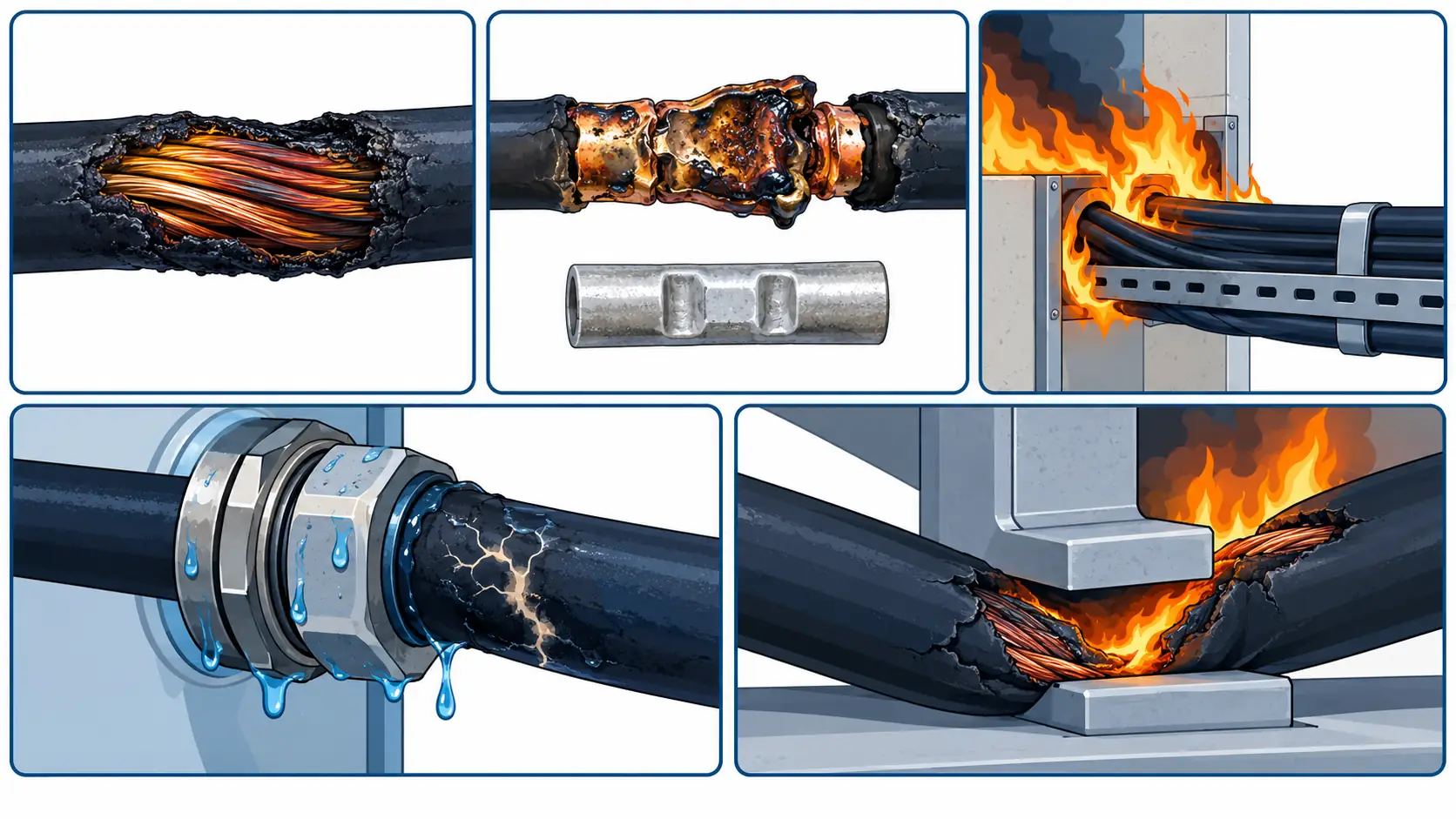
The table sets out the signatures a reviewer may find: what each one points to, what to specify on the replacement order, the evidence to demand, what drives cost and lead time, and how each one misleads when the investigation stops at the first plausible answer.
| Signature | What it points to | What to Specify Next | Evidence to Demand | Cost and Lead-Time Driver | How It Misleads |
|---|---|---|---|---|---|
| Annealed copper with localised char at one point | Heat from outside the cable, or a sustained overload at a single restraint | A larger conductor, a corrected load, or a stand-off at the hot point | Route temperature data and a load record for the same period | Conductor size, which is a modest cost change | Blaming the cable compound when the heat was a process or a load problem |
| Melted copper at a joint or termination | A high-resistance connection that overheated before anything ignited | The correct accessory, the correct crimp tooling and a torque record | The failed accessory itself, bagged, plus the jointing record | Accessory quality and jointing labour, not cable cost | A cable replacement that leaves the same accessory defect in the next line |
| Char over a long parallel run, several circuits involved | External fire entering the cable route, for example through a penetration or a duct | Penetration sealing, barrier material and a route change | The penetration detail and the sealing certificate | Sealing and barrier work, often a small part of the rebuild | Purchasing fire-rated cable while the open penetration remains open |
| Tracking marks, moisture staining and a fault at a gland | Water ingress leading to tracking and then to ignition at the weakest point | Sealed glands, water blocking and a drained route | Seal details and the gland arrangement as installed | Gland and sealing cost, with no cable cost change | Reading the tracking pattern as fire damage and missing the water source |
| Mechanical tear or crush with burning behind it | Impact damage first, conductor contact and arcing second, fire third | Mechanical protection at the point of damage, plus a route change | Photographs with a scale and the damaged section retained | Protection material and installation, usually inexpensive | A fire cause conclusion that ignores the damage pattern underneath it |
Where the Fire Started, and How to Tell
Fire damage on a cable is not the same as fire origin on a cable. A cable can be the most damaged item in a room and still not be the cause, because it was simply the best fuel. Origin is established from the whole compartment, and the cable is one input to that rather than the answer.
Look for the one point that shows more than one mechanism. Genuine origins usually show two or three effects together, such as melting plus arcing plus a mechanical breach at the same location. A location with only char and nothing else is usually a path the fire took, not the place it started.
Secure samples before anyone needs the space back. A metre of failed cable with the accessory, bagged separately and labelled with the position, costs nothing to take and cannot be replaced later. Our note on LSZH versus flame retardant cable sets out how construction affects what burns and what survives, which is what makes a comparison between two cables on the same tray meaningful.
What to Freeze Before the Order Goes Out
Six decisions decide whether the replacement cable addresses the event or repeats it. Each belongs in the requisition rather than in the conversation after delivery.
| Decision | What to State | Evidence to Attach | Cost of Leaving It Open |
|---|---|---|---|
| Cause of the event | Whether the fire started in the cable, at an accessory, or arrived from elsewhere | An investigation note with photographs and the retained samples | A replacement that fixes the cable and leaves the cause in service |
| Circuit integrity requirement | Which circuits must keep working during a fire, and for how long | A fire strategy extract listing the circuits and their duty | Fire-rated cable bought for circuits that do not need it, while critical ones go without |
| Burning behaviour and emissions | The flame retardant class, smoke density and halogen limits required in that space | Test reports for the declared class on the exact construction | A cable that meets the class on paper and behaves differently in a real compartment |
| Penetration and barrier details | The sealing system at every wall and floor crossing, matched to the cable and the barrier | Approved penetration details with the sealing system reference | A fire and smoke path that stays open in the same building after the rebuild |
| Accessory and jointing standard | The accessory type, the crimp tooling and the torque and record requirements | Accessory data, tooling identification and a jointing record sheet | The same high-resistance joint failure that caused the event |
| Records and traceability | The batch marking to be recorded and the as-built route drawing to be updated | Marking on the sheath plus the updated drawing as a handover item | No way to correlate a later event with the cable that was installed |
Specifying Burning Behaviour for the Space
Separate flame propagation from circuit integrity. A cable that resists flame spread stops a fire travelling along the tray. A cable that maintains circuit integrity keeps a circuit alive while a fire burns around it. They are different tests, different constructions and different prices, and requisitions mix them up constantly.
Match the class to the space, not to the whole site. A high-rise riser, a tunnel, a plant room and an outdoor yard have different exposure, and applying the strictest class everywhere is an expensive way to avoid a design decision. Our note on GB 31247 classification sets out how the classes differ, and the same logic applies under other schemes.
Ask for the test report, not the marketing name. Compounds are marketed with names that resemble classes, and a report naming the standard, the class and the construction is the only version worth relying on. Our note on flame retardant cable classes covers how the naming works.
Check that the whole system has been tested, not only the cable. Where a route passes through a rated wall, the barrier, the cable and the sealing system form one assembly, and a tested cable in an untested penetration does not deliver the rating. Our note on firestop cable penetrations covers the details that get missed.
Incoming Inspection and Records
Verify the class marking on the sheath. A cable supplied to a flame retardant specification normally carries a marking, and the marking on the delivered drum is a check no certificate can substitute for. Where the sheath is unmarked, the specification cannot be confirmed in the field.
Match the batch to the test report. A test report for a construction is only meaningful if the delivered cable is that construction, so the batch reference on the drum belongs on the receiving record alongside the report. It is the link that makes the report usable after an event.
Record the route as built. Grading and placement are part of the environment the cable can tolerate, and the drawing is what a future investigation will use to work out which cable was where. Our note on fire survival cable sets out the construction side of that duty; the route record is the other half.
Cost and Lead Time
Standard flame retardant constructions in common sizes are stock or short-run items and add little to a programme. Low smoke, halogen-free and higher-class constructions carry a real premium and run to order more often, which is why the class should be decided by space rather than by default. Circuit integrity constructions sit at the top of the range, are made to order in most sizes and carry the longest lead time, so they belong in the programme from the start.
Copper is still the largest element of the price, and after an event the schedule pressure tends to hide that. Ask how the copper element is calculated and how long the quotation holds, because a fast order placed during a rebuild usually pays a premium that a planned one does not. That mechanism is covered in our note on copper price and cable procurement.
When a Fire-Rated Cable Is Not the Answer
When the circuit does not need to survive. Most circuits on a site can go out in a fire, and the fire strategy says which ones cannot. Buying circuit integrity cable for everything doubles the cable budget without changing the outcome.
When the problem is the penetration. A rated cable through an unsealed opening leaves the smoke path exactly where it was. Sealing the penetration is usually the cheaper half of the fix and the half that gets deferred.
When the cause was an accessory. Where the event started at a joint or a termination, the cable performed as designed. Replacing the cable while keeping the accessory type guarantees a repeat, and the tooling and the record are the parts that need the attention.
When the burning behaviour of the contents matters more than the cable. In a store or a plant room with a large fuel load, the compartment and the detection do more work than the cable class. The cable specification should follow the fire strategy, not lead it.
RFQ Checklist
- Whether the event started in the cable, at an accessory, or arrived from outside
- The circuits required to maintain integrity, with the duration and the standard behind it
- The flame retardant class, smoke density and halogen limits for each space
- Test reports naming the standard, the class and the exact construction
- Penetration sealing systems matched to the cable and the barrier rating
- Accessory type, crimp tooling identification and a jointing record sheet
- The marking to be verified on the sheath at delivery
- Batch reference on the receiving record, linked to the test report
- As-built route drawings with grading and placement, as a handover item
- Sample retention: a length of the failed cable and the failed accessory, bagged and labelled
- Copper basis and the validity window of the quoted price
- A named person responsible for the investigation record before the area is cleared
Conclusion
A cable fire is answered twice: once by the evidence, and once by the purchase order. The evidence has to be secured before the site is cleared, and it usually points somewhere other than the cable. The purchase order then has to follow the fire strategy, the space and the actual cause, rather than a general wish for a better cable. Where those two step apart, the same event happens again.
Kexingyu Cable Group (KXYE) has manufactured cable in Quanzhou since 1996, including low smoke halogen-free, flame retardant and circuit integrity constructions for risers, tunnels, plant rooms and industrial buildings, supplied with test reports that name the standard, the class and the construction. Send us the space, the fire strategy extract and the circuits that must survive, and we will come back with the construction and the evidence that applies. A request for quotation is the fastest route.