
LSZH vs Fire-Retardant Cable: What's the Difference?
LSZH and fire-retardant are often used interchangeably in casual conversation, but they describe two different things — here's how to tell them apart.
Introduction
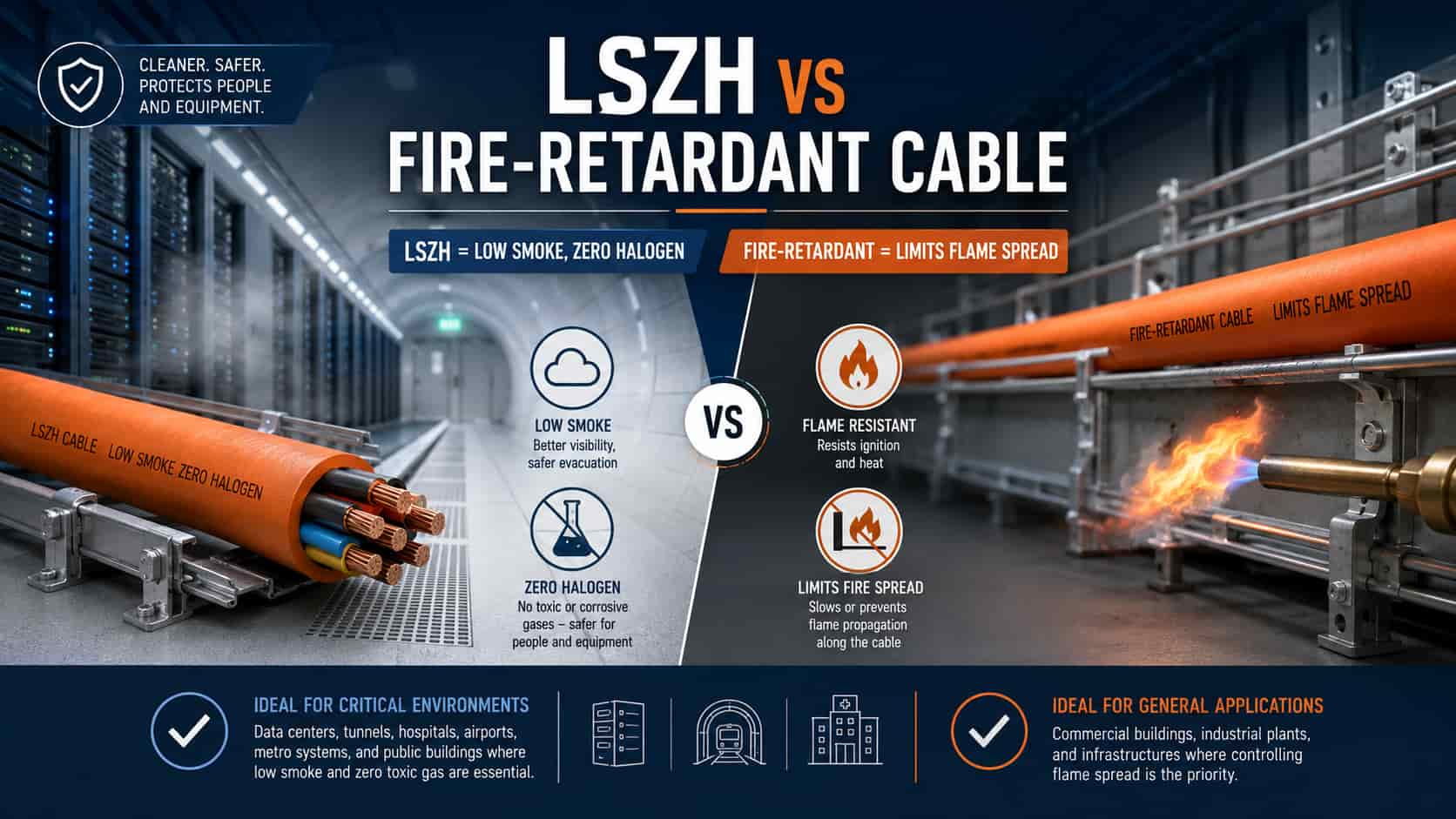
“LSZH” and “fire-retardant” show up together so often on cable datasheets that many buyers assume they mean the same thing. They don’t. Each term describes a different aspect of how a cable behaves in a fire — and understanding the distinction matters when you’re specifying cable for a building, tunnel, ship, or any space where fire safety codes apply.
What LSZH actually means
LSZH stands for Low Smoke Zero Halogen. It describes what happens when the cable’s outer sheath and insulation materials burn — specifically, that they release minimal smoke and do not emit halogen gases (like chlorine, commonly released by standard PVC when burned). Halogen gases are dangerous for two reasons: they’re toxic to breathe, and they combine with moisture to form corrosive acids that can damage sensitive electronic equipment even after a fire is extinguished. LSZH is primarily about limiting the toxicity and corrosivity of what a burning cable releases — not about whether the cable itself keeps burning.
What "fire-retardant" actually means
Fire-retardant (sometimes called flame-retardant) describes a cable’s resistance to sustaining or propagating a flame. A fire-retardant cable is designed so that if it does catch fire — often due to an external ignition source — the flame does not travel along the length of the cable to spread to other equipment or cable runs. This is typically tested and certified against standards like IEC 60332, which specifically measures flame propagation along a cable or bundle of cables.
The key difference in one sentence
Fire-retardant is about whether the fire spreads; LSZH is about what the smoke contains if the cable does burn. A cable can be fire-retardant without being LSZH, and in principle could be LSZH without a strong fire-retardant flame-propagation rating — though in practice, most cable designed for critical facilities is specified to meet both properties together.
Where each property matters most
Fire-retardant performance matters most anywhere cables are bundled together in trays or ducts, since a fire that propagates along a cable run can spread damage far beyond its original source. LSZH matters most in enclosed, occupied, or equipment-dense spaces where toxic smoke or corrosive gas would cause serious harm to people or hardware — this is exactly why LSZH cable is standard specification in data centers, hospitals, transit tunnels, and ships. If you’re specifying cable for a facility like a data center power project, LSZH is typically a baseline requirement rather than an optional upgrade.
Can a cable be both?
Yes, and for most critical-facility applications, this is exactly what’s specified — a cable that is both LSZH (low smoke, zero halogen) and rated fire-retardant against flame propagation standards. These aren’t mutually exclusive properties; they’re addressed by different aspects of the cable’s material formulation and construction, and a well-specified cable datasheet will state both ratings separately with their relevant standard references.
What to check on the datasheet
Look for explicit standard references rather than just the marketing terms — IEC 60332 (or equivalent) for flame propagation, and IEC 60754 / IEC 61034 for halogen content and smoke density, are the specific tests that back up “fire-retardant” and “LSZH” claims respectively. Also confirm the conductor size and voltage rating fit your project, the same way you would for standard XLPE or PVC cable — for guidance on that, see our cable sizing guide.
Where Kexingyu Power fits in
We manufacture LSZH and fire-retardant cable to IEC standards for data centers, commercial buildings, and other critical facilities. Browse the full range on our Cables & Wiring Systems page.
LSZH & Fire-Retardant Cable
Common questions from project buyers specifying cables for data centers, hospitals, transit systems and other fire-sensitive facilities.
01 Is LSZH cable required by code or only recommended?
This depends on the project location, facility type and governing fire-safety standard. LSZH cable is commonly specified for enclosed, occupied or equipment-dense spaces such as data centers, hospitals, transit tunnels and ships. Buyers should confirm the applicable building code, project specification and authority requirements before finalizing the cable construction.
02 Can a cable be both LSZH and fire-retardant?
Yes. LSZH and fire-retardant describe different performance properties and are often specified together. LSZH limits smoke, halogen gas and corrosive emissions when cable materials burn, while fire-retardant construction limits flame propagation along the cable. Critical-facility specifications commonly require both properties in the same cable.
03 Is fire-retardant cable the same as fire-resistant cable?
No. Fire-retardant cable is designed to resist flame propagation and reduce the spread of fire along a cable run. Fire-resistant, circuit-integrity or fire-survival cable is designed to continue carrying electrical power for a specified period during a fire. Emergency lighting, fire pumps and life-safety systems may require the second category.
04 How can buyers verify an LSZH or fire-retardant cable claim?
Check the datasheet and test documentation for explicit standard references rather than relying only on the words “LSZH” or “fire-retardant.” IEC 60332 covers flame propagation testing, IEC 60754 addresses halogen gas and acidity, and IEC 61034 measures smoke density. The supplier should be able to provide relevant test reports for the cable construction being offered.
Recent Posts
Voltage Stabilizers vs UPS: Do You Need Both?
Voltage Stabilizers vs UPS: Do You Need Both? One device fixes how high or low the voltage is; the other fixes whether there is voltage
Energy Storage for Data Centers: A Growing Backup Power Option
Energy Storage for Data Centers: A Growing Backup Power Option Batteries have always backed up data centers in the form of UPS strings. Grid-scale BESS
Thermal Runaway in Lithium Batteries: What BESS Buyers Should Understand
Thermal Runaway in Lithium Batteries: What BESS Buyers Should Understand How thermal runaway starts, how it propagates, and which evidence buyers should require before approving