
What Certifications Should You Check on a Power Cable Before Buying?
A practical checklist for verifying cable standards and test documentation before you place an order — not just taking a supplier's word for it.
Introduction
A cable datasheet can list impressive-sounding specifications and still fall short of what a project actually requires — the difference usually comes down to whether those specifications are backed by real, verifiable certification, or just stated as marketing claims. This checklist covers what to actually verify before an order goes ahead.
Why certifications matter more than they seem
Cable certification isn’t paperwork for its own sake — each standard corresponds to a specific, tested performance characteristic that affects safety, code compliance, or long-term reliability. Buying uncertified cable, or cable with certifications that don’t match your project’s actual requirements, is a risk that often doesn’t surface until an inspection, an insurance claim, or a failure years into service.
IEC standards — the global baseline
For most international projects, IEC standards form the baseline reference. IEC 60502 covers power cable for rated voltages from 1kV to 30kV, IEC 60332 covers flame propagation (fire-retardant performance), and IEC 60754 / IEC 61034 cover halogen content and smoke density for LSZH cable specifically. Confirm which specific IEC standard applies to your cable type and voltage class — a general reference to “IEC compliant” without a specific standard number is not sufficient documentation.
Region-specific standards
Depending on the destination country, your project may also need to reference regional standards alongside or instead of IEC — GB standards for projects with Chinese design input, BS standards for UK-influenced specifications common in parts of Africa and the Middle East, UL standards for North America, and AS/NZS standards for Australia and New Zealand. Confirm early in the project which standard set your specification actually requires, since manufacturing to the wrong standard family can mean re-ordering.
Type test reports vs routine test certificates
These are not the same thing, and suppliers sometimes blur the distinction. A type test report is a comprehensive, one-time test of a cable design against the full requirements of a standard, typically performed by an accredited third-party lab. A routine test certificate confirms that a specific production batch passed basic quality checks, but does not re-verify the full standard compliance. For critical projects, ask for both — the type test proves the design meets the standard, and routine test certificates confirm your specific batch was manufactured correctly.
Certifications specific to cable type
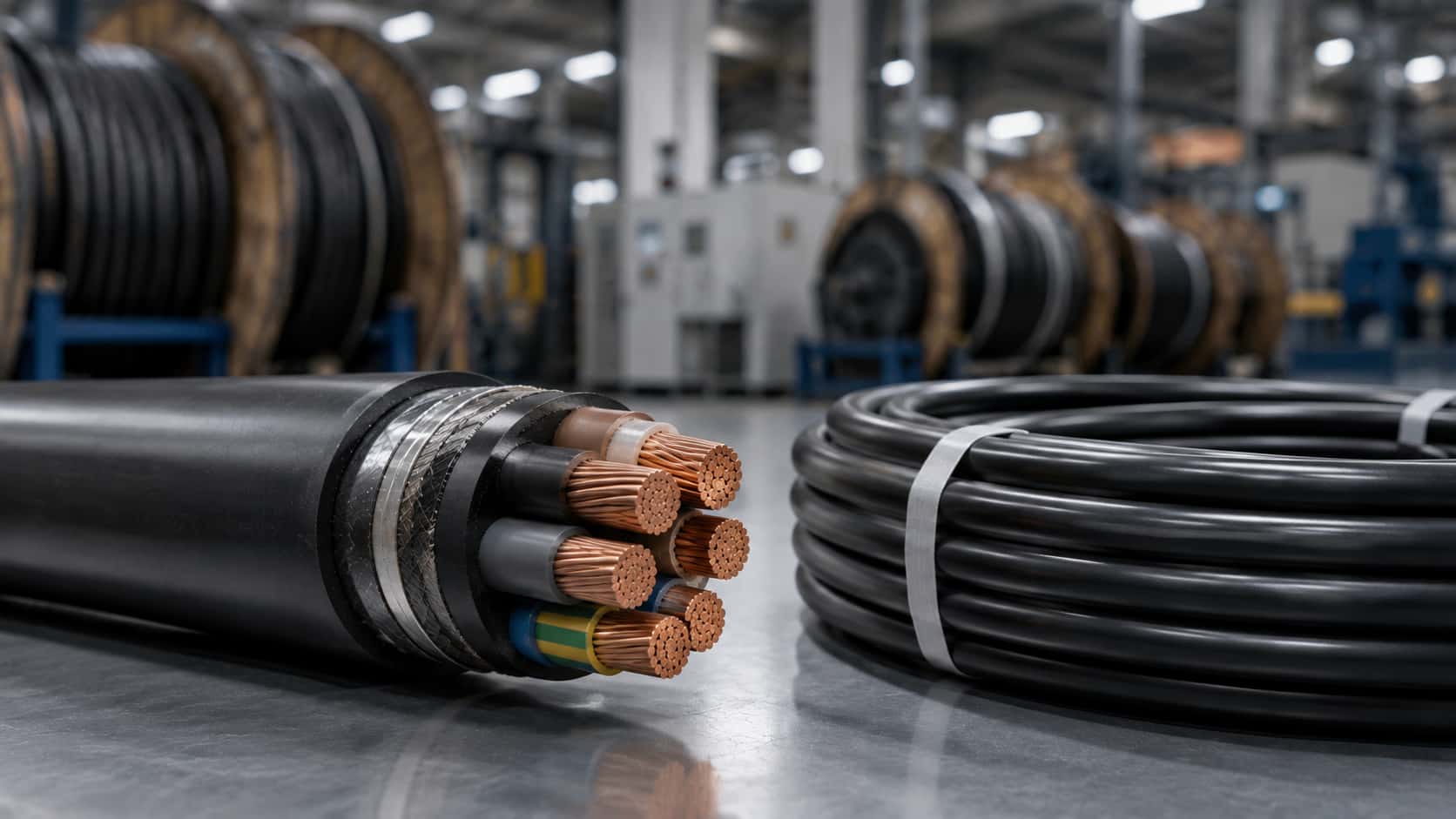
Some cable types carry additional certification requirements beyond the general standards above. LSZH and fire-retardant cable should reference the specific smoke and flame standards covered in our LSZH vs Fire-Retardant Cable guide. Solar PV cable should carry standards like EN 50618 or UL 4703, discussed in our solar cable specification guide. Matching the certification to the actual cable type and application is as important as confirming the certification exists at all.
Red flags when a supplier can't produce documentation
Be cautious if a supplier can only provide a general compliance statement rather than a specific test report with a lab name, test date, and referenced standard; if the datasheet lists standards without a way to verify them on request; or if routine test certificates aren’t available per production batch. A manufacturer confident in its product should be able to produce this documentation without friction.
A simple checklist before you order
Confirm the specific IEC (or regional equivalent) standard number for your cable type and voltage class; request the type test report from an accredited lab, not just a compliance statement; confirm routine test certificates will be provided for your specific production batch; and verify any application-specific certifications — LSZH, solar, armored — match what your project actually requires.
Where Kexingyu Power fits in
All cable we manufacture is produced to IEC and GB standards with type test reports and batch-level routine test certificates available on request. Browse the full range on our Cables & Wiring Systems page.
Cable Certifications
Common questions from project buyers reviewing cable standards, certification claims and test documentation before placing an order.
01 Is a compliance statement the same as a test report?
No. A compliance statement is the supplier's declaration that a cable meets a particular standard, while a test report records the tests performed, the results obtained and the exact cable design evaluated. Buyers should request the underlying report and confirm that its voltage rating, conductor size, insulation system and construction match the cable being offered.
02 Do I need both type-test reports and routine-test certificates?
For critical projects, both are commonly requested because they serve different purposes. Type testing demonstrates that a cable design meets the required performance standard, while routine testing checks each manufactured length or production batch for specified electrical and construction requirements. The purchase specification should clearly state which reports must be submitted before shipment.
03 Can cable tested to an IEC standard be used when the project specifies BS or GB?
Not automatically. IEC, BS and GB standards may share technical principles, but their detailed requirements, test methods, dimensions and acceptance criteria are not always identical. When a project specification names a particular standard, the cable and supporting documentation should normally comply with that stated standard unless the consultant or approving authority formally accepts an equivalent.
04 What should I do if a supplier will not provide test documentation?
Treat the refusal as a significant sourcing risk, especially when the documents were required in the enquiry or purchase specification. Ask for the report number, issuing organization, tested product description and validity details. Before placing the order, confirm that the submitted documents can be traced to the manufacturer and the actual cable construction being supplied.
Recent Posts

Voltage Stabilizers vs UPS: Do You Need Both?
Voltage Stabilizers vs UPS: Do You Need Both? One device fixes how high or low the voltage is; the other fixes whether there is voltage

Energy Storage for Data Centers: A Growing Backup Power Option
Energy Storage for Data Centers: A Growing Backup Power Option Batteries have always backed up data centers in the form of UPS strings. Grid-scale BESS
Thermal Runaway in Lithium Batteries: What BESS Buyers Should Understand
Thermal Runaway in Lithium Batteries: What BESS Buyers Should Understand How thermal runaway starts, how it propagates, and which evidence buyers should require before approving