Why Robot Cables Have Cores: Aramid and Center Support Elements Explained
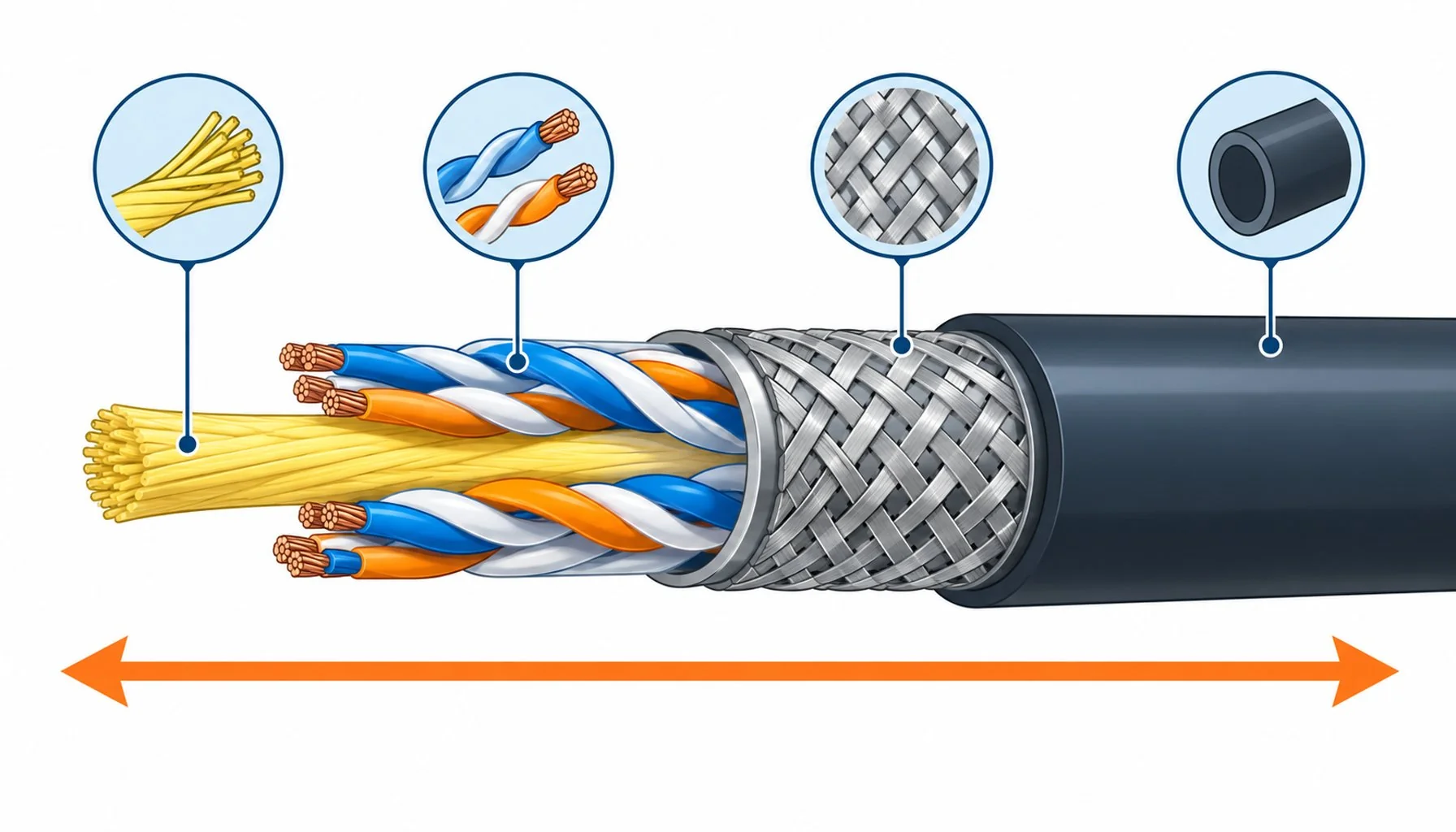
Quick Answer: The center element of a motion cable is its tensile skeleton: aramid or engineered cores carry the pull, keep geometry round and stop conductors from doing structural work they were never built for.
Strip the jacket off a quality robot cable and you find something most cable catalogs never mention: a dense yellow or white element running down the middle, or a carefully engineered core around which the twisted pairs wrap. Buyers see it as filler. Engineers know it as the part that decides whether the conductors spend their lives conducting electricity or pulling weight. On a moving cable, tension is everywhere: the cable’s own weight in a long chain travel, the acceleration forces of a robot axis, the reach of a gantry, the stored pull of a dress pack around a joint. Something in the cable has to carry that tension, and if the design provides nothing for the job, the copper does it, and copper under repeated tensile load fatigues exactly the way it does under bending. This guide explains the quiet center of motion cable: what aramid and other support elements actually do, the difference between a filler, a support and a tensile member, when each belongs in a build, and how to read a construction sheet to know which one you are buying.
Introduction
The center element exists because of a division of labor that stationary cable never needed. A cable bolted in place carries almost no tension; its conductors can sit idle in any geometry the jacket provides. A cable in motion is a structural member of the machine: it hangs, accelerates, decelerates and gets pulled around corners, every cycle, for years. Hand that structural role to the conductors and they fail in tension, at terminations and at the points where the load concentrates. Hand it to a dedicated element, and the copper keeps its day job. That is the entire logic, and it explains why the element is chosen for tensile strength, elasticity and bending behavior rather than for cheapness of volume. The failure it prevents, conductor fatigue under combined bending and tension, is the most common mode in the moving-cable catalog of cable failure causes, and the element is the least expensive insurance against it in the whole construction.
Aramid: The Material Doing the Heavy Lifting
Aramid, the family of fibers behind brand names like Kevlar and Twaron, dominates the tensile element role for good reasons. Its strength-to-weight ratio is exceptional, carrying loads that would need several times the weight in steel at a fraction of the mass. It is flexible, bending with the cable through millions of cycles without fatiguing the way a steel element would. It is non-conductive, so the tensile path stays out of the electrical circuit entirely. And it is cut-resistant, which is why the same fiber appears in gloves and sleeves around the plant. In cable, aramid appears in two geometries: as braided wrappings around the core, controlling strain distribution through the cable walls, and as longitudinal center elements carrying straight tensile loads. The engineering choice between and among them is a design decision, not a decoration, and it interacts with the lay geometry and the conductor construction covered in the stranding class guide: a cable whose tension path, lay and stranding are designed together behaves like a system, while a cable that adds aramid as an afterthought gets a consolation prize. Weight matters too, which is why aramid rather than steel dominates in robots and humanoids, where every gram is billed to the battery.
| Element | What It Is | What It Does | Where It Belongs |
|---|---|---|---|
| Aramid center element | Longitudinal aramid member at the cable center | Carries tensile load off the conductors; keeps the core round | Robot cable, high-cycle flex, any tension duty |
| Aramid braid or wrapping | Woven aramid layer around or within the core | Distributes strain through the cable wall; burst and tear control | Dress packs, torsion builds, demanding flex duty |
| Engineered center element | Extruded or braided non-aramid support member | Geometry control and moderate tensile support | Mid-duty flex cable, cost-balanced builds |
| Filler | Inert material filling interstices | Roundness and packing only; no tensile role | Static and light-duty cable; harmless but not protection |
| Steel tensile member | Steel wire or strand at the center | Maximum tensile capacity | Heavy reeling and vertical runs, where weight is not the enemy |
Filler, Support or Tensile Member: Reading the Construction Sheet
The difference between the elements is the difference between three products that look identical on a sales page, and the construction sheet is where a buyer tells them apart. It is also where supplier quality shows first, which is why the vetting logic in the manufacturer verification checklist applies before the fine print is read. Fillers are volume: cheap polymer or textile material that makes the cable round and keeps the pairs packed, contributing nothing against tension. Support elements add geometry control, keeping the core’s shape stable so the pair twisting behaves predictably through flex cycles. Tensile members carry load, and their specification language should say so: breaking load, elastic modulus, and how the element is anchored at the terminations, because a tensile member that slides at the gland transfers its load back to the copper at exactly the wrong place. The reading discipline is the same as everywhere in this series: ask what the element is made of, what load it is rated for, and how it is terminated, and treat any answer of filler as a sign that the cable expects its copper to do structural work. Buyers comparing builds across suppliers will find the wider method in the guide to reading equipment datasheets, and the accessory-side anchoring that finishes the tension path in the cable accessories review.
| Specification Line | What to Ask | Why It Matters |
|---|---|---|
| Element material and type | Aramid, engineered element or filler, in writing | Decides whether tension has a structural path at all |
| Breaking load of the element | Rated tensile capacity of the member, not the whole cable alone | Margin against the cable's actual weight and acceleration loads |
| Termination anchoring | How the element is clamped or potted at glands and connectors | An element that slips at the gland returns its load to the copper |
| Interaction with lay | Whether tension path and pair lay were designed together | System-built cables age evenly; patched ones concentrate strain |
| Weight contribution | Element mass per meter in the final build | On robots and humanoids the gram budget is real money |
When Center Elements Are Not the Answer
Honest limits: not every cable needs a tensile skeleton, and overspecifying it is its own small waste. A short, light run in a small chain carries little tension and lives fine on a support element or even a filler. Vertical runs and heavy reeling duty, meanwhile, need more than aramid comfortably provides, which is where steel tensile members and fully different constructions take over, and pretending an aramid element serves a 300-meter vertical reeling duty is a spec-sheet fantasy. The element also cannot substitute for the rest of the tension path: glands, strain reliefs and terminations carry the load into the machine, and a weak anchor defeats a strong member. And torsion duty changes the geometry question entirely, which is why the neighboring guide on torsion construction treats the center element as one player in a balanced lay rather than as a standalone hero. The element is insurance, cheap relative to what it protects, and worthless without the system around it.
RFQ Checklist: Getting the Core You Specified
Make the invisible layer a visible line item:
- Tension duty stated: cable weight per travel, acceleration loads, any vertical or reach component
- Element type and material required in writing, filler not acceptable for tension duty
- Breaking load and elastic behavior of the element, with margin against your duty
- Termination anchoring method described: how the load leaves the element into the machine
- Weight per meter of the final build, where robots and humanoids make grams count
- Flex test evidence at your duty, since the element is part of the system being tested
Conclusion
The center of a motion cable is where its structural life is decided, and it is the layer buyers look at least. Aramid elements carry the pull so the copper can carry the current; engineered supports keep geometry honest; fillers merely fill, and knowing which one is in the cable is the difference between specifying a motion product and rebadging a stationary one. Ask about the center, anchor it properly, and the conductors will spend their million cycles on electricity instead of weightlifting.
Kexingyu Cable Group (KXYE) builds robot and motion cable with aramid tensile elements specified by load and anchored by design, published in the construction sheet rather than hidden behind filler language. Send your tension duty through the RFQ page, and we will show you exactly what is holding your cable together.