Brazil: Automotive Recovery and a 38% Robot Growth Year

Quick Answer: Brazil’s robot installations jumped 38 per cent in 2025 with automotive demand roughly tripling, driven by Chinese carmaker investment, and every new body shop consumes motion cable by the kilometre.
Automation markets rarely move in straight lines, and Brazil just reminded everyone. IFR’s World Robotics 2026, published in September 2026, recorded Brazilian installations up 38 per cent for 2025, with the automotive industry’s demand roughly tripling on the back of new vehicle plants funded largely by Chinese carmakers. A 38 per cent year is a statistic; a tripling industry is a supply chain event, and it lands on cable suppliers with unusual force, because automotive body shops are the most cable-intensive environments in manufacturing outside a semiconductor fab.
Introduction
The recovery has a specific shape. Brazilian automotive production had run well below capacity for years, and the investment that turned the market came with a new ownership map: Chinese manufacturers building or retooling plants in Bahia and São Paulo state, bringing production engineering practices that automate heavily from day one. Global installations reached about 600,000 units in 2025 on IFR’s count, and Brazil’s 38 per cent growth stands out among large economies for what it represents: a cyclical rebound amplified by structural new entrants rather than a mature fleet inching forward.
This article reads the market from the demand side: where the new robots are working, what duty they impose on cable, and how Brazilian purchasing behaves in a boom year. The machine safety regulation that applies to Brazilian installations, including NR-12, is covered in its own guide and only referenced in passing here. Buyers comparing sources should start with the framework in the guide to international sourcing mistakes.
Where the 38 Per Cent Came From
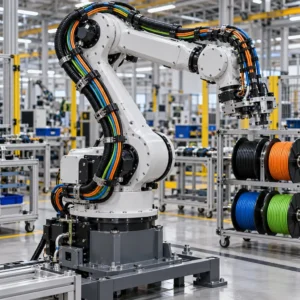
Automotive is the headline, and it deserves the detail. A new vehicle plant installs robots in waves: body-in-white welding cells first, then paint handling, then final assembly automation, then the tiered suppliers feeding them. Each wave carries its own cable duty. Welding cells combine heavy dress packs with heat, spatter and some of the strongest electromagnetic interference on any factory floor. Paint and sealing lines run long travels with torsion at every wrist. Supplier parks add machine tending and press automation at volumes that multiply the OEM’s own consumption.
Around the automotive spike, Brazil’s other industries added steadier growth: food processing, logistics, and the agro-industrial complexes that make the country’s export economy distinctive. These buyers automate more cautiously, but they broaden the cable market beyond its automotive core and give suppliers volume that survives the automotive cycle’s swings. The pattern matters for planning: a cable supplier who builds capacity only for automotive demand will ride a rollercoaster, while one who serves the steadier segments alongside it compounds through the cycle.
What Automotive Duty Does to Cable
Body shop duty is the hardest regular duty in the cable world, and Brazilian plants are no exception. Dress packs on welding robots flex through complex three-dimensional paths, every cycle, at heat levels that age jackets from the outside and spatter that pits them mechanically. Torsion at the wrist axes works the cable’s internal structure, and where stranding and lay length are wrong, failures appear within months rather than years. Add the EMI environment of weld controllers, and the shield requirements that electronics plants treat carefully become survival requirements here.
The failure analysis behind those requirements is well understood and documented in the guide to why cables fail on machines: torsion fatigue, jacket heat ageing, shield disruption near high-current switching. What Brazilian conditions add is distance and environment. Plants and supplier parks spread across wide sites, runs between buildings may need mechanical protection, a decision the guide to armoured versus unarmoured cable walks through, and the insulation choices for higher-voltage feeder runs compare as set out in the analysis of XLPE versus PVC insulation.
| Segment | What drove it in 2025 | Cable duty profile | What buyers press on |
|---|---|---|---|
| Automotive body and paint | New plants from Chinese carmakers; demand roughly tripled | Weld dress packs, torsion at wrists, heat, spatter, heavy EMI | Torsion life and spatter resistance with test evidence |
| Component and supplier parks | Tier suppliers following the new OEM capacity | Machine tending, press automation, three-shift cycles | Duty-matched ratings and reliable delivery |
| Food and agro-industry | Steady modernisation of export-scale processing | Washdown-rated jackets, cold rooms, moderate cycles | Washdown compliance and jacket durability |
| Logistics and ports | Export infrastructure and e-commerce build-out | Continuous motion, weather exposure, long outdoor runs | Weathering performance and mechanical protection |
How Brazilian Buying Behaves in a Boom
The automotive concentration has a sourcing consequence worth stating plainly. New plants commission on global schedules, and their cable arrives through integrators and machine builders who specify to the parent company’s standards, then through local channels who supply the spares and the second-phase orders. A supplier who enters with the first wave and holds construction stability through the second becomes the replacement default for years. One who enters with the first wave and substitutes later loses the account permanently. The supply-model choices that shape this are compared in the guide to OEM versus ODM supply.
When Growth Headlines Are Not the Answer
Boom-year purchasing has its own physics. Schedule pressure rises, so suppliers who commit honestly to lead times win against those who promise optimistically and slip. Compliance attention rises with it, because new plants are inspected thoroughly from the start, and the safety regulation that governs machine installations, NR-12 among others, touches cabling through the machine’s overall compliance; the regulation itself is treated in the dedicated guide, and the broader certification landscape maps onto the overview in the cable certification checklist. And the installed base grows so fast that the replacement phase begins earlier than in slow-growth markets, because intensive three-shift duty ages cable on schedule regardless of how new the plant is.
The wider environment matters too. Import logistics into Brazil are famously demanding, with customs processes and local content considerations that stretch timelines, and freight across long inland distances adds cost that ex-works pricing hides. Buyers know this and discount suppliers who ignore it, which is why landed-cost realism, addressed in the guide to international sourcing mistakes, earns credibility here faster than a low headline price.
| Decision | Why it matters in this market | Practical handling |
|---|---|---|
| Torsion and flex evidence | Body shop duty punishes wrong stranding within months | Provide torsion test data and flex results at the real radius |
| Spatter and heat resistance | Weld cells age jackets from outside in | Offer spatter-resistant jacket grades with test evidence |
| Landed-cost realism | Customs and inland freight reshape ex-works prices | Quote the landed model; discount suppliers who ignore it |
| Construction stability | Second-wave orders become replacement defaults | Lock constructions with change control from the first order |
| Site runs and protection | Wide sites and outdoor runs need mechanical protection | Decide armoured versus unarmoured per run, not per project |
RFQ Checklist: Motion Cable for a Brazilian Plant
Three cautions. First, a 38 per cent year is not a trend line; Brazil’s automation demand has cycled before, and a supplier who builds for the spike without the steadier segments will feel the trough. Second, the automotive tripling reflects new capacity arriving, not a mature market’s steady state; today’s commissioning wave becomes tomorrow’s replacement base only if suppliers hold their constructions and their records. Third, growth does not simplify compliance: machine-level safety regulation applies as it does everywhere, and the certification overview in the cable certification checklist remains the honest map before any shipment.
Conclusion
Send these so the quote survives the boom-year schedule:
- Application: weld cell, paint handling, machine tending, washdown or logistics duty
- Duty per axis: travel, cycles per shift, torsion at wrists stated explicitly where present
- Actual bend radius and dress pack path geometry for robot applications
- Environmental exposure: spatter, heat, washdown chemicals, weather for outdoor runs
- Required compliance paperwork, named at inquiry stage and matched to the regulation
- Delivery window with the commissioning schedule attached
- Landed-cost terms: who handles customs, port and inland legs
- Spares plan for the first two years of three-shift operation