
Why Mineral Insulated Cable Protects Data Center Fire Circuits
Quick Answer: Mineral insulated cable survives fire because its insulation is magnesium oxide and its sheath is solid copper — nothing in the current path can burn, melt at fire temperatures or release gas. That is why BTTZ and its flexible relatives protect the circuits a data center must keep alive: fire pumps, alarms, smoke extraction and emergency lighting.
Introduction
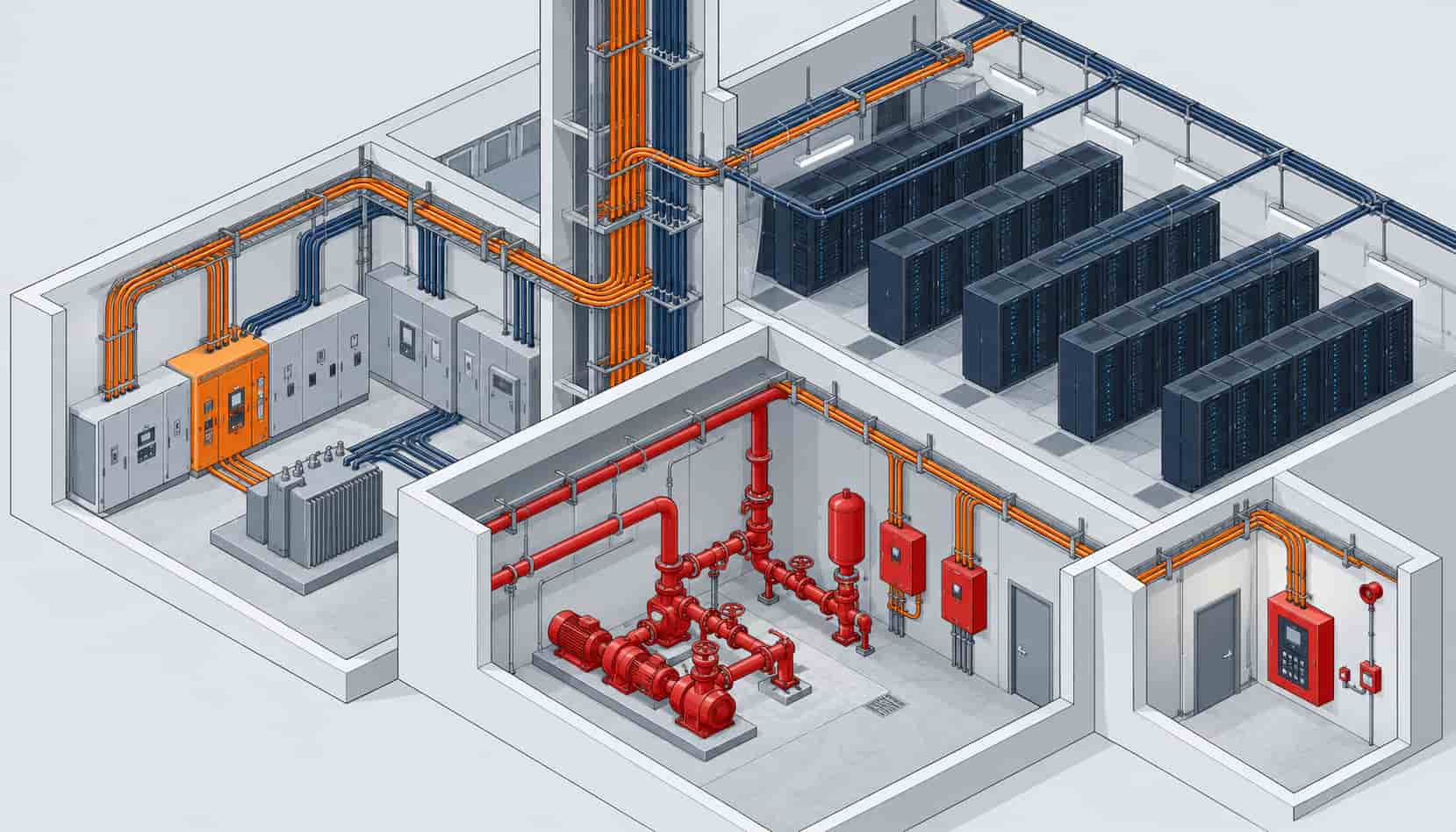
A data center fire is a low-probability event with an asymmetric cost: the building may survive, but the circuits that fought the fire — and the certification that proves they did — determine whether the facility reopens at all. This is why fire protection engineers treat certain circuits differently from everything else in the building. They must conduct electricity during the fire, not merely afterward, and the cable that carries them is specified for survival rather than efficiency. The stakes keep rising with the buildout we track in data center power demand growth, and the fire-safety conversation now extends across our wider data center power equipment coverage.
Mineral insulated cable is the strongest answer available, and its rigid form — BTTZ in the Chinese designation system — has protected tunnels, airports and petrochemical plants for decades. Data centers now specify it, or its flexible successors BBTRZ and NG-A (BTLY), for the same reason. This article explains the physics, the standards, the practical installation behavior, and where mineral insulated cable is — and is not — the right specification.
Which Circuits Must Survive the Fire
Codes and insurers converge on a short list of circuits that must keep working while the fire burns: fire pump supplies, fire alarm and detection loops, smoke extraction and stairwell pressurization fans, emergency lighting and evacuation systems, and in data centers specifically, the suppression system controls. Each of these performs its function during the event. A feeder that fails at minute four of a sixty-minute fire scenario has failed its only job.
The environment these circuits face is severe: direct flame at 750-950 °C, water from sprinklers hitting hot sheaths, mechanical shock from collapsing structures, and in some test regimes a sequence of all three. Ordinary flame retardant cable resists the spread of fire along itself; it is not designed to carry current through the flame. That distinction — the one between not burning and continuing to operate — is the entire reason fire-rated cable exists, and it is developed further in our LSZH versus fire retardant cable comparison.
The Physics: Why Magnesium Oxide Does Not Burn
BTTZ cable is built from the outside in as copper sheath, compressed magnesium oxide powder insulation, and solid copper conductors. Every component is inorganic. Copper melts at 1083 °C, above the sustained temperature of most building fire scenarios the tests model; magnesium oxide is a ceramic that insulates as well at 900 °C as at room temperature. There is no polymer in the current path, so there is nothing to pyrolyze, drip, or emit corrosive gas — and the cable emits essentially no smoke.
This construction is why the cable does not need flame to be survived — it simply does not participate in the fire. The trade-offs are mechanical: mineral insulation absorbs moisture if the sheath is breached, so end sealing is critical, and the rigid form has a minimum bending radius that congested routes must respect. Those practicalities, not the physics, are where installation planning earns its money.
Rigid BTTZ, Flexible BBTRZ and BTLY: Picking the Form
Rigid mineral insulated cable offers the ultimate fire performance but pulls stiff: large cross-sections need forming tools, bending radii are generous, and long runs demand more joints, each a sealed termination that moisture can attack. Flexible mineral insulated designs — BBTRZ, NG-A (BTLY) and similar constructions — wrap the conductors in mineral or mica-based insulation inside a metal sheath or interlocked armor, holding a comparable fire survival rating while bending and pulling like conventional cable. On congested risers and retrofit routes, flexibility frequently decides the specification; on short, straight, critical runs, rigid BTTZ remains the most robust answer.
Between mineral insulated products and the polymer fire-resistant family sits WDZN-YJY: mica-glass tape over the conductor inside a low smoke zero halogen construction, whose XLPE insulation behaves very differently in fire than PVC — the material contrast is explained in our XLPE versus PVC cable comparison. It survives fire for the required duration at lower cost and installs like ordinary cable, which is why it dominates general fire-resistant applications. The strictest life-safety circuits — fire pumps above all — still justify metal-sheathed mineral construction. Where the line sits is an engineering decision per circuit, made against the test standards below.
| Option | Construction | Fire Survival Behavior | Best Used For |
|---|---|---|---|
| BTTZ (rigid MI) | Solid copper conductors, compressed MgO, copper sheath | Full current through flame; no smoke or gas; survives water spray and shock | Fire pumps, shortest critical runs, highest-hazard circuits |
| BBTRZ / NG-A (BTLY) | Mineral or mica insulation, metal sheath or interlocked armor, flexible | Comparable survival rating with conventional pulling and bending | Risers, congested routes, retrofit life-safety circuits |
| WDZN-YJY | Mica-glass tape over conductor, XLPE insulation, LSZH sheath | Fire-resistant duration at lower cost; installs like standard cable | General fire-resistant circuits where code permits |
| Flame retardant only | Standard conductor and insulation, flame-retardant sheath | Does not spread fire; does not carry current through flame | Not applicable to life-safety circuits |
The Standards: BS 6387, GB/T 19216 and IEC 60331
International buyers most often reference BS 6387, whose categories describe survival under combined attack: C for fire alone at 950 °C for three hours, W for fire plus water spray, and Z for fire plus mechanical shock — the full C-W-Z sequence being the demanding benchmark for fire pump circuits. GB/T 19216 specifies the Chinese flame-through regime, and IEC 60331 provides the international equivalent. A serious manufacturer states exactly which category the offered product passes and supplies the type test report; the difference between passing C and passing C-W-Z is a real engineering difference, not paperwork.
Evidence discipline matters as much as the rating. Fire performance is the most-counterfeited claim in the cable market precisely because it is invisible until the worst day. The verification chain — type test reports matching the exact construction, batch routine tests, and third-party inspection where the project warrants it — is the same one described in our power cable certifications checklist, applied with extra rigor on fire-rated lines.
The Standards: BS 6387, GB/T 19216 and IEC 60331
International buyers most often reference BS 6387, whose categories describe survival under combined attack: C for fire alone at 950 °C for three hours, W for fire plus water spray, and Z for fire plus mechanical shock — the full C-W-Z sequence being the demanding benchmark for fire pump circuits. GB/T 19216 specifies the Chinese flame-through regime, and IEC 60331 provides the international equivalent. A serious manufacturer states exactly which category the offered product passes and supplies the type test report; the difference between passing C and passing C-W-Z is a real engineering difference, not paperwork.
Evidence discipline matters as much as the rating. Fire performance is the most-counterfeited claim in the cable market precisely because it is invisible until the worst day. The verification chain — type test reports matching the exact construction, batch routine tests, and third-party inspection where the project warrants it — is the same one described in our power cable certifications checklist, applied with extra rigor on fire-rated lines.
Installation: Where Mineral Insulated Projects Succeed or Stall
Mineral insulated cable changes the installation plan, and projects that ignore this stall. Rigid BTTZ needs bending radii several times the cable diameter, support spacing tighter than polymer cable, and sealed terminations at every end — plus gland kits and potting compounds on site. Route surveys should pre-identify every bend and termination point, and drum lengths should be cut to route segments so joints land where the design put them, not where the drum ran out.
Flexible mineral insulated products relax the pulling plan but not the sealing discipline: every cut end is a moisture path until sealed, and site storage in humid coastal climates — most of Southeast Asia and the Gulf — argues for sealed ends until the hour of termination. Inspectors increasingly ask for the sealing evidence as part of commissioning, and the mechanisms behind common cable failures — water in the wrong place, terminations done in haste — apply to fire-rated circuits with higher stakes than anywhere else.
| Circuit | Recommended Cable | Rating Anchor |
|---|---|---|
| Fire pump supply | BTTZ rigid MI or BBTRZ flexible MI, sized per motor start study | BS 6387 C-W-Z full sequence |
| Fire alarm and detection loops | BBTRZ / BTLY flexible MI or WDZN-YJY per code | BS 6387 C or GB/T 19216 per AHJ |
| Smoke extraction and pressurization fans | Flexible MI in risers; rigid MI on short runs | C-W-Z where fans serve evacuation routes |
| Emergency lighting and signage | WDZN-YJY or flexible MI per duration requirement | IEC 60331 duration per circuit duty |
| Suppression system controls | WDZN-YJY with LSZH sheath; MI where routed through risk zones | Fire resistance plus IEC 60754 / 61034 |
When Mineral Insulated Cable Is Not the Answer
Mineral insulated cable everywhere is over-engineering, and the budget it consumes comes from lines that need it less. General lighting, small power and mechanical services circuits are properly served by LSZH flame retardant cable; the fire-resistant requirement attaches to the life-safety list, not the whole building. Specifying BTTZ for circuits that will never see flame buys copper sheaths at copper prices and installation friction for no additional safety.
The second over-reach is mechanical rather than electrical: routes with many tight bends, frequent terminations or vibration-heavy environments punish rigid MI construction, and forcing it there creates sealing and fatigue problems that defeat the cable’s purpose. Match the construction to the route — rigid MI where the run is straight and the stakes are highest, flexible MI where geometry is human, polymer fire-resistant where the code allows it. Kexingyu Cable Group (KXYE) manufactures all three families, which keeps that match a technical decision rather than a sales one.
RFQ Checklist: Buying Fire-Rated Cable
- Circuit list marking which loads are life-safety and their required survival duration
- Test standard and category: BS 6387 C, W, Z individually or the full sequence; GB/T 19216; IEC 60331
- Construction preference per route: rigid MI, flexible MI, or polymer fire-resistant with justification
- Route survey with bend points, termination locations and drum length segmentation
- Sealing and gland kit scope, potting compounds and storage plan for humid climates
- LSZH requirements where circuits run through occupied or enclosed spaces
- Type test report copies matching the exact construction, plus batch routine test records
- Third-party inspection scope for fire-rated lines
- Delivery milestones aligned to riser and pump-room construction sequence
- Copper price mechanism, since sheaths and conductors make MI cable copper-intensive
Fire-rated cable is one of the categories where the factory’s own quality system matters most, because the product’s entire value is in an event nobody hopes to witness. Buy it from a manufacturer, with reports, per drum.
Conclusion
Mineral insulated cable protects data center fire circuits for a reason rooted in physics: copper and magnesium oxide have nothing to burn, so the circuit keeps conducting through conditions that destroy every polymer-based cable in the building. Rigid BTTZ is the most robust form, flexible BBTRZ and BTLY bring the same survival to real-world routes, and WDZN-YJY extends fire resistance affordably to the circuits that need less.
Specify per circuit rather than per building: the life-safety list earns metal-sheathed mineral construction, the rest of the plant earns LSZH, and every fire-rated line earns type test evidence that matches the drum it ships on. That discipline costs minutes in the specification and buys the only outcome that matters on the day it is tested.
Recent Posts
Thermal Runaway in Lithium Batteries: What BESS Buyers Should Understand
Thermal Runaway in Lithium Batteries: What BESS Buyers Should Understand How thermal runaway starts, how it propagates, and which evidence buyers should require before approving
Energy Storage for Data Centers: A Growing Backup Power Option
Energy Storage for Data Centers: A Growing Backup Power Option Batteries have always backed up data centers in the form of UPS strings. Grid-scale BESS
YJV vs YJY: Reading Chinese Cable Designations Like a Local
YJV vs YJY: Reading Chinese Cable Designations Like a Local YJV vs YJY: Reading Chinese Cable Designations Like a Local Quick Answer: YJV and YJY