
Data Center Power Demand Growth: What the Next 5 Years Look Like
Data center power demand is climbing at a pace the industry has not seen since the cloud build-out of the 2010s—and the next five years will decide who gets the transformers, switchgear and grid capacity to grow, and who waits in the queue.
Introduction
Every forecast published in the last two years has been overtaken by events. Estimates of global data center electricity demand that looked aggressive in 2022 were revised upward when AI training clusters arrived, revised again as inference workloads spread into enterprise software, and revised a third time as sovereign AI programmes turned compute into national policy. The direction is not in dispute; only the slope is. Across credible forecasts, data center demand grows several times faster than overall electricity demand through 2030, with AI-adjacent facilities growing fastest of all.
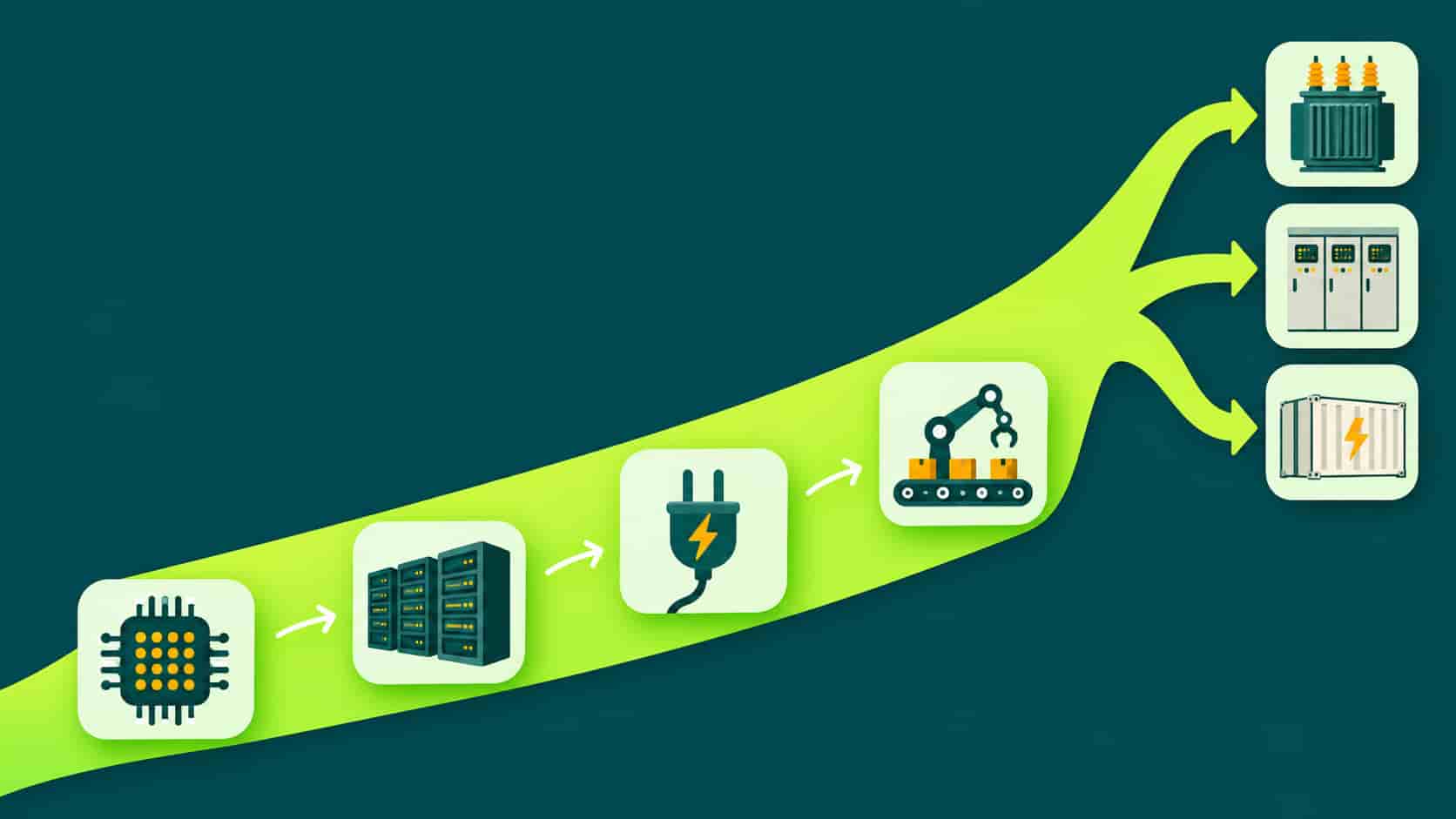
For the people who actually build these facilities—developers, EPC contractors and the equipment suppliers behind them—the forecast matters less as a number than as a set of physical consequences. Power demand becomes transformer orders. Transformer orders collide with a manufacturing base that was already short. Grid queues stretch connection dates beyond construction schedules. And every one of those frictions lands on the data center power equipment procurement plan.
This article unpacks the drivers behind the next five years of demand growth, where the power will physically come from, and what the growth curve means for equipment lead times, pricing and purchasing strategy. It is written for buyers rather than analysts: the question is not “how big is the market” but “what should I order, and when.”
Why the Forecast Keeps Moving Up
The revision cycle has a simple mechanism. Traditional enterprise demand grew predictably with office IT and cloud migration, which is why a decade of forecasts held roughly to trend. AI broke the trend in two ways at once: training clusters concentrate enormous power in single buildings—well beyond what a hyperscale hall drew five years ago—and inference moves compute out of a few giant regions into dozens of mid-sized markets close to users. More sites, each drawing more power, in places where the grid was sized for light industry.
Capacity announcements reinforce the loop. When operators announce gigawatt-scale campuses, utilities plan transmission for them, which reassures investors, which funds more campuses. The pipeline of announced projects now far exceeds the pipeline of energized ones—and that gap is exactly where equipment buyers live. A forecast that only counts announced capacity overstates near-term demand; a forecast that only counts energized capacity understates the procurement surge already working its way through transformer factories. Planning against the gap, not either endpoint, is the practical position.
The Five Drivers Behind the Numbers
Demand growth is not one force but five, and they pull on the equipment supply chain in different places. The table below is the version procurement teams work from.
| Driver | What Is Changing | Impact on Power Equipment |
|---|---|---|
| AI and HPC clusters | Single-site loads moving from tens of MW toward hundreds of MW | Larger substations, more MV switchgear bays, higher-capacity transformers per building |
| Cloud regions and edge build-out | Growth spreading from a few hubs into dozens of secondary markets | Repeat volumes of mid-sized packages instead of one-off mega orders |
| Grid interconnection queues | Connection dates stretching years beyond construction schedules | On-site generation, storage and interim substations to bridge the wait |
| Efficiency and sustainability rules | Reporting requirements and power-usage commitments hardening into policy | Higher-efficiency transformers, monitoring, and storage for peak management |
| Ageing facility retrofits | First-generation cloud halls upgrading power trains in place | Replacement transformers and switchgear ordered under live-facility constraints |
The drivers compound rather than add. An AI campus in a grid-constrained market hits all five at once: it needs more equipment per building, in a market with the longest queue, against efficiency rules, while neighbouring legacy facilities are retrofitting with the same suppliers. That is why demand signals show up in lead times before they show up in any statistics.
Where the Power Will Come From
Grid connection remains the backbone, but the queue is reshaping the mix. In the markets attracting the most build-out, connection requests already exceed what local networks can absorb, and utilities are quoting wait times measured in years for new large feeds. Developers respond in three ways, and each pulls different equipment.
First, they buy position in the queue—securing capacity early, sometimes before the facility design is finished, which pulls transformer and switchgear orders earlier in the project cycle. Second, they bridge the wait with on-site resources: gas generation, battery storage sized to shave the facility’s own peaks, and interim substations that can be redeployed when the permanent feed arrives. The storage play in particular has matured—our overview of data center energy storage backup covers how operators are using it between grid limits and load growth. Third, they design for staged energization, phasing MV distribution so the first halls can run on partial infrastructure while the rest is built.
The physical consequence: the next five years of data center demand is also a five-year demand surge for transformers, medium-voltage switchgear, backup generation and storage—competing with data centers’ own growth for factory slots that were already tight before AI arrived.
What Growth Means for Lead Times and Prices
Every driver in the first table eventually becomes a procurement event. The translation looks like this.
| Market Shift | Effect on Lead Times and Pricing | Action for Buyers |
|---|---|---|
| Equipment queues lengthen | Large power transformers quoting multi-year; MV switchgear in many months | Order the long-lead anchor items at planning stage, not at detailed design |
| Price inflation on key components | Grain-oriented electrical steel, copper and factory slots repriced upward | Fix prices and quantities in framework agreements where demand is firm |
| Capacity reserved earlier | Factories allocate slots by order date, not urgency | Reserve slots with contractual dates; our transformer lead-time piece shows the mechanics |
| Designs standardise | Repeat ratings let factories plan runs and shorten queues | Standardise transformer and switchgear ratings across the portfolio |
| Framework agreements replace spot buys | Buyers without frameworks pay both longer waits and higher prices | Consolidate volumes with one coordinated supplier before the next phase |
The pattern is consistent across markets: the buyers who treated equipment as a planning item in 2024-2025 are energizing on schedule now, and the buyers who treated it as a construction item are paying for slots that no longer exist at prices that did not used to be quoted. The shortage dynamics for both switchgear and transformers have been building for two years—our separate looks at the data center equipment shortage and switchgear lead-time planning go deeper on both.
When Chasing the Peak Forecast Is Not the Answer
The counter-risk is real too. A five-year forecast is a probability distribution, not a schedule, and equipment bought against the top of the range can strand capital the same way equipment bought against the bottom strands schedules. Three disciplines keep the build-out honest.
First, phase against energized demand, not announced demand: order the first phase against contracted tenants and committed loads, and hold the later phases as options rather than orders. Second, standardise before you scale—a repeatable rating across sites turns every later order into a factory’s planned run instead of an emergency. Third, keep the demand signal separate from the hype cycle: a campus announcement is not a load, and a load is not a connection agreement. Equipment decisions should track the most conservative document in that chain that still guarantees revenue.
How to Position Your Next 5 Years of Purchases
Translating the forecast into a procurement posture comes down to a short list:
- Map every project’s long-lead items—power transformers, MV switchgear, generator sets—and put real dates against each;
- Reserve factory slots at planning stage with contractual delivery dates and stage payments;
- Standardise ratings across the portfolio so repeat volumes earn priority and shorter queues;
- Plan the grid-queue bridge—storage, interim generation or a mobile substation—into the schedule instead of discovering it late;
- Consolidate purchases with one coordinated supplier so interface responsibility and slot priority sit in one contract;
- Revisit the plan quarterly: lead-time quotes from suppliers are the most current demand forecast money can buy.
Conclusion
The next five years of data center power demand will reward the same instinct that rewarded the last five: treat power equipment as the schedule, not as a line item on it. The growth is real, the drivers compound, and the manufacturing base responds to order dates rather than intentions.
Buyers who lock capacity early, standardise what repeats, and plan the grid queue as part of the design will find the growth curve navigable. Buyers who wait for forecasts to converge will discover that in this market, the forecast converges after the factory slots are gone.
Frequently Asked Questions
The questions equipment buyers and facility planners ask most about the demand outlook.
Recent Posts
Voltage Stabilizers vs UPS: Do You Need Both?
Voltage Stabilizers vs UPS: Do You Need Both? One device fixes how high or low the voltage is; the other fixes whether there is voltage
Energy Storage for Data Centers: A Growing Backup Power Option
Energy Storage for Data Centers: A Growing Backup Power Option Batteries have always backed up data centers in the form of UPS strings. Grid-scale BESS
Thermal Runaway in Lithium Batteries: What BESS Buyers Should Understand
Thermal Runaway in Lithium Batteries: What BESS Buyers Should Understand How thermal runaway starts, how it propagates, and which evidence buyers should require before approving