Chemical Resistant Cable for Site Exposure: Acid, Oil and Solvent Selection
Quick Answer: Chemical resistance is a system property, not a sheath property. The compound that resists the chemical is not always the one that survives the temperature, the UV or the mechanical duty, and the fluid usually reaches the cable through a gland or a sheath nick rather than through the polymer itself. The buyer’s job is to name the chemical, its concentration and its temperature, choose the sheath and the accessory together, and ask for evidence on the compound rather than on the cable reference. Pick wrong and the sheath swells, hardens or cracks within a season.
Introduction
A chemical plant, an effluent works and a food factory all buy cable into some kind of exposure, and the exposure is rarely uniform. One run sits above a bund and takes occasional splash, another is washed with caustic every night, and a third sits in vapour that nobody has ever measured.
This guide is for the buyer who has to specify cable against a chemical rather than against a weather condition. It covers what site chemicals actually attack, why resistance belongs to the whole construction and not just the outer sheath, how oil, acid and solvent duties differ, and the decisions to freeze before the order goes out. Constructions built for these duties sit in our oil resistant cable range, and the material comparison behind them is in our note on cable sheath materials compared.
What Site Chemicals Actually Attack
The polymer itself, in three different ways. A chemical can swell the sheath, soften it, or harden and crack it. Swelling changes the diameter and can jam a gland; softening loses the abrasion resistance that the outer layer was bought for; cracking opens a path to everything underneath.
The inner layers long before they are visible. Fillers, tapes and the bedding between the cores are often less resistant than the sheath, and once the fluid is past the outer layer it finds them first. A cable can look sound and have a degraded core wrapping inside it.
The metal layers. Acids and alkalis attack steel armour, aluminium tape and the tinning on a conductor, and the attack is usually faster once the fluid has breached the outer layer. On a chemical site the metal layers are the part that decides how long the run lasts.
Resistance Is a System Property
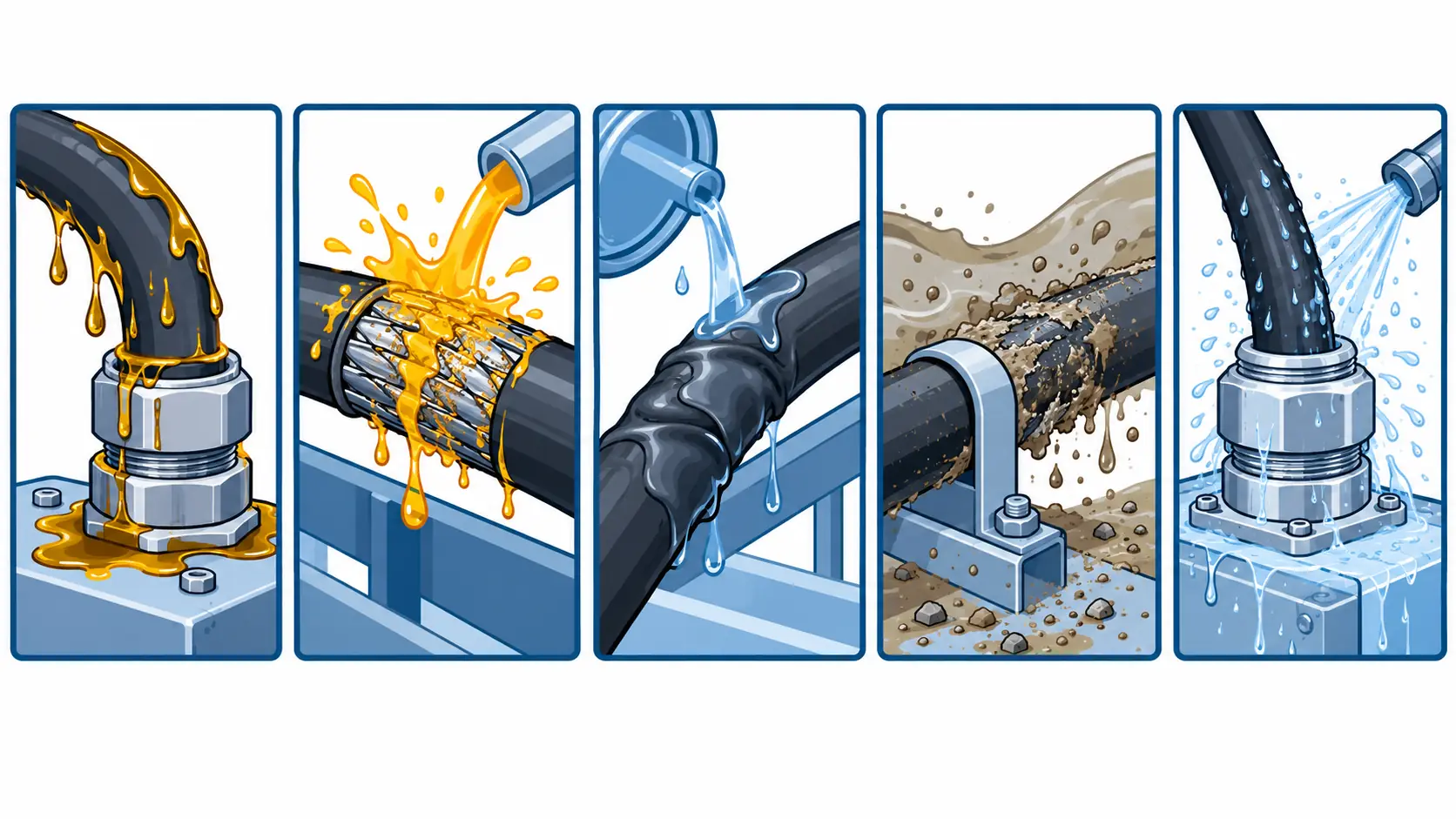
The table sets out the exposure types a buyer actually writes into a specification: what each one attacks, what to specify, the evidence to demand, what drives cost and lead time, and how each one fails when the choice is made on the sheath name alone.
| Exposure | What it attacks | What to Specify | Evidence to Demand | Cost and Lead-Time Driver | How It Fails |
|---|---|---|---|---|---|
| Mineral oil, fuel and hydraulic fluid | PVC and some rubbers soften and swell; oil creeps along cores and into glands | Sheath compound, oil temperature, and whether the duty is splash, mist or immersion | Oil immersion test to a named standard with duration, temperature and property change recorded | Special compounds are made to order and add weeks; common sizes are more available | A standard sheath that swells on contact, loosening the gland and opening the seal |
| Acid and alkali splash | Steel armour, aluminium layers and tinning, once the outer layer is breached | The chemical, its concentration and temperature, and the metal layers in the construction | Chemical resistance table from the compound maker plus the metal layers named on the construction sheet | Non-metallic or coated metal constructions cost more and can extend the lead time | An intact-looking sheath over an armour that has already been eaten through |
| Solvent and vapour | Almost every common sheath, by dissolving or softening it rather than swelling it | The solvent, its concentration, the vapour temperature and the contact time | Immersion or vapour test result on the specific compound, not a general resistance chart | The hardest duty to satisfy; often needs a barrier and mechanical protection rather than a better polymer | A sheath that softens and wipes away, leaving the cores exposed within weeks |
| Sewage and effluent | Sheath, fillers and metal layers at once, with abrasion added to the chemical duty | Compound with both chemical and abrasion evidence, plus the route and the washdown regime | Chemical and abrasion test results on the compound, with the effluent analysis named | Compounds that do both cost more; the accessory is often the limiting item | A sheath that survives the chemistry but is worn through at a support |
| Washdown chemicals and detergents | The gland seal and the sheath at every wash point, once or several times a day | The chemical, concentration, temperature and frequency of washdown | Compound data plus the gland seal material and its rating for the washdown | Small material cost; the programme cost is the correct accessories and the crew that fits them | A seal that fails at the gland and lets washdown water into the cores |
Oil, Acid and Solvent Are Different Problems
Oil is a swelling problem. Mineral oil and hydraulic fluid work their way into a polymer, soften it and swell it, and the swelling loosens the grip of the gland. Oil also creeps along the cores, so the part that fails is often a termination rather than the run. A compound that resists oil at 60 degrees may not resist it at 100, which is why the test temperature belongs in the specification. Our note on the cable oil resistance test covers how the evidence is normally presented.
Acid and alkali are a metal problem. The polymer often survives an acid that destroys the armour underneath it, and the failure appears as a broken earth path or a rusty armour with no visible sheath fault. Where the fluid is acidic or alkaline, the specification has to name the metal layers and not just the sheath compound.
Solvent is the hardest of the three. A solvent dissolves or softens the polymer rather than swelling it, and very few common compounds resist it for long. Where a solvent duty is unavoidable, the answer is usually mechanical: a barrier layer, a metallic protection and a route that keeps the cable out of the liquid rather than a more exotic sheath.
Temperature multiplies all of them. A chemical reaction roughly doubles in rate for every ten degrees, so a compound rated for a chemical at ambient may be unsuitable at process temperature. Specify the temperature of the fluid, not the temperature of the room.
What to Freeze Before the Order Goes Out
Six decisions decide whether a chemical-duty order can be accepted without argument. All are cheap to write into a requisition and expensive to discover once the drums are on site.
| Decision | What to State | Evidence to Attach | Cost of Leaving It Open |
|---|---|---|---|
| Chemical identity and duty | The chemical, its concentration, its temperature and whether the contact is splash, mist or immersion | A schedule naming the fluid at each run, taken from the process data sheet | A compound chosen for the wrong fluid, or for a temperature it never sees |
| Sheath compound and evidence | The compound, plus the specific test that proves it against that chemical | The maker's resistance data and the immersion test with duration and temperature | A general resistance chart accepted in place of a test on the compound delivered |
| Inner layers and fillers | Whether the fillers and tapes also resist the fluid, or are protected by a barrier | Construction sheet naming the inner layers and the barrier | A resistant sheath over a filler that degrades and lets the fluid along the cores |
| Metal layers and coating | The armour or screen material and the coating that has to resist the fluid | Material certificate for the metal layers with the coating named | Armour destroyed under an intact sheath, appearing later as an earth fault |
| Accessory material and seal | The gland material, seal compound and the enclosure metal it contacts | Gland specification sheet with the seal material and its chemical rating | A resistant cable landed in a gland that fails within one washdown cycle |
| Route, drip and spill control | The drip shields, bunds and washdown the route is exposed to | A route drawing with drip lines and wash points marked | A cable routed under a drip line that nobody thought to mention |
Installation and Routing Around Chemical Exposure
Route out of the drip line. The cheapest protection on a chemical site is moving the run a metre sideways, out of the splash zone of a flange or a sampling point. A drip shield over a gland is a small cost that removes most of the exposure.
Keep it out of the bund. A bund holds spilled chemical, and a cable lying in it is immersed in whatever the bund catches. Where the route has to cross one, run it high and protect the crossing.
Seal the gland against the fluid, not just the weather. A gland that is rated for rain is not necessarily rated for the site chemical, and the seal is often the first component to fail. Specify the seal material against the fluid and confirm it with the accessory supplier.
Repair with a documented material. A chemical site will damage a sheath during construction, and a wrap of general-purpose tape is not a repair. Use the maker’s repair material so the patch resists the same fluid as the cable, and record where it was applied.
Watch the supports. On an effluent or slurry duty the abrasion at a cleat can wear through a sheath the chemistry never touched. Support spacing and material belong in the same specification, and the failure patterns are in our note on oil resistant machine cable.
Incoming Inspection and Test Evidence
Ask for the test that matches the fluid. A generic “chemical resistant” claim is not evidence. What counts is an immersion or vapour test on the specific compound against the specific chemical, at the specified concentration and temperature, with the change in mass, hardness or tensile strength recorded.
Match the certificate to the construction. The compound on the certificate has to be the compound in the cable, and the construction sheet has to name the sheath, the inner layers and the metal layers. Where those do not line up, the evidence describes something else.
Cut a sample where the duty is severe. On a solvent or hot oil duty, a short sample taken from a drum end at goods-in is the only way to see the layers and the compound code. It is a five-minute check that no certificate replaces.
Record the baseline. Photograph the delivery and note the compound code on the goods-received document, alongside any test result supplied. Where the run is critical, the periodic checks are in our note on in-service cable testing.
Cost and Lead Time
Special compounds add a percentage rather than a multiple to the price and are usually available on a normal lead time in common sizes. Non-metallic or coated metal constructions add both material and process time and can run to order. Barrier systems with a metallic layer and a protective oversheath are the longest item, because several layers have to be applied and tested in sequence.
Copper is still the largest part of the bill on most orders, and the compound premium is small next to the movement in copper over a long programme. Ask how the copper element is calculated and how long the quotation holds; the mechanism is covered in our note on copper price and cable procurement.
When a Chemical Resistant Cable Is Not the Answer
When the exposure is occasional splash. A washable, UV-stable standard compound with a drip shield often outlasts an expensive specialty sheath that was bought for a duty the run never sees.
When the failure is at the accessory. Repeated faults at the same gland, on a run whose sheath is sound, point to the seal and the gland material rather than the cable. Fixing the accessory is cheaper and more effective.
When nobody has identified the chemical. A resistance claim against an unnamed fluid is a guess. Get the fluid identified with its concentration and temperature before the order, because a specification written against “chemicals generally” cannot be tested and cannot be enforced.
When the real problem is mechanical. On a duty where the cable is dragged, abraded or crushed, a better polymer does not solve a protection problem. Mechanical protection and a better route come first, and the chemistry is easier once the cable stays intact.
RFQ Checklist
- The chemical, its concentration and its temperature at each run, from the process data
- Whether the contact is splash, mist, immersion or vapour, and for how long
- Sheath compound, with a resistance test against that chemical at that temperature
- Inner fillers and tapes, and whether a barrier protects them from the fluid
- Metal layers and their coating, named on the construction sheet
- Gland material and seal compound, rated for the same fluid and confirmed against the panel metal
- Drip shields, bund crossings and washdown points shown on the route drawing
- Sheath repair material and the procedure to be issued with the delivery
- Support material and spacing, checked for abrasion as well as for chemistry
- Compound code and construction sheet shipped with each drum
- Any witnessed immersion or abrasion tests, with the acceptance criteria agreed in advance
- Copper basis and the validity window of the quoted price
Conclusion
Chemical duty is a system decision. Name the fluid with its concentration and temperature, choose a compound that has evidence against it, protect the metal layers and the inner materials, and land the cable in an accessory rated for the same fluid. Most failures blamed on a sheath are actually a gland, a filler or a piece of armour that was never specified, and those are the parts a buyer can control before the order.
Kexingyu Cable Group (KXYE) has manufactured cable in Quanzhou since 1996, including oil resistant, chemical duty and effluent constructions with sheath and filler systems matched to the fluid, and test evidence that names the compound and the test. Send us the fluid, its concentration and its temperature at each run, and we will come back with the compound, the accessory and the evidence that applies. A request for quotation is the fastest route.