Oil Resistance Testing: IRM Oils, Standards and Real-World Coolants
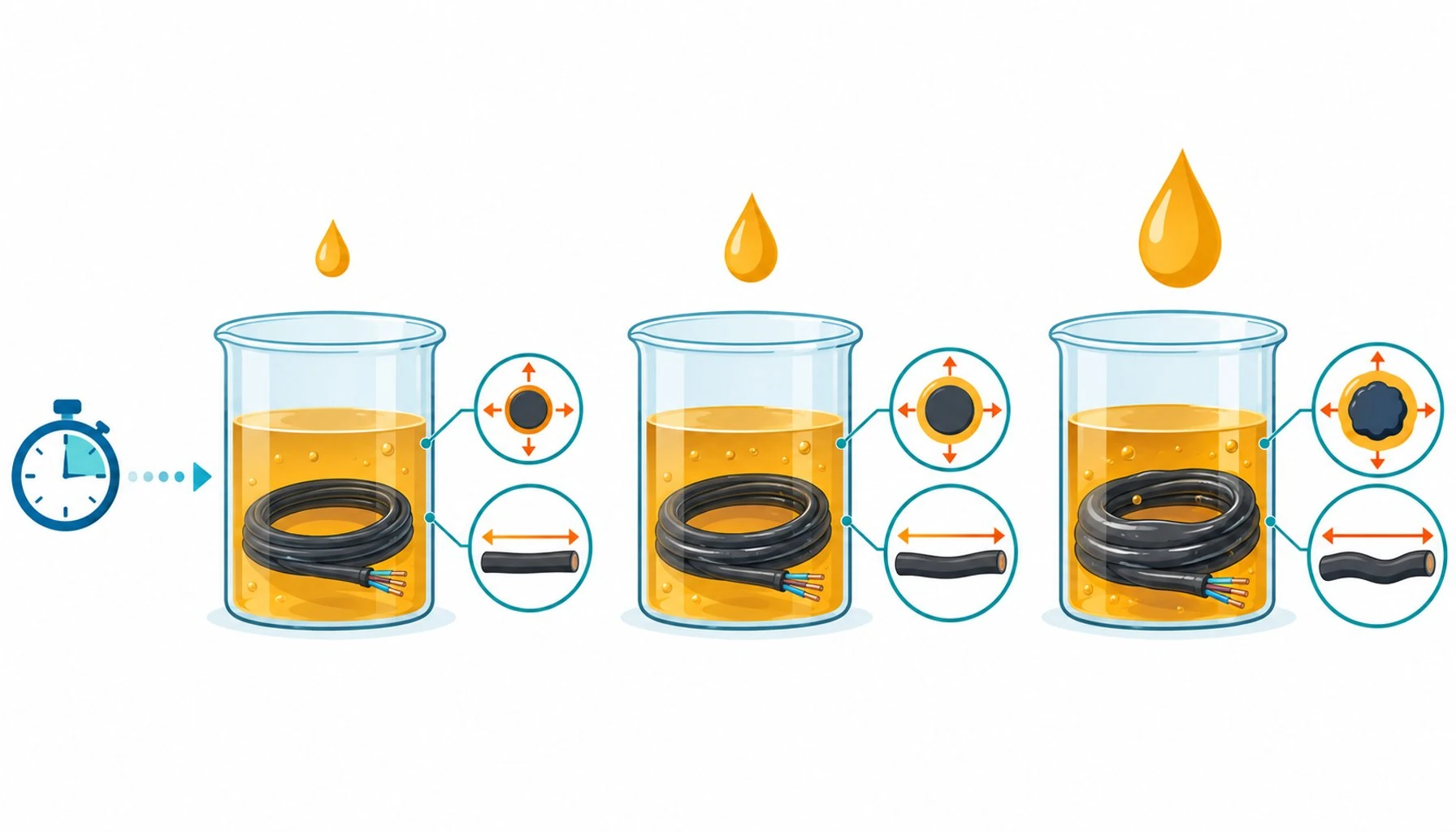
Quick Answer: Oil resistance testing soaks cable samples in standardized IRM reference oils, measures how tensile and elongation survive, and the result is a solid screening tool, as long as you remember that a machine tool’s real coolant is not the oil in the beaker.
Oil is the quiet killer of cable sheaths on the factory floor. Coolant mist settles on drag chains, hydraulic fluid drips into cable trays, lubricants pool in machine bases, and a sheath that swells, softens or cracks in that environment exposes everything inside it. Oil resistance testing exists to sort compounds before the floor does, and the method that dominates specifications is immersion in IRM reference oils under defined conditions, followed by mechanical retesting. The system works, but it carries a gap buyers should understand: reference oils are standardized stand-ins, and real machine coolants are emulsions with their own chemistry. This guide walks the method, the oils, the pass logic, and the distance between the beaker and the machine tool.
Introduction
Why not just test in real coolant? Because real fluids vary by brand, batch, age and contamination, and a test whose results depend on the dealer down the street is not a test. The standards community solved this the way it usually does, with reference materials: IRM oils, standardized mineral oils with defined aniline points and viscosities, ranging from IRM 901 through 903 in escalating aggressiveness toward rubber compounds. Immersion in these oils produces repeatable numbers that mean the same thing in every laboratory, which makes them the common language of oil resistance claims.
The material mechanics behind the test connect directly to compound chemistry: a sheath resists oil because its polymer network and additives resist the oil’s penetration and extraction. The compound families most often specified for oily environments, PUR sheaths among them, are compared in the guide to XLPE versus PVC insulation and related material guides, and the immersion test is how those material claims get audited.
The Method: Soak, Retest, Compare
The standard sequence follows the logic of the mechanical test family: specimens cut from the sheath, conditioned, measured, immersed in the reference oil at a defined temperature for a defined duration, then removed, wiped and retested for tensile strength, elongation and, in some procedures, volume change. The specification expresses the outcome as retention values and sometimes a maximum swell. A compound that keeps its elongation and barely changes volume passed with room to spare; a compound that gained twenty percent weight and lost a third of its elongation spent the bath absorbing oil and weakening, and the same process will run in reverse order on the machine.
Temperature and duration do the acceleration. Higher temperatures drive oil penetration faster, which is how a seventy-hour bath represents months of splash and wipe-down exposure. It also means the test conditions matter as much as the oil class: a rating in IRM 902 at moderate temperature does not automatically cover a hot sump environment, and a datasheet that quotes the oil class but not the temperature is quoting half a claim. The reading discipline for datasheet fine print is covered in the guide to reading equipment datasheets.
The Oils: What IRM 901, 902 and 903 Represent
The three reference oils bracket the aggressiveness range that cable sheaths meet. IRM 901 is the mildest, a relatively gentle mineral oil that screens basic fuel-and-lubricant tolerance. IRM 902 sits in the middle and is the most quoted class in industrial cable specifications, a reasonable stand-in for general machine lubricants. IRM 903 is the aggressive end, high aromatic content that attacks many compounds severely, and it functions partly as a stress test for claims of broad oil resistance. A sheath rated through 903 has cleared the hardest bench test in the set; a sheath rated only through 901 has cleared the easiest, and the difference between those two claims is frequently the difference between compounds, not just documents.
| Reference oil | Aggressiveness | What it roughly represents | Typical use in claims |
|---|---|---|---|
| IRM 901 | Mild | Light lubricating oils, benign mineral oil exposure | Baseline oil tolerance on general-purpose cable |
| IRM 902 | Moderate | Common machine lubricants and hydraulic fluids | The standard class quoted on industrial cable datasheets |
| IRM 903 | Aggressive | Aromatic-rich oils that attack many compounds | Stress-test class for premium oil-resistant sheaths |
| Real coolant emulsion | Variable | Water-based metalworking fluids with emulsifiers and additives | Not covered by IRM ratings; needs application-side evidence |
| Real cutting oils | Variable | Neat oils, formulation-dependent | Approach IRM classes unevenly; verify by compound and duty |
The Coolant Gap: What the Beaker Does Not Model
The gap between reference oil and real service has three parts. First, emulsion chemistry: water-based coolants carry emulsifiers and surfactants that attack some compounds in ways neat mineral oil does not, so a perfect IRM score does not guarantee coolant tolerance. Second, dwell pattern: machines splash, mist, drain and dry in cycles, and repeated wet-dry cycling with swarf abrasion stresses sheaths differently from continuous immersion. Third, mixture effects: tramp oil, bacteria-laden coolant and metal fines combine into an environment no single reference fluid represents. The failure patterns that result, swelling, surface cracking and abrasion-accelerated breakdown, are cataloged in the guide to common cable failure causes.
The practical answer is layering evidence: the IRM class screens the compound, and application-side evidence, supplier experience in comparable machine tools, sample exposure trials, covers the gap the reference oil leaves. The vetting questions that extract that application-side evidence are covered in the guide to vetting equipment manufacturers, and the evaluation sequence below turns both layers into a protocol.
| Step | What happens | What a pass looks like |
|---|---|---|
| Classify the exposure | Identify fluids on the route: coolant type, neat oils, hydraulic, temperature | Exposure map with the worst fluid and temperature per cable run |
| Screen the compound | Request IRM immersion data with temperature, duration and retention values | Retention and swell within specification at the matching class |
| Check the emulsion gap | Ask for coolant exposure evidence or sample trials in the real fluid | Supplier data or a trial in your machine's coolant |
| Assess the mechanical stack | Oil plus motion plus abrasion evaluated together, not separately | Combined duty accepted by the supplier in writing |
| Verify in service | Inspect exposed runs at defined intervals after installation | Sheath intact, no swelling or cracking at planned checks |
When Oil Ratings Are Not the Answer
Honest limits: an oil resistance rating is a material screen, not a service guarantee. It says nothing about flex endurance, and an oil-proof sheath on the wrong construction still dies in the chain. It does not cover mechanical damage, sharp swarf, or hot chips that cut a jacket no oil class predicted. Ratings measured at mild temperatures do not transfer to hot sumps and enclosed runs without derating, and no IRM class models a coolant’s emulsion chemistry. The rating’s honest role is to eliminate the compounds that will fail early and to give the survivors a fair trial in the real environment; it was never meant to close the case alone.
RFQ Checklist: Oil Resistance Requirements on a Cable RFQ
Attach these items to the RFQ:
- Fluid inventory: every oil and coolant that contacts each cable route, with temperatures
- Reference class requested: minimum IRM class for the sheath, with retention limits
- Test conditions: temperature and duration stated for every oil claim you accept
- Emulsion evidence: coolant-side test data or a sample trial in the actual machine fluid
- Combined duty: oil exposure plus bend cycles plus abrasion considered together
- Verification plan: inspection intervals for exposed runs during the first months of service
For the acceptance culture that surrounds delivered equipment generally, the guide to factory acceptance testing applies, and cable trials slot neatly into the same discipline.
Conclusion
Oil resistance testing earns its place in every machine cable specification: immersion in IRM reference oils, mechanical retesting and retention limits sort compounds honestly and repeatably. The system’s limits are equally clear, reference oils are stand-ins, coolants are emulsions, and ratings say nothing about flex duty. Buyers who layer the class rating with coolant-side evidence get sheaths that survive the sump; buyers who read the class alone get the same lesson the floor teaches everyone eventually.
Kexingyu Cable Group (KXYE) supplies oil-resistant machine cable with immersion data stated, class, temperature and retention, and practical coolant experience behind it. Send your machine’s fluid environment through the RFQ page, and we will quote the sheath that matches the sump, not just the datasheet.