Cleanroom and Semiconductor Cabling: Motion Cable in Controlled Environments
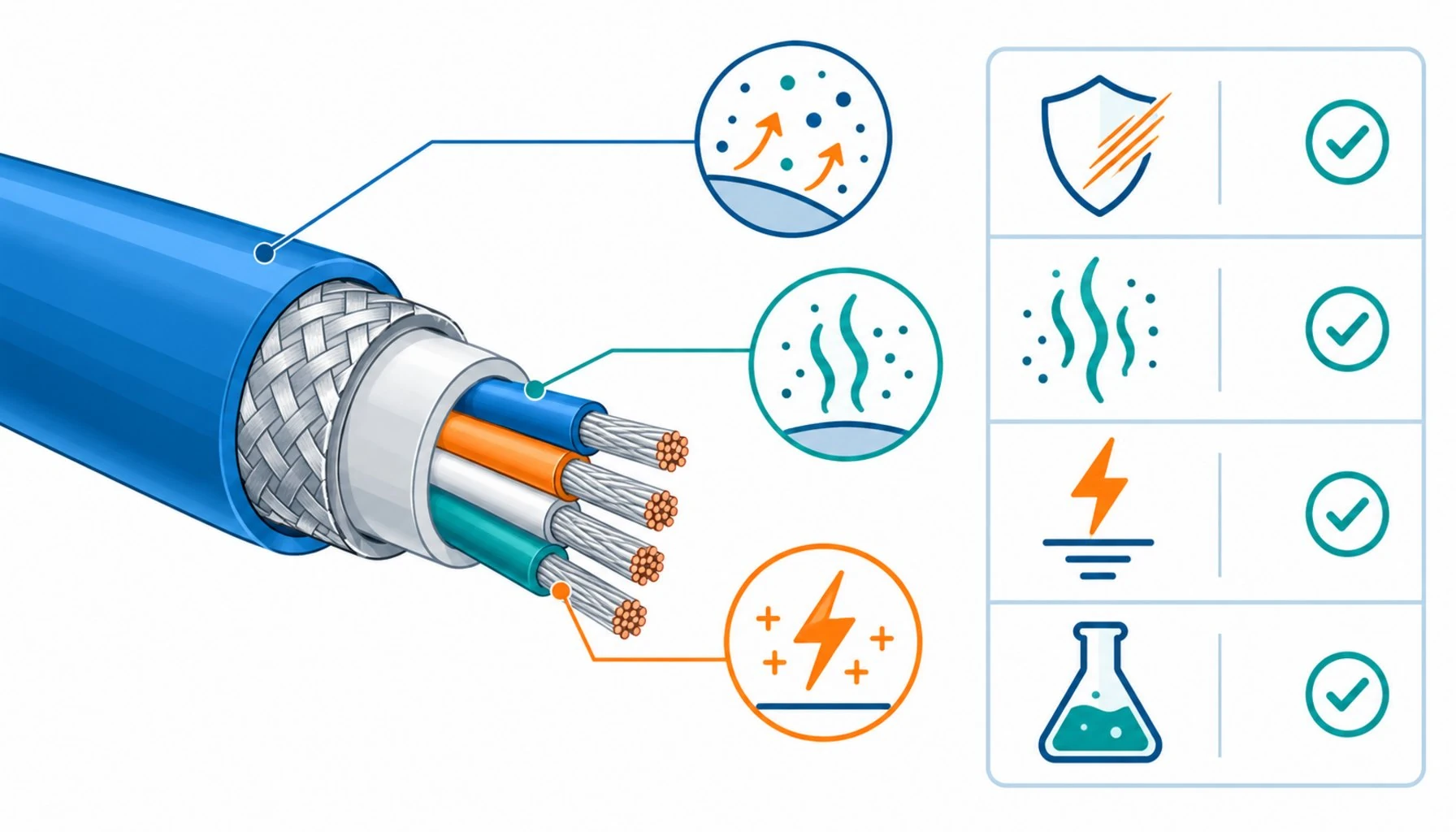
Quick Answer: A cleanroom motion cable has to bend for millions of cycles while shedding no particles, outgassing almost nothing and staying antistatic — construction, jacket compound and documentation all change once the room is classified.
In most factories, a cable that flexes for a million cycles and keeps its shield intact has done its job. In a cleanroom, that same cable can fail every requirement while passing none of its electrical tests — because the failure mode is invisible: particles. Semiconductor tools, display lines, pharmaceutical filling machines and laboratory automation all move their axes inside rooms where the air is cleaner than a hospital operating theater, and every rubbing surface, every abraded jacket, every puff of vapor from the wrong plastic goes straight into the product. The cable in a motion axis is one of the largest moving polymer surfaces in the tool, which makes it a first-class citizen of contamination control rather than a commodity. This guide covers what a classified room demands from motion cable — particle generation, outgassing, electrostatic discharge, chemical resistance and the documentation that validation teams need — and how to specify cable that passes the room as well as the machine.
Introduction
Cleanrooms are classified by the concentration of airborne particles, and the semiconductor industry operates mostly at the demanding end of that scale. Inside a wafer handling tool or an automated inspection machine, motion axes run through cable chains exactly as they would anywhere else — with one difference: everything the cable sheds lands on a product worth more per square centimeter than the cable itself. The cable’s jacket abrades against dividers and guides; its plastics release volatile compounds that condense on optics and wafer surfaces; its surface charges and discharges, and a single electrostatic event can damage a sensitive device or spark a particle-attracting charge patch on a wafer. None of these failures shows up on a continuity tester. All of them show up as yield loss.
This is why cleanroom motion cable is a distinct product family, not a color option. The construction disciplines are the ones every motion cable follows — fine stranding, short lay, braid shields, the physics covered in the drag chain guide — but the materials, surface behavior and paperwork change entirely. The failure habits documented in the common causes of cable failure still apply, and then the room adds a second list on top.
What a Classified Room Asks of a Cable
The requirements cluster into four groups, and each one eliminates ordinary cable for a different reason.
Particle generation. Anything that rubs sheds. A cable jacket sawing against a chain divider every cycle for a year is a particle factory with a power rating. Cleanroom-rated cables use low-abrasion jacket compounds, smooth surfaces without embossed text or ribs, and in demanding applications are run in wear-tested pairings with their carriers. Some tools go further and test candidate cables inside the actual chain design before release — because a datasheet cannot predict how a specific jacket behaves against a specific divider compound.
Outgassing. Plasticizers and additives in conventional PVC migrate out over time, and in a cleanroom those vapors condense on the coldest nearby surface — often a lens, a wafer chuck or a sensor window. Low-outgassing constructions use compounds selected and tested for volatile content, and the test data matters: not all jackets sold as cleanroom-grade have been measured, and the difference between a measured material and an asserted one is a fab’s defectivity meeting.
Electrostatic discharge. Moving, separating and rubbing surfaces generate charge — the triboelectric effect is unavoidable in a moving axis. In electronics handling, that charge must be controlled: many cleanroom cables carry static-dissipative jackets that bleed charge slowly to ground instead of accumulating it for a sudden release. The grounding discipline that makes shields effective, familiar from control and instrumentation wiring practice, extends to the cable surface itself here.
Chemical and radiation environment. Semiconductor processes use aggressive chemistry, plasma byproducts and UV; pharma cleanrooms use vapor-phase disinfectants that attack ordinary jackets between every shift. The jacket compound has to survive the room’s actual chemistry — and the cleaning chemistry is often more aggressive than the process chemistry.
| Requirement | What the Room Demands | What Ordinary Cable Does Wrong | Evidence to Ask For |
|---|---|---|---|
| Particle generation | Minimal shedding over the full flex life | Embossed legends, ribbed jackets, abrasive compounds against dividers | Wear test in the actual chain pairing, particle count data |
| Outgassing | Low volatile content, no condensables on optics | Plasticized PVC releasing vapors for years | Outgassing test report for the jacket compound, by batch if critical |
| ESD control | Static-dissipative surfaces, controlled bleed paths | Insulating jackets that accumulate triboelectric charge | Surface resistance specification and its test method |
| Chemical resistance | Survives process chemistry and cleaning agents | Jackets that swell, crack or cloud under disinfectants | Immersion or wipe test data against the room's actual agents |
Matching the Cable to the Room Class and the Machine
Cleanroom classes are not one environment. A Class 100,000 packaging line under ISO 8 discipline and a wafer front-end tool at ISO 2 share a vocabulary and little else. Over-specifying costs real money — cleanroom-rated cable carries a premium — and under-specifying costs yield. The practical approach is to map where each cable run actually sits: cables outside the classified space or in equipment-adjacent service chases follow normal industrial practice; cables inside the room but not near product follow reduced requirements; cables in the product zone or in direct contact paths get the full treatment. Equipment builders who apply the strictest requirement everywhere pay for it on every quote, and builders who skip the zoning documentation get to argue with the fab’s contamination engineers during tool acceptance instead.
Motion duty does not disappear inside the room, either. The chain still needs its bend radius and fill discipline; flex life requirements still come from the axis duty; and the validation team will want the same flex and test evidence a factory buyer would ask for. The difference is that the evidence package doubles: electrical and mechanical proof, plus the contamination and materials documentation the room demands — a good reason to read the full datasheet discipline before qualifying a supplier in this segment.
Documentation: The Part Validation Teams Actually Read
In ordinary industrial buying, the datasheet is a courtesy. In regulated and classified environments it is an input to qualification, and the cable that cannot produce documents becomes the tool that cannot pass acceptance. The papers that matter: material declarations for the jacket and insulation compounds, outgassing and particle test reports tied to real test methods, surface resistance data for static-dissipative claims, chemical compatibility statements against named agents, and batch traceability that lets a quality team trace a suspect cable back to its production record. Certification expectations extend to the whole equipment package — the machine’s own compliance work, including the wiring, follows the same logic outlined in the cable certifications checklist. Buyers who collect this package at quotation time, rather than after delivery, qualify suppliers faster and with fewer surprises.
One practical warning from semiconductor tool projects: retrofits are expensive in cleanrooms. Changing a cable means opening the tool in the room, re-qualifying the area, and losing production during the work. The modest premium for a fully documented cleanroom cable is trivial against one unplanned tool-down event for a harness swap — the economics that justify over-specifying in this segment, at least at the product-zone boundary.
| Check | What to Pin Down | Why It Decides the Outcome |
|---|---|---|
| Room zoning | Which cable runs sit in which cleanliness class and product zone | Requirements and cost scale by zone; blanket specs waste money |
| Motion duty | Chain geometry, travel, speed, cycles per day per axis | Flex life physics do not stop at the airlock |
| Contamination evidence | Particle wear test, outgassing report, test methods named | Asserted cleanroom-grade is not measured cleanroom-grade |
| ESD behavior | Surface resistance targets and grounding path for dissipative jackets | Uncontrolled charge means damaged product or attracting surfaces |
| Chemistry list | Process chemicals plus cleaning and disinfection agents | Disinfectants often out-aggress the process itself |
| Documentation set | Material declarations, batch traceability, change notification | Validation consumes paper; missing documents stop acceptance |
When Cleanroom Cable Rules Are Not the Answer
Honesty about scope keeps this guide useful. The requirements here address cable that moves inside classified space — chain runs, robot harnesses, lift axes in the room. They do not cover the fixed installation feeding the tool: facility wiring, power distribution to the tool’s connection point, and the grounding electrode system belong to building and fab electrical engineering under their own codes. Laboratory automation and pharma filling machines add regulatory frameworks — GMP validation, for instance — that sit above cable selection and shape the documentation rather than the copper. And for environments that are merely dusty or humid but not classified, industrial motion cable with the right jacket chemistry does the job without the cleanroom premium. Match the requirement to the actual zone, and the specification stays honest.
RFQ Checklist: What to Send the Cable Supplier
Put the room and the machine in writing before quotes come back:
- Room classification per zone, and which cable runs sit in each zone
- Motion duty: chain geometry, travel, speed, cycles per day per axis
- Contamination requirements: particle and outgassing targets with test methods
- ESD requirements: surface resistance class and grounding scheme
- Chemistry: process agents and cleaning/disinfection agents the jacket will meet
- Documentation package: material declarations, test reports, batch traceability, change control
- Flex life requirement with verification method, plus spares policy for in-room replacement
Conclusion
In a classified room, the motion cable is judged by what it sheds as much as by what it carries. Low-abrasion jackets, measured outgassing, static control and a documentation package that survives validation are the difference between cable that disappears into the tool and cable that appears in the defectivity data. Specify by zone, demand measured evidence, and treat the paper as part of the product.
Kexingyu Cable Group (KXYE) supports equipment builders with motion cable constructions and the documentation discipline classified environments demand — batch traceability, honest test references and materials transparency. Describe your room class and axis duty through the RFQ page, and we will respond with constructions and evidence matched to the zone, not the brochure.