Custom Motion Cable: What Factories Can Customize and What to Ask For
Quick Answer: Real cable factories customize core counts, hybrid content, jacket compounds, shielding, colors, printing and lengths on motion constructions; knowing which levers exist, and which evidence to demand, turns a custom RFQ from a slogan into a specification.
Every cable supplier’s website says custom cable, and the word means opposite things at opposite ends of the industry. At one end it means a factory with its own stranding, insulation extrusion, shielding and jacket lines, which can change the construction of the cable itself. At the other it means an assembler who buys stock constructions, cuts them to length and molds a connector on. Both businesses are legitimate, but they answer different questions, and a buyer who cannot tell them apart pays factory prices for assembly work or waits assembler timelines for factory engineering. This guide maps what can genuinely be customized in motion cable, what each customization costs in lead time and minimums, and the questions that reveal which kind of supplier is answering your RFQ.
Introduction
Custom motion cable exists because machines are specific. A robot harness wants exactly the core mix the arm carries, a chain wants the length and marking scheme the machine’s maintenance system uses, a special environment wants a jacket compound the standard range does not offer. The customization itself is ordinary manufacturing: the same production steps, run to your parameters instead of the catalog’s. What separates a good custom experience from a bad one is not the factory’s willingness, it is the specificity of the request and the evidence attached to the result. The sections below walk the customization levers in the order they appear in the cable, from copper outward.
Lever One and Two: Core Configuration and Hybrid Content
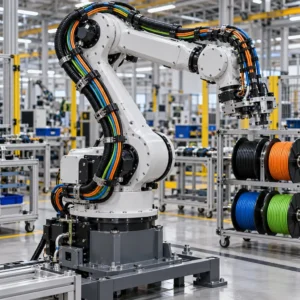
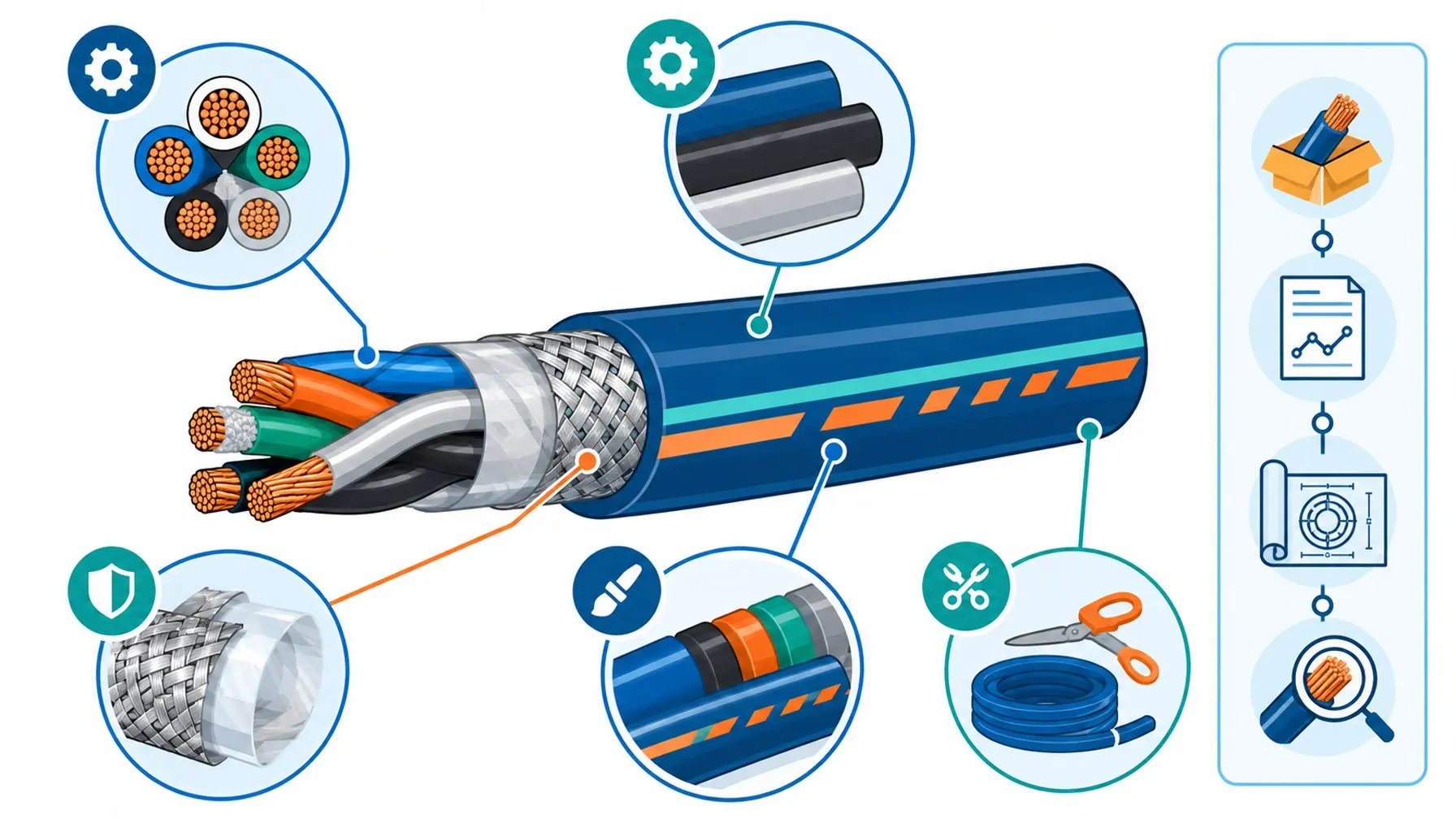
The most common customizations are the least exotic: conductor counts and sizes, pair counts and pitches, and the mix of element types inside one jacket. Hybrid construction, power cores, brake pairs, encoder pairs and data elements in one cable, is where factory capability shows, because the elements must be separated, individually shielded where needed, and balanced through the bundle so that bending treats them equally. A factory running its own bunching and stranding can tune the lay and the bundle geometry to the element mix; an assembler cannot, and the difference appears in flex life when hybrids are involved.
What to ask: the construction drawing of the proposed hybrid, the separation and shielding architecture, and flex-cycle evidence for the specific element mix, not a generic hybrid claim.
Lever Three: Jacket Compound and Environmental Tailoring
Jacket customization is where the machine’s environment earns its specification: oil-resistant formulations tuned to the actual fluids, cold-flex compounds for the actual winter, low-friction surfaces for the actual chain dividers, flame-retardant grades where the installation demands them. Factories with their own extrusion lines can adjust compounds and thicknesses with moderate minimums; factories without them offer the jacket options their upstream stock carries. The compound decision logic itself, matched to environment rather than to habit, follows the selection principles compared in the guide to insulation and jacket chemistry, and environmental extremes push into the territory covered by the cold-duty and fluid-resistance guides.
What to ask: which compound the proposal uses, its test data against your named fluids and temperatures, and whether the data comes from the proposed construction or from a catalog cousin.
Lever Four: Shielding Architecture
Shielding customization covers coverage class, braid density, foil companions and individual shields per element, and it matters most when the cable carries sensitive signals beside noisy power, the hybrid situation again. The customization is real engineering: changing shield architecture changes the cable’s EMC behavior and its flex endurance, and the two interact. The grounding and termination context that the shield must serve starts from the cabinet-side practice described in the guide to control cabinet construction, and a custom shield proposal should be judged against that end-to-end system, not as a standalone line item.
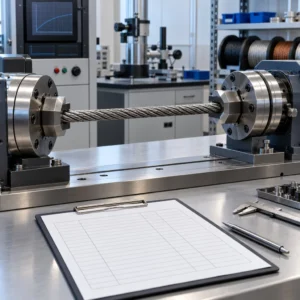
What to ask: shield coverage and construction per element, and test evidence that shield continuity survives the claimed cycle count.
Lever Five Through Eight: Colors, Marking, Lengths and Packaging
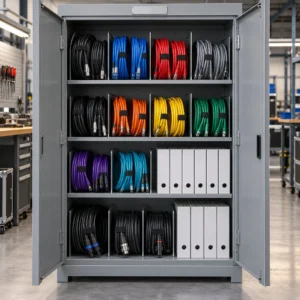
The service customizations are small individually and large in aggregate: jacket colors that make harness identification instant, meter marking printed along the jacket for cut-length verification and maintenance, exact lengths delivered coiled to the machine’s routing, connector terminations pre-installed, and packaging that suits the assembly line rather than the warehouse. These customizations cost little at factories with marking and cutting capability, and they repay themselves in installation speed and maintenance accuracy. Length-and-marking schemes deserve a moment of design: a harness delivered cut, marked and coiled to the machine’s dimensions removes a whole category of field error from the project.
The table below summarizes the levers, what each buys, and the evidence that should accompany each one in a serious quotation.
| Lever | What it buys | Typical cost in lead time or minimums | Evidence to demand |
|---|---|---|---|
| Core configuration | Exact electrical content per harness | Low; often within standard tooling | Construction drawing with strand data |
| Hybrid element mix | One cable instead of four; chain space saved | Moderate; engineering input required | Flex-cycle evidence for the specific mix |
| Jacket compound | Fit to the actual fluids, cold and abrasion | Moderate; extrusion line time | Test data against your named environment |
| Shielding architecture | EMC behavior matched to the signals carried | Moderate | Coverage data and continuity through cycling |
| Color and printing | Instant identification, cut-length verification | Low; marking setup per scheme | Marking proof before the production run |
| Lengths, coiling, pre-termination | Field errors removed from the project | Low to moderate | Termination test reports per harness |
Telling a Factory From an Assembler
The distinction that protects the purchase is process ownership. A factory owns the stranding, insulation, shielding and jacket steps, and can therefore change them; it answers construction questions from its own process data and its own lab. An assembler owns cutting, termination and logistics, and answers construction questions with its upstream supplier’s documents, which may or may not arrive. Neither is the wrong supplier for every job: assemblers excel at fast, small-batch harness work on standard constructions; factories are the right answer when the construction itself must change. The comparison below makes the split concrete, and the questions after it reveal which side of it a quotation is really from.
| Capability | Cable factory | Assembler | What it means for a custom RFQ |
|---|---|---|---|
| Change core mix and lay | Yes, own stranding | No, buys stock constructions | Hybrid duties need the factory |
| Adjust jacket compound | Yes, own extrusion within minimums | Only the catalog options upstream offers | Environment-specific jackets need the factory |
| Shield architecture | Yes, engineered per element | As built upstream | EMC-critical harnesses need the factory |
| Small-batch speed | Slower, line scheduling | Fast, cutting and termination only | Urgent standard-construction jobs favor assemblers |
| Construction documentation | From own process data and lab | Relayed from upstream, if it arrives | Demand the construction sheet and see who signs it |
| Flex-cycle evidence | Tested constructions with reports | Inherits or omits | The evidence question settles the identification fast |
When Custom Cable Is Not the Answer
Honest limits: customization has a price in lead time, minimums and re-qualification, and standard constructions solve most duties. If a catalog construction meets the duty with margin, the custom version mostly buys uniqueness. Custom also concentrates risk on one construction: a specification error propagates through every meter delivered, which is why prototypes and first-article evidence matter more on custom orders, not less. And some “custom” requests are actually machine problems in disguise, a routing geometry that no cable should have to survive, a duty no construction was ever tested for; the honest supplier talks about the machine before quoting the cable. The disciplined sequence is duty, standard range, then custom, in that order.
RFQ Checklist: Making the Custom Request Real
Bring the customization to the supplier as engineering:
- Duty statement in numbers: radius, cycles, speeds, fluids, temperatures, signals carried
- Proposed construction requirements: cores, hybrid mix, shielding, jacket compound, with the reasoning
- Evidence required: flex-cycle and environmental test data for the proposed construction, not a family claim
- Prototype or first-article plan: what gets tested, by whom, against which criteria before volume
- Marking, color, length and packaging scheme, specified on the drawing
- Supply continuity: process data retention, so the twentieth reel matches the first
Conclusion
Custom motion cable is ordinary manufacturing run to your numbers, and the value of the word custom depends entirely on who owns the process behind it. Real factories customize cores, hybrids, jackets, shields and markings with evidence attached; assemblers customize length and connectors on constructions someone else built. Knowing which levers exist, what each costs, and which questions reveal the supplier’s capability turns the RFQ into an engineering conversation, and the delivered cable into what the machine actually needed.
Kexingyu Cable Group (KXYE) runs its own stranding, extrusion and testing lines, and customizes motion cable constructions from core mix to jacket compound with first-article evidence as standard practice. Send your machine’s duty through the RFQ page, and we will quote the construction, not just the cable.