Edge Data Centers: Cable Needs for Small and Distributed Sites
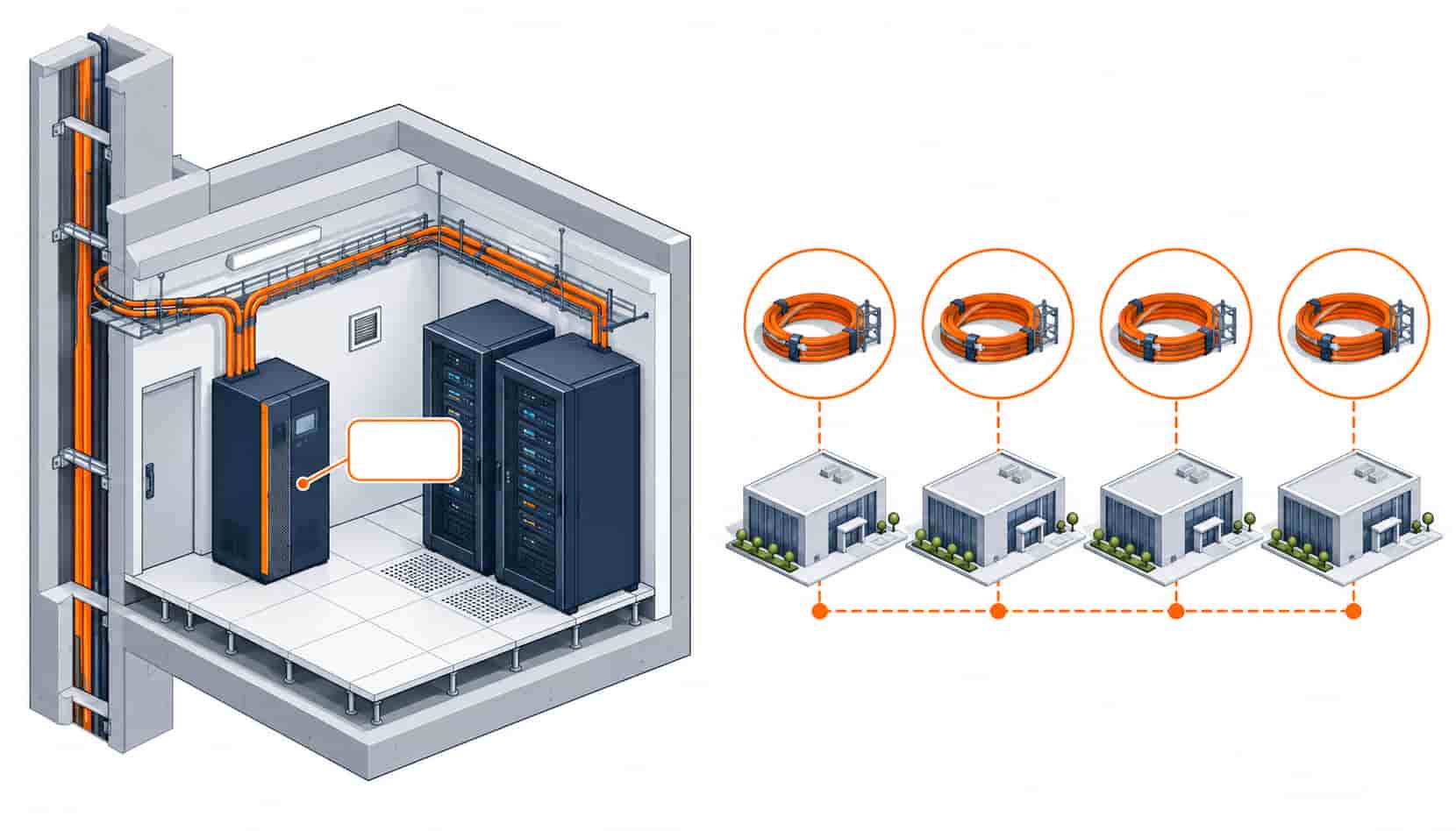
Quick Answer: Edge data centers need more cable discipline than big halls: a handful of feeders carry everything and sites run unattended — the scope is small, the margins smaller. The edge market runs on small numbers. A typical edge room holds a few racks fed by an integrated power cabinet in the 3–20 kVA range — UPS modules, lithium batteries and monitoring built into one enclosure. The cable scope fits in one delivery. What makes the work hard is not scale but repetition and remoteness: the same small design is rolled out across a dozen cities, and nobody is standing in the room when a feeder misbehaves.
Introduction
Hyperscale cabling advice assumes engineers, security guards and a spare tray for everything. Edge sites have none of those luxuries. The room may be a repurposed telecom closet on the second floor of an occupied office building, behind a door that a facilities technician opens twice a year. Cable chosen and installed casually at the edge does not fail differently than in a big hall — it just fails without witnesses, and the repair crew arrives from two hours away.
This article works the edge cable problem from three sides: what actually differs at small distributed sites, how to size and protect cable for integrated power cabinets in the 3–20 kVA class, and how to standardize the specification so the tenth site is as clean as the first. The power architecture these cabinets sit inside follows the same principles as larger plants — our data center power collection covers the upstream picture.
What Makes Edge Cabling Different
Three differences drive every edge cable decision. First, concentration: with a handful of feeders carrying the whole site, no single cable has a cheap backup — each one is a single point of failure and is specified accordingly. Second, environment: edge sites live inside occupied buildings, plenum spaces and shared risers, so fire performance, smoke and installation neatness matter as much as ampacity. Third, distribution: an edge fleet of forty sites multiplies every specification decision by forty, which turns standardization from a nicety into the entire economic case.
The table below maps the common edge site types to their cable scope and the failure modes that show up when the scope is treated casually.
| Site Type | Typical Power Scale | Cable Scope | Watch-Outs |
|---|---|---|---|
| Micro edge / server closet | 3â10 kVA integrated cabinet | One input feeder, short rack whips, slim monitoring cable | Undersized building wiring assumed by the landlord |
| Edge pod / containerized unit | 10â50 kVA | Mains feed, internal cabinet wiring, external generator or BESS tie | Outdoor UV, rodents, gland sealing and earthing at the pad |
| Regional edge room | 20â100 kVA, several cabinets | Small distribution board, A/B feeds, structured runs between cabinets | Grouping on one small tray, no spare ways planned |
| Carrier hotel cage / colo edge | 50â200 kVA | Feeders from house distribution, cross-connect cabling, metering circuits | Building rules on fire performance and working windows |
Right-Sizing Feeders for Small Integrated Cabinets
An integrated 3–20 kVA cabinet — UPS module, lithium battery string and battery management in one enclosure — compresses the power train, but it does not compress the electrical reasoning. The input feeder still carries the full charging current plus load, still needs protection coordination with the building supply, and still deserves the same derating arithmetic as a hall feeder. A 10 kVA cabinet on a shared riser with a generous growth assumption will draw far more than its nameplate while recharging batteries after an outage, and the feeder that ignores that recharge window is the one that trips at the worst moment. Sizing method and derating depth are the same as any critical feeder; the battery recharge contribution is simply the edge-specific twist, and the runtime arithmetic behind it is covered in UPS battery backup time calculation.
Output side, the temptation is the opposite error: because loads are small, cable gets chosen by habit — a coil of whatever was on the drum last time. Small loads still deserve a real cable schedule, even a one-page one: circuit, load, length, voltage drop, protection, label. At the edge the schedule is small enough to be perfect, and perfection there is cheap.
Cable Choices for Occupied and Unattended Buildings
Edge sites inherit their buildings, and the buildings impose rules. In occupied offices, retail spaces and hospitals, low smoke zero halogen construction is not an upgrade — it is the price of admission to the riser, because the smoke that a PVC fire releases in a shared riser endangers people who never knew the edge room existed. The trade-offs between constructions are compared in our LSZH versus fire-retardant guide, and the same logic applies at one-tenth the scale.
Unattended operation changes the protection question. Nobody sees a tray getting warm in a closet, so the cable either gets engineered to fail quietly rarely, or the site gets monitoring that notices — thermometry on the feeders, alarm contacts from the cabinet, and physical protection that keeps rodents, cleaners and unauthorized hands away from live runs. Conduit and small trunking in exposed areas, sealed glands at every entry, and armored constructions where the route leaves the protected envelope are all cheap insurance at edge scale; the armor decision framework is laid out in armored versus unarmored cable.
Standardizing Across a Distributed Fleet
The economic center of edge cabling is the fleet, not the site. Forty sites with forty bespoke cable schedules mean forty procurement events, forty drum inventories and no spares commonality; forty sites on one standard specification mean one recurring order, kits that fit every room and a technician who carries the same spare glands everywhere. The standard sheet should fix the input feeder sizes, the LSZH construction family, gland and labeling conventions, and the test record format — so a site report from city twelve reads like a site report from city one.
Multi-site standardization also changes the procurement shape. Ordering in fleet batches steadies the copper basis, aligns deliveries with rollout phases, and lets the supplier plan production instead of quoting each site cold — the same logic that governs UPS fleets across locations, discussed in sourcing UPS supply for multi-site data centers, applies directly to the cable that feeds them. Fleets rolling out across Southeast Asia add grid-variability questions on top, which are addressed in our Southeast Asia data center power guide.
| Check Item | Requirement | Why It Matters |
|---|---|---|
| Feeder includes recharge | Sized for load plus battery recharge current | Post-outage recharge trips habit-sized feeders |
| One-page cable schedule | Every circuit with length, drop, protection, label | Small enough to be perfect; perfection is cheap |
| LSZH in occupied buildings | Non-negotiable in shared risers and plenums | Smoke endangers people outside the site |
| Physical protection | Conduit, glands, armor where routes are exposed | Nobody is there to see the tray get disturbed |
| Fleet standard sheet | Same constructions, glands, labels at every site | Spares, training and procurement all multiply |
| Monitoring touchpoints | Feeder thermometry and alarms reach the NOC | Unattended sites must self-report |
When Edge Is Not the Answer
Edge sites solve latency and bandwidth problems, not capacity problems. If the requirement grows past a hundred kilowatts, needs tiered redundancy or needs space for a second power train, the honest answer is a proper facility — compact substation and all — rather than a closet pushed past its design. The point at which an edge room should graduate to a real plant is a design decision, and the crossover equipment is covered in our compact substation for data centers guide.
Equally, if the building cannot give the site a compliant feed — no spare ways on the house distribution, risers with no capacity, a landlord who will not allow the fire-performance documentation — then the edge economics were never real, and no cable specification rescues a site whose power supply was imagined rather than surveyed.
RFQ Checklist: Ordering Cable for Edge Sites
Edge RFQs succeed when they standardize the fleet, so include:
- Fleet standard sheet: constructions, sizes, gland and label conventions
- Per-site cable schedule: circuits, measured lengths, voltage-drop limits
- Feeder sizing note covering load plus battery recharge current
- LSZH requirement stated for all occupied-building routes
- Armored or conduit specification for exposed route segments
- Kitting by site: each location’s cable, glands and labels packed together
- Delivery phased to the rollout calendar, not to one site’s urgency
- Copper price linkage held across the fleet order
- Test reports per batch, keyed to site IDs for the documentation set
- Monitoring touchpoints listed so alarms match the NOC scheme
Conclusion
Edge cabling is a discipline of small numbers multiplied. Each site needs only a handful of cables, which means each one can be — and must be — specified without compromise: sized for recharge, protected for an unattended room, fire-rated for a building full of people who did not ask to host a data center.
Kexingyu Cable Group (KXYE) supports edge fleets with standardized constructions, per-site kitting, phased deliveries and copper price linkage held across the rollout — so site forty is specified as cleanly as site one, and the fleet’s cable never becomes its weakest link.