
Compact Substations for Data Centers: A Faster Path to Power
Why data center developers now buy substations the way they buy servers—factory-built, tested as a unit, and ready to energize—and what to check before you order
Introduction
Ask a data center developer what the schedule is really about, and the answer is rarely servers. It is power: when the grid connection lands, when the transformers arrive, and when the substation can be energized. In the current market—long equipment queues and utilities working through connection backlogs—the substation has moved from background infrastructure to the critical path of the entire project.
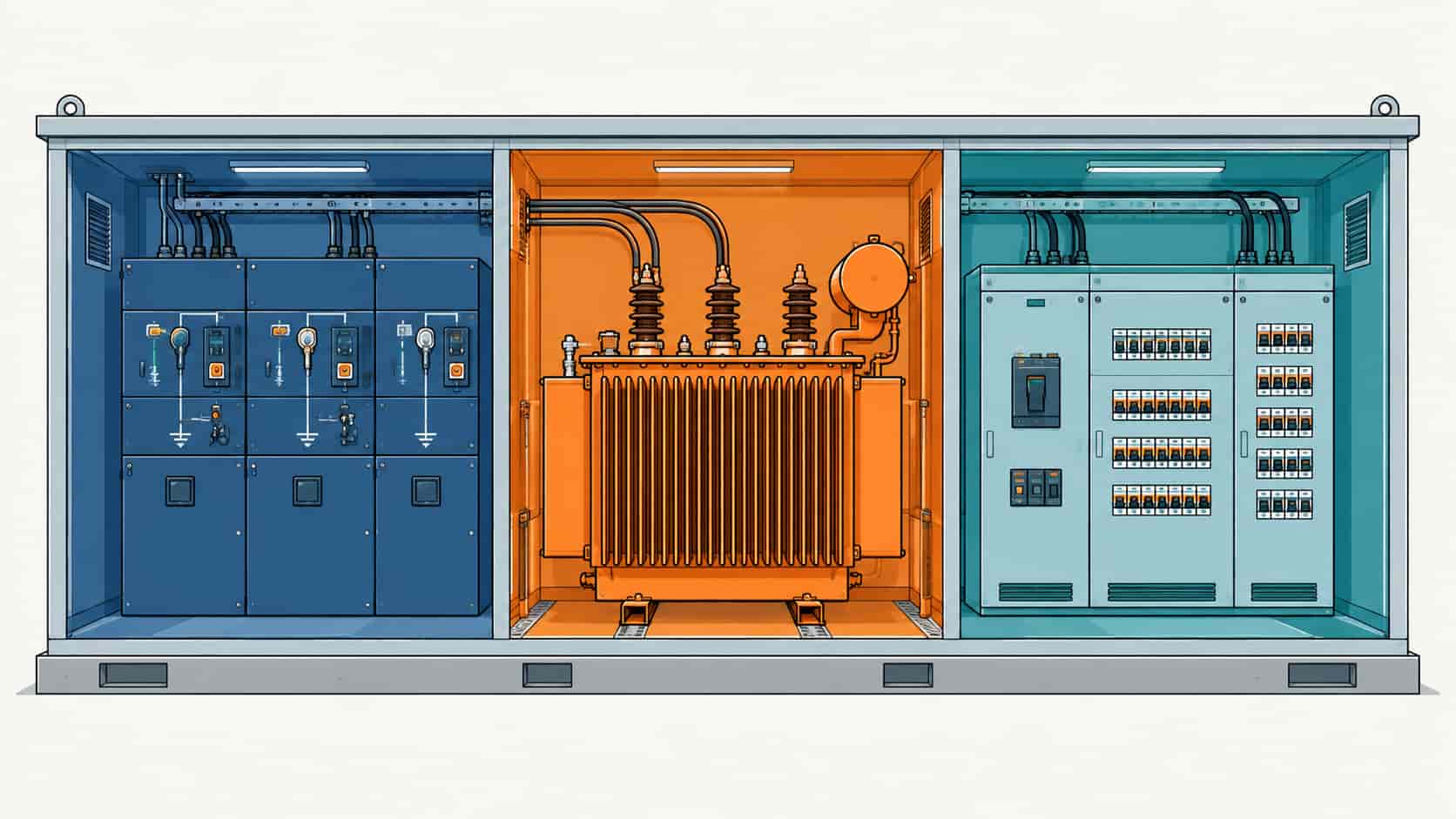
The compact substation is the industry’s factory answer to that pressure. Instead of assembling switchgear, a transformer and LV distribution on site over months of civil works and vendor coordination, the complete block arrives as one tested unit, is set on a plinth, and is connected. The logic is the same one that reshaped data center halls themselves—build it in a controlled environment, test it before it ships, and compress the time between order and first power.
But “compact substation” is a broad label, and quotations under that label can hide very different products. This guide covers what a compact substation actually is and contains, the configurations used around data centers, how to size and specify one, the honest trade-offs against a site-built substation, and the points that belong in your RFQ. For the wider equipment context, start from our transformer and substation range, then come back for the compact-block detail.
Why Time-to-Power Changed the Buying Logic
A conventional substation is a construction project. Civil works run first, then equipment arrives in batches from different suppliers, then cabling, then testing—a sequence where every interface is a schedule risk and every month of weather is a threat. Data centers feel this sequence more than most assets, because the building is often ready before the power is. The industry’s own supply chain pressures have made it worse: our analysis of the 2026 switchgear and transformer shortage shows lead times that stretch projects by quarters, not weeks.
A compact substation attacks the sequence itself. The enclosure, the MV switchgear, the transformer and the LV board are integrated and wired at the factory while civil works run in parallel at the site. Testing happens as a complete unit before shipment—so the site accepts a finished block instead of commissioning an assembly of parts. One supplier carries the integration responsibility, which removes the classic dispute triangle between the switchgear vendor, the transformer vendor and the electrical contractor.
The result is not a discount product—per kVA it usually costs more than the sum of its parts. What it buys is time and certainty: a shorter, flatter schedule with fewer parties on it, which is exactly what a data center business case values most.
What a Compact Substation Actually Is
In standard terms, the workhorse is the compact secondary substation covered by IEC 62271-202: a factory-assembled, type-tested combination of an HV switchboard—often a ring main unit—a transformer, and an LV switchboard, all inside one enclosure. Type testing matters more than marketing: it means the complete assembly, not just its parts, has survived the standard’s temperature-rise, dielectric, arc and IP verification.
The concept extends beyond that baseline. Skid-mounted blocks place MV boards, one or two transformers and LV distribution on a single fabricated steel base, factory-piped and factory-wired. Small walk-in enclosures add working space and climate control. Ratings for data center duty typically sit at distribution levels—up to 36 kV, transformers from a few hundred kVA to around 3,150 kVA per unit, LV boards sized for the hall’s busbar. Beyond those levels the physics of heat rejection and transport logistics start to favor a purpose-built substation instead.
Around a data hall, compact blocks appear in three roles: as the main MV/LV conversion step for a hall or phase; as dedicated substations for high-density loads such as cooling plant; and as fast-deploy blocks for edge and smaller sites where a full substation building never makes sense. The configurations you are most likely to meet:
| Configuration | What's Inside | Typical Role in a Data Center |
|---|---|---|
| Compact secondary substation | Ring main unit + oil-immersed transformer + LV board in one IEC 62271-202 enclosure | Edge sites, small halls, dedicated building loads |
| Dry-type compact unit | Cast-resin transformer with MV/LV gear in a low-profile, fire-conscious enclosure | Indoor rooms, basement or rooftop locations near the load |
| Skid-mounted block | MV switchboard + one or two transformers + LV board, factory-piped and wired on one steel skid | Campus phases and containerized halls built in repeatable steps |
| Small walk-in (e-house style) | Walk-in enclosure housing MV hall, transformer bay and LV/auxiliary room with climate control | Larger blocks, harsh climates, where indoor access matters |
| Redundant pair package | Two matched compact units with interlocked incoming supplies | N+1 halls and dedicated cooling blocks |
Sizing and Specifying for a Data Hall
Sizing starts from the load classes, not from the nameplate of a preferred transformer. Separate the IT load from cooling, auxiliaries and future headroom, then let the redundancy scheme drive unit sizes: in an N+1 arrangement, N compact units must carry the full hall load with one out, which usually means each unit runs well below its rating in normal operation. Our guide to transformer capacity sizing walks that arithmetic; the compact-block twist is that the transformer, MV protection and LV busbar must be sized as one coherent assembly, because the factory will build and test exactly what is specified.
On the MV side, decide the switchgear philosophy early: fuse-protected RMUs are compact and economical, while circuit-breaker configurations buy selectivity and easier fault recovery—data centers usually lean to the breaker option on incoming positions. Ask for arc-fault classification on both MV and LV boards, and for monitoring that speaks to the site’s SCADA or DCIM rather than a proprietary island. On the LV side, form of separation, busbar rating, and the interface toward generators and ATS logic need to be in the specification, not discovered at commissioning.
Losses belong in the tender even though a compact block buys speed: an inefficient transformer inside a tidy enclosure still burns money for twenty years. Specify load and no-loss figures with test tolerance, and weigh the dry-type versus oil-immersed choice honestly—dry-type buys fire safety and indoor placement, oil-filled buys efficiency and rating headroom.
Compact versus Site-Built: The Real Trade-offs
The honest comparison is not “good versus bad” but where each profile fits. A compact block wins on schedule, single-point responsibility and quality evidence—a type-tested assembly with a witnessed factory test is a stronger artifact than a collection of certificates. A site-built substation wins on ceiling: ratings above the compact range, fully bespoke layouts, and utility interfaces with their own requirements. The table collects the trade-offs buyers actually feel:
| Aspect | Compact Substation | Site-Built Substation |
|---|---|---|
| Schedule | Factory build runs parallel to civils; energize in weeks to a few months | Sequential construction and installation; commonly a year or more |
| Responsibility | One supplier integrates and tests the complete block | Multiple contracts; interfaces managed by the owner |
| Quality evidence | Type-tested assembly plus witnessed FAT as a unit | Proven through site testing after installation |
| Ratings ceiling | Typically up to 36 kV and around 3,150 kVA per transformer | Practically unlimited |
| Customization | Standardized options; limited bespoke layouts | Fully engineered to the plot and utility |
| Relocation | Relocatable; expansion within enclosure and busbar limits | Permanent; extension means construction |
| Cost profile | Higher cost per kVA, far lower site and supervision cost | Lower equipment cost, higher civil and labor cost |
In practice, serious data center campuses mix both: a site-built intake at the grid interface where the utility’s requirements govern, and compact blocks repeated hall by hall as the build phases advance. The mix captures the compact profile where it is strongest—repetition, speed, and testable units—without forcing it where it does not belong.
When a Compact Substation Is Not the Answer
Be realistic about the boundaries. Above the compact ratings class—at transmission voltages, or with transformers measured in tens of MVA—enclosure transport and heat rejection stop being a factory problem and become an impossibility. A utility that mandates its own switchgear types, building layouts or protection schemes will not accept a sealed third-party block at the point of common coupling either; the interface belongs to the utility’s world.
Growth plans deserve the same honesty. A compact unit expands within its busbar spare ways and its enclosure volume; a hall that will triple needs either units sized for that journey from day one or a layout that accepts more plinths later. And an architectural or urban context that demands a substation disappear into a building envelope is a bespoke project, not a catalogue order. Choosing compact for the wrong project wastes the very advantages it exists to deliver—speed and certainty.
What to Check Before You Sign the Order
Compact does not mean standard, and two quotations under the same name can hide different assemblies. Pin these down in writing:
- Complete-block references: IEC 62271-202 (or equivalent) conformity of the assembly, with the type-test reports available, not just component certificates.
- Transformer data: oil or dry type, rated power, impedance, load and no-load losses with tolerance, temperature class—fixed per the sizing study, not “similar”.
- MV switchgear philosophy: RMU fuse versus breaker configuration, arc-fault classification, and interlocking logic.
- LV board specification: rated current, form of separation, IEC 61439 verification, spare ways, and the ATS/generator interface.
- Enclosure and environment: IP class, corrosion protection, climate class for the site’s temperature and humidity, ventilation or cooling concept, noise level if receivers are close.
- Factory test scope: routine tests on the assembly, which tests you will witness, and the report format and language.
- Transport and placement data: weights, dimensions, lifting points, plinth drawing, and cable connection orientations.
- Documentation and spares: as-built drawings, SCADA points list, recommended spares, and training if the site team is new to the equipment.
Supplier vetting matters as much as the specification—compact substations concentrate a lot of engineering inside one enclosure, and the factory’s integration discipline is the product. The questions to ask mirror our checklist for vetting a transformer manufacturer in China, extended to the switchgear and LV scope inside the same box.
Conclusion
Compact substations sell time and certainty: a type-tested, factory-integrated power block that turns the substation from a construction project into an installation. For data centers racing connection queues and equipment lead times, that profile fits the way campuses are now built—repeated hall by hall, tested as units, and energized on schedule.
The discipline lies in the specification. Size the block from the load and redundancy study, fix the transformer, protection and LV data in the contract, demand the factory test you would demand of any transformer, and respect the boundaries where a site-built substation remains the right answer. Do that, and the compact route delivers exactly what its name promises—a faster path to power. When you are ready to price one, the team at KXY E-Power Group can quote the complete block against your load study.
Frequently Asked Questions
Recent Posts
Voltage Stabilizers vs UPS: Do You Need Both?
Voltage Stabilizers vs UPS: Do You Need Both? One device fixes how high or low the voltage is; the other fixes whether there is voltage
Energy Storage for Data Centers: A Growing Backup Power Option
Energy Storage for Data Centers: A Growing Backup Power Option Batteries have always backed up data centers in the form of UPS strings. Grid-scale BESS
Thermal Runaway in Lithium Batteries: What BESS Buyers Should Understand
Thermal Runaway in Lithium Batteries: What BESS Buyers Should Understand How thermal runaway starts, how it propagates, and which evidence buyers should require before approving