Solar Cable Standards Compared: EN 50618 vs UL 4703 for PV Farms
Quick Answer: EN 50618 (H1Z2Z2-K) governs solar DC cable across most world markets with a 25-year design life; UL 4703 governs the North American market with its own voltage and temperature classes. The cable’s destination market picks the standard — not the catalog.
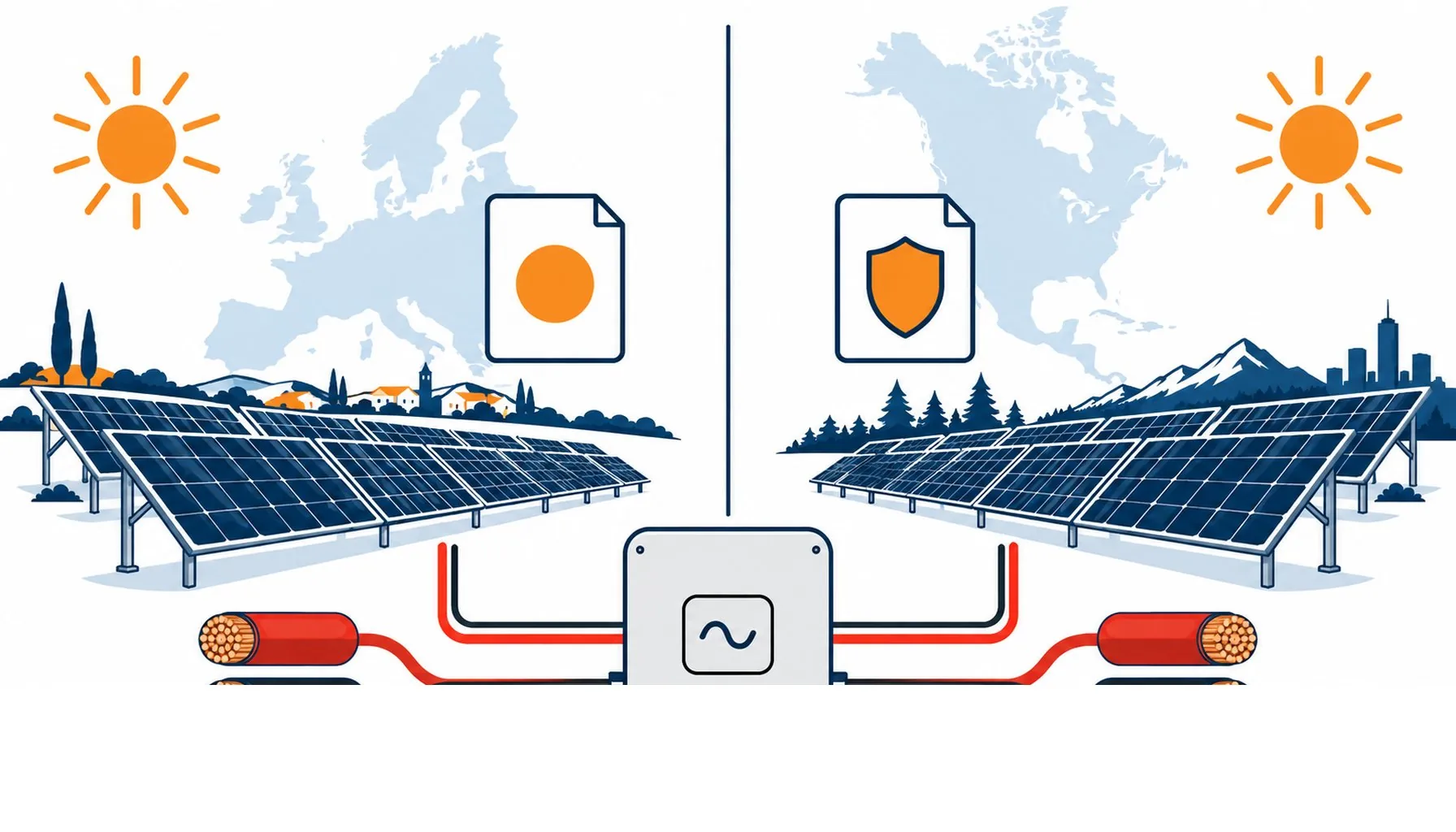
The en 50618 vs ul 4703 comparison is the first fork in every solar DC cable procurement, because the two standards do not compete so much as divide the world: EN 50618 is the European standard that most of Asia, Africa, Latin America and Oceania specify by reference or by market practice, while UL 4703 is the North American answer whose listing is a market-entry requirement rather than a preference. Both describe the same product — a flexible, UV-resistant, ozone-resistant, double-insulated DC cable that lives on rooftops and in array fields for decades — but they test it through different philosophies: EN 50618 through a long-design-life framework with aging requirements measured against a 25-year service horizon, UL 4703 through the North American listing system with its voltage classes and wet/dry ratings. A PV farm’s cable is one of the cheapest line items and one of the hardest to replace, buried in trenches and clipped across rooftops for its whole life — which is why the standard, the evidence and the verification deserve the same rigor as the modules themselves. This guide compares the two standards and the market evidence each demands.
Introduction
Solar DC cable lives in the harshest regime any cable tolerates: ultraviolet radiation all day, temperature from cold nights to roof-deck highs, ozone and weather, mechanical stress at clips and entries, and DC voltage for a design life that outlasts most buildings’ refits. The standards exist to make that survival testable rather than hopeful, and they sit inside the wider solar specification stack that the solar cable specification guide covers — cable alongside connectors, inverters and the DC architecture they serve. The reason the standards fork is regulatory geography: markets either adopt the EN framework directly or through their own harmonized versions, or they require North American listing for products sold into their jurisdiction, and the two paths test overlapping but not identical properties. The buyer’s job is matching the cable’s standard to its destination market first, its project specification second — a sequence that mirrors the certification choreography of every electrical export, documented in the power cable certifications checklist. The two standards, compared:
EN 50618: The Long-Design-Life Standard
EN 50618 defines the H1Z2Z2-K construction that has become the de facto global solar cable: double-insulated XLPO (cross-linked polyolefin) over a fine-stranded tinned copper conductor, rated 1.5 kV DC (with the 1.8 kV class extension in later editions), conductor temperatures to 120°C, and — the standard’s signature — a design life requirement anchored at 25 years, demonstrated through long-term aging tests on the compound. The test profile reads like a field tour: UV exposure, ozone, thermal aging at elevated temperatures, hot-set verification of the cross-link, cold bending, notch and pressure resistance, and the fire and smoke behaviors the installed pathway’s code demands. The standard’s philosophy is durability as a system: the compound, the tinning (which resists corrosion at connections), the strand flexibility for tool-handled installation, and the marking that states the construction on the jacket. Markets across Europe, the Middle East, Africa, Asia-Pacific and much of Latin America specify H1Z2Z2-K directly or accept it as the reference, and projects across those regions — from utility-scale farms to the rural electrification builds described in the rural electrification equipment guide — quote it as their baseline DC cable.
UL 4703: The Listing Standard for North America
UL 4703 is the North American standard for photovoltaic wire, organized around the listing system: the cable carries a UL mark, tested to the standard’s requirements by UL or a recognized lab, with voltage classes — 600 V, 1000 V, 2000 V — and temperature ratings expressed in the North American wet/dry idiom (90°C wet, 105°C dry in common constructions, with 90°C wet versions for conduit runs). The construction overlaps EN 50618’s — XLPO or XLPE double insulation over tinned copper, UV and ozone resistance — but the evidence framework differs in kind: listing is a market-entry certificate, verified in the UL directory, rather than a standard’s conformity declaration. Projects in the United States and Canada require the listing as code compliance, which makes the verification chain concrete: the mark, the file number, the listing scope matched to the construction ordered. For procurement teams running multi-market solar programs — the coordination pattern described in the multi-country inverter rollout guide — the practical consequence is a two-SKU reality: EN-conformant cable for the EN world, listed PV wire for North America, ordered per destination rather than assumed universal.
| Aspect | EN 50618 (H1Z2Z2-K) | UL 4703 (PV Wire) |
|---|---|---|
| Framework | European standard, conformity evidence | North American listing, UL mark |
| Home markets | Europe, MEA, APAC, much of LatAm | United States, Canada |
| Voltage class | 1.5 kV DC (1.8 kV edition) | 600 / 1000 / 2000 V classes |
| Temperature | Conductor to 120°C | 90°C wet / 105°C dry idioms |
| Design life | 25-year requirement with aging tests | Requirement via listing tests |
| Verification | Test reports to the standard | Listing mark + file number checked |
The Verification Chain: Making the Standard Provable
Both standards suffer the same market failure mode: jackets that claim what the compound does not deliver, and the verification chain is the buyer’s answer. Evidence per shipment: EN-side, test reports to EN 50618 for the delivered batch — UV, aging, hot-set — tied to the drum markings; UL-side, the listing mark matched to a live file number whose scope covers the construction ordered. Compound identity: the cross-linked polyolefin is the cable’s lifetime; batch traceability on the compound, the same discipline power-side buyers audit, keeps later drums identical to the tested ones. Construction check at the dock: tinned copper confirmed (a scrape shows white tin over copper), double insulation present, strand count and conductor size matching the order — three minutes of cutting, per the datasheet reading guide‘s read-the-metal discipline. Market match: the destination’s code decides which standard’s evidence the project needs, decided at order time, not discovered at customs. Suppliers serving both standards from one production base make the two-SKU program straightforward, and the supplier-side questions — compound sourcing, batch records, dual-standard certification — are the ones the solar inverter manufacturer checklist adapts to every component of the DC chain.
Climate and Application: Where the Standards Meet the Field
The standards’ differences compress once the cable meets its field, and the field’s realities cut across both. Desert arrays: sustained high ambient plus roof-deck heat push conductor temperatures toward the ratings’ ceilings — derating and sizing decisions that the specification owns, whatever the standard. Coastal and monsoon regions: salt, humidity and immersion cycles stress jacket and connections; the tinned conductor and double insulation are the common defenses, and the storage-plus-solar architectures described in the solar-plus-storage guide add DC bus duty the cable shares with the battery interconnect. Cold climates: installation cold-bend limits and compound brittleness are tested in both frameworks but bite differently by compound batch — a cold-weather project verifies the property on the delivered drums. Utility-scale trenches: the DC feeder runs live in soil for decades, where the design-life argument of EN 50618 and the listing durability of UL 4703 both reduce to the same buyer demand: batch evidence, compound traceability, and construction verified at the dock. The standard sets the floor, and the field decides how much margin above it the project ends up buying.
| Destination | Standard | Evidence to Demand |
|---|---|---|
| European Union and EEA | EN 50618 H1Z2Z2-K | Test reports to the standard, per batch |
| Middle East and Africa | EN 50618 by market practice | H1Z2Z2-K marking + reports |
| Asia-Pacific | EN-based or national variants | Standard named in the contract |
| United States and Canada | UL 4703 listing required | UL mark, file number, scope match |
| Latin America | Mixed by country | Market check before the order |
| Multi-market programs | Two SKUs, one production base | Both evidence chains per destination |
RFQ Checklist: Solar Cable Lines for the RFQ
Put the standard in writing:
- Destination market named; standard selected to match
- Construction stated: H1Z2Z2-K or PV wire, voltage class
- Conductor: tinned copper, strand class, cross-section
- Compound and design life evidence per batch
- UL file number verified where listing applies
- Dock check: tin, double insulation, strand count
- Fire and smoke class per pathway code
Conclusion
EN 50618 and UL 4703 are two doors into the same product: a flexible, UV-hardened, double-insulated DC cable built for decades on rooftops and in trenches. The destination market picks the door — EN conformity across most of the world, UL listing in North America — and the buyer’s protection is the same in both: batch evidence, compound traceability and a three-minute dock check that the metal and the jacket match the standard they were sold under.
Kexingyu Cable Group (KXYE) manufactures solar DC cable to both standards from one production base: H1Z2Z2-K constructions with 25-year design-life evidence, UL-listed PV wire with verifiable file numbers, tinned fine-stranded copper throughout, and batch records that keep every drum identical to the one that was tested.