Cold Weather Cable for Extreme Sites: Flex, Installation and Handling
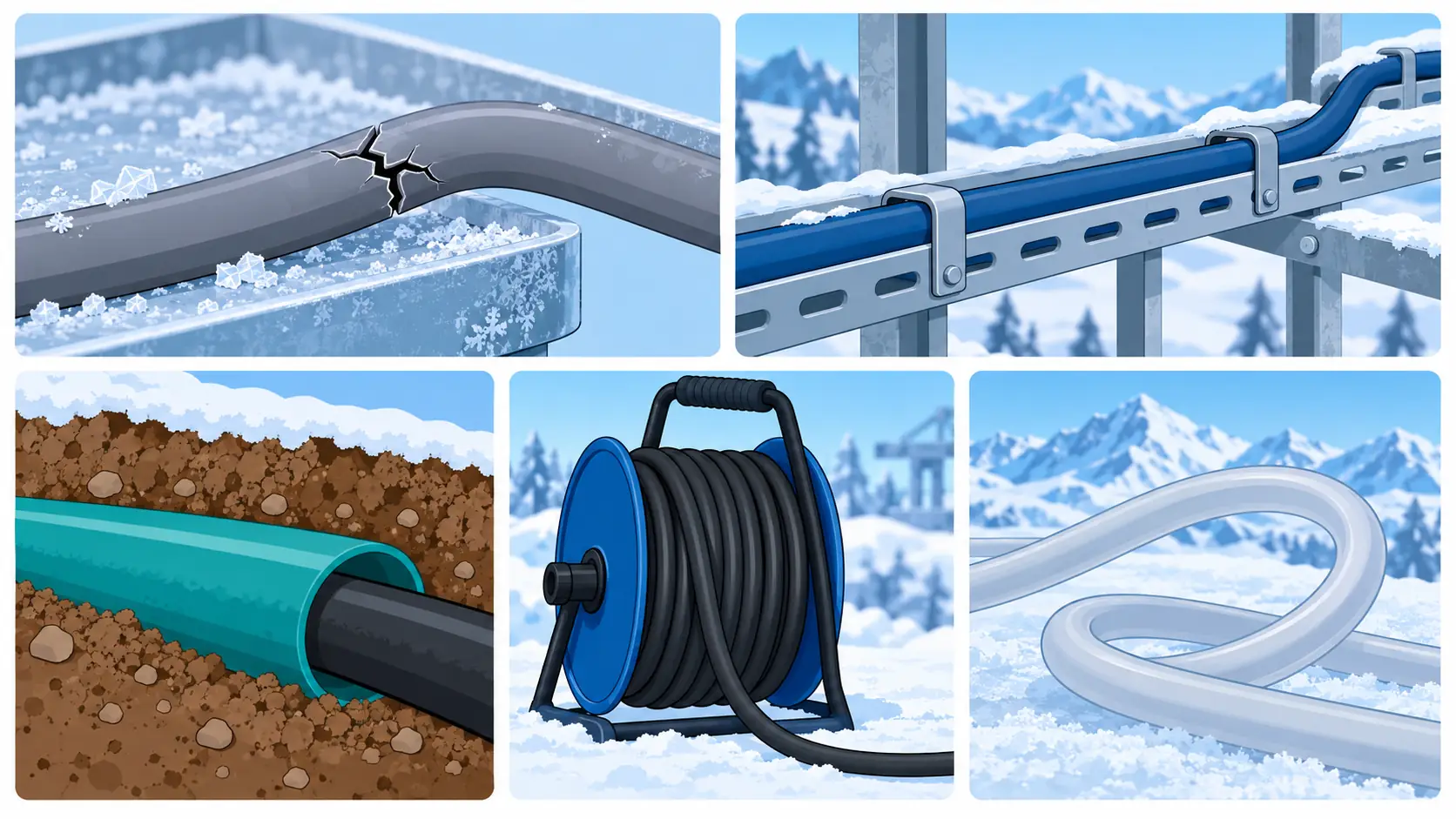
Quick Answer: A cold weather cable is not defined by one number. A sheath that stays flexible at minus forty is a different requirement from a sheath that survives an impact at minus forty, and both are different again from a cable that is simply laid and never moved. Most winter failures we see are not a cable that was rated too low but a standard cable that was unrolled, pulled and bent while cold, using handling rules written for a warm day.
Introduction
Cold changes a cable in ways that no electrical test picks up. The insulation gets harder, the sheath loses its give, and a coil that has been sitting on a drum overnight can crack along a fold before anyone has connected it to anything. The cable then goes into service looking fine and fails somewhere later, usually blamed on the manufacturer.
This guide is for buyers specifying cable for mines, quarries, wind farms, cold stores, plateau sites and any outdoor project that runs through winter. It separates the three cold numbers that get mixed up, sets out the constructions that answer each duty, the decisions to freeze before the order goes out, and the handling and inspection rules that keep a good cable from being destroyed on site. Cold-rated constructions sit in our high and low temperature resistant range, and the generic flex behaviour behind them is in our note on low temperature flexible cable.
What Cold Actually Does to a Cable
Thermoplastic sheaths stiffen and can crack. PVC and PE compounds pass through a glass transition as they cool, and below that point the sheath stops behaving like a tough skin and starts behaving like a brittle shell. A sharp fold, a dropped drum flange or a cleat edge is enough to start a crack, and once a crack is in the sheath the water has an entry point for the rest of the cable’s life.
Flexibility falls faster than the temperature rating suggests. A cable can be rated for continuous service at minus forty and still carry a bend rating far warmer. The two numbers come from different tests, and the static one is always the easier of the two. Buying on the service temperature alone is how a cable ends up specified for a duty it cannot take.
Impact and handling loads rise in winter. Cables get dropped, dragged and bent over frozen ground, and the drum flanges get struck by plant. The mechanical loads on a winter site are higher than on a summer one, while the material’s ability to absorb them is lower. That combination is what breaks cables in cold weather, not the ambient itself.
Moisture is still the real enemy. Freeze-thaw cycling drives water into any damaged sheath, and ice expands where water sits. A cable that would have survived a wet winter with an intact jacket can split at a frost crack, and the split usually appears at the point where the cable was bent while cold.
Cold-Duty Constructions Compared
The table sets out the constructions a buyer chooses between: what each one handles in cold, what to specify, the evidence to demand, what drives cost and lead time, and how each one fails when the choice is made on a service temperature alone.
| Construction | What it handles in cold | What to Specify | Evidence to Demand | Cost and Lead-Time Driver | How It Fails |
|---|---|---|---|---|---|
| Standard PVC | Fixed runs in sheltered indoor areas that stay above freezing | The lowest ambient the sheath is rated for, written on the requisition | Compound data with the cold bend temperature stated | Cheapest and fastest in every size | A sheath that cracks at a fold on a winter morning and admits water at the crack |
| Cold-resistant PVC | Outdoor runs down to around minus forty where the cable is fixed, not flexed | The cold-resistant compound class plus the pull tension allowed at low temperature | Cold bend test result at the site's lowest temperature | Small premium over standard PVC and usually a stock item | Installed with warm-weather pulling rules and cracked at a bend or cleat |
| Cold-grade PE jacket | Buried and ducted runs where abrasion and water matter more than flexibility | Jacket compound, the cold bend rating and the minimum bend radius in cold | Cold bend plus the impact test on the jacket | Modest premium; extrusion runs to order more often | Handled like a rubber cable and split at the drum flange or a frozen bend |
| Rubber, EPR or CPE | Runs that are moved or flexed in cold, including reels and trailing duties | Cold flex rating, flex class of the conductor and the working radius at the low temperature | Cold flex test results at the site's lowest temperature, not a service rating | Costs more than PVC and runs to order on most sizes | Bought on a service temperature while the duty is flexing, so it cracks at a repeated bend |
| Silicone rubber | The coldest duties, where the cable must stay flexible well below minus forty | Continuous cold rating, the flex duty and the mechanical protection around it | Compound certificate plus cold flex results on the exact construction | Top of the range for cold duty and often made to order | Soft sheath abraded at a tray edge because nothing was specified to protect it |
The Three Cold Numbers That Get Confused
Cold bend is a test, not a service rating. The cold bend figure says the sheath survived being bent around a mandrel at that temperature, once. It is the entry ticket for a fixed run in winter, and it says nothing about whether the cable can be bent there repeatedly.
Cold impact is a different test again. This one drops a weight on the sheath at temperature and checks for cracks. It matters wherever a cable is at risk of being struck, run over or knocked against steelwork, and a cable that passes a cold bend test can still fail this one. Our note on cold flex testing covers the repeated-movement version of the same question.
Flex duty at temperature is the one that governs moving cables. A reeling, trailing or festooned cable is bent thousands of times, and the number that matters is the flex rating at the lowest temperature the cable will actually see, not at room temperature. Ask for it in writing against the site minimum. Storage temperature is a fourth number that gets forgotten, because a drum kept in an unheated yard overnight arrives at installation temperature and cannot be unrolled as if it were warm.
What to Freeze Before the Order Goes Out
Six decisions decide whether a cold weather order survives its first winter. Each is cheap at specification stage and expensive once the cable is unrolled on a frozen site.
| Decision | What to State | Evidence to Attach | Cost of Leaving It Open |
|---|---|---|---|
| Lowest site temperature | The design minimum air temperature and the temperature of any steel surface the cable touches | A site climate note with the design minimum and the month it occurs | A cable bought for a mild winter and cracked in the first cold snap |
| Static or moving duty | Whether the run is fixed, reeling, trailing or festooned, per route | A route drawing marking every route that moves | A fixed-run construction used on a moving duty, failing at the flex points |
| Cold bend and impact evidence | The cold bend temperature and cold impact temperature required, against the site minimum | Test reports for both, on the exact construction offered | A sheath that passes on paper and splits at the first winter impact |
| Installation temperature rules | The lowest temperature at which the cable may be unrolled, pulled and bent, and the radius to respect | The manufacturer's laying instruction with the cold handling limits | Site pulling the cable on a freezing morning and cracking it before energisation |
| Mechanical protection | Armour, duct, tray cover or a protective sleeve wherever the cable meets plant traffic or ice | Cross-section and route details showing the protection at each risk point | A cold-cracked sheath that fills with meltwater and fails the following spring |
| Marking and traceability | The cold rating to be printed on the sheath and the batch to be recorded | Marking to be verified on arrival plus the compound certificate | A general compound supplied under a cold specification with no way to prove it |
Installing and Handling in Cold Weather
Move the drum into the warm before laying. The single most effective winter rule is to bring the drum into a heated store or a heated container overnight and lay the cable warm, while the site is still cold. The cable cools quickly once it is on the tray, and it will not be bent again.
Respect a larger bend radius than the summer figure. The radius a cable will tolerate in cold is larger than the radius in a warm plant room, and the difference is large enough to matter on a tight tray route. Our note on minimum bend radius sets out how the working radius is set, and in winter the site figure should be the conservative one.
Pull slowly and watch the tension. Cold sheaths have a higher friction against the tray and duct, so the same pull needs more force and the cable takes more load. Pulling tension is calculated on a warm-day friction figure, which is why winter pulls fail at the sidewall. The technique is covered in our note on cable pulling and sidewall pressure.
Protect the vulnerable sections, not the whole run. Where a cable crosses a haul road, passes a ploughed edge or sits under falling ice, a duct, a cover or a sleeve at that section is cheaper than upgrading the entire run. Draw each of these points, because site teams will otherwise improvise.
Incoming Inspection and Storage
Check the marking against the order. A cold-rated sheath normally carries its rating, and the marking is the cheapest check available on arrival. Where the sheath carries nothing and the paperwork claims a cold compound, the specification has not been met in a form you can rely on.
Cut a sample from a cold duty and bend it. A short length conditioned to the site minimum and bent around a mandrel shows whether the compound behaves as claimed. It is a crude test, but it catches a substituted general compound faster than a review of the certificates.
Store drums off the ground and out of standing water. A drum that sits in a puddle wicks water into the outer layers, and the freeze-thaw cycle then opens the sheath at the point where it was bent. The storage rules in our note on drum packaging and export cover the same issue on a long sea leg, and the principle on site is identical.
Cost and Lead Time
Standard and cold-resistant PVC are stock items in every common size and add no meaningful lead time. Cold-grade PE jackets carry a modest premium and are usually available from stock or on a short run. Rubber, EPR and silicone constructions are the real step in price on cold duty and normally run to order, so they belong in the programme rather than in a late change.
Copper remains the largest element of the price on a power cable, and the compound premium for cold duty is a smaller number than most buyers expect. Over a winter programme, the movement in copper between tender and purchase order is usually the bigger risk, so ask how the copper element is calculated and how long the quotation holds. That mechanism is covered in our note on copper price and cable procurement.
When a Cold Weather Cable Is Not the Answer
When the problem is handling, not material. A standard PVC cable laid warm and never bent again in the cold is often correct for a fixed run in a sheltered position. Buying a silicone construction to compensate for a pulling plan that ignores winter is paying for the wrong fix.
When the route is the real fault. A cable that cracks every winter on the same tray is being flexed by movement in the steelwork, not by the ambient. Fix the support and the material question mostly disappears.
When the requirement is heat, not cold. A site that swings from minus thirty to a hot process area is a dual-temperature job, and a compound chosen only for the cold end can be the wrong one at the hot end. Both ends belong in the same requisition.
RFQ Checklist
- The design minimum air temperature and the temperature of any steel surface the cable contacts
- Whether each route is fixed, reeling, trailing or festooned, marked on a route drawing
- The cold bend temperature and the cold impact temperature required, stated separately
- The flex rating at the site’s lowest temperature for any route that moves
- The conductor flex class and the working bend radius at low temperature
- The lowest temperature at which the cable may be unrolled, pulled and bent, from the maker
- Mechanical protection at each point of plant traffic, ice fall or abrasion
- Storage and laying temperature limits, to be printed on the drum or the paperwork
- Marking on the sheath, with the cold rating to be verified on arrival
- Compound certificate with cold bend and impact test results on the exact construction
- Copper basis and the validity window of the quoted price
- Batch traceability for the delivered drums
Conclusion
Cold duty comes down to keeping three numbers apart. Fix the cold bend rating for a fixed run, add the cold impact rating wherever the cable can be struck, and use the flex rating at temperature for anything that moves. Then lay it warm, respect the winter radius and protect the sections that meet plant. Most winter cable failures are a handling decision, and handling is the part of the specification the buyer can still control on the day.
Kexingyu Cable Group (KXYE) has manufactured cable in Quanzhou since 1996, including cold-resistant PVC, PE-jacketed and rubber constructions for mines, quarries, wind farms and cold stores, supplied with cold bend and cold flex test results against the site minimum. Send us the route with the design minimum temperature and the duty of each run, and we will come back with the construction, the handling limits and the tests that apply. A request for quotation is the fastest route.