Cable Pulling Tension and Sidewall Pressure: What to Cap in the Specification
Quick Answer: Cable pulling damage is the most expensive defect in a data hall because it is invisible on the day it happens. The cap belongs in the enquiry, not in a site instruction: a maximum pulling tension taken from the cable manufacturer for the construction you are buying, a maximum sidewall pressure for the tightest bend in the route, a named lubricant that is compatible with the jacket, and a pulling log signed per run. Ask for those four and you have converted an installation habit into a verifiable deliverable. Skip them and the first evidence of damage will be a test failure months later, when pulling the cable out costs several times what pulling it in did.
Every experienced installer has a story about a cable that passed its insulation test on the day of installation and failed eighteen months later. The usual cause is mechanical damage that did not breach the insulation far enough to show up on a low-voltage test, but did damage the conductor surface or the semiconducting layer. Nothing about that failure is visible in a photograph, which is why the only durable protection is a calculated limit plus a record showing it was respected.
Introduction
Pulling tension gets treated as an installer’s craft question. It is a purchasing question, for a simple reason: the limit depends on what you bought. Two cables of the same voltage class and cross-section can have different maximum pulling tensions because of the conductor strand construction, the armour, and the jacket material. One can be pulled round a route that will destroy the other. Whoever places the order is the party who decides which of the two is on site, and the party who can put the limit into writing while there is still negotiating leverage.
There is a second reason. The pulling plan is the cheapest engineering deliverable in a cabling package and one of the most effective. A one-page calculation per run, done before the cable arrives, tells the contractor where to place the reel, how many people the pull needs, whether a conveyor is required, and whether any bend in the route has to be modified before the tray is installed rather than after. Our note on buying cable tray for high-density halls covers the route side of that interface.
The Two Limits That Decide Whether a Pull Is Safe
Two numbers govern whether a pull damages the cable, and they fail in different places.
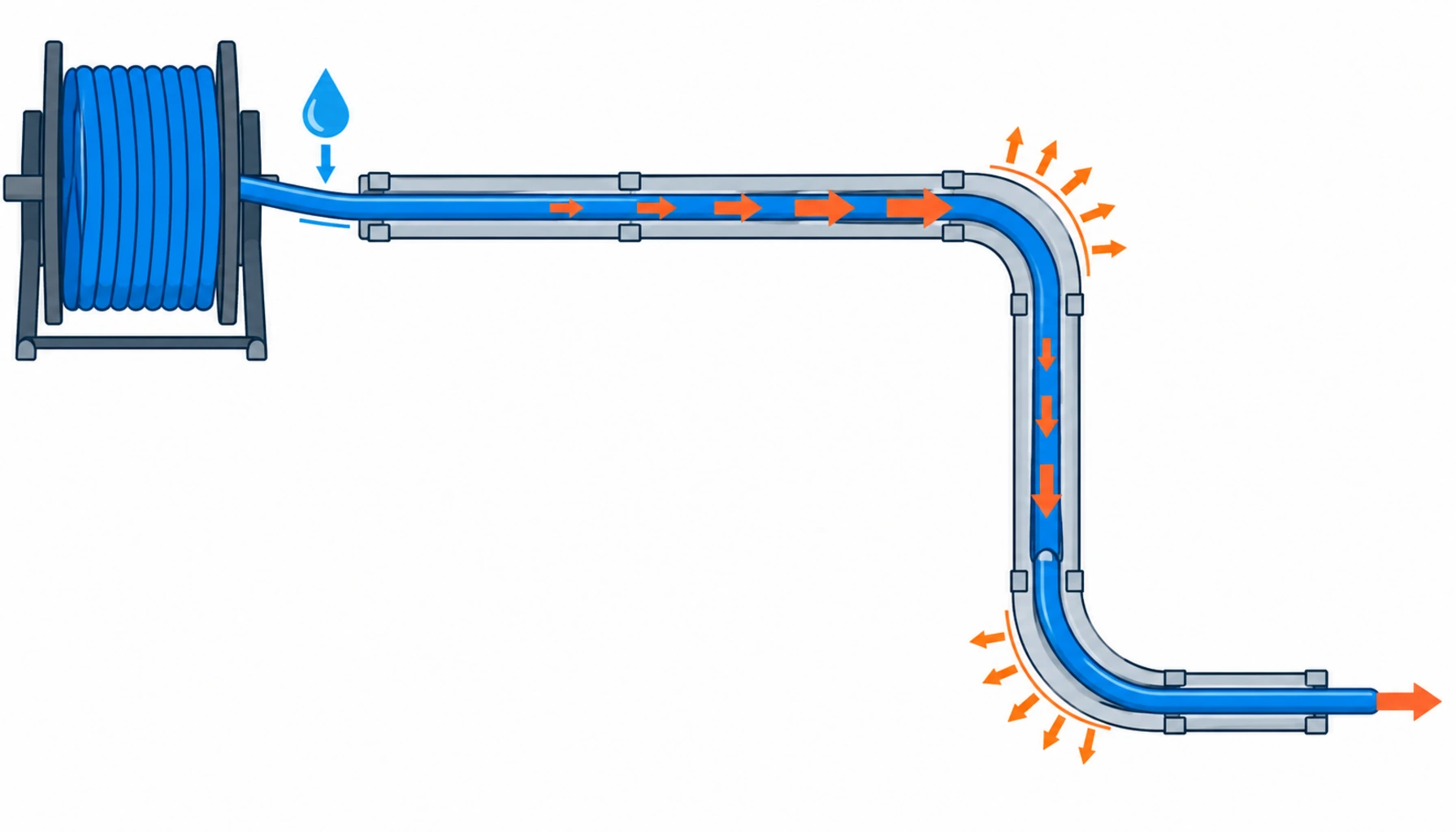
Pulling tension is the force along the cable axis at the pulling end. It accumulates with length, weight and friction, and it multiplies at every bend. A long route with several bends can reach a tension that no amount of lubricant will bring down, which means the answer is a shorter pull, a different reel position, or an intermediate pull. The maximum allowable tension is published by the cable manufacturer and is usually expressed as a function of the conductor cross-section and the construction. It is not a rule of thumb and it is not the same number for every cable of a given size.
Sidewall pressure is the force the cable exerts sideways on a bend as it goes round it. It is the tension divided by the bend radius, which means a tight bend turns a comfortable tension into a damaging sidewall pressure with no change in the pull itself. For large power cable this is usually the limit that decides whether a route is passable, and it is the reason that the minimum bend radius and the tray geometry have to be agreed before either is bought. Where the numbers say a bend is marginal, the cheaper answer is almost always to widen the bend or move the reel, not to slow the pull down and hope.
Both limits are affected by things a buyer controls. Jacket material and the lubricant chosen have to be compatible, because some lubricants attack certain jacket compounds. Armoured constructions are heavier and generate more friction but take axial load better in vertical sections. Conductor stranding matters: a flexible construction tolerates repeated modest bends that would work-harden a rigid one. None of these are visible in a price comparison, which is exactly why they need to be named in the enquiry.
The Decision Table: How to Control the Pull
The table compares the ways the pulling risk can be controlled, in the terms a buyer prices them. The last two columns are the commercial ones: what the method costs in time and equipment, and what it looks like when it fails.
| Measure | What to Put in the Enquiry | Record to Demand | Cost and Time Shape | Failure Mode If Omitted |
|---|---|---|---|---|
| Calculated pulling plan | A tension calculation per run, with reel position, route length, bend angles and expected maximum tension | The calculation, plus the manufacturer's tension limit it was checked against | One page per run, hours of engineering, no material cost | Limits discovered on site, when the only remaining options are slower and more expensive |
| Load cell and pulling log | That tension is measured at the pulling end and recorded for every run | Signed log per run with the measured peak tension | Small equipment cost, a few minutes per pull | No evidence either way when a cable fails a test a year later |
| Lubricant specified by compatibility | The lubricant type, and confirmation it is compatible with the jacket compound supplied | Lubricant datasheet and jacket compatibility statement | Low unit cost, significant effect on measured tension | Jacket swelling or cracking, or a pull cancelled halfway through |
| Cable conveyor or intermediate pull | The runs where calculated tension exceeds the limit, and the method proposed for each | Method statement naming the equipment and the pull sequence | Equipment hire and extra labour on the affected runs only | Pulling through the limit because it is the only method on site |
| Route modification before installation | The bend radii and the pulls that depend on them, agreed before the containment is ordered | Revised route drawing with the radii annotated | Cheapest option when caught at design stage, impossible once the tray is fixed | A bend that cannot be passed at any tension, and a route rebuilt inside a live build |
What to Ask For Before the Cable Is Ordered
The sequence matters more than the content. A pulling calculation done after the cable is delivered has nothing left to influence, so the enquiry should name the deliverables that have to exist before the order is confirmed.
The manufacturer’s tension limit for the exact construction. Not for the size, not for the family, for the construction being offered. Ask for it as a number with the basis stated, and attach it to the order so it travels with the cable to site.
The minimum bend radius under load and installed. Manufacturers often publish two figures, one for the cable being pulled and one for the cable at rest in its final position. The first is the one the pulling plan needs, and it is usually the larger. Using the installed figure in a pulling calculation is a common and expensive shortcut.
The jacket compound and the compatible lubricant. Ask the supplier to state the jacket material and to confirm which lubricant families are acceptable. This is a two-line answer that removes a whole class of site argument.
Reel lengths and drum weights. Reel length decides how many joints the route needs, and joint count is a cost and a reliability question. It also decides what lifting equipment the site needs, which is often the reason a longer reel is rejected after it has been ordered. Confirm the reel length against the site’s handling capacity, not the other way round. Our note on terminating and testing MV cables in data center substations covers what each extra joint costs in termination work.
Reel Length, Joints and the Second Pull
The economics of a pull have one dominant term: what it costs to take the cable out and do it again.
A first pull uses the route as built. A second pull has to remove the damaged cable, which is slower and riskier than installing it, then inspect and repair whatever the removal damages, then re-pull. In practice the second pull costs several times the first, before counting the programme slip and the fact that the tray is now occupied by other services. Any measure that reduces the probability of a second pull is therefore cheap at almost any price, which is the argument for the calculated plan, the load cell and the specified lubricant.
Reel length interacts with this directly. Longer reels mean fewer joints, and joints are the weak point of any cable run. They also mean heavier drums, more awkward handling and a higher tension at the start of the pull. The right answer is usually the longest reel the site can handle rather than the longest reel the factory can make, and it has to be settled before manufacture because reel length is a production decision. Where the route is congested and the pull is marginal, splitting the run into two pulls with a joint in an accessible position can be better engineering than one heroic pull, provided the joint location is designed for maintenance access rather than chosen by whoever is holding the rope.
What to Freeze in the Pulling Specification
| Item | What to State | Evidence to Attach | Cost of Leaving It Open |
|---|---|---|---|
| Maximum pulling tension | The manufacturer's limit for the construction supplied, as a number, on the purchase order | Datasheet extract naming the construction | Pulling to whatever the winch will give, with no basis for a claim either way |
| Minimum bend radius under pull | The pulling radius, not the installed radius, annotated on the route drawing | Manufacturer figure with the condition it applies to | Bends built for the at-rest figure and a pull that damages a shield or a sheath |
| Sidewall pressure cap | The maximum lateral force allowed at each bend, and the calculation that shows it is respected | Per-bend calculation using the route geometry | The passable route identified only after the tray is fixed and loaded |
| Lubricant and compatibility | Lubricant type, jacket compound, and written confirmation the two are compatible | Lubricant datasheet plus supplier statement | Jacket degradation, or a pull stopped halfway with cable in the route |
| Tension measurement | Where tension is measured, at what sampling rate, and who signs the log | Signed pull log per run, delivered with the test records | No evidence when a cable fails months later, so the cost lands on the buyer |
| Reel length and joint strategy | Reel lengths against site handling capacity, and the intended number and location of joints | Reel schedule and joint position drawing | Extra joints in inaccessible places, or drums the site cannot lift |
| Pull sequence and staging | The order of pulls, staging areas and how the route is protected during each one | Method statement agreed with the containment and fire stop trades | Pulls done into a route that other trades are still working in |
| Post-install verification | The tests to be run after each pull, and the pass criteria that trigger a re-pull | Test records per run, with the criteria referenced | A marginal cable accepted by default, and a failure attributed later to something else |
When Pulling Limits Are Not the Answer
There are routes where the pulling analysis will say no, and the answer is not a stronger winch.
Where the bend cannot be widened. An existing building sometimes offers a route with a bend that no reasonable cable size can pass. Buying a more flexible construction can help, and so can changing to a busway or a different route entirely. Pulling harder is not an option, and a contractor who offers to try is describing a risk transfer that has not been priced.
Where the whole route is marginal. If several bends are individually close to the limit, the cumulative tension makes the pull unsafe even if each bend passes in isolation. This is the case for a busway riser or a prefabricated distribution approach, where the number of uncertain pulls falls. Vertical distribution is covered in our note on high density rack cabling.
Where the cable is being bought for repeat movement. Trailing and reeling applications are a different product category and they are not specified by pulling tension. Buying a tray-grade cable for a moving application because it passed the tension calculation confuses two different requirements.
Where nobody will keep the record. A pulling log only has value if it exists after the fact. If the project has no mechanism for collecting signed logs, the money spent on the analysis is reduced to a plan that nobody can prove was followed. In that case, better to spend the same budget on route modification, which changes the physical outcome rather than documenting it. The tests that come afterwards are set out in our note on insulation resistance and continuity testing.
RFQ Checklist
- Maximum pulling tension for the exact construction, as a number with its basis stated
- Minimum bend radius under pull, separate from the installed figure
- Sidewall pressure cap and the per-bend calculation showing the route respects it
- Jacket compound and a written lubricant compatibility statement
- Reel lengths offered, drum weights, and the handling equipment each one requires
- Joint strategy: how many, where, and whether each location is accessible later
- Tension measurement method, sampling interval, and the person who signs the log
- Pull sequence with staging areas and route protection during each pull
- Tests to be run after each pull and the pass criteria that force a re-pull
- Cost and programme treatment of a re-pull, agreed in advance rather than argued afterwards
- Delivery of the signed pull log with the test records, as a contractual deliverable
- Route drawing revised with radii and reel positions annotated before the order is confirmed
Conclusion
Pulling is the one part of a cabling project where the damage is done silently and paid for late. The protection is four numbers written into the enquiry: the tension limit for the construction you are actually buying, the pulling bend radius, the sidewall pressure the route is allowed to reach, and the lubricant that is compatible with the jacket. Add a signed log and the four become verifiable. Leave them out and the only surviving evidence of how the cable was installed is somebody’s memory.
Kexingyu Cable Group (KXYE) supplies the cable that goes into the pull: the WDZ-YJY, WDZN-YJY, BTTZ, BBTRZ, NG-A (BTLY), KVV and YJV ranges, along with multi-purpose distribution cable, the medium voltage XLPE armoured cable used on substation feeders, and the distribution equipment at the far end including the GGD power distribution cabinet. Every construction ships with the tension and bend radius figures the pulling plan needs, and copper price linkage is available on project-scale orders. Send the route drawing with the maximum cross-section you intend to pull and we will return the limits, the reel options and a schedule that fits the site handling capacity; the fastest route is a request for quotation.