Evaluating a High-Flex Cable Supplier: 7 Questions That Filter Fast
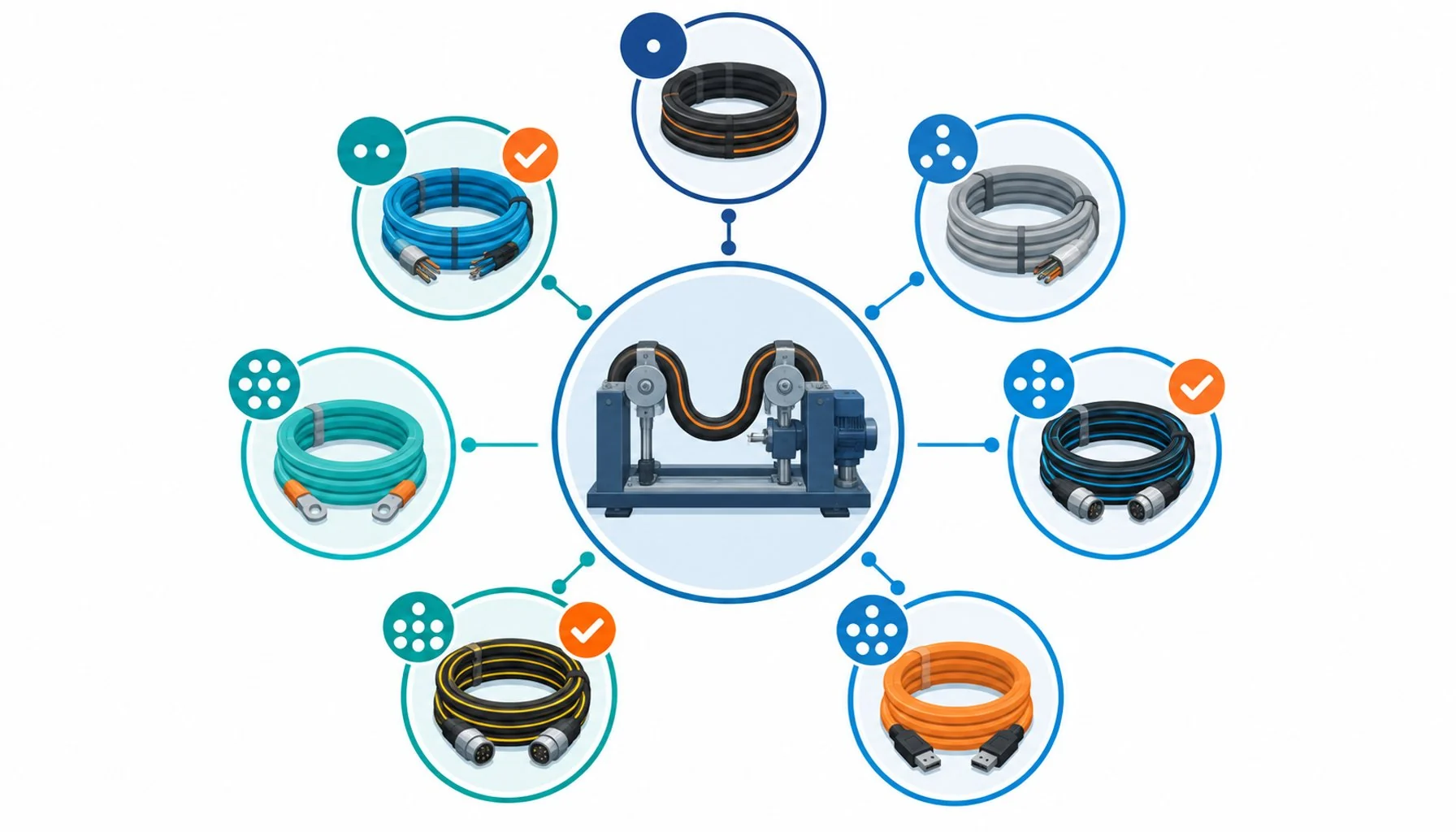
Quick Answer: Seven questions decide most high-flex supplier evaluations: which machine strands the wire, what a flex report proves, what is made in house, how constructions stay constant, which certificate covers the build, what happens after a failed batch, and who answers when a cable fails in the field.
Supplier evaluation usually starts as a document exercise. Capability statements arrive, the factory profile looks impressive, and the first order goes out on the strength of a well-formatted PDF. Nine months later a cable carrier is being refitted because the conductor fatigued early, and the conversation turns to what the supplier actually controls and what it merely passes along.
Introduction
The seven questions below exist to shorten that loop. Each one is answerable in a single call, and each one separates suppliers who own their process from suppliers who assemble other people’s products into a catalogue. They come from a specific angle: high-flex and torsion cable for robot axes, cable carriers and pick-and-place machinery, where the construction has to survive millions of stress cycles and where a small process difference becomes a large service difference.
None of the questions requires the supplier to share trade secrets. All of them require the supplier to know its own process, which is the actual test. A factory that runs fine stranding in house and tests its own cable can describe both without hesitation. A trading office cannot, and the failure to answer is the answer.
Question One: Which Machine Strands This Construction?
Flex life begins in the strander. A high-flex conductor is built from many fine wires bunched in a specific pattern with a controlled lay length, and the machinery that does this is not the same machinery that makes building wire. Ask which strander the construction runs on, how many wires per bunch, and what lay length is used. Answers come back either as specifics or as a restatement of the cable type, and the difference is the whole point of the question. If the supplier has to check with a third party before answering, you have learned where the conductor is made.
Question Two: What Does the Flex Report Actually Prove?
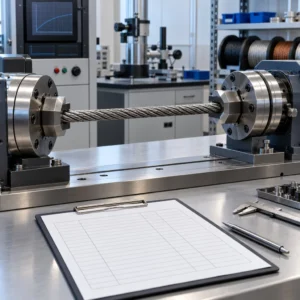
A bend test report is evidence only if it describes the test. Ask for the rig geometry, the bend radius, whether the cycle was a reverse bend, a rolling bend or torsion, the applied voltage or monitoring method, and the pass criterion. A report that says “passed flex test” with no setup behind it is a marketing document. A report that names the construction, the radius and the cycle count at failure is data you can compare against your own duty. The discipline of testing to a defined criterion is the same one that makes factory acceptance testing meaningful, and it applies with more force to a wear part than to a static assembly.
Question Three: What Is Made In House and What Is Bought In?
Very few cable factories do everything. The honest ones tell you which steps they own and which they outsource, and a genuine high-flex supplier will normally own conductor drawing or bunching, insulation and the final assembly and test. Where compounding or specialty jacketing is outsourced, ask who the compound supplier is and how incoming material is verified. Outsourcing is not disqualifying; unmanaged outsourcing is. The same transparency test belongs in any assessment of vetting a Chinese electrical equipment manufacturer, where the supply chain behind the product matters as much as the product itself.
Question Four: How Do You Keep a Construction Constant?
Repeatability is the quiet requirement behind every flex claim. Ask how the factory documents a construction, who can approve a change, and whether customers are notified when a material, a supplier or a process step changes. Suppliers with a change-notification process answer in specifics. Suppliers without one answer with reassurance. Over a product life of several years and a dozen production batches, that single difference decides whether your twentieth delivery behaves like your first.
Question Five: Which Certificate Covers This Exact Build?
Certificates are frequently held at company level and quoted at product level. The useful question is narrower: for this construction, in this size, is there a valid certificate, and can I see its scope and the standard version it was assessed against. Standards get revised, and a certificate issued against a superseded edition may not satisfy a customer’s compliance review. Where a specific certificate is not held directly for a specialty motion construction, it can often be arranged through the cooperating manufacturing system with the scope confirmed in writing before the order, which is a normal and workable answer. What is not workable is a certificate number that turns out to cover a different product family. The scope questions asked around cable certification apply here in full.
Question Six: What Happens When a Batch Fails Your Own Test?
Every factory has failures. The question is what the factory does with them. Ask what happens when a finished reel fails routine electrical testing, whether the batch is quarantined, whether the failure and its disposition are recorded, and whether a customer can see that record. A supplier with a real quality system describes a workflow. A supplier without one describes the reel being reworked until it passes.
Question Seven: Who Answers When a Cable Fails in the Field?
Field failure is where the commercial relationship is either proven or exposed. Ask who the technical contact is, what data the supplier will review, how fast a response is expected, and how a claim is adjudicated when the cable has been installed for a year. Suppliers who can describe a failure investigation, covering installation radius, cycle history and batch records, are describing a capability, not a courtesy.
What the Answers Reveal
Score the seven answers and a pattern emerges, usually on the first call. The table below is the short version of that pattern, and it is worth keeping beside the enquiry sheet.
| Question | A strong answer sounds like | A weak answer sounds like |
|---|---|---|
| Stranding equipment | Named machines, wires per bunch, lay length | The cable type restated in marketing words |
| Flex test evidence | Rig, radius, cycle count, failure criterion, construction named | "Passed flex testing" with no setup described |
| In-house scope | A clear split of owned and outsourced steps, with suppliers named | "We control the whole process" without specifics |
| Construction control | Documented build, approval route, change notification to customers | Assurance that nothing ever changes |
| Certification | Scope and standard edition stated for the exact build | A company-level certificate offered as product proof |
| Failed batches | Quarantine, disposition record, customer visibility | Rework until the test passes |
| Field support | Named technical contact and a failure investigation method | A sales contact and a warranty clause read aloud |
When the Seven Questions Are Not the Answer
The questions also work in combination. A supplier that answers one and two well but cannot describe change control is a factory with good equipment and weak systems, which is a manageable risk if you audit regularly. A supplier that answers four and five well but stumbles on the strander is usually a reseller with good documentation, which is a different kind of problem and shows up as inconsistent flex life across batches. Reading profiles rather than single answers is where the evaluation earns its keep.
| Profile | What it usually means | How to handle it |
|---|---|---|
| Good equipment, weak systems | Process capability is real; control is informal | Audit regularly, put change control in the contract, retain samples |
| Strong systems, outsourced production | Documentation is better than the process it describes | Verify the outsourced steps directly and name them in the specification |
| Small specialist factory | Deep capability in a narrow construction range | Accept a narrower catalogue in exchange for construction control |
| Large generalist factory | Capacity and stability, less attention per order | Secure a named construction and a named technical contact |
| Reseller with good paperwork | Little visibility of the line that makes the cable | Qualify the producing factory separately before any production order |
RFQ Checklist: Turning the Answers into a Purchase
Three limits are worth stating. First, questions filter, they do not qualify: only test data mapped to your duty and a successful sample will do that, and no conversation replaces a bend test. Second, a small factory can be excellent and a large one mediocre; scale is not the variable these questions measure. Third, if your application is a static run with a handful of movements a day, the high-flex apparatus is unnecessary, and buying it wastes money on both sides. Spend the effort on the applications where flex life is the binding constraint, and confirm the failure modes that matter through the evidence in common cable failure causes.
Conclusion
Once the answers satisfy you, put them in writing with the enquiry:
- The construction as agreed, with stranding, shield and jacket named
- The duty profile and the flex test criterion you expect to see proven
- Copies of test reports for the exact construction, not a family representative
- Certificate scope and standard edition, confirmed before the order
- Change-notification terms and who at the factory signs them off
- Batch record and retained sample expectations per delivery
- Named technical contact for field questions
- MOQ, lead time and the first delivery date