Industrial Ethernet in Drag Chains: PROFINET, EtherCAT and Flex-Rated Data Cable
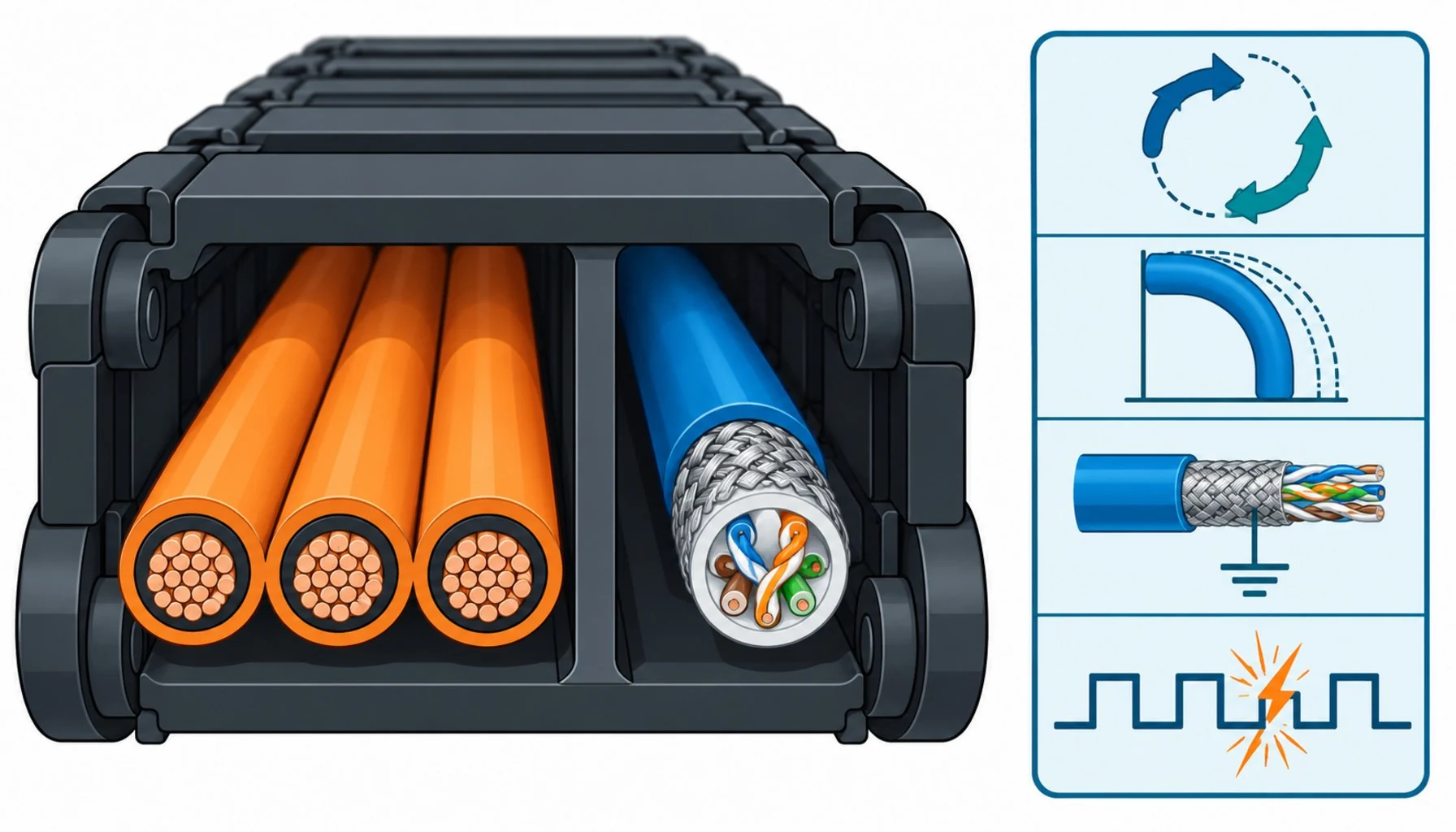
Quick Answer: Real-time Ethernet riding a drag chain needs flex-rated construction — bonded pairs, controlled impedance and braid shielding — because office-grade cable loses its geometry within weeks of motion and takes the protocol down with it.
A modern machine is a network with motors attached. PROFINET, EtherCAT, EtherNet/IP and their cousins carry synchronization, motion commands and safety signals over standard Ethernet physics — and on nearly every machine, that network physically rides through a drag chain alongside the power cables that make the machine move. The combination works, but only when the data cable is built for the environment. The uncomfortable lesson shops learn repeatedly: a patch cable that performs flawlessly in an office switch fails inside a chain within weeks, because office cable is built to lie still. Its pair geometry relaxes, its foil shield cracks, its impedance drifts — and a real-time protocol that depended on sub-millisecond consistency starts dropping telegrams that look, from the controller, like phantom machine faults. This guide covers what industrial Ethernet actually demands from a cable in motion, how the major protocols differ in their requirements, and the specification that keeps network traffic flowing through a million chain cycles.
Introduction
Industrial Ethernet is ordinary Ethernet physics plus hard real-time promises. PROFINET RT, EtherCAT, EtherNet/IP, POWERLINK — each implements determinism differently, but all of them share the same physical layer discipline: the cable must preserve the impedance, pair symmetry and shielding integrity that the protocol’s timing assumes. In a cabinet, any decent cat5e delivers that. In a chain, the cable bends, twists slightly and rubs its neighbors millions of times, and each cycle tries to destroy the geometry. The failure pattern is insidious because it is gradual: error counters climb, retries absorb the damage, and the machine keeps running — until the day the margin runs out and the faults appear as diagnostics no one can reproduce at the bench. The failure mechanics are the standard ones from the cable failure catalog, with protocol timing as the victim that makes them visible.
What Flex-Rated Actually Means for a Data Cable
Chain-rated Ethernet cable is ordinary Ethernet construction re-engineered at every layer. The pairs are bonded or tightly and consistently twisted with short lay so pair geometry survives bending — impedance is a physical spacing promise, and spacing is what motion attacks. The conductors are finer stranded with shorter lay than stationary cable, for the same flex-life physics as any motion cable. The shield is a dense braid, often combined with foil in demanding cases, because a foil-only shield cracks within weeks of chain duty. The jacket is typically PUR or a low-friction compound that tolerates rubbing against chain dividers and resists the oils it will meet. And the whole construction is tested — genuinely chain-rated products publish cycle counts at stated bend radii and speeds, tested in actual chains, because element-level ratings do not guarantee system-level survival. Reading those test conditions critically is the same skill as reading any supplier datasheet, covered in the datasheet review guide.
The category confusion to avoid: cat5e, cat6 and cat6a describe electrical performance categories for stationary wiring, not motion ratings. A cat6a cable with no flex rating is the wrong product in a chain at any category number; a chain-rated cat5e construction outlives it by years. Specify the motion rating first and the category within it.
| Protocol | Timing Character | What It Needs From the Cable | Common Mistake |
|---|---|---|---|
| PROFINET (RT/IRT) | Cycle times down to sub-millisecond; IRT demands tight jitter control | Consistent impedance, good shield, PROFINET-conformant construction | Using generic cat5e in the chain because the cabinet cable worked |
| EtherCAT | Very tight synchronization across slaves; frame processing on the fly | Low and stable delay, flex-rated geometry, disciplined grounding | Ignoring bend radius at chain entries until sync errors appear |
| EtherNet/IP | CIP-based, CIP Motion demands the same discipline as motion buses | Chain-rated construction; ODVA-conformant cable where specified | Assuming all Ethernet cable is interchangeable because connectors fit |
| Modbus TCP / non-real-time | Tolerant timing, ordinary retry behavior | Still needs flex rating for chain survival, though timing is forgiving | Treating tolerance of timing as tolerance of broken shields |
The EMC Side: Sharing a Chain With Power
The chain is a small, crowded electromagnetic neighborhood: servo power cables with steep PWM edges run meters alongside the data cable they will corrupt if allowed. The defenses are the standard power-versus-signal discipline — the same separation logic described for control and instrumentation wiring — applied in chain geometry. Chains with dividers put power and data in separate compartments; without dividers, spacing and a screened barrier do the work. The Ethernet cable’s braid shield must be grounded at both ends in most industrial practice, with the grounding path engineered rather than improvised at the gland. And crossings happen at right angles where the routing leaves the chain. Machines that skip this discipline produce a signature: network errors that rise with axis speed and vanish when the axes are disabled — an EMC audit disguised as a network problem.
Installation Details That Decide the Outcome
Three installation habits separate networks that run for a decade from networks that debug forever. First, bend radius at the chain entries and the fixed-end transitions — the tightest point sets the requirement, and data cable tolerates less radius than power cable of the same jacket diameter, so the chain selection meeting needs the data cable’s number on the table. Second, connector care: industrial RJ45 and M12 connectors are precision assemblies, and on a chain cable the connector back is where installation stress concentrates — strain relief, correct crimping and no unsupported hangs. Third, keep the office habits out of the machine: no re-terminated field repairs on chain cable, no cable ties crushing the jacket at the gland, no coiling excess length into a tight loop at the cabinet entry. The cabinet-side discipline follows the same entry and separation rules described for custom control cabinet work — the chain is just the part that moves.
| Check | What to Pin Down | Why It Decides the Outcome |
|---|---|---|
| Protocol and cycle time | Which protocol, which timing class, jitter requirements | Sets the impedance and shielding quality bar |
| Motion duty | Chain radius, speed, cycles per day, verified chain test data | Chain-rated means tested in a chain, not asserted on a datasheet |
| Category within rating | cat5e/6/6a as needed by the protocol — inside the flex rating | Category without flex rating is the wrong product in a chain |
| EMC layout | Compartments or spacing from power runs, grounding scheme | Network errors that track axis speed are shield failures |
| Connector plan | M12 or RJ45 per environment, strain relief, termination quality | Connector backs concentrate installation stress |
| Diagnostics discipline | Error counter monitoring in the maintenance routine | Rising counters show the creep before the machine stops |
When Flex-Rated Ethernet Rules Are Not the Answer
Honesty about scope keeps this guide useful. Chain-rated Ethernet solves the motion problem for data cable in chains, dress packs and moving looms. It is unnecessary for stationary cabinet and facility wiring, where standard industrial cable is correct and the flex premium is waste. It is not the whole answer for robotic vision applications, where signal integrity demands add camera-specific requirements. It does not substitute for protocol engineering: cycle times, switch configuration and network topology remain the controls engineer’s territory, and a perfect cable cannot compensate for a bad network design. And it does not cover power and hybrid requirements — a servo axis carrying power and Ethernet together is a hybrid cable decision with its own discipline. Match the cable to the motion, verify the rating with test data, and the network stops being the machine’s recurring ghost.
RFQ Checklist: What to Send the Cable Supplier
Put the network’s reality in writing before quotes come back:
- Protocol, timing class and category requirement, stated separately from the motion rating
- Chain geometry: inner radius, speed, cycles per day, expected service life
- EMC environment: power cables in the same chain, divider or spacing plan, grounding scheme
- Connector requirements: M12 or RJ45, ingress protection, termination style
- Jacket environment: oil, coolant, chips, temperature, UV exposure
- Proof: chain test data at stated radius and cycles, batch traceability
- Spares: pre-terminated lengths for the highest-motion axes
Conclusion
Industrial Ethernet turned machine networks into motion systems, and the data cable in the chain is now a motion component with a protocol riding on it. Flex-rated construction, real shielding, radius discipline and clean terminations keep telegrams flowing for the machine’s life; office-grade cable in a chain buys weeks of margin and then a debugging saga. The cable is part of the network’s timing budget — specify it that way.
Kexingyu Cable Group (KXYE) supplies chain-rated industrial Ethernet and data cable constructions with tested flex lives, braid shielding and batch traceability behind every rating. Describe your protocol, chain geometry and duty through the RFQ page, and we will respond with constructions rated for the motion, not just the category.