
Industrial UPS Manufacturer: What to Ask Before You Order
A UPS purchase is a ten-year relationship with a factory you may never visit—the questions you ask before the order decide how that relationship behaves on the day something fails
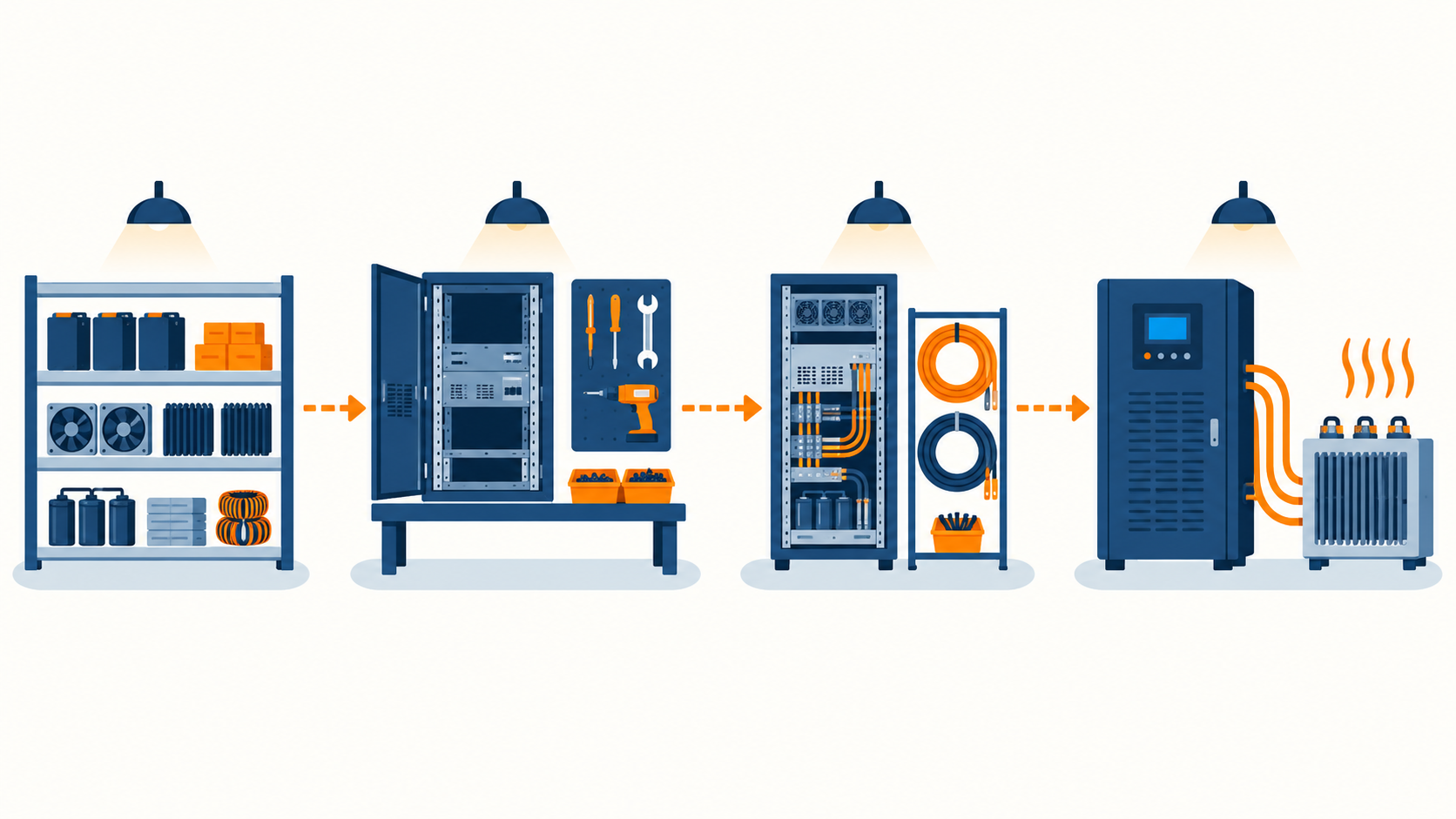
Introduction
Industrial UPS procurement has an asymmetric risk profile that buyers underestimate. The equipment itself is mature technology—double-conversion machines from a competent factory are all capable of the job on the day they are commissioned. What separates manufacturers is everything around that day: whether the type tests are real, whether the components inside match the quotation, whether a failed module draws a spare from a local shelf or starts a six-week international shipment, and whether the warranty clause means what it appears to mean. These differences stay invisible until the worst day—by design, the UPS fails rarely, and each buyer gets few chances to learn.
That is why the vetting conversation matters more for UPS than for many other purchases. The questions in this guide are not a formality; each one is built to force a specific, verifiable answer—named certificates, witnessed tests, contactable references—and each has a wrong answer that should end the negotiation. The guide also includes the red flags, because in this market the fastest risk filter is recognizing the signals of a factory that is assembling rather than manufacturing.
The same logic extends across the power train: our checklists for transformer manufacturers and switchgear manufacturers apply the identical discipline to neighboring equipment. For how the UPS fits with the rest of the system, start from the data center power equipment range.
Why Manufacturer Choice Is a Ten-Year Decision
A UPS system’s service life stretches across a decade of batteries, control boards, firmware updates, load growth and personnel turnover. The purchase price is the smallest number in that story: battery replacements arrive on a 3–5 year cadence for VRLA, service events arrive unpredictably, and each one converts directly into downtime risk when the support network is thin. Buyers who optimize the initial quotation above all else are pricing the only part of the lifecycle they can see, and accepting risk on all the parts they cannot.
There is a second, quieter reason: the manufacturer is also the design authority. When the site adds load, changes battery chemistry, or integrates storage years later, someone must still understand the machine deeply enough to adapt it. A factory that built the design can answer; a trading company that resold it forwards the question into a void. Choosing a manufacturer is choosing who will hold the engineering knowledge of your critical power system for the next ten years—so the vetting questions are really asking one thing: is there a factory, a design team and a support organization behind the quotation, and can they prove it?
Start with the Factory: Capability You Can Verify
The first round of questions establishes whether the seller actually manufactures. Ask where the production happens—the legal entity, the address, the relationship between that entity and the brand on the quotation. Ask what is produced in-house versus bought in: cabinet fabrication, module assembly, transformer or choke winding, final integration and test each tell you something about where quality is actually controlled. Ask for the production capacity in units or kVA per month and the current utilization, which reveals both whether your order will wait in a queue and whether the factory is growing or shrinking.
Then ask to see it. A genuine manufacturer invites factory audits without hesitation and offers a standard visit agenda: production floor, module assembly, test bays, warehouse, quality office. Resist the temptation to treat a video call tour as equivalent—walk the floor if the order justifies it, and watch for the details that marketing cannot fake: whether test bays are occupied with real units, whether work-in-progress is labeled and traced, whether the assembly line matches the product family being quoted. The audit visit section below gives the visit a structure.
Design Authority and Type Testing
Industrial UPS units carry type tests under the IEC 62040 series—performance, safety and EMC—which are the industry’s baseline proof that the design was verified by someone competent. The vetting question is not “are you certified” but “whose certificates, for which exact models, tested where, and can we witness?” Certificate numbers should be traceable to a named laboratory and a named model family; a certificate for a different frame size than the one quoted is a near-miss worth probing. Strong manufacturers also accept third-party or customer witnessing of type and routine tests, because they have nothing to hide in the test bay.
Design authority shows in smaller ways too. Ask who owns the control firmware and how updates are managed—forklift upgrades to control code are a lifecycle risk when nobody owns the source. Ask how design changes are handled after order: change notices, impact assessment, re-test triggers. A factory with real engineering answers these in sentences; an assembler routes them to a supplier you have never met and will never contract with.
Quality Systems and the Component Question
A quality management certificate is the entry ticket, not the answer. The differentiating question in UPS procurement is the component bill of materials: which brands of IGBT modules, capacitors, control boards, fans and batteries are actually inside the quoted machine. This is not brand snobbery—the failure statistics of power electronics concentrate in a handful of components, and their quality tiers are real. The answer belongs in the contract, not the conversation: a bill of materials with named brands, agreed as binding, with change control requiring notice.
Behind the BOM sit the incoming inspection and traceability systems. Ask how components are received and checked, whether serial numbers trace a finished unit back to its component lots, and what the factory does when an incoming lot fails. Manufacturers with mature quality systems answer with documents; the rest answer with assurances. And ask about the two components that age fastest—electrolytic capacitors and cooling fans—what brands and ratings are specified, and what the recommended replacement intervals are. The quality of a UPS is largely decided before it is ever assembled.
Testing: Where Promises Meet Load
Factory testing is the single most valuable quality milestone a buyer controls, because it happens before the machine ships and after the design is real. The essential offer is a witnessed factory acceptance test (FAT) on the actual serial-numbered unit: full-load or load-bank testing, transfer and retransfer sequences, battery discharge test, bypass operation, alarm and communication checks—against a test protocol agreed before order. The protocol matters as much as the test: it converts “we test everything” into a numbered list both parties sign.
Ask what percentage of production units receive full-load testing versus sampling, and whether the quoted unit is one of them—some factories test types, not units. Ask for sample FAT reports from previous projects, blanked for confidentiality, and read how failures found during test were recorded and resolved. A manufacturer that tests each unit at full load and keeps honest failure logs is telling you something no brochure can; one that resists witnessed testing has answered the question in its own way.
References, Warranty and the Support Network
References are the cheapest insurance in procurement. Ask for three projects of similar duty—capacity, load type, climate, grid conditions—delivered in the last three years, with contactable principals. Then actually call. The questions that matter are operational: what failed, how fast were parts and people, did the documentation match the machine, would they buy again? Manufacturers with a genuine export track record in your region will have reference customers who answer; the absence of any contactable reference in comparable duty is a finding in itself.
Warranty and support terms convert promises into obligations. Read what the warranty actually covers—parts, labor, travel, despatch—and what it excludes, which is where the real terms hide. Ask for written response commitments: hours to remote diagnosis, days to parts, days to an engineer on site, and where the nearest spare parts inventory physically sits. The vetting areas and the answers that distinguish strong manufacturers are summarized below:
| Area | Questions to Ask | What a Strong Answer Sounds Like |
|---|---|---|
| Factory and capacity | Which entity produces, at which address, what is in-house, current utilization | Named works, audit visit offered without hesitation, production floor matches quoted product family |
| Design and type tests | Who owns the design and firmware; which IEC 62040 certificates for which models | Certificate numbers traceable to named lab and exact frame; witness of type tests accepted |
| Quality system | ISO 9001 scope; incoming inspection; component traceability | Documents produced on request; serial traceability to component lots |
| Components | Which brands of IGBTs, capacitors, fans, batteries inside this quote | Binding BOM with named brands in the contract; change control with notice |
| Testing | FAT scope; per-unit full-load test; witnessed test policy | Signed test protocol before order; every unit load-tested; sample reports shared |
| References | Three comparable projects, contactable, recent | Names, ratings, climates offeredâand the phone call goes well |
| Warranty and support | Parts/labor/travel coverage; response times; spare parts location | Written terms with committed hours/days; regional parts inventory identified |
| Export experience | Export record to your region; packing spec; documentation language | Regular shipments, seaworthy packing standard, contract-committed language |
Red Flags: When to Walk Away
Most problematic suppliers announce themselves early, in ways that are easy to rationalize away in the excitement of a low number. The patterns below recur across power equipment procurement—the same list applies to generators, switchgear and transformers—and each one has a rational response:
| Red Flag | Why It Matters | What to Do |
|---|---|---|
| Quotation arrives in hours with no technical questions asked | Nobody has sized or checked anything; you are buying a box number | Send load data and design questions; a real engineer replies with real answers |
| Type-test certificates cannot be named, or witnessed FAT is refused | The tests may not exist for this design | Require traceable certificate numbers as a condition of order |
| Components described as "imported brands" without names | The quality lottery is inside the cabinet | Insist on a binding BOM with named brands; walk if refused |
| No contactable reference in comparable duty or climate | Your project becomes the experiment | Ask for three; verify by phone before shortlisting |
| Warranty excludes labor, travel or response time is undefined | Downtime risk silently transferred to the buyer | Negotiate a written SLA before the order, not after the failure |
| Price far below every other bid | Something was cutâbattery brand, copper, testing scope, or support | Audit the delta line by line; cheap usually has an address |
| Factory visit deflected to a "showroom" or traded for a deposit | The production floor may not match the quotation | Visit the address on the business license, unannounced if possible |
Structuring the Audit Visit
A factory audit earns its cost when it follows a plan instead of a brochure tour. Structure the day in layers: start in the production areas for the quoted product family—module assembly, cabinet integration, wiring—then the test bay, where occupancy with real units and load banks is the single most honest sight in the building. Continue through quality control: incoming inspection records, calibration stickers on instruments, traceability samples pulled on request. Close with the commercial functions—export documentation, packing lines, spares warehouse—because support quality lives there too.
Bring your own checklist and your own questions, and ask them on the floor, not in the meeting room. Two habits separate useful audits from ceremonial ones: ask to see the unit next in line for the test bay and follow it through the sequence; and ask for one traceability demonstration—pick a serial number and follow it back to component lots live. A factory that passes those two tests in person has passed most of the paper checks as well.
Getting It in Writing: Contract Items That Matter
The vetting conversation only becomes protection when its answers harden into contract text. The essentials: the bill of materials with named component brands as a binding annex; the FAT protocol as an order condition, with witnessed tests and defined acceptance criteria; warranty terms with explicit coverage of parts, labor and travel, plus committed response times; documentation deliverables in the contract language—manuals, as-built drawings, test reports; and a spares and training package sized to the site’s reality rather than the manufacturer’s convenience. None of these clauses is exotic; together they convert a good conversation into a good decade.
One final note on certifications for the wider equipment package: credentials follow the equipment, not the invoice—our checklist on electrical equipment certifications explains which documents to verify and why certificates for one model rarely cover its siblings. Apply the same rule to the UPS: the certificate, the test report and the serial number on the machine should all name the same thing.
Conclusion
Vetting an industrial UPS manufacturer is a search for the people behind the quotation: the factory that builds, the engineers who own the design, the test bay that proves each unit, the support network that answers on the worst day. Every question in this guide forces one of those people to show themselves—through certificates that trace, tests that can be witnessed, references that answer the phone, and warranty terms written in hours and days rather than adjectives.
Run the questions, structure the audit, put the answers in the contract, and the ten-year relationship starts on solid ground. When you are ready to test a manufacturer against this list—including us—the team at KXY E-Power Group welcomes factory audits, witnessed testing and reference calls as standard practice, across UPS systems and the switchgear, transformers and storage equipment that complete the power train.
Frequently Asked Questions
Recent Posts

Power Cable Warranty Terms: What to Demand and What to Watch For
Power Cable Warranty Terms: What to Demand and What to Watch For Quick Answer: A usable warranty names its scope, duration, evidence standard, exclusions and
The Cable Sample Approval Process: What to Test Before Mass Production
The Cable Sample Approval Process: What to Test Before Mass Production Quick Answer: Sample approval tests the supplier’s claims while changes are still cheap —
Cable Drum Packaging for Export: Specs, Marking and Transit Protection
Cable Drum Packaging for Export: Specs, Marking and Transit Protection Quick Answer: Export packaging is a technical specification: drum size for weight and bend radius,