
Nigeria's Electrification Push: Equipment Needs for Mini-Grid Projects
Nigeria runs one of the largest mini-grid build-outs in Africa—and the shopping list behind it, from LFP battery cabinets to 33 kV ring main units, is now standard enough to procure like a product line, provided developers avoid the sizing traps that sink most budgets.
Introduction
Nigeria carries the largest absolute electricity access deficit of any single country: well over half of its roughly 220 million people are either unconnected or served by a grid so unreliable that a small petrol generator remains the real household backup. Extending the national grid alone would take decades and more capital than the sector can mobilise. Mini-grids are the shortcut the country has chosen—solar-hybrid plants of 50 to 500 kW, built and operated by private developers, selling metered power to communities the grid serves poorly or not at all.
The framework is unusually mature for the region. The Rural Electrification Agency (REA) has run dedicated mini-grid programmes since the first regulations were issued in 2016, those regulations were revised in 2023 to formalise interconnected mini-grids that feed surplus into the distribution network, and World Bank-backed financing lines have moved the model from pilot projects to portfolios. For equipment buyers this means the market has settled: the architecture, the voltage levels and the failure modes are known, and the bill of materials repeats from project to project.
It also means the equipment decision is where projects are won or lost. Land and local labour are comparatively inexpensive; the imported plant—the arrays, batteries, inverters, transformers, switchgear and metering—typically accounts for 60 to 70% of capital cost, and its quality determines the tariff a community will accept and the uptime a lender’s technical advisor will sign off. This guide walks through the generation plant, the core equipment list, the sizing mistakes that sink budgets, the distribution layer that turns generation into revenue, and what belongs in the RFQ.
The Policy Engine Behind the Boom
Two regulatory categories define what you buy. An isolated mini-grid stands alone: it generates, stores and distributes everything its community consumes, with no utility connection. An interconnected mini-grid, recognised explicitly since the 2023 revision, plugs into a distribution company’s feeder, can export surplus power and must meet utility-grade protection and metering at the point of connection. Most of the current pipeline is isolated; the interconnected segment is where experienced developers are positioning for the next phase, and it changes the equipment scope significantly.
The procurement consequence is documentation. Results-based financing and commercial lenders audit the plant before money moves: IEC type-test certificates, factory acceptance test reports and traceable nameplates are disbursement conditions, not paperwork afterthoughts. Developers who bought on price alone have watched payments stall over missing certificates. Build the documentation trail into the purchase order from day one, and treat the supplier’s ability to produce it as part of the technical offer.
The Generation Plant: Solar, Storage and Backup on One Bus
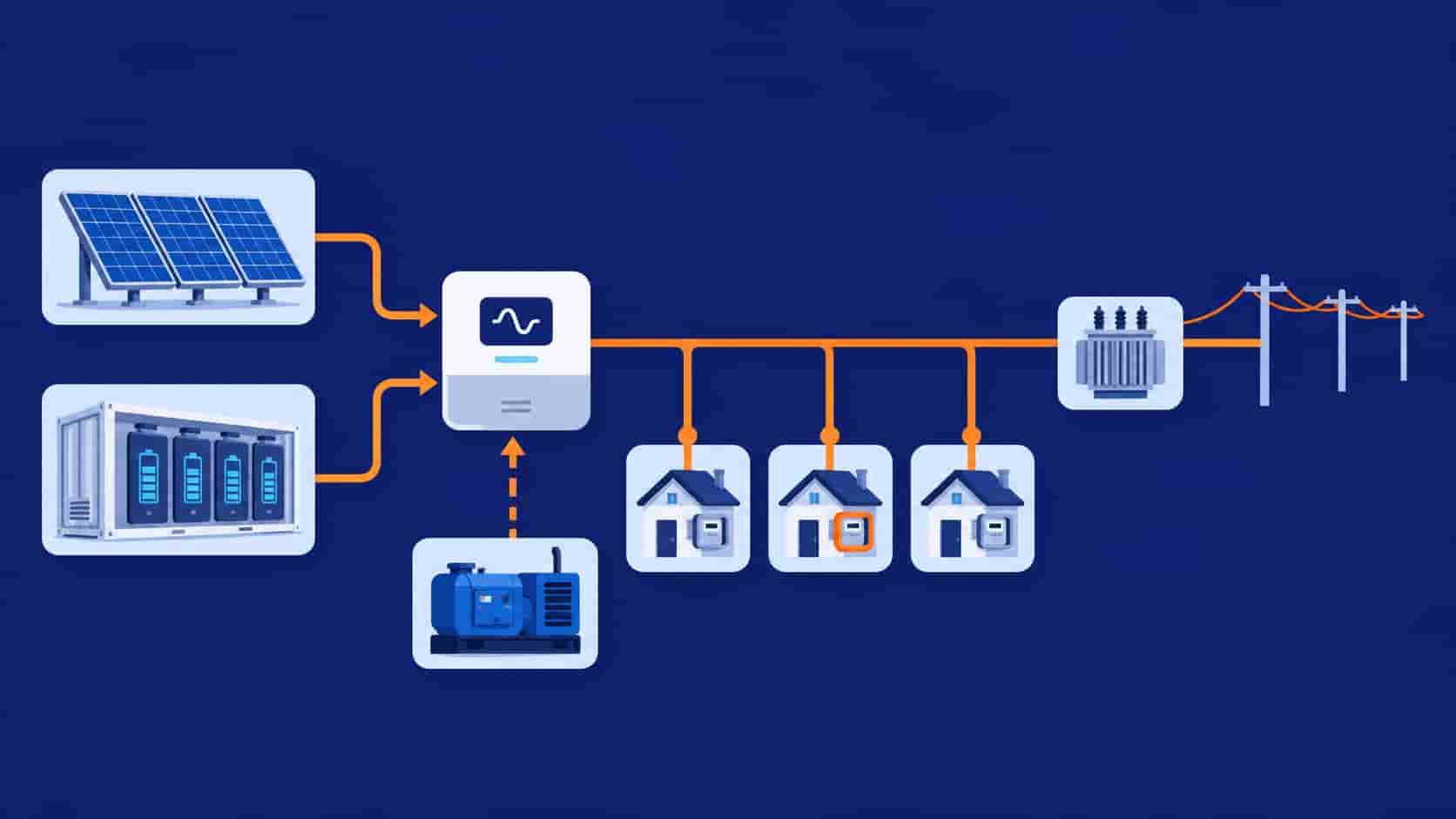
A Nigerian solar-hybrid mini-grid puts three sources on one low-voltage bus: PV arrays through a hybrid inverter, a battery energy storage system, and a diesel genset that the inverter starts and stops as required. The inverter is the conductor of the orchestra, and it must be a grid-forming unit—one that creates voltage and frequency for the community, because there is no utility grid to follow. Grid-tie experience does not transfer. Grid-forming parallel operation and black-start capability are the two datasheet lines to verify before anything else, and they are the two most often discovered missing at commissioning.
The battery is the anchor asset. Lithium iron phosphate (LFP) in a containerized cabinet with an integrated battery management system and cooling has become the default for two-to-four-hour autonomy: it tolerates Nigerian ambient temperatures, delivers thousands of cycles in daily cycling duty and holds its capacity through the heat that destroys lesser chemistries. If the technology is new to your team, our battery energy storage systems guide covers the fundamentals from cells to containers. And the genset is not a leftover—it runs real hours through the wet season between April and October, when cloud cover cuts solar yield for days. The same generator-plus-storage coordination logic we set out in our generator and storage hybrid systems overview applies directly at mini-grid scale.
In practice, a 200 kWp PV array with 500 to 800 kWh of LFP storage and a 100 to 150 kVA synchronizing genset is a common configuration for a market-town site with several hundred connections. The ratios matter more than the absolute numbers—and they are precisely where most projects go wrong.
Core Equipment for a Solar-Hybrid Mini-Grid
The bill of materials repeats from site to site even when the capacities move. The table below is the version Nigerian developers and their equipment suppliers work from—a 100-500 kW solar-hybrid plant with its distribution layer.
| Equipment | Role in the Mini-Grid | Typical Specification | Procurement Notes |
|---|---|---|---|
| PV modules and mounting | Daytime generation feeding the hybrid inverter bus | 450-550 W mono modules on hot-dip galvanized steel, IEC 61215/61730 certified | Specify salt-mist (IEC 61701) coating for coastal states and include 2-3% spare modules |
| Grid-forming hybrid inverter (PCS) | Converts DC to AC and balances solar, battery and genset on one bus | 100-500 kVA units, parallel-capable, grid-forming mode with black start | Verify true off-grid parallel operationânot grid-tie onlyâand ask for existing Nigerian or West African references |
| Battery energy storage (BESS) | Carries the evening peak and bridges wet-season cloud | LFP chemistry, 2-4 h autonomy, 20 ft containerized cabinet with BMS and HVAC | Get cycle-life warranty in writingâ6,000 cycles at 80% depth of discharge is the working benchmark |
| Backup diesel genset | Wet-season backup and black-start source | Synchronizing sets with AMF controllers sized for the evening peak | Right-size to avoid wet stacking; agree day-tank capacity and fuel logistics for the site |
| MV transformer and ring main unit | Steps the LV bus up to 11 or 33 kV and protects the feeder | 11/0.415 kV or 33/0.415 kV, 500-2,500 kVA; RMU with protection relays | Match the local distribution company's network before orderingâthe same family as our transformers and substations range, at the smaller ratings |
| LV distribution and metering | Delivers power to households and secures revenue | ABC overhead conductors, distribution boards, prepayment meters | Choose meters certified to integrate with your payment platform; losses are a revenue problem, not only a technical one |
Two rows deserve emphasis. The grid-forming inverter is the single point of technical failure in the plant—insist on documented off-grid parallel operation and a reference site before you release the deposit. And the MV transformer voltage must match the local distribution company’s network before you order; retrofitting a 33 kV winding to an 11 kV feeder is a season lost.
Sizing: Where Mini-Grid Budgets Go Wrong
The failure pattern is consistent across the market: plants built from population statistics instead of measured demand end up oversized on paper and undersized at the evening peak. The loads that make mini-grids profitable—grain mills, cold rooms for fish and perishables, water pumping, welding shops—are exactly the loads a household headcount survey misses. Two weeks of data logging across a representative sample of connections, including the market day, is the cheapest engineering a project will ever buy.
| Parameter | What to Define | Common Mistake | How to Avoid It |
|---|---|---|---|
| Peak demand (kW) | Metered or surveyed load profile, including productive-use machinery | Sizing from household counts instead of measured demand | Run a two-to-four-week load survey with data loggers before fixing equipment ratings |
| Daily energy (kWh) | Total daily kWh plus network losses and growth headroom | Forgetting ATC&C losses and the connections still to come | Add 15-25% for losses and three to five years of connection growth |
| Battery autonomy | Hours of evening load the BESS carries without sun | Copying a 4-hour template regardless of the site's load curve | Derive autonomy from measured evening demand and wet-season solar data |
| PV-to-storage ratio | kWp of PV per kWh of usable storage | Oversizing PV the battery cannot absorb, wasting clipping losses | Model PV, storage and genset run-hours together as one system |
| Protection and earthing | Relay settings, fault levels and earthing resistance targets | Treating the mini-grid like a large home installation | Request a protection coordination study and earthing design with the switchgear RFQ |
Autonomy is the most contested parameter. Four hours of storage has become a template, but a site whose demand collapses after 21:00 can run shorter autonomy and put the money into panels, while a site with night markets and cold storage cannot. The parameters trade against each other—optimising one alone simply moves the cost to another line of the bill of materials.
B
From the Busbar to the Last Household: MV and LV Distribution
Generation is half the system; the other half is the network that turns it into billed kilowatt-hours. The low-voltage bus at 400/230 V serves the core cluster within a few hundred metres of the plant. Beyond that, stepping up to 11 kV or 33 kV through a distribution transformer and a ring main unit keeps losses and voltage drop in check for outlying clusters. Whether that MV layer exists at all follows the settlement pattern, not the datasheet—compact villages stay low-voltage end to end, while linear settlements along a road justify the step-up.
On the LV side, aerial bundled conductor is the standard: it resists illegal connections and vegetation contact far better than bare conductors, which matters when losses come out of the developer’s margin. On the MV side, specify to IEC and confirm the local distribution company’s cable standards before ordering—our guide to IEC, GB and BS medium-voltage cable standards maps the differences that matter at the plinth.
Metering is the revenue layer. Prepayment meters that integrate with the developer’s payment platform are the norm, and the choice is as commercial as it is technical: a meter that works smoothly with mobile-money collections cuts commercial and collection losses more than any conductor upgrade will. The distribution layer is where a well-sized plant either becomes a business or quietly leaks its revenue.
When a Standard Mini-Grid Package Is Not the Answer
The first exception is the interconnected mini-grid. The moment a plant ties into a distribution company’s feeder, the point of connection needs utility-grade protection, metering and often a small injection substation—and that is where household-class packages stop. A prefabricated substation delivered as one factory-tested unit puts the protection and metering interfaces in one enclosure, takes integration risk away from the site crew and gives the disco a substation it recognises.
The second is the productive-use cluster. A market hub with fifty welding shops, mills and cold rooms is an industrial load in miniature: it needs dedicated feeders, larger switchgear ratings and a protection coordination study that household-class packages do not carry. Sizing that load from household averages is how evening peaks collapse plants.
The third is environment. Coastal sites in the Niger Delta eat standard enclosures—salt mist demands C4/C5 coating and higher IP ratings—while Harmattan dust across the north clogs unprotected ventilation paths. Neither condition is exotic; both are line items you specify in the RFQ rather than discover in year two of the concession.
What to Put in Your Mini-Grid Equipment RFQ
The RFQ is where this guide becomes a contract. A competitive package for a Nigerian mini-grid should include:
- A single-line diagram and the measured or surveyed load profile, so bidders size the plant instead of guessing;
- Equipment ratings and quantities by item, with the PV-to-storage ratio stated as a requirement, not a suggestion;
- IEC type-test certificate requirements and SONCAP conformity documentation for customs clearance;
- A factory acceptance test protocol with witness rights for the BESS and switchgear before shipment;
- Packing specifications for sea freight to Lagos (Apapa or Tin Can) or Onne, with container-level packing lists;
- Communications requirements for remote monitoring—Modbus at minimum, with the SCADA access level defined;
- A spares list sized to the first two years of operation, and warranty terms that name battery cycle life;
- Contractual lead-time dates for each package, so the transformer order anchors the delivery schedule.
One supplier holding the whole package changes the negotiation. Interface responsibility for the inverter, battery and genset triangle sits with the vendor instead of the developer’s engineer, factory acceptance happens once on one test bench, and there is a single warranty address when something fails in year three.
Conclusion
Nigeria’s electrification arithmetic guarantees the pipeline: the population keeps growing, the grid cannot keep pace, and the regulatory machinery for mini-grids is among the most developed in Africa. The developers who win that pipeline will not necessarily be the ones with the boldest financing—they will be the ones whose plants measure what they promised, season after season, because the equipment behind the meter was specified against the real load curve, the wet season and the collection problem.
Start with the survey, standardise the bill of materials across your portfolio, and buy from suppliers who document what they ship: grid-forming capability, battery cycle life, protection coordination and SONCAP paperwork. Communities will judge the mini-grid by whether the lights stay on at night and the meter accepts payment—and both outcomes are decided in the equipment RFQ, long before the first panel is mounted.
Frequently Asked Questions
The questions Nigerian mini-grid developers ask most before signing equipment contracts, with the answers procurement teams need.
Recent Posts
Energy Storage for Data Centers: A Growing Backup Power Option
Energy Storage for Data Centers: A Growing Backup Power Option Batteries have always backed up data centers in the form of UPS strings. Grid-scale BESS
Thermal Runaway in Lithium Batteries: What BESS Buyers Should Understand
Thermal Runaway in Lithium Batteries: What BESS Buyers Should Understand How thermal runaway starts, how it propagates, and which evidence buyers should require before approving

What Cables Does a Data Center Need? The Complete Cable List
What Cables Does a Data Center Need? The Complete Cable List Quick Answer: A data center needs eight cable families — medium voltage feeders, low