On-Grid vs Off-Grid vs Hybrid Inverter: Which One Do You Need?
Three inverter architectures designed for different relationships with the utility grid — and a practical way to select the right one before specifying a solar power project.
Why This Choice Comes Before Almost Everything Else
Before sizing panels, batteries, or cabling, a solar project must establish how the system will interact with the utility grid. That architectural decision determines whether the project needs an on-grid, off-grid, or hybrid solar inverter. It also affects battery requirements, outage performance, generator integration, utility approval, protection design, and total project cost.
The three categories are sometimes presented as simple product labels, but the real difference is how each system manages energy sources and loads. A grid-connected factory trying to reduce daytime electricity costs has very different requirements from a remote facility without utility access. A hospital, data room, shop, or residence that needs selected loads to remain powered during an outage requires another configuration again.
This guide builds on the basic operating principles covered in What Is a Solar Inverter and How Does It Work? and focuses on the practical differences procurement teams and project developers should confirm before requesting a quotation.
On-Grid Inverters
An on-grid inverter, also called a grid-tied inverter, converts solar DC power into AC power synchronized with the utility supply. Solar generation is normally consumed by site loads first. Where local regulations and the utility interconnection agreement permit it, surplus energy may be exported to the grid. In markets where reverse power flow is restricted, the project may instead require a zero-export controller and suitable metering.
Key characteristic: standard operation stops when the grid fails
A conventional on-grid inverter monitors grid voltage and frequency and shuts down when the utility supply is lost or moves outside permitted limits. This anti-islanding behavior prevents the PV system from energizing a disconnected utility circuit that personnel may be working on. As a result, a standard grid-tied solar system does not provide backup power during a blackout, even when sunlight is available.
Some products marketed for grid-connected applications include a separate backup function, but this must be confirmed from the exact model documentation. Backup operation normally requires a compatible battery, a designated backup or EPS output, appropriate switching equipment, and a separate critical-load circuit. These products are functionally closer to hybrid systems than to basic on-grid inverters.
When an on-grid inverter is usually appropriate
- The site has a stable utility connection.
- The main objective is to reduce daytime grid electricity consumption.
- Backup power is not required from the solar system.
- The project needs the lowest initial equipment cost and simplest architecture.
- Grid export or zero-export operation can be approved and configured locally.
Off-Grid Inverters
An off-grid inverter supplies loads independently of the utility grid. The battery bank normally acts as the stable energy source for the AC system, while solar PV charges the battery through an integrated or external MPPT charge controller. Many off-grid projects also include a diesel generator or another auxiliary source for extended periods of low solar production.
Key characteristic: the system must balance generation, storage, and demand
With no utility grid available as a fallback source, an off-grid system must be designed around the site’s daily energy consumption, peak load, motor-starting current, required autonomy, seasonal solar resource, acceptable battery depth of discharge, and generator strategy. Selecting the inverter only by its continuous kilowatt rating is not sufficient.
The inverter must also provide adequate surge capacity for pumps, compressors, air conditioners, transformers, and other loads with high starting current. Battery voltage, charge and discharge current, MPPT voltage range, generator input, communication protocol, and battery management system compatibility must all be checked at the system level.
When an off-grid inverter is usually appropriate
- The site has no utility connection or the connection cost is prohibitive.
- The local grid is too unreliable to be treated as the primary energy source.
- The project can accommodate sufficient PV capacity and battery storage.
- A generator is available or planned for long low-sunlight periods.
- The load profile and required autonomy can be calculated accurately.
Hybrid Inverters
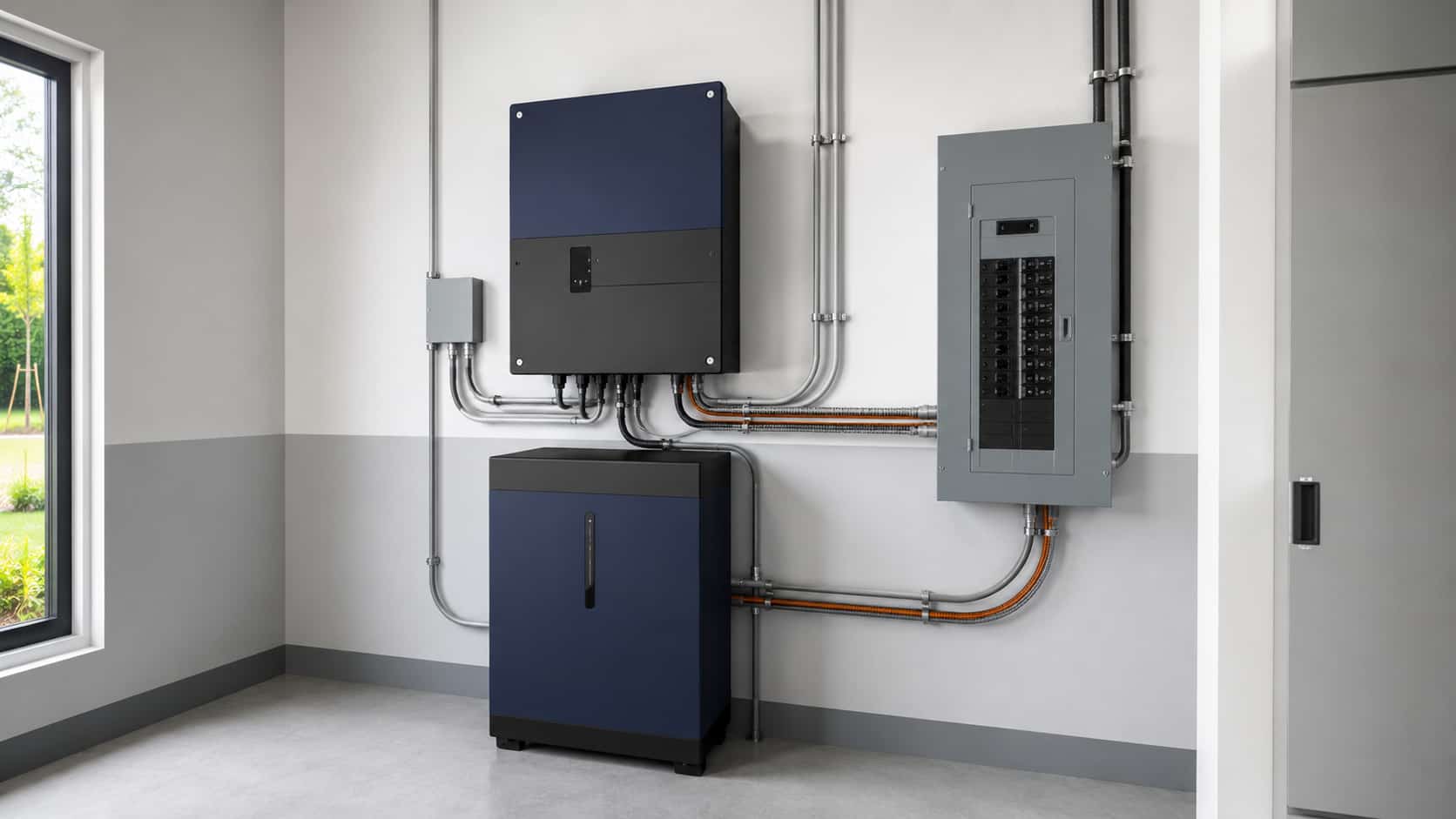
A hybrid inverter coordinates solar PV, battery storage, connected loads, and the utility grid within one control architecture. During normal grid-connected operation, it can prioritize solar self-consumption, charge the battery, limit export, or export surplus energy where permitted. When correctly configured for backup operation, it can disconnect a designated backup-load circuit from the utility and continue supplying those selected loads from the battery and available PV power.
Key characteristic: flexibility depends on the complete configuration
A hybrid label does not automatically guarantee whole-site backup. The inverter must have a compliant backup or EPS output, sufficient power and surge capability, compatible battery storage, correct neutral and earthing arrangements, and the required internal or external transfer equipment. The project must also separate essential loads from nonessential loads unless the inverter and battery system are sized to support the entire site.
Transfer time is another important specification. A backup output suitable for lighting and general appliances may still have a transfer interruption that is unacceptable for sensitive servers, medical equipment, or industrial controls. Where uninterrupted operation is required, the design may also need a UPS or another power-quality solution.
When a hybrid inverter is usually appropriate
- The site has a grid connection but needs backup for selected critical loads.
- The owner wants to increase solar self-consumption by storing excess generation.
- Time-of-use tariffs make battery charging and discharging economically useful.
- Zero-export control, peak shaving, or scheduled energy management is required.
- The project can support the higher initial cost and additional commissioning work.
Comparing the Three at a Glance
The correct choice is determined by grid availability, backup requirements, battery strategy, permissible grid export, and the site’s load profile. On-grid systems are usually the simplest choice for reliable grid-connected sites without backup needs. Off-grid systems are engineered for independent operation. Hybrid systems provide the greatest flexibility, but only when the battery, switching, protection, and backup-load design are specified together.
| Comparison Point | On-Grid | Off-Grid | Hybrid |
|---|---|---|---|
| Utility grid required | Yes | No | Normally connected to the grid, but selected loads may operate independently during an outage |
| Battery required | No | Normally required | Required for backup and energy-storage functions; some models can initially operate without one |
| Operation during a grid outage | Standard systems shut down | Continues while sufficient solar, battery, or generator energy is available | Can support designated backup loads when the complete backup system is correctly configured |
| Grid export | Possible where utility approval and local regulations permit | Not applicable | Possible where permitted; zero-export operation may also be configured |
| Generator integration | Uncommon and model-dependent | Common in larger or critical off-grid systems | Available on selected models and system configurations |
| Backup-load design | Not normally included | The entire system is designed around independent loads | Usually requires a designated critical-load circuit, transfer equipment, and compatible battery |
| Typical application | Grid-connected sites focused on reducing daytime electricity costs | Remote sites with no reliable utility connection | Grid-connected sites requiring backup, self-consumption, peak shaving, or time-of-use management |
| Initial equipment cost | Generally lowest | Generally high because of battery and system-sizing requirements | Medium to high depending on battery capacity and backup design |
| System complexity | Lowest | High | Medium to high |
Actual functions vary by inverter model, battery compatibility, system configuration and destination-market grid requirements.
On-Grid, Off-Grid and Hybrid Inverters
Common questions from project developers and buyers comparing grid-connected, independent and battery-supported solar inverter systems.
01 Can an on-grid inverter work during a power outage?
A standard on-grid inverter shuts down when the utility supply fails. Its anti-islanding protection prevents the solar system from energizing a disconnected utility circuit. Backup operation requires a system specifically designed with a compatible battery, a backup or EPS output, appropriate switching equipment and a designated critical-load circuit.
02 Does a hybrid inverter always require a battery?
Some hybrid inverter models can initially operate as grid-connected solar inverters without a battery. However, a compatible battery is required for energy storage and backup operation. Battery-free operation must be confirmed from the technical documentation for the exact inverter model.
03 Can a hybrid inverter power the entire building during an outage?
It can only support the entire building when the inverter, battery, transfer equipment and electrical distribution system are designed for the full building load. Many projects instead use a separate critical-load panel because supporting selected essential loads reduces the required inverter power and battery capacity.
04 Can an off-grid inverter connect to a diesel generator?
Many off-grid inverters support generator input and battery charging, but the connection method varies by model. The permitted voltage and frequency range, charging current, minimum generator loading, automatic-start signal and synchronization requirements should be confirmed before equipment is selected.
05 Can a hybrid inverter export electricity to the grid?
Many hybrid inverters can export surplus solar energy, but export depends on local regulations, utility approval, metering and approved protection settings. Where reverse power flow is prohibited, a compatible meter, current transformer or external power controller may be required for zero-export operation.
06 Which inverter is best for an area with an unreliable grid?
A hybrid inverter is often suitable when a grid connection exists but outages are frequent. A fully off-grid system may be more appropriate when the grid is unavailable for extended periods or cannot be treated as a dependable energy source. The decision should consider outage duration, load profile, battery autonomy and generator availability.
07 Is a hybrid inverter a replacement for a UPS?
Not automatically. A hybrid inverter may have a brief transfer interruption when the grid fails, while a double-conversion UPS is designed to supply sensitive loads without that interruption. Servers, medical equipment and critical industrial controls may therefore still require a dedicated UPS.
08 What information is needed to select the correct inverter?
Provide the installation country, grid voltage and frequency, phase configuration, PV capacity, continuous and peak loads, motor-starting loads, required backup time, battery information, generator requirements, export restrictions, installation environment and required certifications.