What Is a Solar Inverter and How Does It Work?
A plain-language introduction to the piece of equipment that turns solar power into something you can actually use.
Introduction
If you’re looking into solar power for the first time, you’ll run into the term “inverter” constantly, often without a clear explanation of what it actually does or why a solar system needs one at all. Here’s the plain-language version.
What a solar inverter actually does
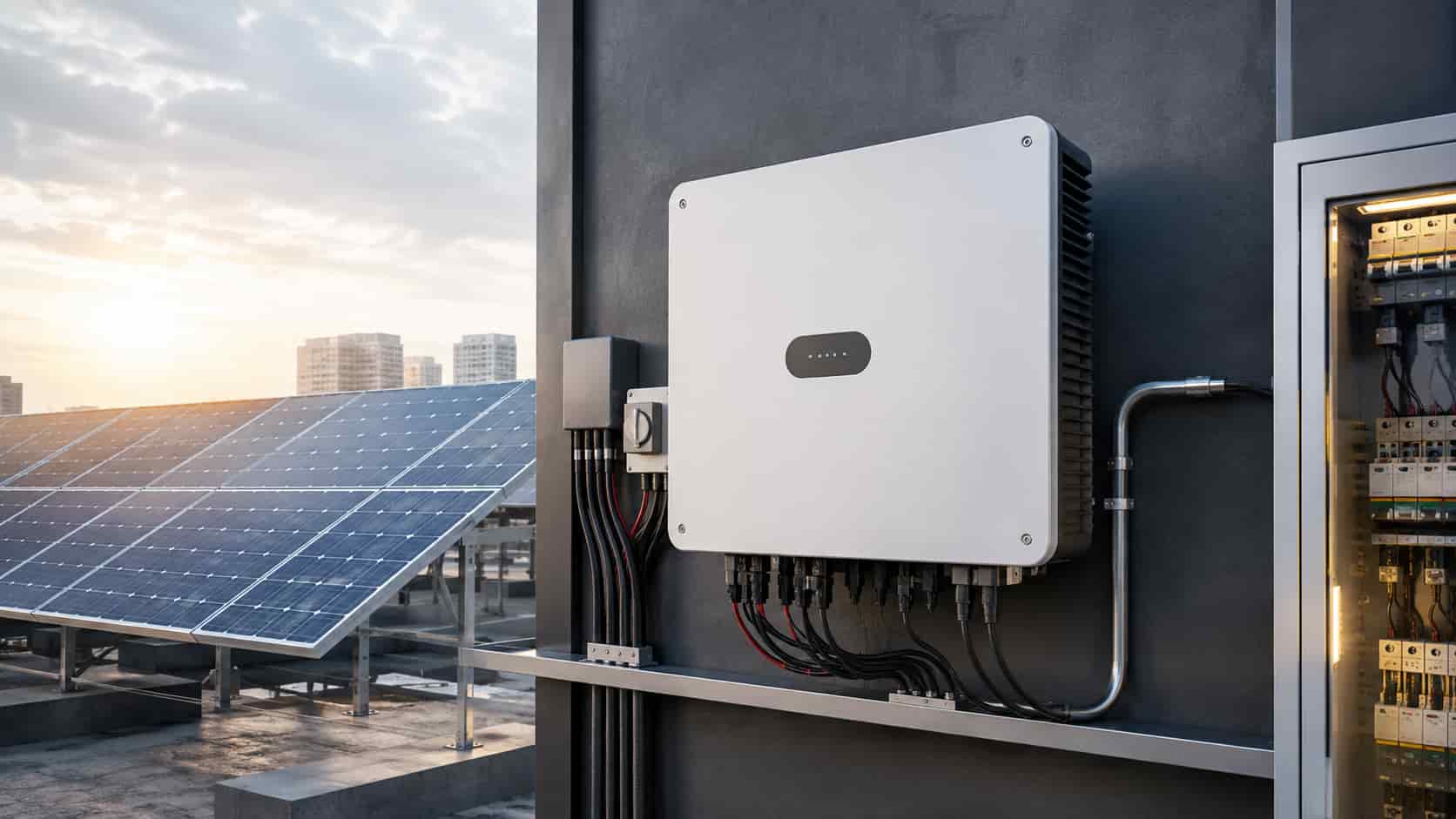
A solar inverter converts the direct current (DC) electricity produced by solar panels into alternating current (AC) electricity, which is the form of power used by the grid, most household and industrial equipment, and standard electrical infrastructure. Without this conversion step, the electricity solar panels generate isn’t directly usable for most applications.
Why this conversion is necessary
Solar panels generate DC power as a byproduct of how photovoltaic cells work at the physics level. But the electrical grid, and the vast majority of equipment designed to run on grid power, operates on AC. The inverter is the bridge between these two forms of electricity, making solar-generated power compatible with the AC systems it needs to feed into or power.
Core components inside an inverter
A modern solar inverter contains power electronics (semiconductor switching components) that perform the actual DC-to-AC conversion, an MPPT (Maximum Power Point Tracking) controller that continuously adjusts the electrical operating point to extract the maximum possible power from the connected solar panels as sunlight conditions change throughout the day, and monitoring and communication electronics that track performance and, in most modern units, report data to a monitoring platform or building management system.
The main inverter types, briefly
Inverters come in several configurations suited to different project scales and grid conditions — string inverters and central inverters for grid-connected systems of different sizes, hybrid inverters that integrate battery storage, and off-grid inverters for locations without reliable grid access. Each of these deserves its own detailed comparison, which we cover in dedicated guides elsewhere on this site.
Efficiency and how it's measured
Inverter efficiency describes how much of the DC power fed into the inverter is successfully converted to usable AC power, with the remainder lost as heat during conversion. Modern inverters typically achieve efficiency in the high 90s percentage range under optimal conditions, though real-world efficiency varies with load level, temperature, and how well the inverter is sized relative to the connected solar array.
Where inverters fit in a solar system
Panels connect to the inverter via solar-rated DC cabling — see our solar cable specification guide for what that cabling actually needs to meet — and the inverter’s AC output then connects to the building’s electrical system, the grid, or in hybrid configurations, a battery storage system. The inverter is genuinely the central coordination point of a solar installation, not just a passive conversion box.
Where Kexingyu Power fits in
We manufacture inverters across on-grid, off-grid, and hybrid configurations, alongside the solar cable, storage, and switchgear used in complete solar projects — browse inverter specifications directly on our Inverters & Power Conversion page.
Solar Inverter Basics
Common questions from project buyers and facility managers learning how solar inverters convert, control and deliver photovoltaic power.
01 Can a solar power system operate without an inverter?
A solar system can operate without an inverter when it is designed exclusively for compatible DC loads, but most building, commercial and grid-connected systems require one. Solar modules generate DC electricity, while utility grids and most conventional electrical equipment use AC power. The inverter converts DC to AC and typically also manages functions such as maximum power point tracking, grid synchronization and system monitoring.
02 Why does solar inverter efficiency matter?
Inverter efficiency determines how much of the DC energy produced by the solar array becomes usable AC electricity. Conversion losses are primarily released as heat, so lower efficiency reduces overall system yield. Buyers should consider not only maximum efficiency but also efficiency across different load levels, because a solar inverter normally operates over a wide power range throughout the day.
03 Does every solar panel need its own inverter?
No. Many commercial and utility-scale systems connect multiple solar modules into strings that feed one or more string or central inverters. Microinverter systems use a small inverter at individual module level, while power optimizers may provide panel-level control while still using a separate inverter. The appropriate architecture depends on system size, shading conditions, monitoring requirements, maintenance strategy and project cost.
04 How long do solar inverters typically last?
Service life varies by inverter type, component quality, operating temperature, loading, ventilation and maintenance conditions. Inverters often have a shorter expected service life than photovoltaic modules because they contain power electronics, cooling systems and other components subject to electrical and thermal stress. Long-term project planning should therefore consider warranty coverage, replacement availability and lifecycle maintenance rather than assuming the inverter will last as long as the solar modules.