Port and Terminal Automation: Cranes, Reels and Megawatt Motion
Quick Answer: Automated terminals move containers with megawatt-class cranes and motorised cable reels, and quayside duty, salt, sun, tension and tons of steel, makes port cable a discipline of its own.
The port is where automation meets weather. A modern container terminal runs ship-to-shore cranes, automated stacking cranes and driverless horizontal transport through salt spray, monsoon rain, tropical sun and round-the-clock schedules, and the machinery involved is not the nimble kind: a ship-to-shore crane hoists containers weighing tens of tonnes with drives measured in megawatts, fed through motorised cable reels that spool hundreds of metres of power cable in and out, all day, in the wind. Cable at a port is not an accessory to the machines; it is the umbilical that makes them possible, and the environment it lives in would destroy a standard industrial construction within a season.
Introduction
Terminal automation has accelerated because the bottleneck it removes is human scheduling: manually driven horizontal transport and crane cabins cap throughput in ways software does not. IFR’s World Robotics 2026 counts global industrial installations at roughly 600,000 units for 2025, but ports sit mostly outside those statistics, buying their automation as heavy machinery projects rather than robot fleets. The demand they create is smaller in unit count than a car plant and much larger per unit: each crane is a megawatt-scale machine whose cable systems, reels, festoons, pendant and control runs, are engineered as part of the crane itself.
This article walks the terminal’s cable systems from the ship’s edge to the yard, with the environment held firmly in view, because at a port the environment is half the specification. The electrical standards landscape for the medium-voltage feeds these machines use is mapped in the guide to IEC, GB and BS standards, and the drive electronics at the heart of crane motion follow the logic in the comparison of VFDs versus soft starters.
The Cable Reel: The Port's Signature Machine
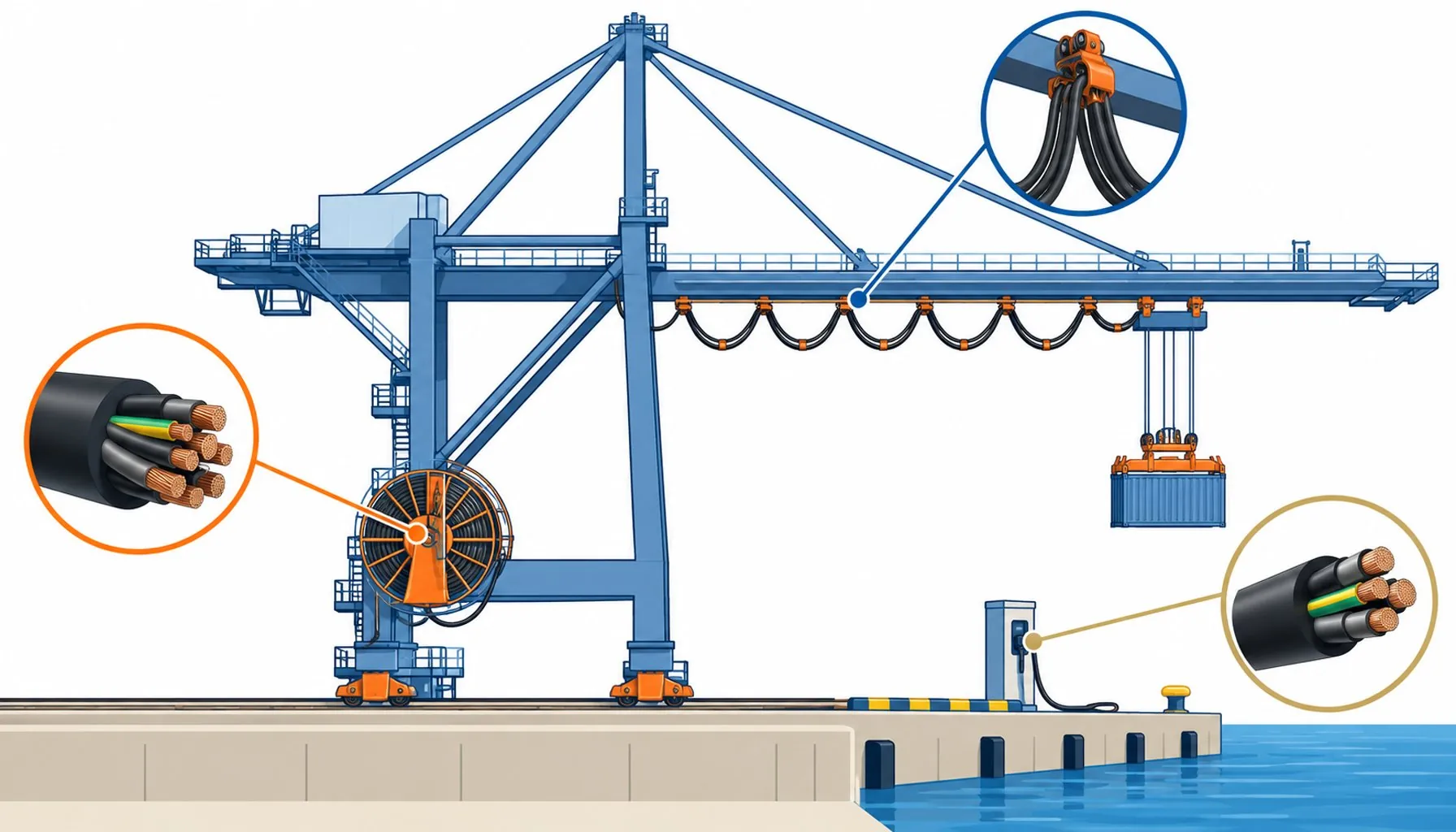
No cable application is more distinctive than the motorised reel. A ship-to-shore crane travels along the quay, and its power follows on a drum that winds and unwinds hundreds of metres of medium-voltage cable, under tension, at travel speed, exposed to salt air and driving rain. The cable for this duty is engineered as a system with the drum: conductor stranding and insulation that tolerate repeated bending at the drum diameter, a jacket that resists abrasion against itself on the drum layers, torsion behaviour that survives the spooling geometry, and terminations rated for the tension the drum exerts.
Reel failures are spectacular and expensive: a cable that pulls its termination under load stops a crane that the terminal depends on, and the repair involves a boom and a schedule. The engineering defence is layered: match the drum diameter to the cable’s minimum bend radius with margin, spec the jacket for self-abrasion across drum layers, and treat the tension calculation as a live design input rather than a nameplate afterthought. The protection decision for fixed runs between crane and substation follows the reasoning in the guide to armoured versus unarmoured cable.
From Quayside to Yard: The Rest of the Terminal
Around the cranes, the terminal’s other motion systems carry their own cable duties. Automated stacking cranes run rails on tall steel structures, feeding power and data through festoon systems or energy chains that climb and traverse with the crane’s trolley, and their cable competes with wind loading as well as flexing. Horizontal transport, whether automated guided vehicles or shuttle carriers, recharges at docks whose charging leads endure the same fatigue cycles as any mobile fleet, at higher currents. And the yard’s fixed infrastructure, substations, motor control centres and communication backbones, follows the distribution planning in the industrial power distribution checklist.
The environment threads through all of it. Salt attacks every metal surface and many compounds; UV degrades jackets that would last decades indoors; temperature swings from tropical decks to night operations stress compounds cyclically; and the wind turns festoon systems into mechanical instruments. The failure catalogue that results, jacket chalking, conductor corrosion at terminations, fatigue at festoon saddles, is the marine-adjacent version of the patterns in the analysis of why cables fail on machines, with weather added to every entry.
| System | Machine | Cable duty profile | Environment extras |
|---|---|---|---|
| Motorised reel feed | Ship-to-shore crane power | Medium-voltage cable spooling under tension at travel speed | Salt air, rain, wind, self-abrasion on the drum |
| Festoon and energy chain | Stacking cranes, trolleys | Climbing and traversing flex, wind loading | UV and full weather exposure at height |
| Charging infrastructure | AGVs and shuttle carriers | High-current dock cycles, fatigue at strain reliefs | Dock wash, standing water, traffic abuse |
| Fixed distribution | Substations, MCCs, yard feeds | Megawatt feeds, long outdoor runs | Burial, rodent, flooding and corrosion exposure |
Specifying for the Quayside
The table’s pattern is worth naming: port cable duty is mechanical tension with weather, not flexing with dust. That inverts some industrial priorities. Torsion and tension ratings matter as much as bend cycles; jacket weathering and UV performance separate the qualified from the generic; and termination engineering, glands, strain relief, corrosion protection, determines whether the cable’s life survives its fittings. A supplier who serves ports with indoor constructions and a marine brochure will be found out in the first typhoon season.
When the Port Story Is Not the Answer
Four specification disciplines decide port cable outcomes. First, treat the reel as a system: drum diameter, spooling tension and cable construction are designed together, and the cable supplier’s input belongs at the design stage, not the procurement stage. Second, demand weathering evidence: UV, salt mist and thermal cycling data on the actual jacket compound, not just mechanical flex results. Third, match standards to the feed: the medium-voltage and control standards for the terminal’s supply side are mapped in the guide to IEC, GB and BS cable standards, and the terminal’s drives impose the harmonic and EMC conditions described in the VFD comparison. Fourth, plan maintenance around the calendar: ports service equipment in weather windows, and cable that arrives with traceable batch data, as the certification culture in the cable certification checklist encourages, keeps those windows short.
| Decision | Why it matters at the port | Practical handling |
|---|---|---|
| Reel system co-design | Drum diameter and tension govern cable life | Involve the cable supplier at crane design stage |
| Weathering evidence | UV and salt defeat indoor-grade jackets | Require UV, salt mist and thermal cycling data per compound |
| Tension-rated terminations | The drum pulls on its termination constantly | Engineer glands and strain relief for the real tension |
| Standards-matched feeds | Megawatt feeds run at medium voltage | Map IEC, GB or BS requirements before ordering |
| Weather-window maintenance | Service happens when the weather allows | Buy batch traceability that keeps repairs fast and certain |
RFQ Checklist: Cable for Port and Terminal Projects
Three cautions. First, terminals differ: a river barge terminal and a deep-water automated hub share vocabulary, not specification, and cable sized for one is mis-bought for the other. Second, “marine-grade” is another marketing term without a standard; the honest substitute is named test data for the actual exposure, salt, UV, tension, flex, in the combination the application imposes. Third, automation projects at ports run for years through phases, and cable bought in phase one should still match phase four; the change-control discipline that industrial buyers take for granted matters even more when the equipment weighs ten thousand tonnes.
Conclusion
Send these so the quote reflects quayside reality:
- System: reel feed, festoon, charging or fixed distribution, each specified separately
- For reels: drum diameter, spooling tension, travel speed and cable length
- For festoons: travel, wind loading and the saddle geometry
- Voltage class and the applicable standards family for the feed
- Drive environment: rectifier and regenerative loads, harmonic and EMC expectations
- Climate: salt, UV index range, temperature swing and storm exposure
- Termination and gland requirements with the real tension figures
- Batch traceability and change-control expectations across project phases