Why Robot Cables Fail: 8 Failure Modes That Stop Production Lines
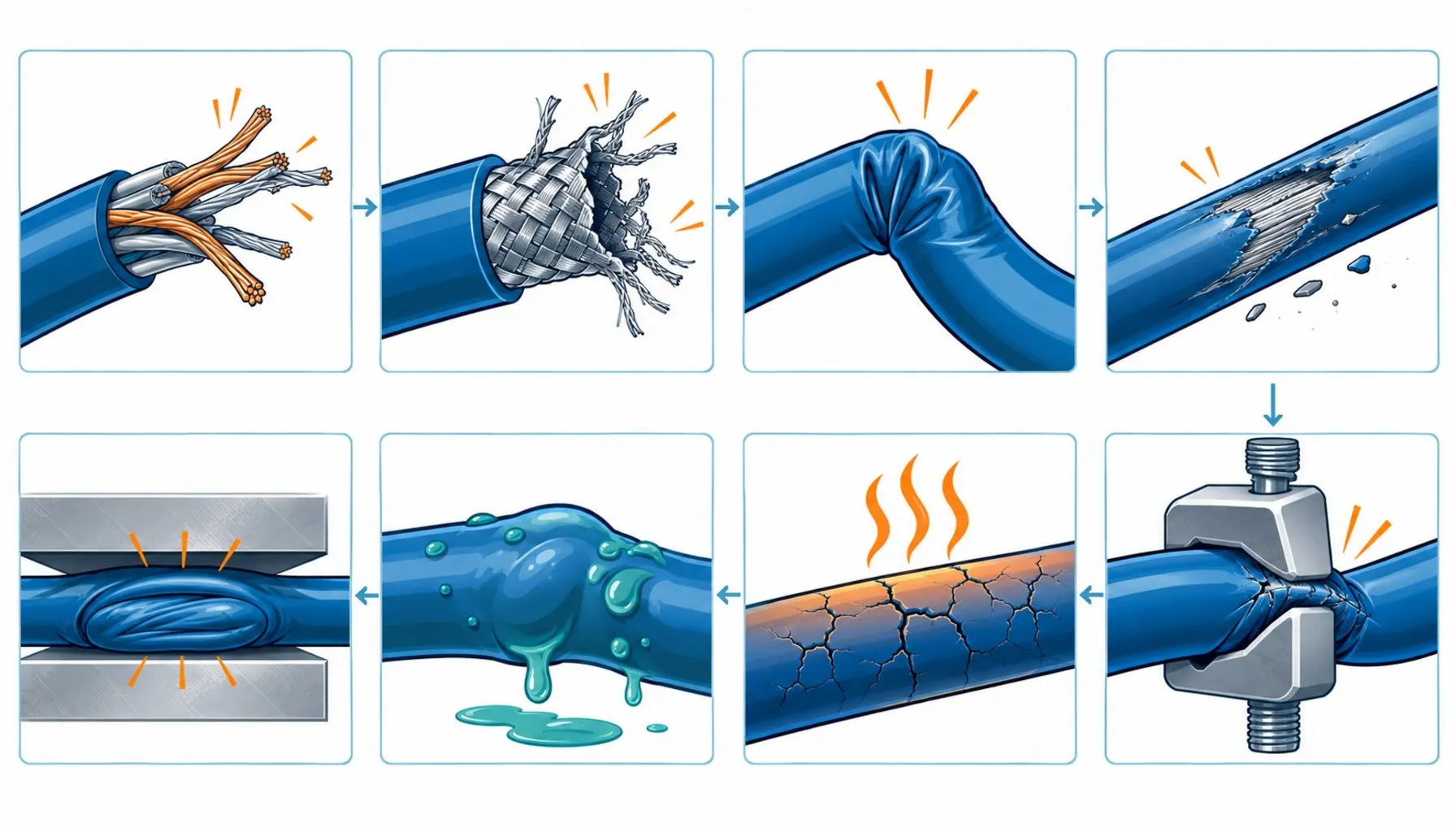
Quick Answer: Robot cables fail in eight predictable ways — conductor fatigue, shield rupture, kinking, abrasion, crush, chemical attack, heat aging and installation damage — and every one of them is preventable at specification time.
When a robot line stops, the cable is one of the most frequent defendants — and one of the least understood. Maintenance crews see the symptom: an axis fault, a position drift, a visible split in a dress pack. What they rarely get is the diagnosis: which failure mode this is, what caused it, and whether the replacement cable will die the same death in the same place. This guide is the diagnosis sheet. It lays out the eight failure modes that account for the overwhelming majority of robot and motion cable stoppages, what each one looks like on the floor, the root cause behind it, and the specification decision that prevents the repeat. Read it before the first failure and it is a checklist; read it after the third one and it is a post-mortem. Either way, the pattern that emerges is the same: cables rarely fail by bad luck — they fail exactly where motion meets constraint, chemistry meets jacket, or load meets termination, and all eight modes are visible in advance to anyone who looks.
Introduction
The eight modes divide into three families: mechanical failures, where motion physics does the damage; environmental failures, where the process attacks the materials; and electrical or installation failures, where the damage arrives through the terminals or the routing. Every robot cable failure I would put money on lands in one of the eight. The diagnostic habit worth building: when a cable fails, do not just replace it — autopsy it. Where exactly did it break? At a gland, at a chain entry, at a kink, mid-run under a clamp? The location names the mode, the mode names the cause, and the cause names the specification change that prevents the next one. The general background on why cables fail in any service is covered in the common causes of cable failure; this guide is the robot-specific version, ordered by how often each mode stops production.
The Eight Failure Modes at a Glance
| Mode | What It Looks Like on the Floor | Root Cause | Prevention |
|---|---|---|---|
| 1. Conductor fatigue | Axis faults at the same cycle count; continuity that flickers when the cable is moved | Coarse stranding work-hardening at a fixed bend point — usually a gland or chain exit | Fine short-lay stranding, strain relief done right, radius discipline at entries |
| 2. Shield rupture | Intermittent position faults, EMI symptoms that track axis motion, pass at the bench | Foil or worn braid shields cracking under flexing; noise leaks into signals | Braid shields rated for motion, correct grounding, separation from power |
| 3. Kinking and torsion failure | A visible kink that fails within cycles; cables on rotating axes twisting apart | Torsion accumulating in a cable not built to distribute it | Torsion-rated constructions for rotating duty; never exceed stated twist |
| 4. Abrasion | Jacket worn through at one contact point; insulation damage in the same spot on every cable in the bundle | Routing against structure or overfilled chains letting cables rub | Standoff routing, abrasion sleeves at contact points, chain fill discipline |
| 5. Crush and pinch | Flat spots, intermittent opens, damage localized where the cable passes a clamp or door edge | Clamps too tight, cable pinched in covers, chain overloaded at one layer | Correct clamp torque, protected pass-throughs, chain load limits respected |
| 6. Chemical attack | Swollen, discolored or brittle jackets in specific zones of the machine | Jacket compound matched to nothing — coolant, cleaning agents or oils doing the matching instead | Jacket chemistry specified against the actual agents, with test evidence |
| 7. Heat aging | Stiff, cracked jackets nearest heat sources; failures concentrated at the hottest cable section | Ordinary compounds losing temper near motors, molds, arcs or enclosures | Heat-rated compounds for the hot zones; routing that respects the temperature map |
| 8. Installation damage | Failures in week two that no duty cycle explains; damage at exactly one point on an otherwise perfect cable | Pulled-by-force installation, kinked during pull, clamped after damage, wrong cable installed by mistake | Installation supervision, minimum pull force, post-install inspection |
The Mechanical Family: Modes 1 Through 5
Mechanical failures dominate the statistics because motion is the robot cable’s defining condition. Conductor fatigue — mode 1 — is the classic: the cable was never rated for the radius or the cycle count it received, and the conductors work-hardened at the tightest point until they cracked. Shield rupture — mode 2 — is its quiet sibling: the cable keeps conducting while the signal quality dies, which is why these failures present as mystery faults instead of visible damage. Kinking — mode 3 — is the most absolute: a torsion-loaded cable without torsion construction fails visibly and immediately, and no repair restores it. Abrasion and crush — modes 4 and 5 — are routing failures wearing cable costumes: the harness was let to rub, clamp or pass through geometry that no jacket survives indefinitely, and the hardware behind those contact points deserves the same scrutiny as the cable itself, per the review logic in the cable accessories checklist. The common thread is that all five are decided at design time — by cable selection, routing and hardware — and merely executed at installation. When mode 1 and mode 2 appear together at the same spot, the diagnosis is almost always the same: a bend radius violated at a transition, which is why the transition points deserve the inspection before the cable run does.
The Environmental and Installation Families: Modes 6 Through 8
Environmental failures are quieter and more preventable than any other family. Chemical attack — mode 6 — appears zone by zone: the jacket sections that touch coolant swell, the sections that touch cleaning agents embrittle, and the sections that touch nothing age normally, which makes the zone map visible in the failure pattern itself. Heat aging — mode 7 — does the same by temperature: the failed sections cluster near motors, molds and arcs. Both modes are jacket chemistry decisions made — or skipped — at specification, and the compound logic behind them is the same one that decides sheath material selection anywhere else. Installation damage — mode 8 — is the mode that offends quality engineers most, because it produces week-two failures of a cable rated for decade-long duty: a kink from a hard pull, a crushed section from a clamp closed on a defect, or the wrong cable installed entirely. Its prevention is not a better cable but a better process — supervision, pull-force limits, and a post-installation inspection that catches the damage while it is still visible on the surface.
From Autopsy to Specification: Closing the Loop
The reason to diagnose modes instead of just replacing cables is that each mode points at a different specification lever. Mode 1 says flex life data was missing; mode 2 says shielding was underspecified; mode 3 says the duty was misnamed; modes 4 and 5 say routing and hardware; modes 6 and 7 say chemistry and temperature; mode 8 says process. A plant that logs failures by mode builds, over a year, a specification improvement list no consultant could produce — and its cable purchases start asking for the evidence that matters, from flex test data to the supplier scrutiny described in the manufacturer verification checklist. The triage table below is the starting template: symptom, most likely mode, first inspection point, and the specification line to fix.
| Floor Symptom | Most Likely Mode | Inspect First | Specification Fix |
|---|---|---|---|
| Axis faults at a regular cycle count | Conductor fatigue (1) | Glands and chain exits for bend radius violations | Flex life data at actual radius and duty |
| Position or EMI faults that come and go | Shield rupture (2) | Shield continuity at transitions; power/data separation | Braid shields, grounding plan, separation discipline |
| Visible kink, then rapid failure | Torsion overload (3) | Rotating duty the cable was never rated for | Torsion-rated construction with stated twist limits |
| Damage in one spot on every cable in the bundle | Abrasion (4) | The contact point — clamp edge, divider, structure | Standoff routing, sleeves, chain fill limits |
| Flat spots and intermittent opens | Crush (5) | Clamps, door edges, chain layer loading | Clamp torque, protected pass-throughs |
| Swollen or brittle jackets in zones | Chemical attack (6) | What those zones are washed or splashed with | Jacket specified against the actual agent list |
| Failures clustered near heat sources | Heat aging (7) | Temperatures at the failure zone under real duty | Heat-rated compounds for the hot zones |
| Week-two failures of a heavy-duty cable | Installation damage (8) | The single damage point and the pull route history | Installation supervision and post-install inspection |
When Failure Analysis Rules Are Not the Answer
Honesty about scope keeps this guide useful. The eight modes here address robot and motion cable — the flexible, moving, dressed and chained wiring of automated machinery. They do not cover stationary power cable failures, which have their own taxonomy, or the electronics inside drives and controllers, whose faults mimic cable symptoms often enough to deserve their own troubleshooting pass first. The diagnostic sequence on a live line belongs to the maintenance engineer: verify power and signals at both ends before condemning the cable. And the modes are prevention tools, not warranty arguments — the useful output is the specification change, not the blame assignment. Log the mode, fix the line in the specification, and the failure stops recurring; that is the whole point of the taxonomy.
RFQ Checklist: Preventing All Eight Modes at Purchase Time
Put the prevention in writing before quotes come back:
- Duty named per circuit: flex cycles, radius, torsion, speed — with test data required
- Shielding and grounding plan for every signal circuit, with separation from power
- Jacket chemistry specified against the machine’s actual agent list, with evidence
- Temperature map of the machine, with heat-rated compounds for the hot zones
- Routing and hardware: standoff clips, abrasion sleeves, clamp torque discipline
- Installation process: pull-force limits, supervision, post-install inspection
- Failure-mode logging in the maintenance routine, feeding the next specification cycle
Conclusion
Robot cables fail in eight ways, and the list is short enough to memorize: fatigue, shield rupture, kinking, abrasion, crush, chemical attack, heat aging, installation damage. Every one of them announces itself in advance — in a routing plan that pinches, a datasheet without flex data, a jacket chosen by price, a pull without supervision. Plants that diagnose failures by mode and feed the answers back into specification stop paying the same tax twice. The cable is rarely the villain; the specification gap is, and it is always visible before the failure is.
Kexingyu Cable Group (KXYE) supplies motion and robot cable constructions engineered against all eight failure modes — flex-tested, chemically rated, torsion-balanced and traceable — and supports buyers with the specification discipline this guide describes. Send your duty profile and failure history through the RFQ page, and we will respond with constructions and evidence aimed at the modes your line actually meets.