Semiconductor Fabs: The Most Demanding Motion Cable Buyer on Earth
Quick Answer: Wafer fabs and their equipment chains impose the strictest motion cable requirements in industry: particle-free jackets, millions of short-stroke cycles and signals that cannot glitch.
Every industry believes its requirements are special, and one actually is. A semiconductor fab is a machine for making machines that make invisible mistakes expensive: a particle the eye cannot see ruins a die worth more than a car, a vibration ruins a lithography exposure, and an intermittent signal ruins a week of production scheduling. The motion cable inside that environment, in wafer-handling robots, EFEM interfaces, overhead transport systems and inspection tools, answers to requirements stricter than any other cable market on earth, including aerospace. This article walks through why the requirements are what they are, and what a supplier must prove before a fab-adjacent cable ships.
Introduction
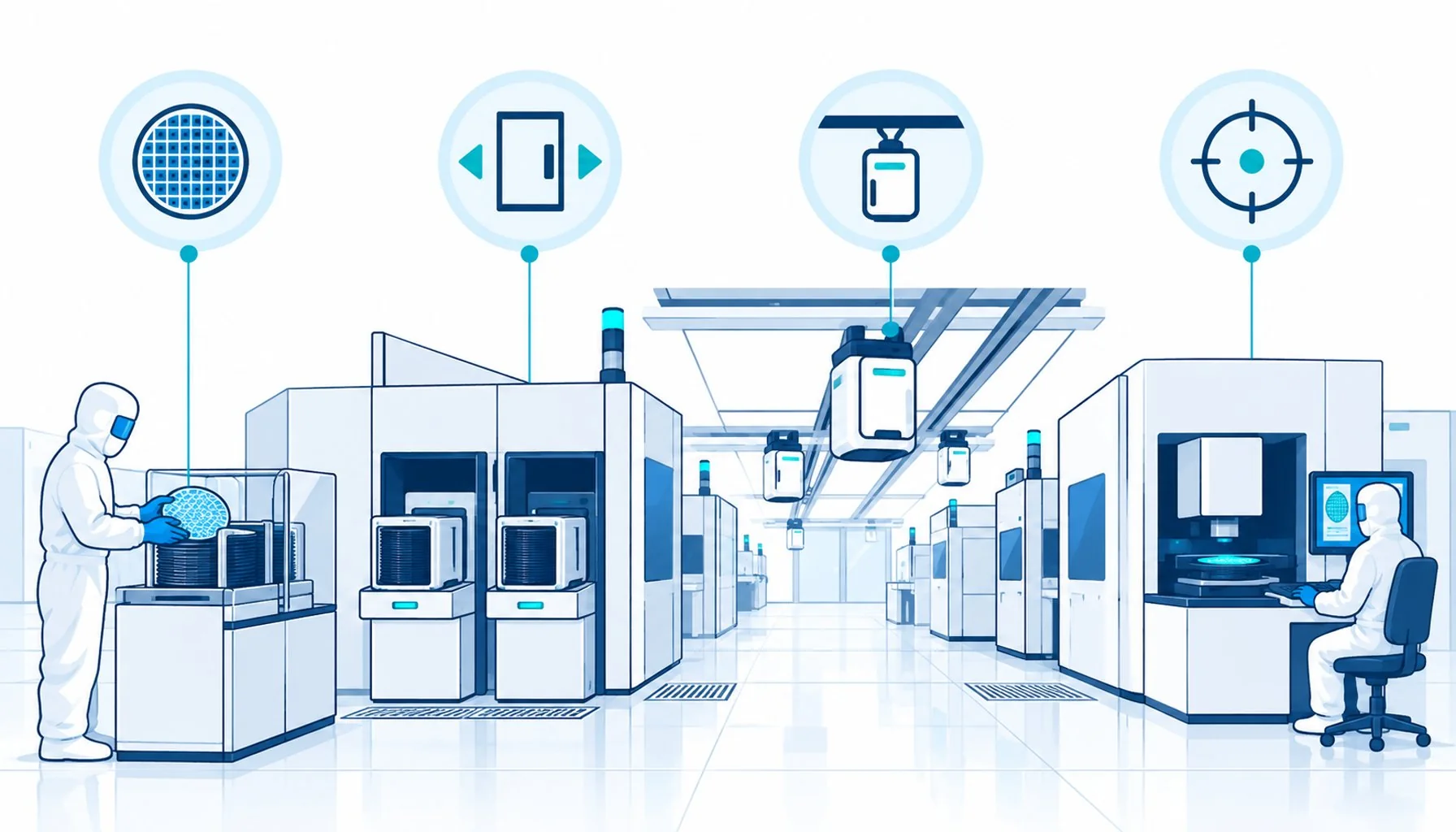
The fab’s automation inventory is easy to underestimate because it hides inside the tools. Every wafer moves hundreds of times between process steps: robots load and unload chambers, EFEMs bridge the tool to the transport system, overhead vehicles carry pods along the ceiling, and inspection stations re-orient and re-measure at every gate. IFR’s World Robotics 2026 counts global industrial robot installations at roughly 600,000 units for 2025, and the electronics industry, with semiconductor equipment at its peak, is among the largest robot-consuming sectors in those statistics. None of that motion is possible without flex cable, and none of that flex cable is ordinary.
The buyer profile explains the rigour. Fabs run their most expensive machines around the clock for years between refits, and the cable inside each tool is qualified with the tool, not procured later. The qualification culture descends from the semiconductor equipment makers, whose specifications flow down to every component, and whose audits read datasheets the way the guide to honest datasheet reading recommends: as engineering claims to be verified, not adjectives to be admired.
The Three Requirements That Define Fab Cable
The first is cleanliness. A cable in a cleanroom is a potential particle source, and the jacket compound, the printing, even the cut ends are scrutinised for what they shed. Low-outgassing compounds, clean-cut jacket constructions and manufacturing and packaging disciplines that keep the cable clean until installation are baseline requirements, not differentiators. This is where the cable industry’s materials culture matters most, and where the compound selection logic in the comparison of LSZH versus fire-retardant jackets overlaps with cleanroom thinking: the chemistry of what a jacket releases matters as much as the mechanics of what it survives.
The second is cycle life at short strokes. Wafer handling is repetitive with a vengeance: a robot or transport interface performs thousands of short-stroke cycles per day, and over a tool’s life the count reaches into the hundreds of millions. Short strokes concentrate flexing into short cable loops, which multiplies the bending frequency per metre, and only constructions with very fine stranding and short-lay geometry survive the arithmetic. The third is signal integrity in a hostile electrical neighbourhood: fabs pack drives, RF generators, plasma sources and high-current heaters into dense racks, and the encoder and sensor signals travelling between them must stay clean through all of it, which makes the shield and grounding discipline in the guide to control versus instrumentation cabling a qualifying requirement rather than a preference.
| Application | Motion profile | Cable requirements | Qualifying evidence |
|---|---|---|---|
| Wafer-handling robots | Multi-axis handling inside or beside process tools | Extreme flex at tiny radii, particle-free, compact | Flex life at radius, particle and outgassing data |
| EFEM and interface | Bridge between tool and transport system | High short-stroke cycles, clean signal bundles | Cycle testing at the real stroke geometry |
| Overhead transport (OHT) | Vehicle movement along ceiling rails | Continuous power and data to moving vehicles | Conductor fatigue and shield continuity in motion |
| Inspection and metrology | Precise positioning, frequent re-orientation | Signal integrity above all, low mass | Transfer impedance data and motion test records |
How Qualification Actually Works
The qualifying-evidence column is the real wall. A fab-side buyer does not ask whether a cable is good; the buyer asks what test, on what sample, at what radius, produced the number on the datasheet, and whether the shipped batch matches that test. Suppliers who arrive with that discipline, and with the manufacturing consistency to hold constructions across years of tool builds, join a supplier list that changes slowly and rewards incumbency. The cabinet-side wiring that surrounds these tools follows the same conservatism, as the build principles in the guide to custom control cabinets describe.
When the Fab Story Is Not the Answer
Entry into the fab cable market runs through the equipment makers, not the fabs. A tool builder qualifies cable into its platform; the fab inherits the qualification when it buys the tool; and after-sale replacement cable must match the qualified construction exactly, because anything else voids the tool’s own warranty chain. This inverts the usual sales motion: the supplier’s customer is the equipment maker, the volume arrives with the tool’s production ramps, and the fabs themselves appear only as the end of a chain of documents. The practical consequence for a cable supplier is patience: qualification cycles run in quarters, sample programmes run long, and the reward is demand that follows the semiconductor cycle with volume in the ramp years.
Two behaviours shorten the cycle. The first is evidence readiness: a supplier who can produce flex, particle and electrical test data in the format equipment makers expect moves to the front of the queue, because the qualification bottleneck is usually documentation, not capability. The second is consistency management: tool builders audit their cable suppliers’ change control precisely because a silent construction change propagates into their installed base, and the supplier who demonstrates change discipline earns the right to ship for years without retesting.
| Decision | Why it matters in this market | Practical handling |
|---|---|---|
| Qualify through the tool maker | Fabs inherit cable via the tool's qualification | Target equipment makers; support their platform specs |
| Evidence in their format | Documentation is the qualification bottleneck | Prepare flex, particle and electrical data to industry formats |
| Cleanroom manufacturing discipline | The cable is a particle source unless proven otherwise | Control compounds, packaging and traceability end to end |
| Short-stroke construction | Short strokes concentrate flexing per metre | Use ultra-fine stranding and short-lay geometry for loops |
| Change control forever | Silent changes propagate into installed tools | Commit to written notice and batch matching for years |
RFQ Checklist: Cable for Fab and Tool Applications
Three cautions. First, “semiconductor-grade” is not a grade: the term circulates in marketing without a standard behind it, and the honest substitute is the specific test data and the specific tool maker’s qualification. Second, the fab market is cyclical; volume follows the equipment cycle, and suppliers who sized capacity on a peak year will carry the trough. Third, not every cleanroom is a fab: electronics assembly, medical device and laboratory cleanrooms share the particle discipline but not the cycle extremes, and a supplier who applies fab-level cost to a packaging cell will lose the order to a correctly-specced competitor. The failure science behind all these environments is shared, as the analysis of why cables fail on machines shows; the specification should follow the duty, not the vocabulary.
Conclusion
Send these so the quote can enter a qualification conversation:
- Tool application and the equipment maker’s platform, where known
- Motion profile: stroke length, cycles per day and design-life cycle target
- Bend radius and loop geometry, measured on the tool, not free air
- Cleanroom class and any particle or outgassing test requirement
- Signal set: encoder, sensor, communication and power cores in the bundle
- Electrical environment: drive, RF or plasma sources near the cable route
- Test evidence requested, in the equipment maker’s format where specified
- Volume forecast across the tool production ramp, with change-control expectations