Short-Lay Stranding: The Geometry Behind Flex Life
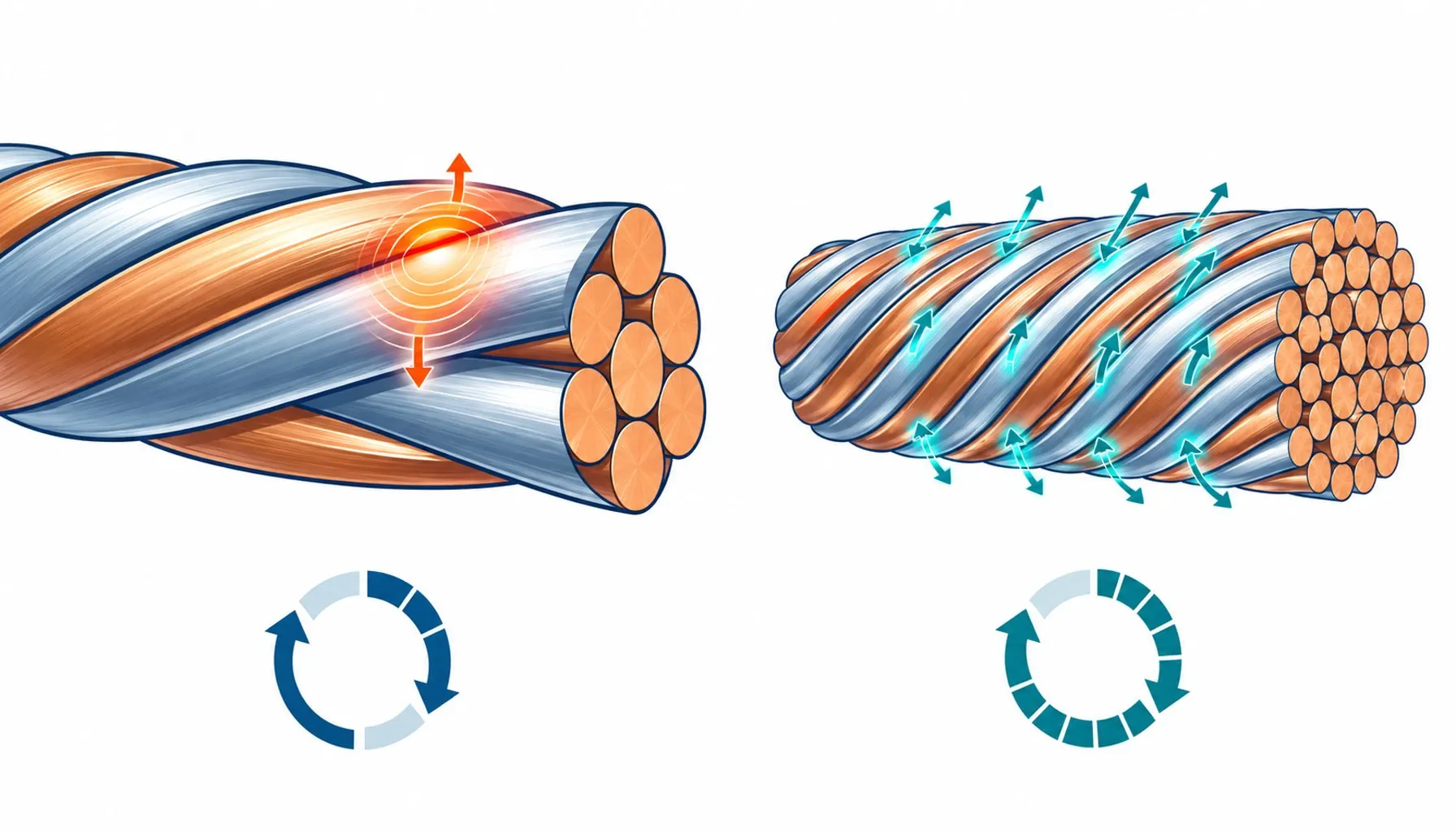
Quick Answer: Short-lay stranding wraps copper in tight, frequent helixes so bending strain spreads across millions of tiny strand movements; it is the single construction choice that separates genuine flex cable from ordinary flexible cable.
Ask three suppliers what makes their cable flex-rated and you will usually get the same answer: fine strands. It is true and it is incomplete. Fine strands are the raw material of flex life, but the geometry that arranges them decides most of the outcome. Two cables can carry identical 0.2 millimeter strands, one built with a lazy long lay and one built short, and the long-lay version will die months earlier in the same chain. The difference hides inside the jacket, invisible at the connector ends, which is exactly why it gets skipped in most buying conversations. This guide pulls that geometry out into the open. It explains what lay length actually measures, why short lays spread bending strain instead of concentrating it, where the practice stops paying, how lay interacts with twisting duty in ways buyers rarely anticipate, and how to specify and verify the geometry without a laboratory. If your cables fail in the conductors, this is the page that explains why.
Introduction
Lay length is the distance a strand travels along the cable axis during one complete turn around it. A short lay means the helix is tight: strands wrap frequently, each turn advancing only a short distance. A long lay means the helix is shallow, with strands advancing far before completing a circle. The distinction sounds academic until you follow one strand through a bend. In a long-lay conductor, the strands on the outside of the bend must travel visibly further than the strands on the inside, and the difference has to be absorbed by stretching copper, which copper resists. In a short-lay conductor, the same bend changes each strand’s position only slightly from one crossing to the next, because the strand meets the bend many times over its length, each time moving a tiny distance relative to its neighbors. Strain that would have been one large event becomes thousands of small ones, each far below the fatigue threshold of the metal. Multiply by millions of bending cycles and the short-lay conductor is still intact while the long-lay twin has opened its first broken strand. That is the whole trick, and it is why flex-life claims without a lay-length statement deserve suspicion from the first line of the datasheet.
Where Short Lay Applies, Layer by Layer
The principle repeats at every level of the cable’s construction, and each level has its own optimum. In the conductor itself, fine strands are gathered into bundles and the bundles into the final conductor, each gathering step with its own lay. Flex-grade conductors shorten the lay at every step, which is why a Class 6 conductor for motion duty weighs and behaves differently from a Class 5 of the same cross-section even when the strand diameter matches. In the cabling of cores into pairs and pairs into the cable, the same logic holds for a different reason: short lay keeps each element’s position within the cross-section stable as the cable bends, so no element is forced to migrate across the cable’s diameter under load, a migration that grinds insulation against insulation over time. Shields participate too, since a braided shield with the right geometry carries its own strain distribution across dozens of wire groups rather than a few. Only in torsion duty does the preference reverse, because twist wants angular reserve that short lay spends; that exception is treated in the torsion construction guide, and the general failure context behind all of this sits in the common causes of cable failure. The point for a buyer is simple: short lay is not one setting but a discipline applied consistently through the whole build, and partial application buys partial life.
| Construction Level | Short-Lay Practice | What It Buys |
|---|---|---|
| Strand bundles | Tight helical gathering of fine strands at every stranding step | Strain split across thousands of small relative movements |
| Final conductor | Short lay over the bundle, often with concentric or bunch stranding | Conductor survives millions of bends without opening a strand |
| Pair cabling | Short, uniform lay of pairs around the center | Element positions stable under bending, no cross-section migration |
| Shield | Braid groups applied with geometry matched to the flex radius | Shield continuity lasts as long as the conductors |
| Overall | Consistent short lay through all levels, not just the conductor | The weakest layer stops deciding the cable's life |
The Costs Nobody Puts on the Quote
Short lay is not free, and the costs explain why it gets quietly skipped. Copper is wound into a tight helix, so a short-lay conductor uses measurably more copper per meter than the same cross-section laid long, and the difference lands in the price of the cable. The stranding process itself is slower and more demanding, since tight helixes of hair-thin copper break during manufacture if tension is sloppy, which is a quality barrier that separates real flex factories from rebranders. The finished conductor is also stiffer in a subtle way: short lay adds mechanical coupling between strands, so a very short lay can raise bending effort slightly even while extending life, and extreme shortening can even hurt by crushing strand-to-strand contact. This is why the right answer is a designed lay, matched to the strand diameter, the cross-section and the target radius, rather than the shortest lay a machine can produce. Buyers who push suppliers only on price get long lays andfatigue; buyers who ask for lay data get engineering. The cost conversation parallels what the comparison of XLPE and PVC insulation shows elsewhere in the cable world: the material that lasts is rarely the material that quotes lowest, and the difference is visible only after the machines have been running for a year.
| Check | What to Ask For | What a Good Answer Sounds Like |
|---|---|---|
| Strand diameter | Actual strand size in millimeters, not just the class label | A number around 0.1 to 0.2 millimeters for motion duty, stated plainly |
| Lay length | Lay figure for conductor and cabling, in millimeters or as lay factor | A stated figure with the note that it is tuned to the target radius |
| Stranding class | IEC class plus the factory's own flex specification | Class 6 or finer with an in-house flex test behind it |
| Flex test | Cycle count at a stated radius and speed | Data from a real chain test, criterion defined, conditions attached |
| Cut sample | A short stripped sample before volume order | Willingness to send one, because the lay is visible in the first centimeter |
How to See It: Reading Lay in a Physical Sample
The best verification costs nothing, because lay is visible. Strip the jacket from a sample, separate one element, and look at the copper: in a short-lay conductor the helix is obvious, strands climbing steeply around the axis, the pattern repeating within a few millimeters. Roll the stripped conductor gently between finger and thumb and it corkscrews visibly; a long-lay conductor barely turns. Count the wraps across ten millimeters and you have the lay length to compare against the datasheet claim. Pair cabling shows the same structure one level up, and cutting a cross-section shows whether elements sit where the drawing says they sit. This five-minute inspection has caught more specification drift than most paperwork reviews, because it tests the cable rather than the brochure. Suppliers confident in their construction send samples without hesitation; the ones who stall are answering a different question than the one you asked. A stripped sample also reveals the center element, the fillers and the general packing discipline, which is why a physical sample belongs in every qualification for motion duty, next to the certificate checks described in the power cable certifications checklist.
When Short-Lay Rules Are Not the Answer
Honest limits: short lay serves bending, and the duty decides the geometry. Torsion applications want long lays for angular reserve, and forcing short-lay geometry into a rotating axis makes the cable fight the motion instead of absorbing it; the two disciplines are opposites and the torsion guide covers that construction separately. Static installations get nothing from short lay at all, since a cable that never moves gains no fatigue benefit from expensive stranding, and the money belongs in insulation or jacket quality instead. And very slow, very wide-radius duty sits in a gray zone where a mid-grade construction may be the honest optimum, because paying full motion-cable prices for a conveyor that flexes gently twice a minute is engineering by anxiety rather than by analysis. The skill is matching geometry to duty, not buying the most extreme specification on the shelf. Where the duty is genuinely mixed, suppliers who engineer rather than rebrand will say so plainly, and the sourcing framework in the cable manufacturer vetting checklist helps separate the two kinds of supplier before the PO is cut.
RFQ Checklist: Specifying Lay Geometry
Put the geometry in the RFQ so it becomes a supply obligation, not a hope:
- Duty statement: bends per cycle, radius, speed and travel, from the real machine
- Strand diameter requirement for all flexing conductors
- Lay-length figure or lay factor for conductor and cabling, with tolerance
- Flex test data at your radius with defined failure criterion
- Stripped sample for lay inspection before volume release
- Note for torsion axes: long-lay balanced construction instead, stated explicitly
Conclusion
Flex life is not a material, it is a geometry. Short lay is the discipline that turns fine strands from a marketing phrase into a fatigue strategy, spreading each bend across thousands of small strand movements that copper can survive millions of times. It costs copper, it costs process care, and it is invisible in the finished cable’s outer appearance, which is why the buyers who ask about lay length are usually the ones whose lines stop failing.
Kexingyu Cable Group (KXYE) applies short-lay stranding through every level of its motion cables, publishes lay and strand data rather than class labels alone, and supplies stripped samples for inspection before volume orders. Send your bending duty through the RFQ page and we will match the geometry to the motion.