Buying Solid State Transformers for Data Centers: Single-Source Risk and What to Specify
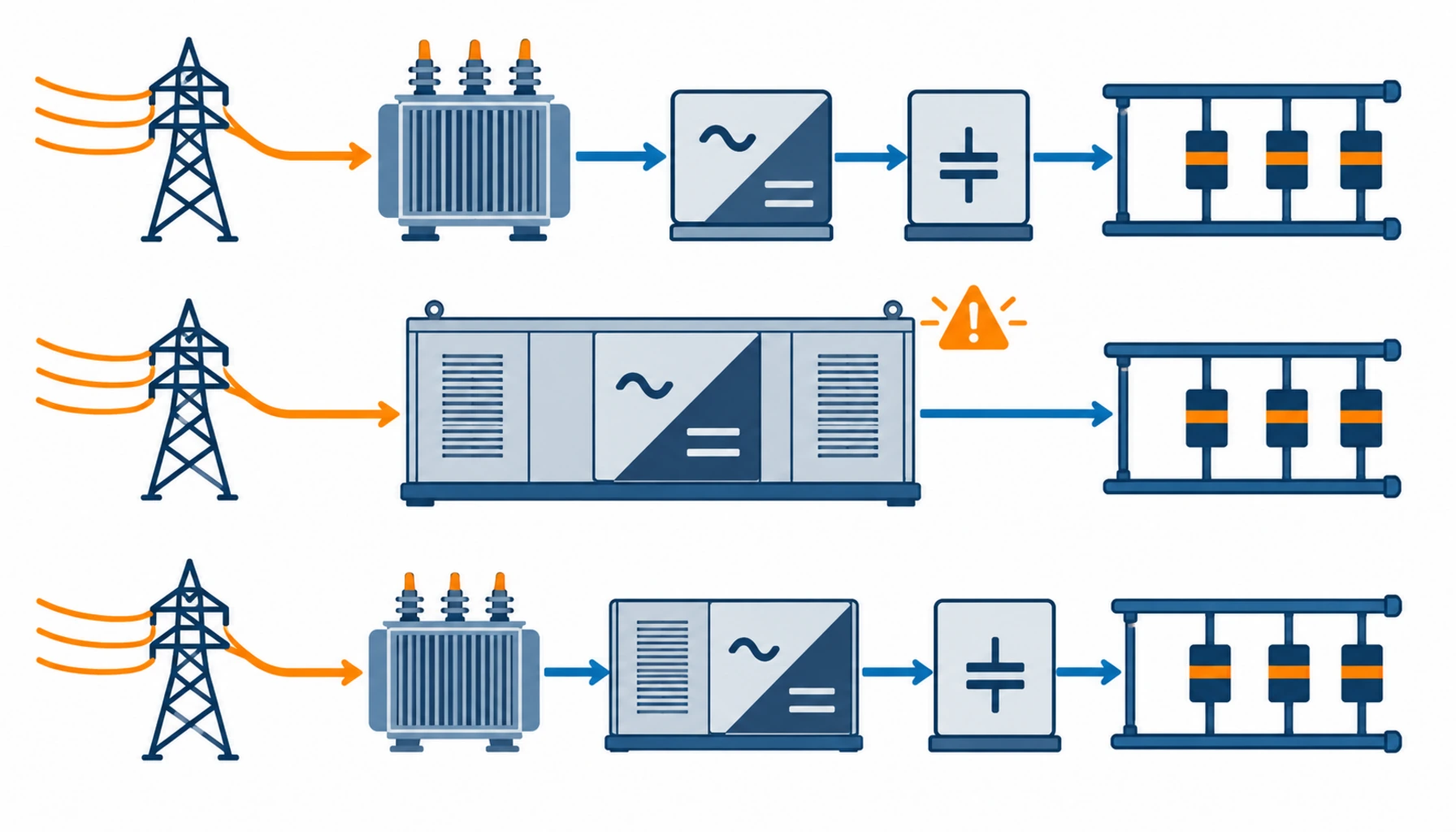
Quick Answer: A solid state transformer takes medium voltage straight down to 800V DC in one step, removing the separate rectifier stage. The device is the pacing item in a room-level DC fit-out, the qualified supplier base is small enough that single-sourcing is a real risk, and the protection coordination study has to be bought with the transformer rather than added later.
About USD 169 million of solid state transformers were sold worldwide in 2024, against a forecast of roughly USD 936 million by 2030. That growth rate is unusually fast for power equipment and unusually small in absolute terms, and the combination has a specific consequence for anyone buying: the technology is real and shipping, but the number of qualified vendors is small enough that a purchasing decision here is also a supply-chain decision.
Introduction
In a conventional data center substation the power path runs in two steps: a medium voltage transformer steps the utility supply down to low voltage AC, and a rectifier converts that to whatever DC the racks use. A solid state transformer collapses those two into one device, taking medium voltage in and putting 800V DC out. It is the third stage of the NVIDIA 800VDC roadmap, targeted at room-level distribution toward 2029, and it is the stage that removes equipment from the bill of materials rather than adding it.
Deployments already exist. A 2.4 MW unit has been installed in a Chinese national computing network project, and at least one vendor has announced an NVIDIA MGX-certified product with UL certification targeted for 2026. The engineering works. What is less well documented is how to buy it, which is a different problem: pricing is not published, lead times are engineering lead times rather than catalogue lead times, and a buyer who treats the device as a substitute for a transformer will discover that it also changes the fault current characteristics everything downstream was designed around. The roadmap context is set out in our note on the 800VDC roadmap in three steps.
The Three Ways to Get From Medium Voltage to 800V DC
It is tempting to treat the solid state transformer as a drop-in replacement. It is not, and the comparison below is the one that decides the budget. The choice is not about which is more advanced, but about which one you can source, staff and sign off on the date your hall energizes.
| Route | Equipment in the Order | Lead Time and Supply Position | Cost Position | Main Risk |
|---|---|---|---|---|
| Conventional chain | MV transformer plus LV rectifier cabinets, AC switchgear, MV cable and terminations | MV transformer and switchgear are the well-known bottleneck, twenty to forty weeks, but from many suppliers | Lowest purchase price, highest equipment count and floor area | Two conversion stages means the efficiency and copper penalty never goes away |
| Solid state transformer | One SST skid, MV cable and terminations, protection coordination study | Engineering lead time rather than catalogue lead time; qualified supplier list is short | Highest unit price, lowest installed equipment count and smallest footprint | Single-source dependency and a fault current profile your downstream protection was not designed for |
| Hybrid | Conventional chain for phase one, MV and room capacity sized for a later SST swap | Conventional equipment is available now; the SST arrives when the supply base matures | Small premium over the conventional chain for the reserved capacity | Reserving the wrong thing — capacity without the clearances and protection scheme to use it |
Why Single-Source Risk Is the Central Issue
A market of USD 169 million moving toward USD 936 million is a market with a handful of credible suppliers and no second tier to fall back on. Compare that with medium voltage switchgear, where the bottleneck is capacity, not availability: there are many manufacturers and the problem is getting a slot. With solid state transformers the problem is different — if your chosen supplier slips, there may be no alternative qualified product to switch to, and the device sits on the critical path of the whole hall.
The procurement response is to qualify a second source before the first unit ships, not after. That means paying for engineering samples or evaluation units from a second vendor early, even though the volume will go elsewhere. It is an insurance premium on the schedule, and it is far cheaper than discovering during commissioning that the only qualified product has a fault current signature nobody modelled.
Second-sourcing has a second benefit that buyers often miss. A second vendor’s datasheet is the fastest way to find out what your first vendor left out of the specification. Questions about creepage, partial discharge limits, cooling philosophy and DC-side isolation appear quickly once two suppliers are answering the same enquiry.
The Protection Study Is Part of the Purchase, Not an Extra
The most expensive misunderstanding about solid state transformers is treating them as a transformer-shaped object that happens to output DC. A conventional transformer passes fault current through largely unchanged, which is what the downstream breakers were selected against. A solid state transformer is a power electronic device: it actively limits current, it can trip in microseconds, and its behaviour under a downstream fault is a design characteristic rather than a physical consequence.
That changes the basis of every protection setting downstream. Coordination has to be re-studied with the device’s actual fault response included, which means the study has to be commissioned as a deliverable alongside the transformer rather than tacked on during commissioning. Put it in the purchase order: the vendor supplies the fault current profile, the system integrator or a third party runs the coordination study against the real distribution layout, and the settings are documented and handed over.
There is also a delivery-side question. A solid state transformer is typically fed from medium voltage switchgear, and that is where the well-documented industry bottleneck sits. Our note on transformer lead time shortages covers how far ahead that equipment has to be placed. The sensible split on an SST project is to order the conventional, long-lead medium voltage equipment first and treat the transformer as the second package, because it is the one with an engineering schedule rather than a factory schedule.
What to Freeze Before the SST Order Goes Out
Because the device is new, the specification does more work than usual. The table below is the list of items to close out, and what goes wrong when each is left to the vendor’s default.
| Specification Item | What to State | Evidence to Demand | Cost of Leaving It Open |
|---|---|---|---|
| Input and output rating | MV supply voltage, output 800V DC class, continuous and overload rating at the hall ambient | Rated output at the stated ambient, not at 25 degrees | A unit that derates below your hall design on the day it is commissioned |
| Fault current profile | The device's behaviour under downstream fault, for coordination purposes | Measured or modelled fault response with test basis stated | Protection settings nobody can verify, and coordination that fails in service |
| DC-side isolation and earthing | Whether the DC system is earthed or unearthed, and the isolation philosophy | Insulation monitoring scheme and alarm thresholds | A ground fault that stays invisible until it becomes a trip |
| Cooling and footprint | Cooling method, heat rejection, clearances and service access | Heat rejection figures and a serviceability drawing | A device that fits the drawing and not the room |
| MV interface | Cable termination type, cable type and installer qualification on the MV side | Termination kits, torque values and inspection records | A termination that fails thermally inside the warranty period |
| Coordination study | Who owns the study, what it covers, and what is handed over | Study report, settings schedule and as-built documentation | A study nobody bought, discovered as a commissioning finding |
| Second source and spares | The second-source qualification plan and the critical spares holding | Delivery commitments with dates, not intentions | An outage nobody can shorten because the replacement is six months away |
When a Solid State Transformer Is Not the Answer
The device is the right purchase for a high-density hall with a long planning horizon and an engineering team that can run the coordination work. It is the wrong purchase in three common situations.
A hall energizing before the supply base matures. Buying a device that exists in small volumes and short supply base turns a technology choice into a schedule dependency. A project that must energize on a fixed date is better served by the conventional chain plus reserved capacity for a later swap, and the reserved capacity has to include clearances and protection scheme, not just amperage.
No capability to own protection coordination. A power electronic front end changes the fault behaviour of the whole distribution layer. A site that cannot run and verify that study should buy the architecture it can support, because the failure mode is not a slower schedule but an installation that cannot be signed off. Our note on MV cable in data centers covers the medium voltage interface in more detail.
Density that does not justify DC at all. Below roughly 100 kW per rack, the copper problem that justifies the whole exercise is not present, and the conventional approach — a transformer, low voltage switchgear and in-rack conversion — remains cheaper and better supported. The conventional transformer end of this decision is covered in our comparison of oil immersed and dry type transformers.
The pattern is the same as elsewhere in this roadmap: the technology is not the constraint, the supply base and the staffing are. A solid state transformer bought without a second source and without a coordination study is not an advanced purchase, it is an unmade decision.
RFQ Checklist for a Solid State Transformer Package
An SST enquiry should carry the electrical consequences of the device, not just the power figure. Send:
- MV supply voltage, earthing arrangement and fault level at the point of connection
- Required 800V DC output rating, continuous and overload, at the hall ambient
- Density profile across fit-out phases, so the rating is not sized to phase one only
- The device’s fault current behaviour under downstream fault, as a required deliverable
- Whether the DC system is earthed or unearthed, with the insulation monitoring philosophy
- Who owns the protection coordination study, what it covers, and what is handed over
- MV cable type, termination method, torque values and installer qualification requirements
- Cooling method, heat rejection, clearances, service access and maintenance intervals
- Second-source qualification plan and critical spares holding, with delivery dates
- Test documentation: rated output at ambient, type test basis, factory acceptance test scope
- Certification for the destination market, including the edition of each standard applied
- Training requirements for operations and maintenance staff
Conclusion
A solid state transformer is best understood as a purchase that removes equipment rather than adding it. The MV transformer, the low voltage switchgear and the rectifier cabinets all disappear from the order, replaced by a single skid — and in exchange the project takes on a short supplier list, an engineering rather than catalogue lead time, and a protection study that has to be bought deliberately. Whether that trade is worth making depends on the energization date, not on how the technology reads in a whitepaper.
The buyers who get this right do two things that are easy to put in a budget. They qualify a second source before the first unit ships, and they commission the coordination study with the transformer instead of after it. Everything else — the rating, the cooling, the MV interface — is ordinary specification work, provided it is written down before the order goes out. Kexingyu Cable Group (KXYE) supplies the medium voltage cable, terminations and the power, control and mineral insulated cable ranges that surround these installations — WDZ-YJY, WDZN-YJY, BTTZ, BBTRZ, NG-A (BTLY), KVV and YJV — together with switchgear and transformer product lines, from a single factory group, with copper price linkage available on project-scale orders. Send your MV supply detail and DC output requirement and we will size the cable side of the package; the fastest start is a request for quotation, or browse the range at transformers and substations.