
Medium Voltage Cable Feeds for Data Centers: A Buyer's Guide
Quick Answer: Data centers take utility supply at 11 kV to 110 kV and distribute on site at 8.7/15 kV to 26/35 kV, so the MV feeder is the single most critical cable in the facility — specified by voltage class, single-core construction, XLPE insulation, screen bonding scheme, armor and sheath, and proven by type test and routine test evidence.
Introduction
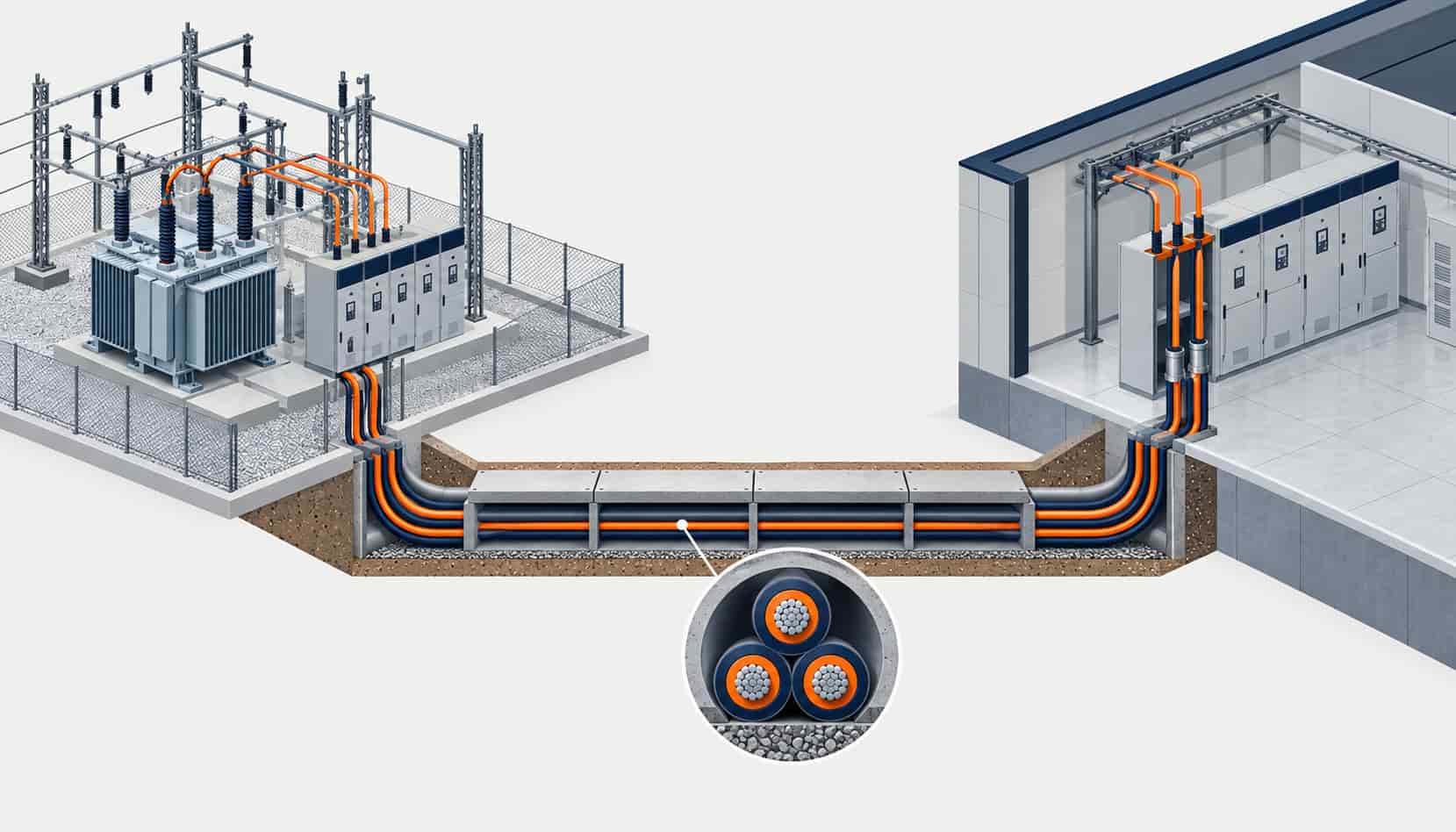
Everything a data center does depends on the few feeder circuits that connect the grid to the main switchgear. Yet MV cable is often bought on price per metre from a generic catalogue line, with the expensive decisions — screen cross-section, bonding scheme, armor material — made implicitly by whoever typed the product code. This guide walks the purchase the way a consultant would: voltage class first, then construction, then the standard, then the evidence that proves the drum you receive matches the offer you accepted.
The buyer’s context is urgent, because MV switchgear and transformer lead times have become a known constraint on data center delivery — a supply-side problem we examine in the 2026 switchgear and transformer shortage. Cable lead time is shorter, but only if the specification is right the first time; reissuing an MV order after a failed audit costs weeks. And when the intake is an integrated compact substation rather than a built room, the MV cable scope and its terminations should be engineered together with the substation, not after it.
Step 1: Get the Voltage Class Right
MV cable is named by its phase-to-earth and phase-to-phase ratings, written as Uo/U: 8.7/15 kV, 12/20 kV, 19/33 kV, 26/35 kV. The rule is that the highest phase-to-phase voltage the cable will ever see — including the utility’s upper tolerance and any transiently elevated fault conditions the network operator allows — must not exceed the U value. Most individual data center halls are fed at 11 kV or 20 kV, which puts 8.7/15 kV and 12/20 kV products at the center of the shopping list; campus-level intake at 33 kV brings 19/33 kV cable into play, and utility substations at 66-110 kV move to HV products outside this guide’s scope.
Two buyer errors dominate this step. The first is under-specifying: choosing 8.7/15 kV for a 20 kV network because the conductor size looked similar. The second is over-specifying blindly: paying for 26/35 kV insulation where 12/20 kV meets the network study, which inflates cost and terminations without adding reliability. Ask the utility for the network study figures, and make the voltage class a contractual line, not an assumption. The way these classes map across IEC, GB and BS rulebooks is compared in our MV cable standards overview.
Step 2: Choose the Construction
Above about 500 kVA per circuit, MV feeders are almost always single-core: one cable per phase, unarmored or with non-magnetic armor, installed in trefoil or flat formation. Single-core construction carries more current per cross-section, terminates more easily at switchgear, and avoids the induced-heating penalty of steel armor on AC circuits. Three-core cable remains sensible for shorter runs, for direct-buried segments where a single trench crossing is cleaner, and at the smaller end of the range.
Conductor is copper by default in data centers — aluminum appears where cost or weight dominates long campus runs, but termination reliability at the switchgear end favors copper. Insulation is cross-linked polyethylene without exception at these classes, chosen for its 90 °C continuous operating rating and proven long-term behavior. Conductor size follows the load study, not habit: ampacity with real grouping derating, then a voltage-drop check on the longest runs, decides the cross-section.
Step 3: Specify the Screen, Armor and Sheath Deliberately
The metallic screen is where MV cable engineering gets real. Its cross-section must carry the single-phase-to-earth fault current for the clearing time of the protection, and its bonding scheme — solid at both ends, single-point, or cross-bonded — must be chosen against circulating current losses and standing voltage limits. Under-specifying the screen is invisible at commissioning and catastrophic at first fault; this is one of the common root causes of cable failure that shows up years later as sheath damage and water ingress.
Armor follows installation: steel wire armor for buried three-core runs, non-magnetic (aluminum wire or alloy) armor for single-core AC circuits, unarmored with mechanical protection where ducts give the route physical cover. Sheath follows environment: PVC where cost rules, low smoke zero halogen indoors and in tunnels, and anti-termite or rodent-resistant compounds in markets where the hazard is real. The trade-offs are laid out in our armored versus unarmored cable comparison.
| Scenario | Typical Construction | Key Specification Points |
|---|---|---|
| Campus intake at 33 kV | 19/33 kV single-core XLPE, Cu 185-400 mm2, ALWA armor | Network study voltage; screen sized to earth fault level; outdoor sheath UV-stable |
| Hall feed at 11-20 kV | 8.7/15 kV or 12/20 kV single-core, Cu 185-630 mm2 | Non-magnetic armor if armored; trefoil spacing; LSZH sheath indoors |
| Duct bank routes | Single-core, unarmored, PE sheath | Thermal resistivity of duct backfill in ampacity study; pulling tension check |
| Direct-buried crossings | Three-core SWA, 8.7/15 to 19/33 kV | Bedding depth, sheath mechanical protection, rodent resistance |
| Compact substation links | Short single-core or three-core, 12/20 kV | Termination geometry matched to substation bushings; bending radius in tight rooms |
| Generator MV tie-ins | 8.7/15 kV single-core, flame-retardant or fire-resistant variants | Fire performance class if routed through shared risers |
Step 4: Demand the Test Evidence Before, Not After
MV cable quality is proven on paper before it is proven in the trench. A quotable manufacturer supplies: type test reports to the relevant standard (IEC 60502-2 or the destination equivalent) covering the exact voltage class and construction; routine test records for every drum, including partial discharge measurement and the 3.5 Uo withstand test; and sheath integrity test results. For larger projects, add a witnessed sample test or third-party inspection at the factory before shipment. The full logic of what to demand, and how certificates map to real production, is detailed in our power cable certifications checklist.
Buyers sometimes accept a “type tested design” claim without checking that the report matches the offered construction — same voltage class but different screen, or an older standard edition. The discipline is simple: report number, product code, and construction details must reconcile line by line, and any deviation belongs in a written deviation note attached to the offer, not in a sales conversation.
| Parameter | What to Write in the Specification |
|---|---|
| Voltage class | "12/20 kV (Uo/U), per network study XX-MV-001" â named study, not habit |
| Conductor | Copper, Class 2 stranded compacted, cross-section per ampacity study |
| Insulation | Dry-cured XLPE, IEC 60502-2 (or named destination standard and edition) |
| Screen | Copper wires plus tape, cross-section ⥠earth fault requirement for protection clearing time |
| Armor | None / aluminum wire (single-core AC) / steel wire (three-core buried) â state which |
| Sheath | LSZH indoor, PE outdoor, anti-rodent where applicable |
| Tests | Type test report copies; routine PD and voltage tests per drum; sheath test records |
| Delivery | Drum lengths per route segment; copper price mechanism; inspection scope |
When a Cheaper MV Offer Is Not the Answer
MV feeder economics look backwards: the cable is a few percent of the electrical package cost, but a failure on it takes the entire facility down. Savings extracted from screen cross-section, insulation quality or routine testing are therefore not savings — they are unpriced risk transferred to the owner. When two offers differ sharply on price, the difference is almost always in the metal (conductor cross-section, screen, or copper-clad substitution), the compound grade, or the testing scope. Ask for the reconciliation, not just the discount.
The second trap is buying MV cable from a trader rather than a factory. Traders add a margin without adding capability, and when a drum fails a sheath test two weeks before energization, the difference between a manufacturer who re-tests and a trader who re-negotiates is project time.
RFQ Checklist: What to Send for an MV Feeder Quotation
- Network study extract: voltage class, fault levels at both ends, protection clearing times
- Route data: lengths per segment, duct or tray or buried, thermal environment
- Construction decisions already made, or the design data for the factory to propose them
- Screen cross-section requirement derived from earth fault study, or the study itself
- Sheath environment: indoor LSZH, outdoor UV, rodent or termite exposure
- Standards and editions: IEC, BS, GB or destination-market equivalent
- Termination and joint kit scope, matched to the switchgear supplier’s geometry
- Drum lengths and delivery milestones aligned to the construction program
- Test requirements: routine per drum, type report copies, third-party inspection scope
- Copper price mechanism and validity period of the offer
Manufacturers who produce MV cable in the same factory group as the LV, LSZH and fire-rated families — as Kexingyu Cable Group (KXYE) does — can align the whole power chain, from data center power equipment down to the last LV feeder, against one quality system and one delivery schedule.
Conclusion
An MV feeder purchase is decided in four moves: the voltage class from the network study, the construction from the load and route, the screen and armor from the fault and environment, and the evidence from the test regime. None of these lines is exotic, but every one of them is cheaper to write into the specification than to fix in the trench.
Buy accordingly: name the standard and edition, size the screen to the study, demand per-drum test records, and hold the copper basis in the contract. With those lines in place, the feeder that connects the grid to your facility will be the quietest asset in the building — which is exactly what a cable this critical should be.
Recent Posts
Thermal Runaway in Lithium Batteries: What BESS Buyers Should Understand
Thermal Runaway in Lithium Batteries: What BESS Buyers Should Understand How thermal runaway starts, how it propagates, and which evidence buyers should require before approving
Energy Storage for Data Centers: A Growing Backup Power Option
Energy Storage for Data Centers: A Growing Backup Power Option Batteries have always backed up data centers in the form of UPS strings. Grid-scale BESS
YJV vs YJY: Reading Chinese Cable Designations Like a Local
YJV vs YJY: Reading Chinese Cable Designations Like a Local YJV vs YJY: Reading Chinese Cable Designations Like a Local Quick Answer: YJV and YJY