Buying a Third-Party Commissioning Agent for Data Center Cabling: Scope, Witness Points and What They Check
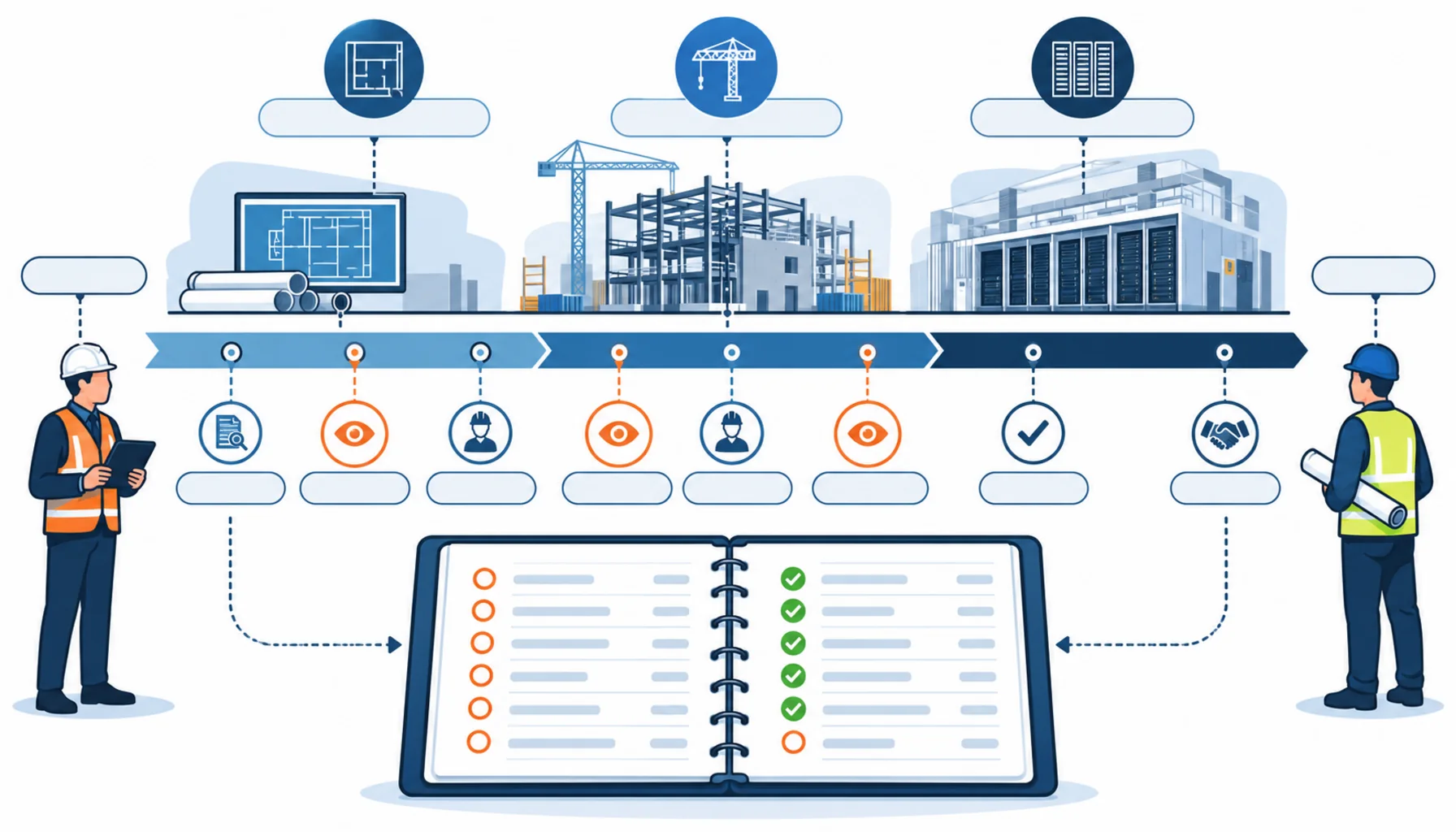
Quick Answer: A commissioning agent is bought as two things and only one of them is attendance. The first is an independent eye on work the contractor has no incentive to examine closely. The second, and the one that decides whether the fee was worth paying, is a closed issues log: every observation recorded, assigned, closed and verified, with the closure evidence attached. Scope the appointment by naming the scope level, the deliverable set, the witness points and the named personnel, and the proposals you receive will be comparable. Leave those open and you will buy a series of signed attendance sheets.
Independent commissioning exists because the party who installs the work is not a neutral judge of it. That is not an accusation of bad faith; it is a statement about incentives and about attention. A contractor is measured on delivering to programme and price, and every extra hour spent finding a fault in their own work is an hour the programme does not have. An owner’s representative whose only job is to check, and who has the authority to write down what they see, changes the economics of finding problems early.
Introduction
The role is often confused with two others and the confusion affects what gets bought. A commissioning agent is not a certification auditor: the auditor examines an evidence set against a published standard and decides whether a rating applies, while the agent is present during the work and watches it happen. Nor is the agent a goods inspector: inspecting equipment before shipment is a factory activity that looks at the product, while the agent looks at the installed system and at the process that produced it. Our notes on TIA-942 certification testing and on third-party cable inspection cover those two roles from their own sides.
What the agent does is verify, witness and record. Where the appointment is well scoped, the same person also reviews the design and the test scripts before anything is built, and that review is where a disproportionate share of the value sits, because a comment on a drawing costs a fraction of a finding on an installation. Where the appointment is made at commissioning stage, that part of the value is simply unavailable, which is why the timing of the engagement is a commercial decision rather than an administrative one.
Four Scope Levels and Where the Value Sits
Commissioning services are usually bought at one of four levels of depth, and the price difference between them is large enough that proposals quoting different levels cannot be compared.
Witness only. The agent attends defined tests and records what they observed. This is the cheapest level and it delivers the least, because the agent’s ability to find a problem depends on the contractor’s test scripts being adequate in the first place. Where the scripts are thin, the agent witnesses a thin test and confirms it happened.
Witness with script and record review. The agent reviews the contractor’s test scripts and records before and after the tests, and comments formally. This is the level at which the agent starts influencing outcomes rather than recording them, because a script review catches the test that proves nothing before it is performed.
Design review plus process ownership. The agent is engaged during design, reviews the specification and the drawings, writes or approves the commissioning plan, defines the test script requirements, and manages the commissioning process through to handover. This is the level at which the appointment starts preventing problems instead of discovering them, and it is the level that suits a project with a defined handover date.
Full commissioning commission, including operational readiness. Adds the operational side: maintenance procedures, training, spares verification and the readiness review that decides whether the facility can be handed to the operating team. For a data center this is the level that closes the gap between the installation being complete and the facility being runnable.
Where the fee sits between these levels is a question of the package value, but the shape is consistent: each step up adds cost roughly linearly and changes the character of the findings from discovered defects to prevented ones. The choice should follow the risk the project is carrying. A hall with a fixed tenant date and a repeating design buys the deeper level; a project with time to rework buys the shallower one and accepts more findings.
The Decision Table: Scope Levels Compared
The table compares the four levels as a buyer would price and evaluate them.
| Scope Level | What to Specify | Evidence You Receive | Cost and Engagement Point | Failure Mode If Chosen Wrong |
|---|---|---|---|---|
| Witness only | The tests to be witnessed, the notice period, and the record format | Signed attendance and observation records per test | Lowest fee; can be appointed late without losing much | Adequate test scripts witnessed well, proving that a thin test was performed |
| Witness plus script and record review | The review deliverable, the comment turnaround time, and how comments are closed | Written review comments per script, plus witness records | Moderate fee; engagement must precede the tests by weeks, not days | Review performed after the test, when nothing can be changed |
| Design review plus process ownership | The design deliverables reviewed, the commissioning plan, and the authority the agent holds | Design review comments, the commissioning plan, the issues log through handover | Highest early cost, largest avoided cost; appointment at design stage | Comments produced without authority to require a response, so nothing changes |
| Full commission including operational readiness | Training, maintenance procedures, spares verification, and the readiness review criteria | Readiness report, training records, verified spares list, closure of all issues | Highest total fee; delivers a facility the operating team can actually run | An installation handed over with no operating capability, and the gap discovered in service |
Witness Points: The List That Makes the Fee Defensible
A witness obligation expressed as attendance at commissioning is satisfied by attending. A witness obligation expressed as a list of points is satisfied by being at those points, and the list is what makes the fee auditable.
The list should be built from the test and inspection activities already in the construction contracts, with one line per point stating what is witnessed, what evidence it produces, and the notice the agent needs. On the cabling side, the points that matter most are the ones where the work will be concealed or energised afterwards, because those are the points at which a missed observation cannot be repeated.
Four categories carry most of the value on a data center.
Concealed work. Cable routing before ceilings and floors close, support spacing, bend radii, the bonding connections before they are hidden, and the penetrations before they are sealed. Verification after concealment is a sample, not a check. The bonding case is set out in our note on grounding and bonding verification and the penetration case under firestop cable penetration systems.
Tests whose evidence depends on method. Insulation resistance measured at the correct test voltage with the recording of conditions, continuity measured with sufficient test current, and thermal scanning carried out at the right load with correct emissivity settings. Each of these can be performed in a way that produces a passing record and proves nothing, and an agent present at the test is the control that closes that gap. The method requirements themselves are set out in our note on insulation resistance and continuity testing.
Fault and switching tests. The tests that demonstrate the facility keeps running when something fails, performed under a written script with an expected response. These carry operational risk and therefore need independence, and they are also the tests most likely to be dropped when the programme is tight.
Documentation reconciliation. The point at which the as-built set is checked against the installation, and the point at which the identification and schedule are verified against what is labelled. Documentation disputes are settled by whoever recorded the observation at the time, and the record set from the agent is that observation. The requirements are covered in our note on cable labeling and documentation.
What They Actually Check on Cabling
A concise statement of the check list is useful in the enquiry, because it is what the agent’s fee is actually buying and it lets you compare proposals by content rather than by claimed experience.
Against the specification. Cable type and construction installed against the schedule, ratings and temperature class, conductor size and material, the fire performance claimed, and the spare capacity actually provided versus the fill ratio the specification required.
Installation quality. Support spacing against the calculation, cleat spacing on vertical runs, bend radii against the cable manufacturer’s pulling figure, pulling records against the tension limit, and termination work against the kit manufacturer’s approved method and the environmental conditions recorded at the time.
Testing adequacy. Whether the test scripts test the right thing, whether the instruments and calibration are appropriate, whether conditions were recorded, and whether the readings are consistent across similar circuits. Consistency is a useful signal: a set of insulation readings where most circuits sit in the hundreds of megohms and three sit just above the criterion is a pattern, not three unrelated results.
Records and reconciliation. Whether the schedule matches the installation, whether the penetration register is complete and current, whether test records are linked to the same cable references used in the schedule, and whether the document set is editable or a scan. The division of testing responsibility between factory and site is covered in our note on factory and site acceptance testing, and the wider cabling checklist is set out in our note on the data center cabling checklist for EPC projects.
Closure. Whether every issue raised was closed with evidence, or closed by agreement without repair, and whether the closure was verified by the same party that raised it. An issues log with open items at handover is not a failure of the agent; an issues log where items were closed without evidence is.
What to Freeze Before Appointment
| Item | What to State | Evidence to Attach | Cost of Leaving It Open |
|---|---|---|---|
| Scope level | Which of the four levels applies, in terms the proposals can be priced against | Scope statement referenced in the tender, not left to each bidder's interpretation | Proposals that cannot be compared, and a fee that buys less than intended |
| Engagement timing | The date of appointment relative to design, construction and commissioning | Programme showing the review milestones before the first test | Design-stage value forgone entirely, and findings instead of prevention |
| Named personnel | The individuals who will perform the work, their experience, and their availability | Curriculum vitae with availability, plus a no-substitution clause without consent | An experienced proposal delivered by whoever is free that month |
| Deliverable set | The commissioning plan, review comments, witness records, issues log and readiness report | Deliverable list with formats and dates in the appointment | A service that produces attendance sheets and no artefacts anyone can use |
| Witness points list | Every point to be witnessed, with the notice period for each | Annexed list, referenced in the construction contracts as well | Attendance at convenient activities rather than at the activities that matter |
| Authority and independence | The agent's authority to raise and require a response to issues, and confirmation of no commercial ties to contractors | Written authority and a signed independence declaration | Findings that are noted and ignored, and an audit trail with no consequence |
| Issues log rules | The severity classes, the response times, and the evidence required to close each class | Log structure agreed before work starts, with closure rules written down | An open list at handover and an argument about what counts as resolved |
| Fee basis and exclusions | Whether the fee is lump sum or time based, and what is excluded | Fee schedule plus a written exclusions list | Additional fees appearing for activities that were assumed to be included |
When an Agent Is Not Worth Buying
Independent commissioning has a real cost and a real return, and there are conditions where the return is not there.
Small and repetitive installations. Where the installation is a standard design delivered many times, the recurring defects are known and the specification can address them directly. The fee is better spent on making the specification precise, which is a one-off cost.
Where the owner has genuine in-house capability. A project with an experienced engineering team that reviews test scripts, attends the critical tests and maintains an issues log is doing the core of the work already. Buying an agent to duplicate it adds a layer without adding independence.
Where the appointment would come too late to matter. Engaging an agent at practical completion buys a witness-only service at a scope-level-three price if the proposal was written generously, and it delivers the weakest of the four levels. Better to define which specific tests and concealed-work points you need witnessed and buy exactly those, than to buy a broad service at the wrong time.
Where the constraint is equipment or labour supply, not quality. An agent finds and documents defects; it does not create electricians. Where the programme is being driven by a shortage of either, the fee will produce a well-documented set of problems rather than a solved one. The supply side of that situation is covered in our 2026 switchgear lead time guide.
RFQ Checklist
- Scope level named in the tender documents, so every bid prices the same service
- Appointment date fixed relative to design review, construction and first test
- Named personnel with curriculum vitae, availability and a no-substitution clause
- Deliverable set listed with formats and dates: commissioning plan, review comments, witness records, issues log, readiness report
- Witness points annexed as a list, cross-referenced in the construction contracts
- Notice period required for each witness point, agreed with the contractors
- Authority to raise issues and require a response, stated in the appointment
- Signed independence declaration confirming no commercial relationship with the contractors
- Issues log structure with severity classes, response times and evidence required for closure
- Verification by the agent of each closure, with the evidence attached to the log entry
- Fee basis stated as lump sum or time based, with a written list of exclusions
- Handover condition: the readiness report states which issues remain open and who owns them
Conclusion
Commissioning is where the twelve preceding subjects in this series converge, and the agent is the party who makes them verifiable. Tray and riser work is concealed, pulling damage is invisible, termination quality is a technique question, penetrations get closed, tests can be performed in a way that proves nothing, earthing hides behind ceilings, labels fade and documentation drifts from the installation. Each of those is manageable with a specification decision made early. What none of them survives is the absence of an independent record of what was actually done.
That is the case for buying the role properly: the right scope level at the right time, a named person, a witness list built around the points that cannot be revisited, and an issues log that is closed with evidence rather than with agreement. Kexingyu Cable Group (KXYE) supplies the cable and distribution equipment that these verifications examine, including the WDZ-YJY, WDZN-YJY, BTTZ, BBTRZ, NG-A (BTLY), KVV and YJV ranges, the multi-purpose distribution cable used on submain routes, and the GGD power distribution cabinet and KYN28 medium voltage switchgear at the origin of the distribution, all from one factory group with copper price linkage available on project-scale orders. Factory routine test records ship with every order, which is what lets an agent separate what was verified in the factory from what has to be verified on site. Send your commissioning scope and the witness points you intend to hold, and we will return the equipment and cable records that support them; the fastest route is a request for quotation.