UKCA and UK Machinery Rules: Cable Compliance After Brexit
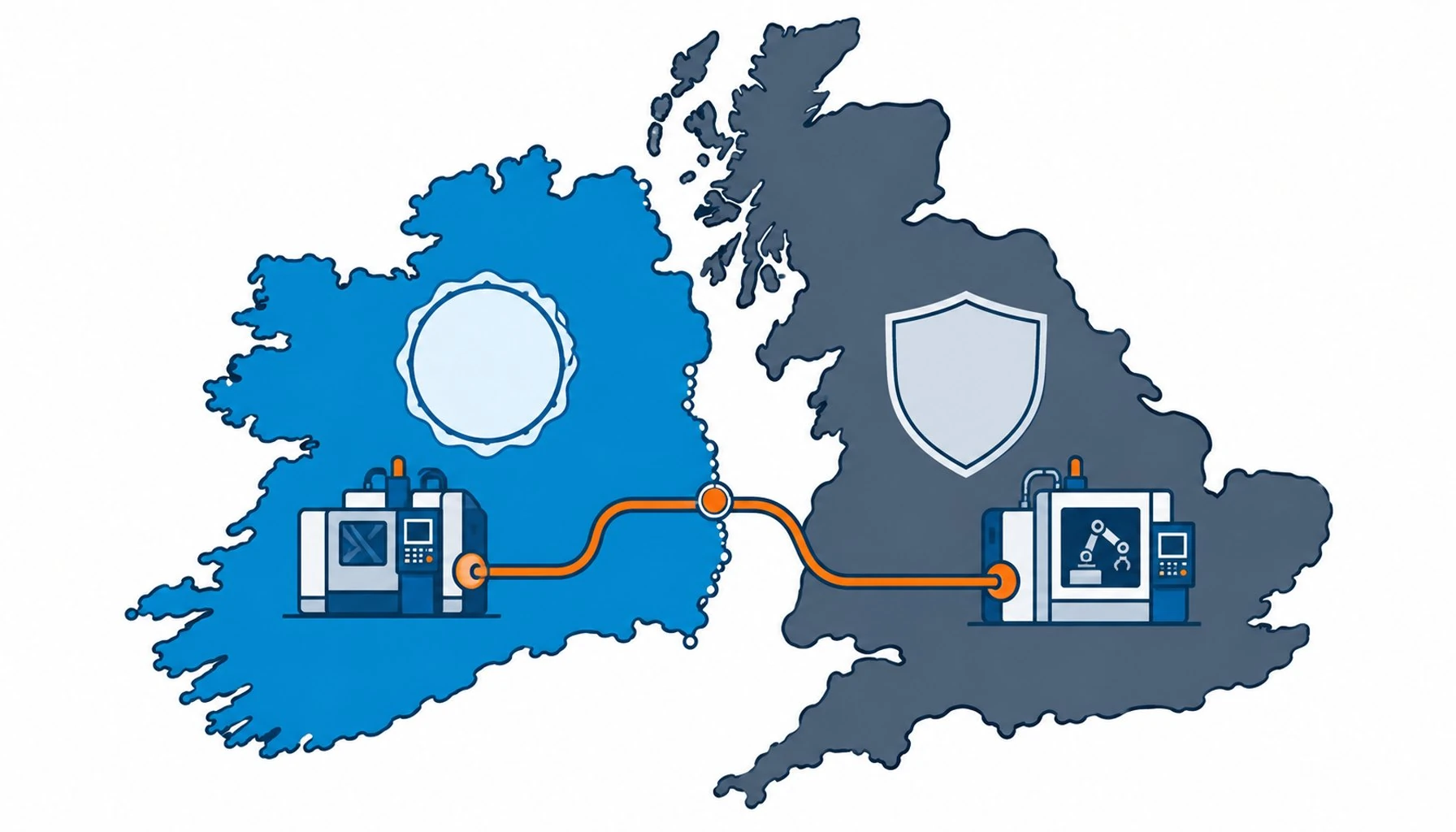
Quick Answer: Great Britain recognises European conformity marking indefinitely for most goods, so a British mark is usually optional. Northern Ireland follows European rules. Either way, the cable evidence is the same.
British conformity marking has been through more changes of plan than any comparable regime, and most of the advice still circulating online describes a position that stopped being true. Builders have paid for British re-testing they did not need, and builders have shipped into Belfast with a mark that is not accepted there. Both mistakes come from the same source: treating the United Kingdom as one market. It is two, and cable inside a machine sits in an unusual position, because the marking differences largely do not change what the cable has to be, only which words the paperwork uses.
Introduction
The sequence matters for understanding the current rule. The transition period ended, a British regime and its own marking were introduced with an expiry date attached to European recognition, and that date was then extended repeatedly and finally removed. The result, in force since late 2024, is that European marking is recognised indefinitely across a defined list of product regulations that includes machinery and electrical equipment, while the British marking remains valid and available as an alternative. Northern Ireland, under its own framework, continues to follow European rules.
For cable this is liberating rather than complicated, because the substantive requirements never diverged. The same electrical standard, the same substance restrictions, the same safety expectations. What differs is administrative: which legislation the declaration of conformity names, which standards it cites, and what language the documentation has to be in. The larger picture of how markets structure this is surveyed in the guide to cable certification checklists.
What Changed, and What Did Not
The change is that a European-conformant machine can be placed on the British market without a second conformity assessment, provided the European compliance chain behind the marking is kept intact. That last condition is where builders get caught: if you rely on European marking to sell into Great Britain, you still need the European conformity assessment to be substantiable, including the documentation and the representative arrangements that support it. A marking you cannot defend is worth less than no claim at all, because it invites questions you cannot answer.
Two features matter before the territory detail. First, the strictness of the machine requirement and the strictness of the cable requirement are unrelated: a market with light machinery rules can have demanding customers, and a market with demanding rules can leave cable entirely to the component chain. Second, several markets regulate cable as a product category in its own right, which means a certificate issued before shipment rather than a declaration compiled afterwards. The table below places the British position in that landscape.
| Territory | Marking position | Governing framework | What the cable still has to supply |
|---|---|---|---|
| Great Britain | European marking recognised indefinitely; the British mark remains valid and optional | Retained product regulations, kept aligned with European requirements | Declarations, test reports and material statements against the standards the file cites |
| Northern Ireland | European marking required; a British-only mark is not valid; a British assessment body produces the dual marking | European rules apply under the region's framework | The same cable evidence, with the European compliance chain intact |
| Categories outside general recognition | The British mark is mandatory | Regulations specific to those product groups | Unlikely to affect cable, but check whether the machine's category is listed |
| United Kingdom generally | Marking is only one obligation | Producer registration, waste and substance regimes | Documentation in English and a United Kingdom economic operator where required |
Great Britain: European Marking, Indefinitely
The practical answer for a machine going to England, Scotland or Wales is that European conformity marking is enough for most regulated goods, and that obtaining a British mark purely as insurance is money spent on a duplicate assessment. Builders who already hold European conformity for a platform do not need to re-test it, re-issue a declaration or re-tool packaging, which is the most common and most wasteful error in this area.
The conditions attached are worth knowing. Keeping the European marking valid means keeping the compliance chain that supports it, including the representation arrangements the European route requires. Documentation and labelling for the British market still have to be in English. And the machine has to satisfy the British regime’s own requirements where those differ, which they largely do not for cable, because the standards referenced on both sides are the same family. Where the standards relate is set out in the guide to cable standards across IEC and national systems.
Northern Ireland: The European Track
Belfast is not a British conformity question. Northern Ireland follows European rules, European marking is required, and a British-only mark will not do. Where the assessment was carried out by a British body, the result is marked alongside the European marking, which is why machines bound for the region sometimes carry a combination that looks unusual at first glance. Most manufacturers simplify by working through a European body and covering both the European market and Northern Ireland with a single marking.
Designated Standards and the Language Question
Behind the marking sits a standards list. The British framework maintains its own designations, which track the international and European standards closely, so a cable declared against a harmonised European standard will generally find an equivalent British designation for the file. The declaration of conformity has to name the legislation it is made under, and that wording is the part builders most often get wrong by copying a European document without adjustment.
Language is the other frequent trip. Safety information and documentation have to be in English for the British market, and this extends to instruction material, warnings and traceability markings. For cable the practical implication is narrow but real: the file needs English-language declarations and, where a product label carries safety information, an English version. Where flame behaviour matters for the application, the classification scheme is worth checking rather than assuming, and the distinction is drawn out in the comparison of low smoke zero halogen and fire retardant cable.
When the British Mark Is Required, and When the Question Is Not the Answer
The general recognition does not cover everything. A defined set of product groups sits outside it, and for those the British marking remains mandatory; the categories include medical devices, construction products, marine equipment, rail interoperability products, cableways, transportable pressure equipment and unmanned aircraft systems. Machines are not in that list, but a machine incorporating a product from it may need the relevant evidence for that component, so the check is worth doing rather than assuming.
Beyond marking, two limits apply. Export obligations continue independently of the mark, including producer registration schemes for packaging and waste electricals, and, from the start of 2027, a carbon border mechanism for certain imported materials. And marking continues to be a question about admissibility rather than suitability: a machine can be perfectly marked and still be specified so that cables fail early, because no conformity route asks how long a cable lasts. The general pattern of these traps across markets is collected in the guide to international sourcing pitfalls.
| Decision | Position that saves money | Cost of getting it wrong |
|---|---|---|
| Which mark to apply | European marking for Great Britain, unless the category requires otherwise | Paying for a duplicate conformity assessment |
| Whether the machine will reach Northern Ireland | Establish it before the design closes | Shipment refused for want of European marking |
| Declaration wording | Name the British legislation the declaration is made under | Documentation that does not support the mark it accompanies |
| Language of documentation | English for safety information, instructions and traceability | Findings at inspection and delays on site |
| Producer obligations | Separate British registration where required, independent of marking | Compliance gaps that surface as penalties rather than delays |
RFQ Checklist: Cable Evidence for a British or Irish Project
Send these with the inquiry so the audit trail is complete on both sides of the Irish Sea:
- Destination territories named separately, including whether Northern Ireland is in scope
- The standards the declaration of conformity will cite on each territory’s side
- English-language declarations, test reports and material statements
- Fire performance classification for cables in occupied or escape-route areas, with the test basis stated
- Substance declarations, since the regimes on both sides restrict the same materials
- Print legend content agreed in advance and matching the designation in the file
- Any component drawn from a product category outside the general recognition
Conclusion
The British conformity question has become simpler than its reputation suggests, and more administrative than technical. For most machines, European marking does the work in Great Britain, Northern Ireland needs the European track, and cable evidence is identical on both sides. What still separates a smooth shipment from a stalled one is the paperwork: the right legislation named, the documentation in English, and component evidence that traces to the goods.
Kexingyu Cable Group (KXYE) supplies control, power and motion cable with English-language declarations and test reports suitable for British and Irish project files, and where a qualified version of a construction is required we supply it through our partner arrangements and identify the certificate holder rather than borrowing a mark. Send the territories and the standards your file will cite through the RFQ page, and we will confirm what can be declared directly.