UTP vs FTP vs S-FTP: Choosing the Right Shielding for Data Halls
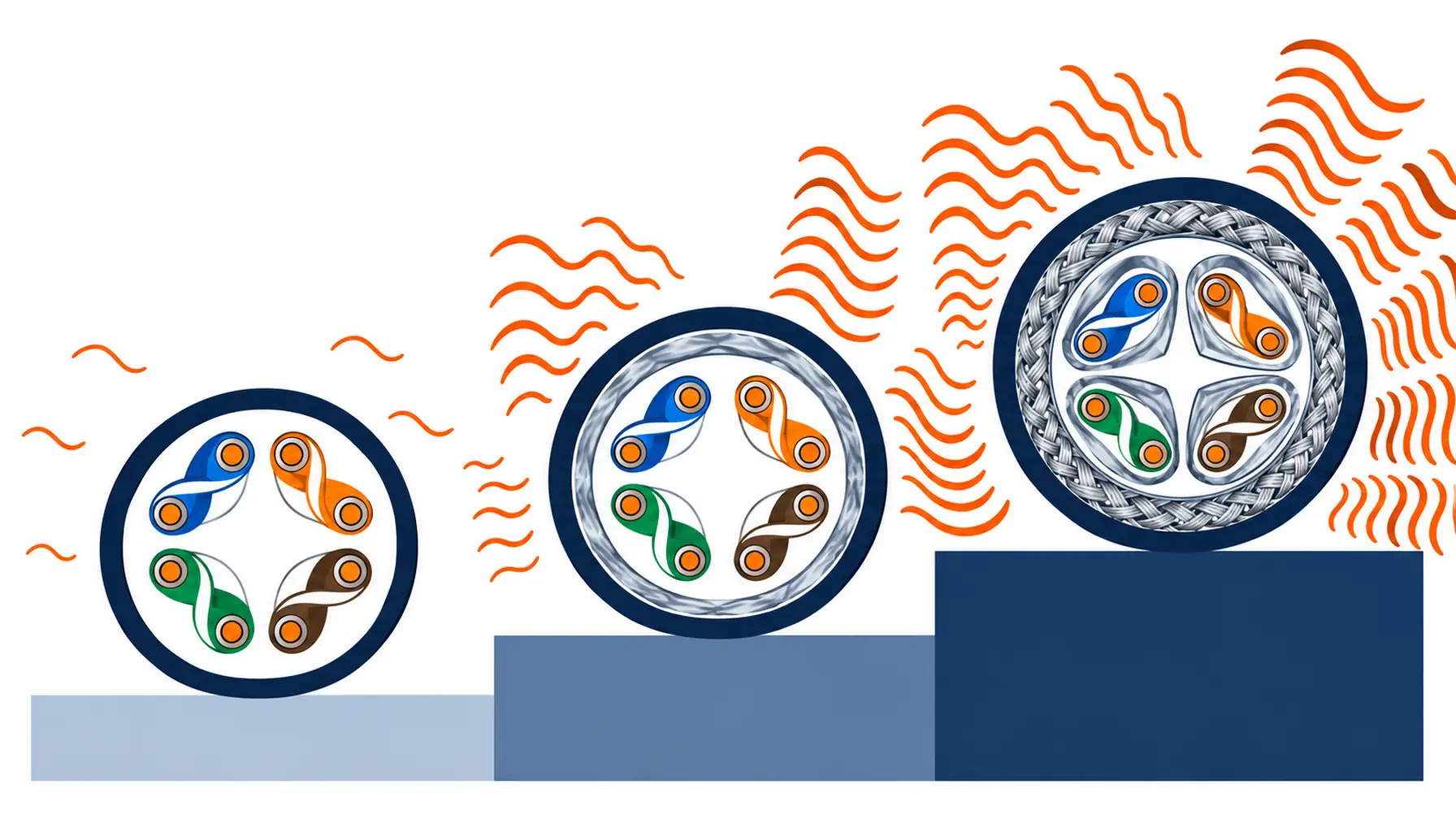
Quick Answer: UTP, FTP and S-FTP are three answers to one question — how much noise surrounds the cable. Match the shielding class to the tray’s electromagnetic reality and grounding discipline; more shield is not automatically better.
The utp vs ftp vs s-ftp decision is usually made the wrong way round: buyers pick the shielding from a catalog out of habit or fear, then discover the tray’s real environment during commissioning. Shielding is a response to noise, so the correct order is to read the noise first — what runs beside the cable, what runs through it, how far the pairs sit from power — and then choose the construction that answers it. Chosen that way, unshielded twisted pair remains the right answer for most horizontal channels in an ordinary environment; foil-shielded FTP answers the tray with moderate neighbors; and fully screened S-FTP earns its cost where density, power bundles or high-frequency neighbors make the air around the cable electrically loud. Chosen the other way — shield everywhere because shield seems safer — the buyer inherits grounding obligations that, unmet, turn the shield from protection into antenna. This guide reads the three constructions against the data hall’s actual environments.
Introduction
The mechanics come first because the acronyms hide real differences. UTP — unshielded twisted pair — relies on the twist itself: each pair’s geometry cancels most of the noise it picks up, and quality of manufacture is the whole defense. FTP — foiled twisted pair — adds a single overall foil screen around the four-pair core, a barrier against external fields and a reflector for the cable’s own emissions. S-FTP — screened-foiled twisted pair — does both: foil around every individual pair and an overall braid around the core, the construction that Cat8 mandates because at 2000 MHz nothing less holds the isolation budget. The engineering principle is the same one that governs shielded control cabling, familiar to buyers from the control versus instrumentation cable comparison: a shield only works when it is continuous and bonded, and a shield that floats collects noise instead of draining it. That principle is what turns the choice from a parts decision into a systems decision — the cable, the bonding, the pathway and the power environment as one design.
UTP: The Default That Deserves Its Reign
Unshielded cable is the default for good reasons that survive scrutiny: it costs less per meter and per termination, it pulls faster and bends tighter, it needs no bonding infrastructure, and in an electromagnetically ordinary building it delivers its full rated channel — 10G over 100 meters on Cat6A — with nothing but twist discipline to maintain. The data hall’s horizontal cabling, office interconnects and pathways that run nowhere near power risers are UTP’s natural home. The conditions that dethrone it are equally concrete: bundled runs sharing trays with power cables or high-current busways, long parallel stretches beside motor or inverter circuits, extreme density where alien crosstalk between dozens of neighbors accumulates, and routes through electrically noisy process areas. Where none of these apply, specifying shield buys cost and obligations without buying performance — a misallocation, just in the quiet direction. The failure modes that end UTP runs early are mostly physical rather than electrical, and the catalog in the common causes of cable failure reads the same for network cable as for power: crush, kink, heat and water, not noise.
FTP and S-FTP: Matching Shield to Noise
FTP — the single overall foil — is the middle answer: a barrier that handles moderate ambient noise and modest neighbor density at a small cost in price and handling. It suits trays with mixed traffic, runs that pass power on their way somewhere rather than living beside it, and halls where the operator wants margin without committing to per-pair termination complexity. Its discipline requirement is real but bounded: the foil bonds through the connector at both ends, continuity is verified by the tester, and the grounding system behind it must exist. S-FTP — pair foils plus braid — is the heavy answer for loud environments: high-density bundles where every cable is an aggressor to its neighbors, racks sharing pathways with heavy PoE runs and power distribution, short-reach high-frequency links where the construction is mandated, and industrial-adjacent halls where drives and inverters populate the walls. The cost is the full discipline: bonded screens at both ends, grounding the hall actually maintains, and terminations handled by people who understand the drain wire. The thermal interplay adds a practical note — dense shielded bundles trap more heat under PoE load, the same pathway arithmetic that sizes power per rack in the rack power distribution comparison.
| Class | Construction | Answers To |
|---|---|---|
| UTP | Twist only, no screen | Ordinary environments, standard density |
| FTP | Overall foil around the core | Moderate noise, mixed trays, passing power |
| S-FTP | Foil per pair plus overall braid | High density, heavy PoE, mandated high frequency |
| F/UTP note | Foil around core, brand-dependent naming | Same role as FTP — read the datasheet |
| Grounding | Continuous, bonded at both ends | Every shielded class, without exception |
| Testing | Field test to class limits per link | The verification no shield can substitute |
The Naming Minefield
Part of the confusion is naming, because the industry labels the same constructions differently across regions and brands: F/UTP, U/FTP, SF/UTP and S/FTP all describe specific geometries, and two suppliers saying “shielded” may mean different products. The buyer’s defense is the datasheet read at the construction level, in the order the layers appear — per-pair screening yes or no, overall screen foil or braid — rather than the acronym on the jacket. The reading discipline is the one practiced in the datasheet reading guide: state the construction in the specification, demand it on the drum, and verify it on the sample. One more environmental line belongs in every shielding decision regardless of class: the sheath compound, LSZH where the pathway runs through enclosed or occupied spaces, and the flame-rating logic that the LSZH versus flame-retardant comparison details applies to network cable exactly as to power cable. Shielding answers noise while the sheath answers fire, and a hall needs both questions asked.
When Shield Everywhere Is Not the Answer
The blanket-shield instinct fails on three grounds. Cost: shielded cable, shielded hardware and the termination labor multiply quietly across thousands of links, and the budget buys no performance where noise was never the constraint. Obligation: every shield installed is a grounding commitment the facility inherits for its lifetime, and an unbonded or broken shield — discovered usually by a tester with an unbalanced-margin reading — can measure worse than no shield at all. False security: shielding does not fix the failures that actually shorten most runs, which are mechanical and environmental, and it invites the belief that pathway discipline can slide because “the cable is shielded.” The honest method runs in the opposite direction: survey the route, measure the neighbors, specify the minimum construction that meets the channel’s test limits with margin, and spend the savings on the pathway and the termination quality that no shield class can rescue. The full cable-layer landscape, power alongside network, is mapped in the data center power hub.
| Environment | Recommended Class | Why |
|---|---|---|
| Office horizontal, ordinary trays | UTP | Noise low; twist suffices |
| Mixed trays, power passing nearby | FTP | Overall foil buys margin cheaply |
| Dense racks, heavy PoE bundles | S-FTP | Alien crosstalk needs per-pair control |
| Cat8 short-reach links | S-FTP (mandatory) | Bandwidth requires the construction |
| Industrial-adjacent halls | S-FTP or FTP by survey | Drives and inverters set the noise floor |
| Enclosed occupied pathways | Any class + LSZH sheath | Fire performance is a separate axis |
RFQ Checklist: Shielding Lines for the RFQ
Put the environment in writing:
- Pathway survey: power, busway and inverter neighbors logged
- Shielding class specified per route, construction-level named
- Grounding and bonding practice committed per shielded run
- Sheath compound per pathway: PVC or LSZH stated
- Termination hardware matched to the shielding class
- Field test to class limits written into acceptance
- Drum markings verified against specification on delivery
Conclusion
UTP, FTP and S-FTP form a ladder that answers a route survey rather than a fashion: twist alone for quiet routes, an overall foil for mixed trays, pair screens plus braid for the loud and the dense. Choose from the environment upward, keep the grounding promises each shield makes, and test every class to its limits — that’s the whole method.
Kexingyu Cable Group (KXYE) supplies the full ladder — UTP, FTP and S-FTP across Cat6A and Cat8 — with constructions stated at the layer level on every datasheet, sheath compounds matched to the pathway, and drums whose markings match the specification they were bought against.