Condensation and Moisture in Site Cable: Specification and Fixes
Quick Answer: Condensation is a specification problem, not a weather problem. Moisture reaches a site cable radially through the sheath, longitudinally along the cores, and through every unsealed gland, joint and duct entry. The buyer’s job is to decide which of those paths matters for each run, name the blocking or barrier system that answers it, and make the supplier show evidence on the construction actually delivered. Get it wrong and it shows up as a failed insulation resistance reading at commissioning, or an earth fault two winters later.
Introduction
Water gets into a site cable by more than one route, and most specifications price for none of them. A cable that reads perfectly on the drum can fail its first insulation resistance test in a wet pit, and one that passes commissioning can develop a fault two cold seasons later, once the sheath has breathed enough damp air to wet the core.
This guide is for the buyer who signs the cable schedule. It covers how condensation forms, the five paths moisture actually uses, the options that answer each one, the decisions to freeze before the order goes out, and the checks that catch a wet delivery before it is energised. The constructions sit in our waterproof cable range, and the material questions behind them are in our note on cable sheath materials compared.
How Condensation Actually Forms
Warm, damp air meets a cold cable. The cable is the coldest surface in the space, so vapour condenses on the sheath and inside the outer layers. On an unheated building in a temperate climate that is a daily cycle rather than an event, and the run nearest an uninsulated wall suffers most.
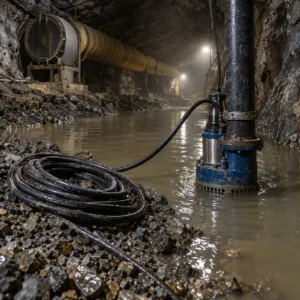
Temperature difference drives it, not rainfall. A plant room can be bone dry and still wet its cables overnight, because the cable cools with the structure while the air stays warm. A pump station or a shaft below ground behaves the same way all year.
Buried and partly buried runs. Where a run leaves a warm building and enters cold soil, moisture migrates from the warm end toward the cold end along the cores, wetting the cable from the inside out.
Vapour, not just liquid. Water vapour passes through many sheath materials over time. Where the core is not blocked, it collects as liquid at the coldest point, usually the lowest end of the run and often the gland.
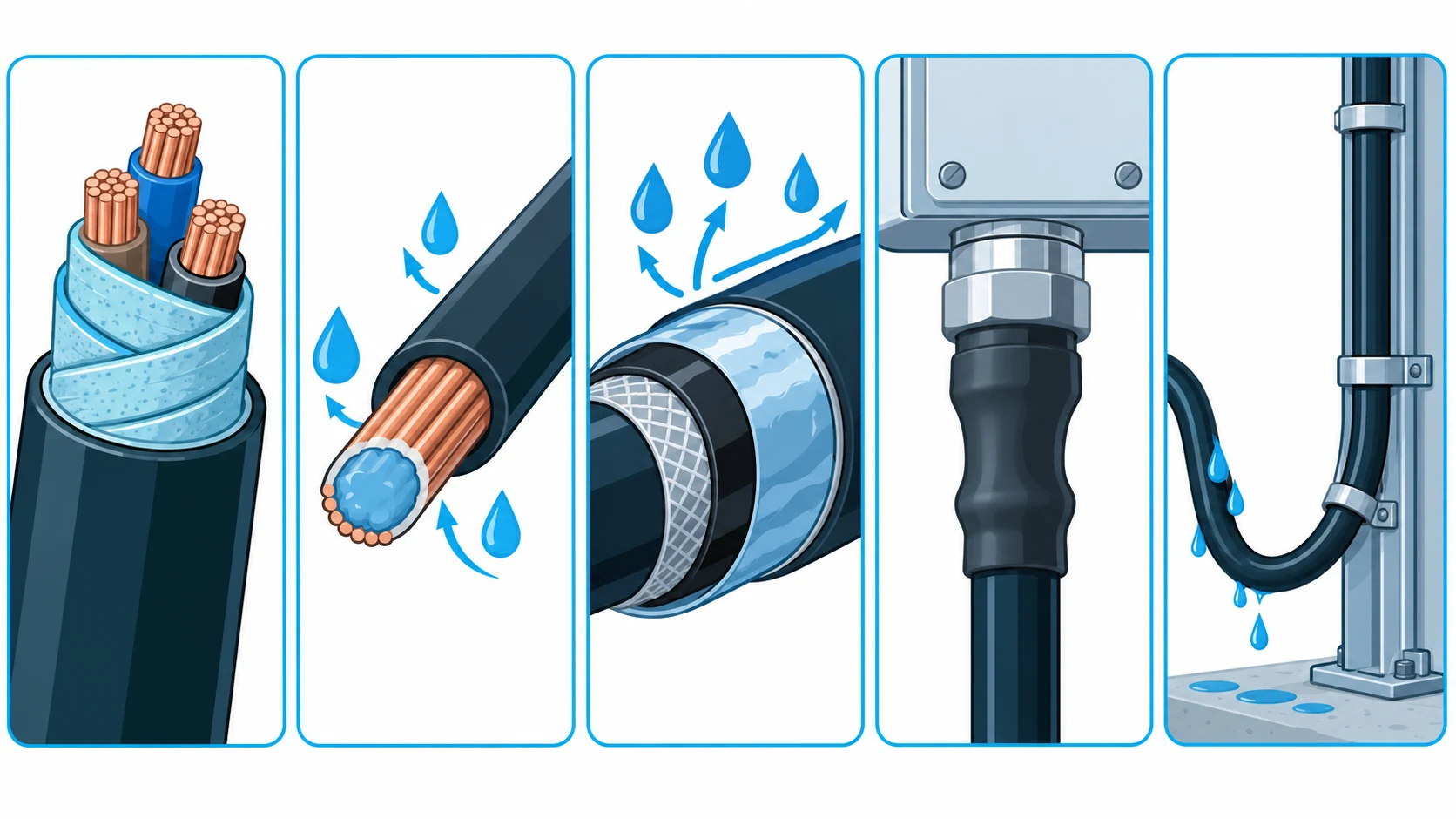
Where Moisture Enters: Five Paths That Matter
Radially through the sheath. Slow but permanent. Where the sheath is permeable and the run is cold, vapour passes inward and condenses. A metallic or bonded barrier closes this path; a thicker polymer sheath only slows it.
Longitudinally along the cores. Once water is inside a cable end, the interstices between cores act as a pipe. Water can travel tens of metres and settle at the lowest point, far from where it entered, which is how a small gland leak becomes a joint failure.
Through the conductor itself. A stranded conductor is a bundle of channels. Unless it is compacted or blocked, it carries water along the length faster than any other path.
Through the gland and termination. The most common entry point on a wet site is where the cable becomes equipment. A gland that is not sealed, or a termination that is taped rather than cold-shrunk, is an open door at both ends of the run.
Through storage and handling. The path nobody logs. A drum left in an open yard with a cut end and no cap takes on water long before installation, and the fault appears months later as a batch problem rather than a site one.
Moisture-Protection Options Compared
The table sets out the routes a buyer can choose to block a wet path: what each one blocks, what to write into the specification, the evidence to demand, what drives cost and lead time, and how each one fails when it is chosen loosely.
| Protection route | What it blocks | What to Specify | Evidence to Demand | Cost and Lead-Time Driver | How It Fails |
|---|---|---|---|---|---|
| Swellable tape or powder in the core | Longitudinal flow along the interstices once water is inside | Where the tape sits, the swell rate and height, and the core configuration | Water penetration test to a named method with the swell height recorded | Materials and an extra taping pass; days, not weeks | Blocking omitted at the ends, so water enters before the tape swells |
| Blocked or compacted conductor | Capillary flow through the conductor strands | Compaction or blocking method, block fill, and the resistance per kilometre | Resistance on the finished length plus a water penetration result on the conductor | Extra drawing and blocking work on every core; adds lead time in larger sizes | A blocked conductor substituted with a plain one, indistinguishable until it is cut |
| Bonded metallic or radial water barrier | Radial vapour transmission through the sheath | Barrier type and thickness, bonding, and how it stays continuous at joints | Barrier thickness record, bonding test, and the jointing method that carries it through | The largest single cost item of the three; adds material and process time | A barrier that is not continuous at glands and joints, leaving the run open at both ends |
| Sealed gland and cold-applied termination | Entry where cable becomes equipment, at both ends | Gland model and ingress rating, sealing method, and the terminations to be used | Gland specification sheet, ingress rating certificate, termination instructions | Accessory cost is small; the programme cost is the crew and time on site | An unsealed gland, or a taped termination that opens within a season |
| Route, drainage and venting design | Standing water at low points and the pooling that finds the weakest seal | Slope and drainage, drip loops, duct sealing, and the low points that must drain | Route drawing with levels marked, plus the duct sealing detail | Nearly free at design stage, expensive to retrofit once installed | A low point nobody drained, so the cable sits in water for years |
What Actually Fails, and How It Looks
Water treeing in XLPE. Where moisture and an electric field act together in cross-linked polyethylene, small tree-shaped voids grow from the conductor screen outward. They start slowly, they are invisible from outside, and they end in a breakdown that no re-termination fixes. Keep water out in the first place, which is why the barrier matters more than the compound.
Corrosion of armour and screens. Steel armour, wire screens and metallic tapes corrode once water is present and the circuit is earthed. On a coastal or wet site this is often the first sign, and it is why a wet run is a poor place for uncoated galvanised armour. Our note on armoured versus unarmoured cable sets out where the armour pays for itself.
Insulation resistance that keeps falling. The classic wet-site symptom is a reading acceptable at commissioning and lower at every later test. Tracking it over time is the cheapest diagnostic available, and the method is covered in our note on insulation resistance testing.
Tracking and flashover at terminations. Contaminated water at a termination creates a conductive path across the surface, and a flashover at a gland is often blamed on the cable when the fault is the seal above it. This is why the accessory and the cable belong in the same specification, covered in our note on in-service cable testing.
The Numbers That Decide the Specification
Insulation resistance figure and test voltage. Fix the acceptance value for the delivered length, the test voltage and the duration, and make it a condition of acceptance rather than a commissioning formality. A number in the specification is the only thing that lets a buyer reject a damp drum.
Swell rate and swell height. A water-blocking tape is described by how fast and how far it swells. Ask for both, because a tape that swells slowly is no use where water arrives in a single season.
Barrier thickness. Where a radial barrier is specified, the thickness and its continuity are the specification. A nominal barrier that is thinner at the weld is where the vapour gets through.
Ingress rating at the gland. The gland is an ingress-protected component and should be specified as one. Our note on IP ratings for connectors explains how the numbers are read and where a claim is thinner than it looks.
Bend radius and low-temperature limit. Sealed constructions are often stiffer, so a cable bent in the cold needs a low-temperature flex figure, tested as set out in our note on cold flex testing.
Design Details and Site Practice
Drain the route, do not just seal the cable. The cheapest fix on a wet site is a route with no low points, sealed duct entries and a drip loop that keeps water off the gland. Water that can leave cannot accumulate at the weakest seal, and a duct that never dries needs drainage at the low end.
Keep terminations out of the wet. Move a gland up a wall, out of a pit or into a sealed box, and the same cable lasts years longer. Where a termination must sit in the wet, use a cold-applied sealed system rather than tape, and break long runs at straight joints, where a blocked sleeve stops water deliberately instead of hoping the whole run stays dry.
Match the equipment enclosure. A sealed cable landed on an enclosure with a missing gasket is a sealed cable with an unsealed end, and the cable specification cannot fix a hole in the panel.
Cap the ends until the moment of termination. A sealed drum is only as good as its end caps, and leaving them on until the gland is fitted costs nothing. Where a cable is cut mid-run, cap both ends the same day.
Test before energising and record the figure. The insulation resistance reading before energisation is the baseline every later test is compared against, and without it a slow decline cannot be measured. Photograph the low points before a pit is closed, because a photo of the cable sitting in a puddle is often the only way to prove later that the route, not the cable, was the fault.
What to Freeze Before the Order Goes Out
Eight items decide whether the delivery can be accepted on a wet site. All are cheap to write into a requisition and expensive to discover after the drums are landed.
| Decision | What to State | Evidence to Attach | Cost of Leaving It Open |
|---|---|---|---|
| Which water path is blocked | Radial, longitudinal or both, run by run, against the site conditions | Route schedule marking wet runs and the exposure of each | Money spent on the wrong barrier, or on none where it was needed |
| Blocking material and swell performance | The blocking system, its swell rate and the swell height required | Water penetration test to a named method with the swell recorded | Blocking too slow to stop water arriving in one season |
| Barrier type and thickness | Barrier material, minimum thickness and how it stays continuous | Thickness record and the jointing method that carries the barrier through | A barrier with a gap at the weld or joint, which is where it leaks |
| Conductor construction | Compacted or blocked, with the resistance per kilometre that applies | Construction sheet naming the conductor build and its resistance | A plain conductor supplied where a blocked one was ordered |
| Gland and termination system | Gland model, ingress rating and the sealed terminations to be used | Gland certificates and termination instructions issued with the order | An open door at both ends of a sealed run |
| Route drainage and venting | Slope, drainage points, drip loops and the duct sealing detail | A route drawing with levels and drainage marked | Standing water at a low point for the life of the installation |
| Insulation resistance acceptance | The acceptance figure, test voltage and duration for the delivered length | The test result per drum, keyed to the drum reference | A damp drum accepted because no figure was ever agreed |
| Storage and handling | Drum wrapping, end caps and the maximum time a drum may stand in the open | A packing and storage instruction issued with the delivery | Water taken on in the yard and blamed on the site months later |
Cost and Lead Time
Standard constructions ship quickly and cover indoor and moderately damp runs, and they are the right answer where the site is genuinely dry. Blocked or barrier constructions are made to order and add material and process time, so they belong in the programme rather than the week before the pull. Fully sealed systems with continuous barriers are the longest, because the barrier has to be carried through the joints as well as the cable.
Water blocking adds to the material bill, but the gap is stable enough to budget against and far smaller than the cost of a fault in a filled pit. Copper is the larger variable on most orders, and over a long industrial programme its movement between tender and purchase order can outweigh the whole protection premium. Ask how the copper element is calculated and how long the price holds, which is covered in our note on copper price and cable procurement.
Incoming Inspection and What to Record
Inspect the drum before unloading. Wrapping intact, end caps fitted, no sheath damage and no sign of standing water on the drum.
Test on arrival, not after installation. The insulation resistance figure taken on arrival separates a delivery problem from an installation problem, and it belongs on the goods-received note beside the drum reference.
Cut a sample and look inside. Where blocking or a barrier was specified, a short sample from the end shows whether the tape, the compound and the barrier are present. Ten minutes answers a question no certificate can.
File the evidence with the delivery. Drum wrapping and storage instructions are covered in our note on cable drum packaging and export, and the acceptance note should record who checked the delivery, on what date and against which clause.
When More Protection Is Not the Answer
When the wet is in the equipment, not the cable. A flooded pit with an unsealed enclosure will fail whatever cable is used. Fix the enclosure and the drainage first, then decide whether the cable needs a barrier at all.
When the failure is at the termination. Repeated faults at the same gland, in a run whose middle has never failed, point to the seal rather than the sheath. Adding a barrier to the cable leaves the real fault in place.
When the run is genuinely dry. A blocked construction in an air-conditioned plant room pays for a property the cable will never use, and it buys a stiffer cable that bends less well.
When the specification has no acceptance test. A barrier clause with no test and no figure is a preference, not a requirement. Protection that cannot be checked at delivery cannot be relied on in service.
RFQ Checklist
- Site conditions per run: indoor, damp, buried, partly buried, pit, flood-exposed or continuously wet
- Which water path is to be blocked, run by run, and the exposure that decides it
- Blocking system with its swell rate and swell height, and the standard used
- Barrier type, minimum thickness, bonding and how continuity is maintained at joints
- Conductor construction, compaction or blocking, and the resistance per kilometre that applies
- Sheath compound and its low-temperature limit, matched to the coldest installation condition
- Gland model and ingress rating, with confirmation that it suits the sheath and the armour
- Termination system, and whether it is cold-applied and sealed to the same rating as the cable
- Route drainage, slope, drip loops and the duct sealing detail, issued as a drawing
- Insulation resistance acceptance figure, test voltage and duration for the delivered length
- Tests to be witnessed, and the records that ship with each drum
- Drum wrapping, end caps and the storage instruction to be issued with the delivery
Conclusion
Moisture is a design problem before it is a maintenance problem. Decide which path has to be blocked, name the blocking or barrier system with a figure attached, seal both ends where the cable becomes equipment, and drain the route rather than trusting the sheath. A specification that does those four things rarely sees a wet-site fault.
Kexingyu Cable Group (KXYE) has manufactured cable in Quanzhou since 1996, including blocked and barrier constructions for wet pits, submersible duties and coastal sites, with water penetration and insulation resistance records that travel with the drums. Send us the route schedule with the exposure, the levels and the termination arrangement, and we will come back with the constructions, the blocking options and the acceptance tests that apply. A request for quotation is the fastest route.