IP Ratings for Robot Connectors: What IP67 and IP69K Really Cover, and What They Silently Exclude
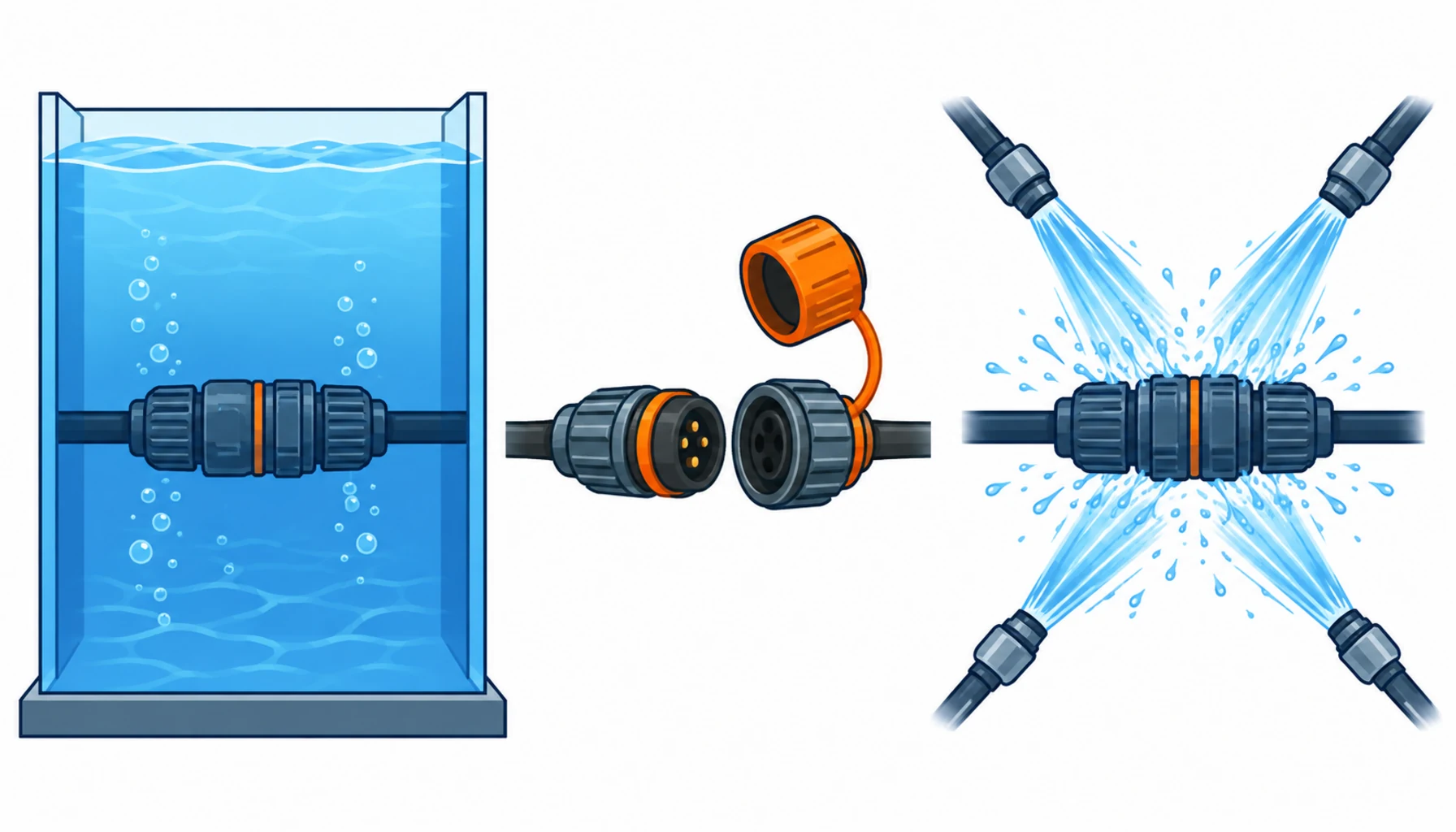
Quick Answer: An IP rating is a test result, not a promise about your machine. IP67 means the mated connector survives immersion in a metre of still water; it says nothing about a connector parked open during changeover, and nothing about the close-range hot jet of a washdown lance, which is IP69K duty. IP69K means the mated connector survives high-pressure, high-temperature spray from defined angles; it says nothing about the unmated state, and nothing about the gasket’s condition after two hundred mating cycles. Buying on the two-digit label instead of the condition behind it is how sealed connectors end up corroded in the very washdown zones they were bought for.
Introduction
Almost every connector datasheet in automation carries an IP figure, and almost none of them state the condition the figure was earned in. The result is a buying language in which IP67 appears on a sensor connector that corrodes in its first season of washdown, and IP69K appears on a housing whose gland never matched the cable jacket. The rating system itself is sound; the way it is bought is not.
This guide reads the IP code the way a buyer should: as a set of test conditions attached to a mated pair in a defined state, with boundaries that matter more than the digits. The connector-side logic pairs with the cable-side decisions in our note on jacket material selection, and the harness-level context is in our note on robot harnesses and connectors.
The IP Code, Read Like a Buyer
The code is defined in IEC 60529 and its vehicle-sector counterpart ISO 20653, and it has two digits. The first covers solid particles and dust, from finger-safe (1) to dust-tight (6). The second covers liquid ingress, and this is where the buying decisions live: 4 for splashing water, 6 for powerful jets, 7 for immersion, and 9 for high-pressure, high-temperature spray. An X in place of a digit means the test was not assessed, not that the protection is absent.
Three reading rules do most of the work. First, every rating applies to the equipment in the state the standard specifies: closed, mated, with cables fitted as tested. Second, the digits are not cumulative in duty terms: IP69K is not “IP67 plus more water”, because the two tests exercise different sealing paths under different physics. Third, the rating belongs to the assembly, not the component: a connector sealed to IP67 with a generic gland on the wrong jacket diameter has no verifiable rating at all.
IP67: What It Covers and What It Silently Excludes
The IP67 test is one metre of still water for thirty minutes, applied to the equipment in its normal sealed condition. For a mated connector with the right gland, correctly seated gaskets and a locked coupling, that is a meaningful result, and it is more than enough for splashes, humidity and hose-down with an open nozzle.
What it silently excludes is longer list. It excludes the unmated state: a connector parked open on a bracket during changeover has no rating at all unless the maker provides caps tested for that condition. It excludes thermal breathing: a sealed assembly cycling between a cold store and a warm hall moves air and moisture through every imperfect joint, and condensation appears inside a connector that technically passed. It excludes pressure: a washdown lance is not still water, it is a concentrated jet with energy the IP67 test never applies. And it excludes ageing: gaskets take a compression set, and a seal that passed on day one is a different seal after a season of thermal cycling and two hundred mating operations.
IP69K: The Washdown Rating and Its Real Test Conditions
IP69K comes from the vehicle sector, originally for equipment cleaned in place with hot high-pressure jets, and the test is specific enough to be useful. Water at around 80 degrees Celsius is delivered at roughly 100 bar through a narrow nozzle from a short, defined distance, swept across the sample in four mounting positions. A connector that passes has a sealing system that resists a genuinely aggressive duty: close-range hot jets, not immersion.
The buying logic follows from the test. IP69K is the rating to require where lances and spray bars are used: washdown food and beverage lines, pet food, meat and poultry, and cleaning-in-place stations. It is not automatically the answer everywhere water exists: for humid indoor lines with occasional splashing, IP67 with a sound gland is the correct and cheaper duty, and paying for IP69K there buys gaskets that are stiffer, hardware that is heavier, and a price step the zone never earns back. Our note on food-grade machinery cable covers the cable-side equivalents of the same washdown judgement.
The Gaps Between the Ratings: Open States, Caps and Cycles
Most connector failures in wet plants happen in the states no rating describes. Three of them are worth writing into the specification by name.
The open connector. During commissioning, changeover and service, connectors sit unmated, and an IP69K mated rating is irrelevant to a hood full of water. Specify protective caps or dummy plugs for every connector that parks open, with their own sealing evidence, and treat the cap as a consumable stocked next to the connector.
The mating cycle. Every rating is earned on a fresh seal. Connectors mated daily for cleaning wear their gaskets and coupling threads, and the effective rating decays with use. Ask for the mating cycle figure behind the rating, and compare it with the planned cleaning frequency before accepting the part for a washdown zone.
The cable entry. The gland is part of the sealing path, and it only seals on the jacket it was clamped for. A hood rated IP69K with a generic gland on a mismatched cable has no rating; the entry geometry is covered in our note on the strain relief and connector interface. On the cable side, the material choices for wet duty are in our weather-resistant cable range.
The Decision Table: Zones, Ratings and What to Demand in Each
| Zone | Rating to Require | Evidence to Demand | Cost and Lead-Time Driver | Where It Fails in Service |
|---|---|---|---|---|
| Dry indoor cabinet and machine interior | IP54 class sealing, dust and drip protection only | Basic sealing data, gasket material declaration | Cheapest hardware; stock lead times | Overspent IP69K hardware that is harder to service than the duty requires |
| Splashed and humid zones | IP67 in the mated condition, caps for open states | Immersion test evidence for the mated pair, gland range matched to the jacket | Standard sealed families ship fast; caps are a consumable line item | Condensation inside connectors cycling between cold and warm areas |
| Hose-down zones, open nozzle | IP67 with verified gland, or IP69K where lances are nearby | Sealing test for the mated pair with the actual gland in place | Gland and jacket matching drive qualification, not the connector itself | Water tracking along the jacket into an otherwise sealed connector |
| High-pressure washdown and CIP | IP69K in the mated condition, per ISO 20653 test conditions | IP69K test report at the stated jet parameters, mating cycle figure for the coupling | Stainless hardware, stiff gaskets and certified sealing carry a real price step | Gasket compression set after a season of daily cleaning, decayed sealing unnoticed |
| Outdoor and UV exposure | IP67 with UV-stable materials and wide temperature gaskets | UV and low-temperature material declarations | Material certification, not sealing, drives cost and lead time | Brittle gaskets and yellowed jackets after two summers, sealing gone with them |
What to Freeze Before the Order Goes Out
| Item | What to State | Evidence to Attach | Cost of Leaving It Open |
|---|---|---|---|
| Rating per zone | The IP figure required in the mated condition, per machine zone, from the cleaning schedule | A zone map with ratings and cleaning methods | IP69K spent where IP67 earns, and IP67 spent where lances fly |
| Test condition | Mated, with the actual gland and cable, as the tested configuration | Test report naming the gland and cable in circuit | A rating that exists on paper and not on the machine |
| Open-state plan | Caps or dummy plugs for every connector that parks open, with their own sealing | Cap sealing evidence and a stocking decision | Hoods full of water during changeover, connectors corroded before their first season ends |
| Mating cycle budget | Cleaning frequency compared against the connector's mating cycle figure | Mating cycle test data behind the rating | Daily-cleaned washdown connectors worn out in a year on a ten-year figure |
| Gland and jacket match | Clamping range matched to the actual cable jacket, per entry | Cable datasheet against the gland data | Water tracking into a sealed connector, misread as a gasket defect |
| Material set | Jacket, gasket and housing materials named for chemistry and temperature | Chemical resistance declarations for the cleaning agents in use | Swollen gaskets and degraded jackets after the cleaning agent changes |
| Thermal cycling duty | Temperature range and cycling stated for cold-store and outdoor service | Low-temperature and cycling evidence for gaskets | Condensation and brittle seals in cold zones, blamed on the plant |
| Sample qualification | Sealed samples tested in the as-installed configuration before volume | A written qualification plan with pass thresholds | A plant full of connectors accepted on datasheet digits alone |
When an IP Rating Is Not the Answer
Where the sealing problem is really the entry. A connector replaced three times in a wet zone usually has a gland mismatch or a routing problem, not a rating problem; our note on why robot connectors fail lists the signatures to check first.
Where the environment is dust and oil, not water. Dry machining and packaging lines with coolant mist need dust ratings and chemical resistance more than a high water digit; the material set matters more than the second digit there.
Where the duty belongs to a different family. Washdown servo axes on mid-size machines may reach the limits of the circular formats; the boundary logic is in our notes on M23 connectors for servo axes and on heavy-duty rectangular connectors. And where the connector world ends and the dressed bundle begins, our note on cleaning duty in robot systems, cleaning robot cable, covers the cable-side judgement.
RFQ Checklist
- IP figure required in the mated condition, stated per machine zone with the cleaning method behind it
- Test report naming the gland and cable configuration actually ordered, not a lab fixture
- IP69K evidence citing the jet parameters and mounting positions of the standard, where washdown duty applies
- Caps or dummy plugs specified for open states, with their own sealing evidence and a stocking line
- Mating cycle figure for the coupling, compared against the planned cleaning frequency
- Gland clamping range matched to the actual cable jacket diameter, per entry
- Chemical resistance declarations for the cleaning agents and coolants in use
- Low-temperature and thermal cycling evidence where cold stores or outdoor duty apply
- Gasket material and housing material named, with UV stability where relevant
- Sample qualification protocol agreed, testing the as-installed configuration before volume release
Conclusion
IP ratings reward buyers who read the condition, not the digits. IP67 is a strong answer for splashed and humid duty in the mated state; IP69K is the washdown answer, earned under hot high-pressure jets with the mated pair and a matched gland. The failures that fill service logs live in the states the code does not describe: connectors parked open, seals worn by daily cleaning, and jackets clamped into glands they were never measured for. Write those states into the specification and the rating becomes what it should have been all along: a property of the machine, not of the datasheet.
Kexingyu Cable Group (KXYE) supplies the cable side of sealed assemblies: jacket materials matched to washdown chemistry, gland-compatible diameters, and the constructions that keep their sealing path intact behind the connector. Send us the zone map and the cleaning schedule, and we will return the constructions and evidence that fit; the fastest route is a request for quotation.